On this page · 13 sections
- How Google ranks local businesses: relevance, distance, prominence
- The single biggest lever: your primary category
- Reviews in 2026: velocity beats volume
- Photos, posts, and profile freshness
- Citations and NAP consistency
- Local SEO meets AI search in 2026
- A Gurugram playbook you can run this quarter
- A 30-day local SEO action plan for Gurugram businesses
- What to measure
- FAQ
- Common local SEO mistakes Gurugram businesses make
- How eCorpIT can help
- References
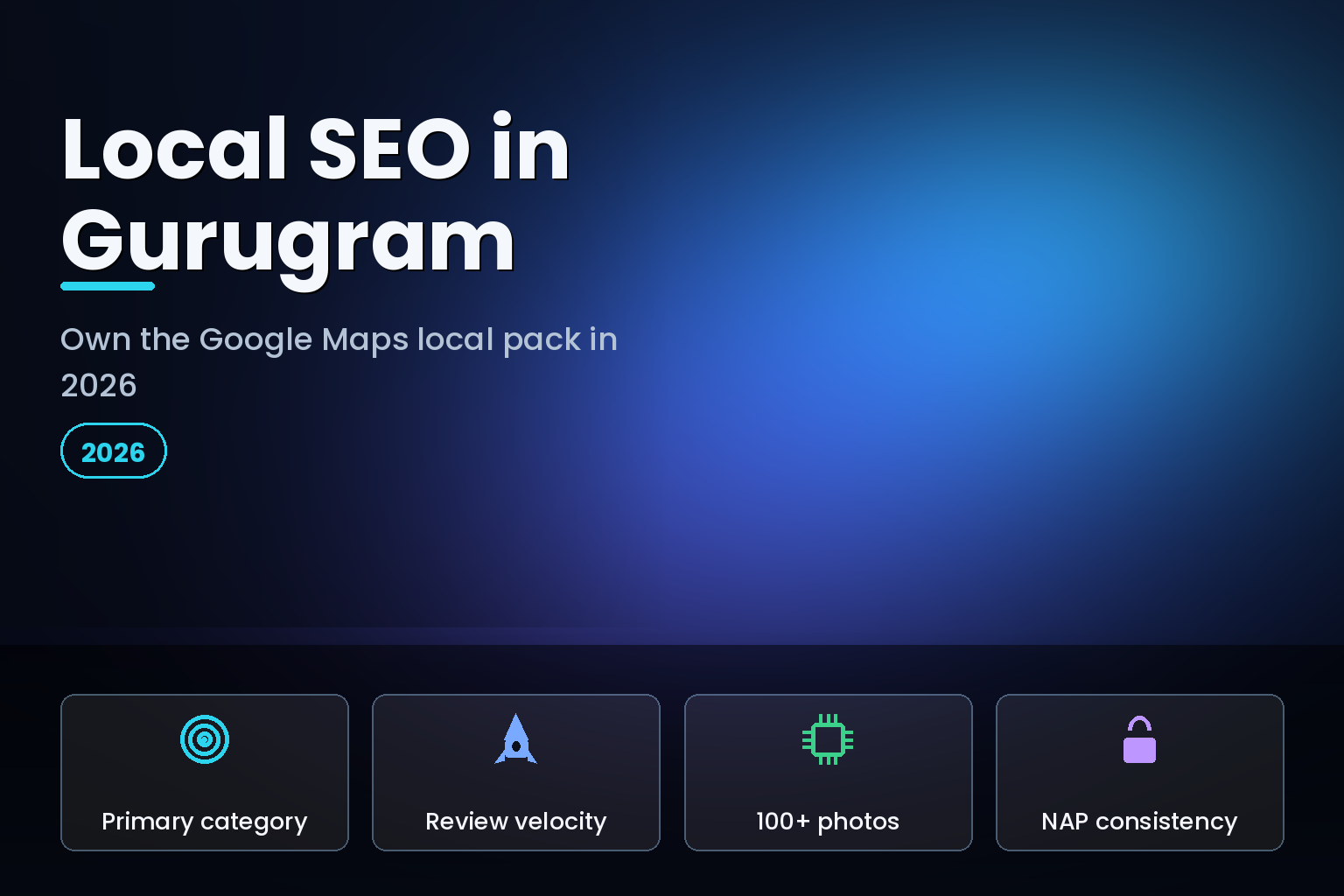
Summary. Local search rewards the businesses that work their Google Business Profile, and the levers are measurable. Google states that local results are "based primarily on relevance, distance, and prominence," and in 2026 your primary profile category alone carries roughly 32% of the ranking weight for service relevance, the single biggest factor. The Whitespark 2026 Local Search Ranking Factors report finds that 8 of the top 10 local-pack signals come straight from the profile. Profiles with 100 or more photos receive 520% more calls than average, by Google's own data, and review velocity now matters more than volume, so 4 recent reviews a month can outweigh 50 old ones. The context is shifting too: AI Overviews appear in about 7% of direct local searches, an estimated 40% of local discovery now passes through AI platforms first, and more than 46% of all Google searches carry local intent. The tool to win all of this is free to list at ₹0. Here is the Gurugram playbook.
For a Gurugram or wider Delhi-NCR business, the local pack, those three map results that sit at the top, is the most valuable real estate in search. In India, 76% of people who search for a local business on a smartphone visit a store within 24 hours, and a large share of those visits convert. This guide is the practical, 2026 version of how to rank there, built on Google's stated factors and the latest ranking-factor research. For the bigger picture of how classic SEO, AI answer engines, and generative search now interact, pair it with our AEO vs GEO vs SEO complete guide.
How Google ranks local businesses: relevance, distance, prominence
Google has been consistent about the three pillars. Relevance is how well your profile and website match the query. Distance is how close you are to the searcher or the place named in the search. Prominence is how well known and trusted Google considers your business, shaped by reviews, links, citations, profile completeness, and website authority.
You cannot move your shop closer to every searcher, so distance is mostly fixed. That leaves relevance and prominence as the two pillars you actively control, and most Gurugram businesses underinvest in both. The good news is that the highest-impact relevance signal is also the easiest to fix, and the prominence signals are a matter of consistent habit rather than budget.
The single biggest lever: your primary category
If you do one thing this week, set your primary Google Business Profile category correctly. It is the number-one ranking factor for the local pack and Maps, accounting for roughly 32% of the ranking weight for service relevance. A dentist listed under a generic "clinic" category will lose to one listed precisely as a "dental clinic," every time, for dental queries.
| Signal | Weight or effect | What to do |
|---|---|---|
| Primary category | ~32% of service-relevance weight | Pick the most specific exact-match category |
| Reviews (velocity and quality) | Top prominence signal | Earn 4 or more recent reviews a month |
| Photos | 100+ photos: 520% more calls | Upload real job photos weekly |
| NAP consistency | Foundational prominence signal | Identical name, address, phone everywhere |
| Profile completeness | 8 of top 10 signals from the profile | Fill every relevant field and service |
Add secondary categories for your other services, list your services and products explicitly, and complete every field. Whitespark's 2026 research is blunt about why this matters: 8 of the top 10 local-pack signals come from the profile itself, so an incomplete profile is leaving most of your ranking power unused. One caution: Google now enforces business-name rules strictly. Your name must match your real-world signage, and stuffing it with "best," "number 1," or keywords risks suspension.
Reviews in 2026: velocity beats volume
Review strategy has changed. Google now weighs how fast you earn new reviews more than how many you have in total. Four genuine reviews a month, every month, signal an active, trusted business more strongly than fifty reviews from three years ago. The practical system is simple: ask every satisfied customer within 24 to 48 hours of the service, and share your direct Google review link from the profile dashboard so leaving one takes seconds.
Respond to reviews, all of them. A prompt, specific reply to a positive review reinforces trust, and a calm, solution-focused reply to a negative one shows future customers how you handle problems. For a Gurugram business serving customers in both Hindi and English, replying in the language the reviewer used is a small touch that reads as genuinely local. Never buy fake reviews; Google's detection is aggressive in 2026 and the penalty, including profile suspension, is far worse than a few critical comments.
Photos, posts, and profile freshness
Photos are both a ranking and a trust signal, and the data is striking: profiles with 100 or more photos get 520% more calls than average. Upload real photos of your work, your premises inside and out, and your team, on a weekly or fortnightly cadence. Avoid stock images, which add nothing and can look generic to both Google and customers.
Use Google Posts weekly. Posts expire after seven days, so a weekly update keeps fresh content in your profile and gives searchers a current reason to choose you, an offer, an event, a new service. Freshness is a 2026 signal in its own right, because Google's systems now read content recency and activity as evidence that a business is open and engaged. A profile that has not posted a photo or update in six months looks dormant, whatever the reality.
Citations and NAP consistency
The golden rule of local SEO still holds: your Name, Address, and Phone number must be identical everywhere they appear, your website, your social profiles, and every business directory. Inconsistent NAP, a "Road" in one place and "Rd" in another, an old phone number on a directory you forgot about, confuses Google's confidence in your data and drags on prominence. Audit your citations across the major India business-listing sites, fix mismatches, and keep a single source of truth for your details so updates propagate cleanly. Mentions of your business now matter nearly as much as links, so consistent listings are worth the afternoon they take to clean up.
Local SEO meets AI search in 2026
The ground is shifting under local search. AI Overviews now appear above the map pack for many informational queries, though only about 7% of direct, high-intent local searches such as "plumber near me," where Google still favours fast map results. The larger trend is that an estimated 40% of local discovery queries pass through an AI-powered platform before the user reaches a traditional results page, and Gartner expects traditional search volume to fall 25% as users shift to AI answers. With roughly 58.5% of Google searches already ending without a click, your profile increasingly has to do the converting, because the searcher may never reach your website.
The defensive move is the same as the offensive one: a complete, accurate, active profile with strong reviews is exactly what AI systems read when they summarise local options. Structured, consistent business data is what gets you cited in an AI answer. Our analysis of ranking versus AI Overview citation data shows how visibility is splitting between classic rankings and AI citations, and why you now need both.
A Gurugram playbook you can run this quarter
Gurugram is dense, competitive, and split across well-defined micro-markets, from Cyber City and Golf Course Road to Sohna Road, Udyog Vihar, and the older sectors. Treat each as its own battleground. Make sure your primary category and service list match what people in your specific area actually search for, and use the locality names naturally in your profile description and website content, because "near me" searches resolve to neighbourhood-level intent.
For a service-area business covering several sectors, define your service areas precisely rather than claiming all of Delhi-NCR, which dilutes relevance. Earn reviews that mention the specific localities and services you want to rank for, since that language reinforces both relevance and prominence. And because so many local searches in India lead to a call or visit within a day, make the path frictionless: correct hours, a working phone number, directions, and current photos. Our B2B performance marketing playbook covers how to connect this local visibility to a measurable pipeline.
A 30-day local SEO action plan for Gurugram businesses
The tactics above are easier to act on as a four-week sequence. In week one, fix relevance. Set your primary category to the most specific exact match, add secondary categories for your other services, list every service and product explicitly, and complete every field on the profile. Because the primary category alone carries about 32% of service-relevance weight, this single week often moves the needle more than anything else.
In week two, attack prominence through reviews. Set up a system to ask every satisfied customer for a review within 24 to 48 hours, share your direct review link, and start replying to every existing review in the language the customer used. Remember that four recent reviews a month outweigh fifty old ones, so the goal is a steady flow, not a one-off push.
In week three, fix data and freshness. Audit your Name, Address, and Phone number across your website, social profiles, and the major India directories, and make them identical everywhere. Upload a batch of real photos, working toward the 100-plus mark that correlates with 520% more calls, and publish your first weekly Google Post. In week four, set the rhythm you will keep: a weekly post, a fortnightly photo batch, a monthly review-velocity check, and a monthly citation audit. By the end of the month you have a complete, active, consistent profile, which is precisely the profile both Google's local pack and AI answer engines reward. Treat the fourth week's rhythm as permanent, because the businesses that stop after setup are the ones that stall.
What to measure
Vanity metrics mislead. The win is not more profile views; it is more calls, more direction requests, and more qualified leads. Track the actions in your profile insights, calls, direction requests, website clicks, and tie them to actual enquiries and customers. Watch your review velocity month over month, your photo and post cadence, and your ranking for your priority categories in your specific localities. If calls and direction requests are rising while you hold a steady posting and review rhythm, your local SEO is working, whatever the raw view count does.
FAQ
Common local SEO mistakes Gurugram businesses make
A few avoidable errors hold back most local profiles. The first is a vague primary category: a "restaurant" that should be a "North Indian restaurant," or a "consultant" that should name its discipline. Since the primary category drives about 32% of service relevance, a vague one quietly caps your ranking. The second is stuffing the business name with keywords or "best," which now risks suspension under Google's stricter 2026 name rules, so the name must match your signage.
The third is treating reviews as a one-time campaign. A burst of fifty reviews followed by silence underperforms a steady four a month, because Google weighs velocity. The fourth is inconsistent NAP: an old phone number on a directory you forgot, or "Sector 44" written three different ways, all of which erode the prominence you are working to build. The fifth is a dormant profile, no posts in months and no fresh photos, which reads as a closed or inactive business to both Google and customers.
The last mistake is measuring the wrong thing. Celebrating a rise in profile views while calls and direction requests stay flat means the visibility is not converting. Fix the category, keep the review rhythm, clean the citations, post weekly, and watch calls and direction requests, not views. None of this costs money beyond time, which is why the businesses that win locally in Gurugram are usually the consistent ones, not the ones with the biggest budgets.
How eCorpIT can help
eCorpIT is a Gurugram-based, CMMI Level 5 and MSME-certified technology organisation, and local search is our own backyard. Our teams run Google Business Profile audits, category and citation cleanups, review-generation systems, and the structured-data work that earns visibility in both the map pack and AI answers. If you run a Gurugram or Delhi-NCR business and want to own your area on Google Maps, talk to us through our contact page and we will build a local SEO plan around your specific localities.
References
- Tips to improve your local ranking on Google — Google Business Profile Help.
- Local search ranking factors: 2026 guide — Local Dominator.
- Google Business Profile optimization checklist 2026 — TrueFuture Media.
- 2026 local SEO: the checklist to stay visible in AI-driven search — Connection Model.
- Local SEO in 2026: what Google's AI Overviews mean for "near me" searches — The Wellsville Sun.
- Local SEO guide for small businesses in India 2026 — Arcenik Technologies.
- How AI-powered local search is helping Indian shoppers in 2026 — Contact Directory AI.
- The complete local SEO guide of 2026 — Growth Minded Marketing.
_Last updated: June 30, 2026._