On this page · 10 sections
- The five lessons at a glance
- Lesson 1: scope to a decision, not a demo
- Lesson 2: price tokens like infrastructure, not a rounding error
- Lesson 3: make evaluation the product
- Lesson 4: govern per agent, not with one uniform policy
- Lesson 5: treat integration with legacy systems as the hard part
- India-specific considerations
- How eCorpIT can help
- FAQ
- References
Summary. Gartner expects more than 40% of agentic AI projects to be canceled by the end of 2027, blamed on escalating costs, unclear business value, and weak risk controls (Gartner, June 25, 2025). The RAND Corporation put the broader enterprise AI failure rate at 80.3%. Yet Gartner still forecasts that 40% of enterprise applications will ship task-specific AI agents by the end of 2026, up from under 5% in 2025. eCorpIT (eCorp Information Technologies, founded 2021, Gurugram) has built and shipped agents against that backdrop. These five lessons come from that work, priced in real 2026 numbers: a Claude Opus 4.8 call runs $5 per million input tokens and $25 per million output; Gemini 3.1 Pro is $2 and $12; and one agent that loops 30 times can spend more on a single task than a chatbot spends in a day.
The gap between a convincing demo and a production agent is where most budgets disappear. Below is what separates the two, with the signal from Gartner, McKinsey, Deloitte, and RAND that backs each point.
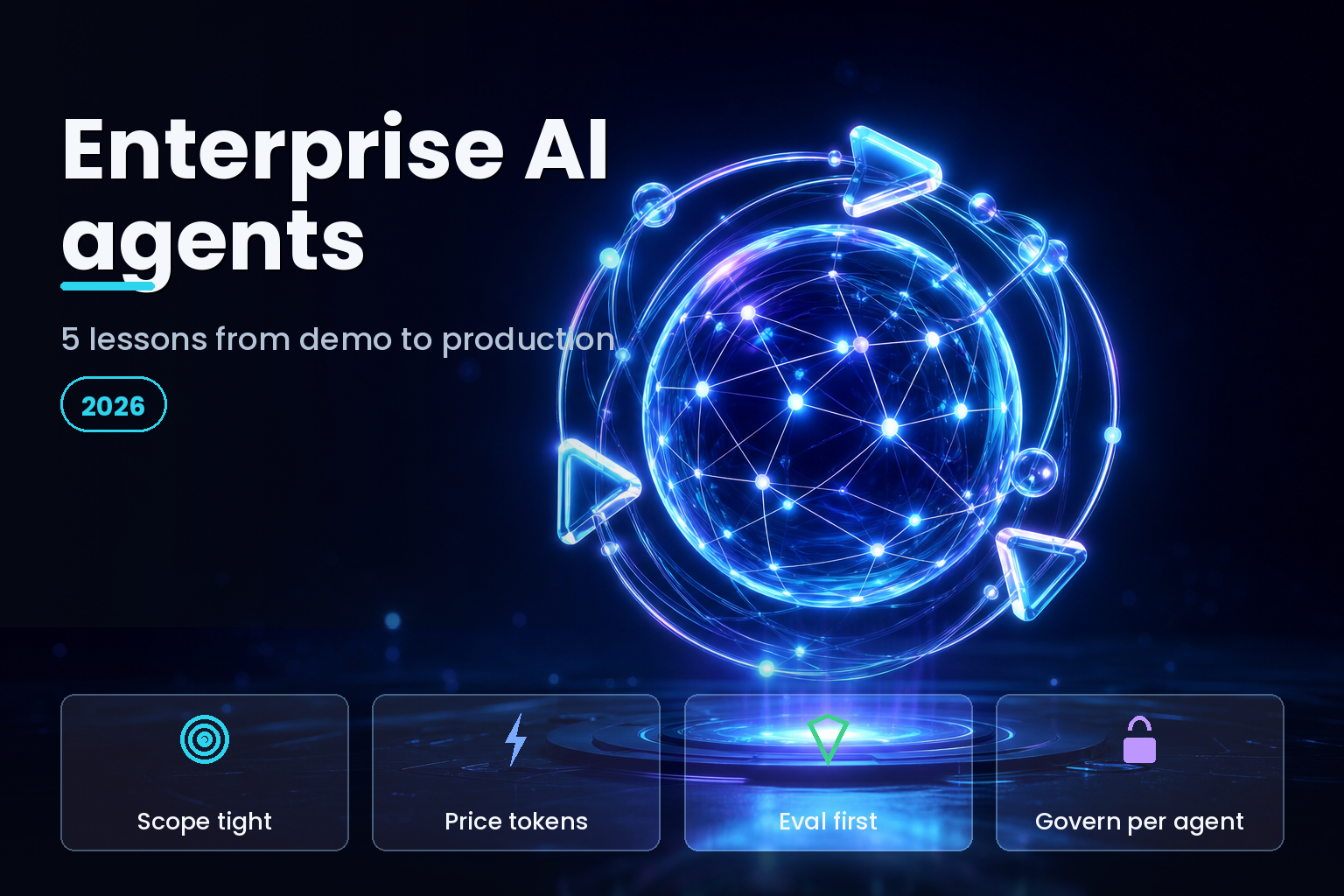
The five lessons at a glance
| Lesson | What goes wrong without it | Sourced signal |
|---|---|---|
| Scope to a decision, not a demo | POCs stall; no ROI | 40%+ of agentic projects canceled by 2027 (Gartner) |
| Price tokens like infrastructure | Costs escalate past value | Escalating cost is Gartner's top cancellation reason |
| Make evaluation the product | Pilots never ship | 88% of agent pilots fail to reach production |
| Govern per agent, not uniformly | Incidents force a shutdown | Only 21% have mature agent governance (Deloitte) |
| Treat integration as the hard part | Legacy friction kills timelines | 46% cite integration as the main deployment blocker |
Lesson 1: scope to a decision, not a demo
A demo shows an agent doing something impressive once. Production asks it to do the right thing a thousand times, cheaply, without a human catching each mistake. Most teams confuse the two.
Gartner's Anushree Verma, Senior Director Analyst, put it plainly: "Most agentic AI projects right now are early stage experiments or proof of concepts that are mostly driven by hype and are often misapplied." A January 2025 Gartner poll of 3,412 webinar attendees found 19% had made significant investments in agentic AI, 42% conservative investments, 8% none, and 31% were still waiting or unsure. The rush is real, and so is the hangover: over 40% of these projects are set to be canceled by 2027.
The fix is boring and it works. Pick a task where a decision is genuinely needed and the value is measurable, not a task you could solve with a script. Verma's own guidance is a good filter: "use AI agents when decisions are needed, automation for routine workflows and assistants for simple retrieval." If a rules engine or a search box would do the job, an agent is the expensive answer to a cheap question.
For eCorpIT engagements, the first week is spent narrowing scope, not widening it. One agent, one decision, one owner, one number it has to move. That discipline is the reason the agent reaches week eight. Our field notes on this are collected in engineering lessons from shipping enterprise AI agents and the broader pattern library in enterprise AI agent use cases.
Lesson 2: price tokens like infrastructure, not a rounding error
Escalating cost is the first reason Gartner gives for cancellation, and it is the one founders underestimate most. A chatbot answers once. An agent plans, calls a tool, reads the result, replans, and calls again, sometimes dozens of times for a single task. Each loop is billed.
Here is the June 2026 price of the frontier and mid-tier models an agent might call:
| Model | Input, per million tokens | Output, per million tokens |
|---|---|---|
| Claude Opus 4.8 | $5.00 | $25.00 |
| GPT-5.5 | $5.00 | $30.00 |
| GPT-5.4 | $2.50 | $15.00 |
| Gemini 3.1 Pro | $2.00 | $12.00 |
| Gemini 3.5 Flash | $1.50 | $9.00 |
The math that matters is not the per-token price; it is the price times the loop count times the traffic. An agent that averages 30 model calls per task, each returning a few thousand output tokens on a premium model, can cost several dollars per completed task. At 10,000 tasks a day, that is real money, roughly ₹40,000 to ₹1,00,000 a month once you add tool and retrieval calls. The teams that survive route cheap steps (retrieval, classification, formatting) to a Flash-class model and reserve the expensive model for the one step that needs judgement.
Instrument spend from day one. Track token usage, tool calls, and iteration count per agent type, not just a monthly invoice total. Our rundown of free measurement tools sits in free AI cost tools for engineering teams. The real cost is usually the loop count, not the model.
Lesson 3: make evaluation the product
The single most repeated failure we see: a team builds the agent, demos it, and only then asks how to tell whether it is working. By then the pilot is stalling. Industry data matches the pattern. Reporting on 2026 agent programs found 88% of agent pilots fail to graduate to production, with evaluation gaps cited by 64% of leaders, governance friction by 57%, and model reliability by 51%.
McKinsey's State of AI trust in 2026 work names the same culprit: a lack of trace-level visibility and quality measurement is among the top reasons agent rollouts stall. You cannot improve or defend what you cannot see.
Practically, that means observability and evaluation are not a later add-on; they are the first thing you build. Capture every model call, tool execution, and reasoning step as a structured trace. Turn real production traces into test cases. Run binary, explanation-backed evaluations on live traffic, not just a static test set, so regressions show up before customers find them. Open tooling like Langfuse and MLflow and commercial platforms like Braintrust and Arthur exist precisely for this loop.
An agent without evaluation is a rumour. An agent with a trace and a passing eval on every change is a product you can defend to a customer and to a regulator.
Lesson 4: govern per agent, not with one uniform policy
Governance is where good agents die quietly. Deloitte's 2026 survey of 3,235 business and technology leaders found only 21% of organizations have a mature governance model for autonomous agents, and 73% named security and data privacy as top concerns. Gartner went further in May 2026, warning that applying uniform governance across every AI agent will itself lead to enterprise AI agent failure: teams treat agents as either fully locked down or fully trusted, and both extremes break.
The workable middle is per-agent risk tiering. A read-only agent that summarises internal documents needs light controls. An agent that can issue refunds, change records, or email customers needs approval gates, scoped credentials, rate limits, and a full audit trail. Match the control to the blast radius.
For Indian deployments, tie this to the Digital Personal Data Protection Act 2023 (DPDP). An agent that touches personal data inherits consent, purpose-limitation, and breach-notification duties. eCorpIT designs agent permissions aligned with DPDP requirements rather than claiming blanket compliance, because the agent, not the policy PDF, is what actually reads the data. The layered approach is detailed in enterprise AI agent governance layers and the privacy view in privacy-first AI architecture lessons.
Lesson 5: treat integration with legacy systems as the hard part
The model is rarely the bottleneck. The bottleneck is the CRM from 2014, the approvals inbox, and the data that lives in six formats. Survey data puts integration with existing systems as the primary deployment challenge for 46% of organizations.
There is also a vendor trap. Gartner describes "agent washing", the rebranding of AI assistants, robotic process automation, and chatbots as agents without real autonomous capability, and estimates only about 130 of the thousands of self-described agentic vendors are the real thing. Buy on demonstrated tool use, error handling, and evaluation support, not on the word "agent" in the deck.
Verma's advice on this is direct: "In many cases, rethinking workflows with agentic AI from the ground up is the ideal path to successful implementation." Bolting an agent onto a broken process automates the breakage. The engagements that ship start by redrawing the workflow, then insert the agent at the one decision point where it earns its cost. The modernization patterns we use are in platform engineering and application modernization.
India-specific considerations
Indian enterprises face the same five lessons with two local pressures. First, cost sensitivity is sharper: a ₹40,000 to ₹1,00,000 monthly token bill for a mid-volume agent has to clear a tighter ROI bar than in a dollar-denominated budget, which pushes Indian teams toward aggressive model routing and smaller models for routine steps. Second, DPDP changes the governance calculus. Consent, data-principal rights, and breach notification are legal duties, not best practices, so per-agent permissioning and audit trails move from "nice to have" to "required before launch." The upside: teams that build evaluation and governance in from day one clear procurement and security review faster, which is often the real gate on go-live.
How eCorpIT can help
eCorpIT is a CMMI Level 5, MSME-certified technology organization based in Gurugram, with senior engineering teams that design, build, and operate enterprise AI agents end to end. We scope agents to a measurable decision, instrument token spend and evaluation from the first sprint, and design permissions aligned with DPDP so the agent clears security review. If you are moving an agent from a promising demo to dependable production, talk to our team and we will map the shortest safe path for your use case.
FAQ
References
_Last updated: July 3, 2026._