On this page · 9 sections
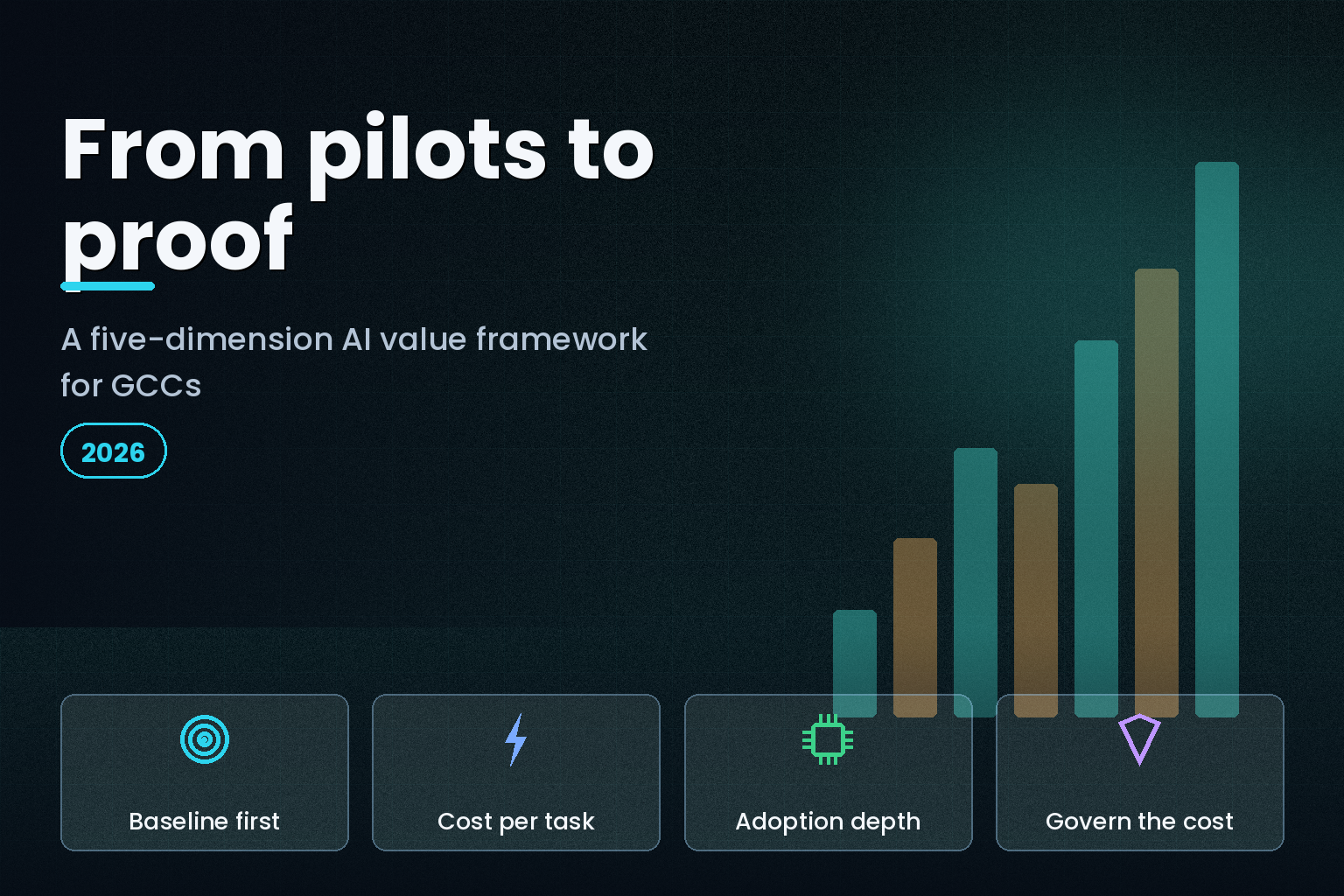
Summary. A Zinnov and ProHance study released on 10 November 2025, based on insights from more than 160 GCC leaders, found that 92% of India's global capability centres are piloting or scaling AI while over 70% lack a structured framework to measure the return. That gap sits on top of a large base: India hosts roughly 2,117 GCCs employing about 2.36 million people, with sector revenue near $98.4 billion as of early 2026, and public-cloud spending in the country is projected to reach $17.5 billion in 2026. The problem in 2026 is no longer whether a GCC can build AI. It is whether it can prove the build was worth it. This piece lays out a five-dimension framework to measure AI value in finance-legible terms, the four readiness pillars that decide whether the numbers hold, and where an engineering partner fits.
The number that should worry GCC boards
Pilots are cheap to start and expensive to leave running. The Zinnov and ProHance study, titled "Navigating AI ROI," puts the mismatch plainly: 92% of India's GCCs are already piloting or scaling AI, but more than 70% cannot measure the impact in a structured way. Karthik Padmanabhan, managing partner at Zinnov, framed it directly: "AI adoption in GCCs is no longer the barrier. 92% are already piloting or scaling use cases. The real hurdle is ROI." He added that "pilots often multiply without proving business impact, governance remains inconsistent, and costs are routinely underestimated."
The study also found a perception gap that makes measurement harder. Leaders reported limited AI adoption and low skills maturity, while employees reported higher proficiency and more frequent use. That gap is a structural blind spot: when leadership underestimates real usage, it also undervalues the productivity already happening at the desk level, and the ROI case gets built on the wrong baseline. Saurabh Sharma, chief operating officer at ProHance, called the destination of an unmeasured programme "pilot purgatory," where ambition is real but value stays unproven.
For an Indian GCC, the stakes are concrete. These centres are moving from cost arbitrage to capability ownership, and AI is the proof point boards are watching. Getting the ROI story wrong does not just waste a budget line. It weakens the case for the centre's next mandate. Teams weighing that mandate against building with an external partner often start from a GCC versus product-partner build decision, and a credible ROI method is what makes either path defensible.
Why pilots multiply but value does not
The Zinnov and ProHance research traces the ROI gap to operating-model readiness rather than model quality. Four barriers came up repeatedly, each with a number attached.
Data and infrastructure was the most cited: 66% of leaders pointed to fragmented data, poor integration, and compliance risk as the thing blocking scale. Governance and change was next: 55% of GCCs said they lack structured governance, which weakens accountability for outcomes. Adoption and usage depth is the measurement trap: 63% of leaders lack visibility into how AI is actually used, even while employees report using it often. Talent rounded it out, with 47% flagging skill shortages and low fluency. None of those are model problems. They are the operational plumbing that turns a pilot into a measurable capability, and the AI coding productivity paradox and ROI plateau shows the same pattern in engineering teams specifically.
The cost side is where most ROI cases quietly fail. Teams count the licence and the model tokens, then miss the governance, data-engineering, evaluation, and change-management costs that keep an AI system reliable after launch. When those hidden costs surface six months in, the return that looked positive on a slide turns negative in the ledger. A measurement framework has to price the whole system, not the demo.
A five-dimension framework to measure AI ROI
The Zinnov and ProHance framework evaluates ROI across five dimensions, and it works as an adaptable guide rather than a single formula. Below is each dimension with the finance-legible metric a GCC can actually report to a board.
| Dimension | What it measures | Metric a board can read |
|---|---|---|
| Stage of maturity | Where the use case sits, from pilot to enterprise scale | Share of use cases past pilot into production |
| Baseline visibility | Before-and-after measurement with clear attribution | Percentage change against a pre-AI baseline per workflow |
| Adoption breadth and depth | Real workflow integration, not licences bought | Weekly active use and tasks completed with AI per user |
| Total cost of AI ownership | Full cost including governance and compliance | Cost per completed task, all-in, versus the manual baseline |
| Value delivered | Tangible gains plus intangible outcomes | Cycle-time and error-rate change, plus customer and employee measures |
Two of these dimensions do the heavy lifting. Baseline visibility is the discipline most programmes skip: without a measured pre-AI baseline and an attribution method, any later improvement is a story, not a number. Total cost of AI ownership is the one finance trusts: cost per completed task, computed all-in against the manual baseline, is a figure a chief financial officer can compare across functions. Report those two credibly and the ROI conversation stops being a debate about vibes.
The practical move is to instrument before you scale. Decide the baseline and the attribution model while the use case is still a pilot, because you cannot reconstruct a before-and-after once the old process is gone. This is exactly the work of taking a use case from AI pilot to production with measurement built in, rather than bolting metrics on after the fact.
The four pillars of readiness
The same study frames scaling as an operating-model question across four pillars. Treat them as a readiness checklist before a board signs off on scale.
| Readiness pillar | Barrier cited by leaders | What to put in place |
|---|---|---|
| Data and infrastructure | 66% cite fragmented data and compliance risk | Unified, access-controlled data platforms with lineage |
| Talent | 47% cite skill shortages and low fluency | Role-based skilling that positions AI as augmentation |
| Governance and change | 55% lack structured governance | Named owners, model policies, and change management |
| Adoption and usage depth | 63% lack visibility into real usage | Usage instrumentation tied to workflow outcomes |
Governance deserves a specific note in the Indian context. Structured governance is not only an accountability control, it is where the Digital Personal Data Protection Act 2023 (DPDP) obligations live: consent, purpose limitation, and reasonable security safeguards over the personal data an AI system touches. A GCC that folds DPDP handling into its AI governance pillar closes the compliance gap and the accountability gap at once, and the skills and reskilling gap in India's GCCs is the constraint that most often slows this pillar down.
What good looks like
A credible 2026 ROI report for a GCC AI programme reads like an engineering post-mortem, not a marketing deck. It names the workflow, states the pre-AI baseline with its measurement date, shows the after figure with the attribution method, and prices the all-in cost per task including governance and evaluation. It reports adoption as weekly active use and tasks completed, not licences purchased. It separates tangible gains, such as cycle-time and error-rate reduction, from intangible ones, such as customer and employee experience, so finance can weigh them differently.
A concrete example makes the method legible. Take a support-ticket triage use case. The baseline is the pre-AI average handle time and first-contact resolution rate, measured for a month before rollout. After rollout, you report the same two figures with the AI contribution isolated for tickets that used the assistant, the all-in cost per resolved ticket including model, evaluation, and governance overhead, and weekly active use among agents. If handle time falls and cost per resolved ticket drops below the manual baseline while resolution quality holds, the return is real and defensible. If cost per ticket rises once governance is priced in, the pilot is not ready to scale, and the framework told you before the board did.
This is also where an outside benchmark helps. Instrumenting adoption and running continuous evaluation is a discipline in itself, and treating AI value measurement as an AI evaluation and observability capability is what keeps the numbers honest after the launch quarter. The broader enterprise picture is not comforting either: a January 2026 Forbes analysis reported that most CEOs still see little measurable return on AI, which tells you the measurement problem is industry-wide, not a GCC quirk. Anchoring a programme to the production use cases where enterprise AI agents earn their keep is a faster route to a defensible number than another undirected pilot.
India-specific considerations
Scale magnifies both the opportunity and the measurement debt. With roughly 2,117 GCCs and around 2.36 million professionals as of early 2026, small per-workflow gains compound into large numbers, but only if they are measured consistently. Public-cloud spending in India is projected at $17.5 billion in 2026, up sharply year on year, so the total cost of AI ownership is rising in step with adoption and needs active FinOps attention, not a once-a-year review. DPDP adds a hard governance line: personal-data workflows must show consent and reasonable safeguards, and that cost belongs inside the total-cost dimension, not outside it. Indian GCCs that measure early and price governance in will make scaling decisions with more confidence than peers still counting licences.
FAQ
How eCorpIT can help
eCorpIT is a Gurugram-based, senior-led engineering organisation, founded in 2021 and certified for CMMI Level 5, MSME, and ISO 27001:2022, with partnerships across AWS, Microsoft, and Google. We help GCCs and enterprises move AI use cases from pilot to production with measurement built in: a pre-AI baseline, an attribution model, all-in cost-per-task accounting, and adoption instrumentation tied to workflow outcomes. We design AI systems aligned with DPDP Act requirements and fold governance cost into the ROI picture rather than leaving it out. To build a defensible AI value case for your centre, contact us.
References
- Zinnov and ProHance — Navigating AI ROI study (coverage via The Tribune)
- The Wire (PTI) — 92% of GCCs piloting or scaling AI, yet over 70% lack ROI frameworks
- Observer Research Foundation — Capability in the age of AI: India's GCCs
- New Kerala — AI to fuel India's tech services growth; public cloud spend to reach $17.5 billion in 2026
- TechChannel News — AI-driven growth to drive cloud spending to $17.5bn in India
- Zinnov — About Zinnov
Last updated: 31 July 2026.