On this page · 11 sections
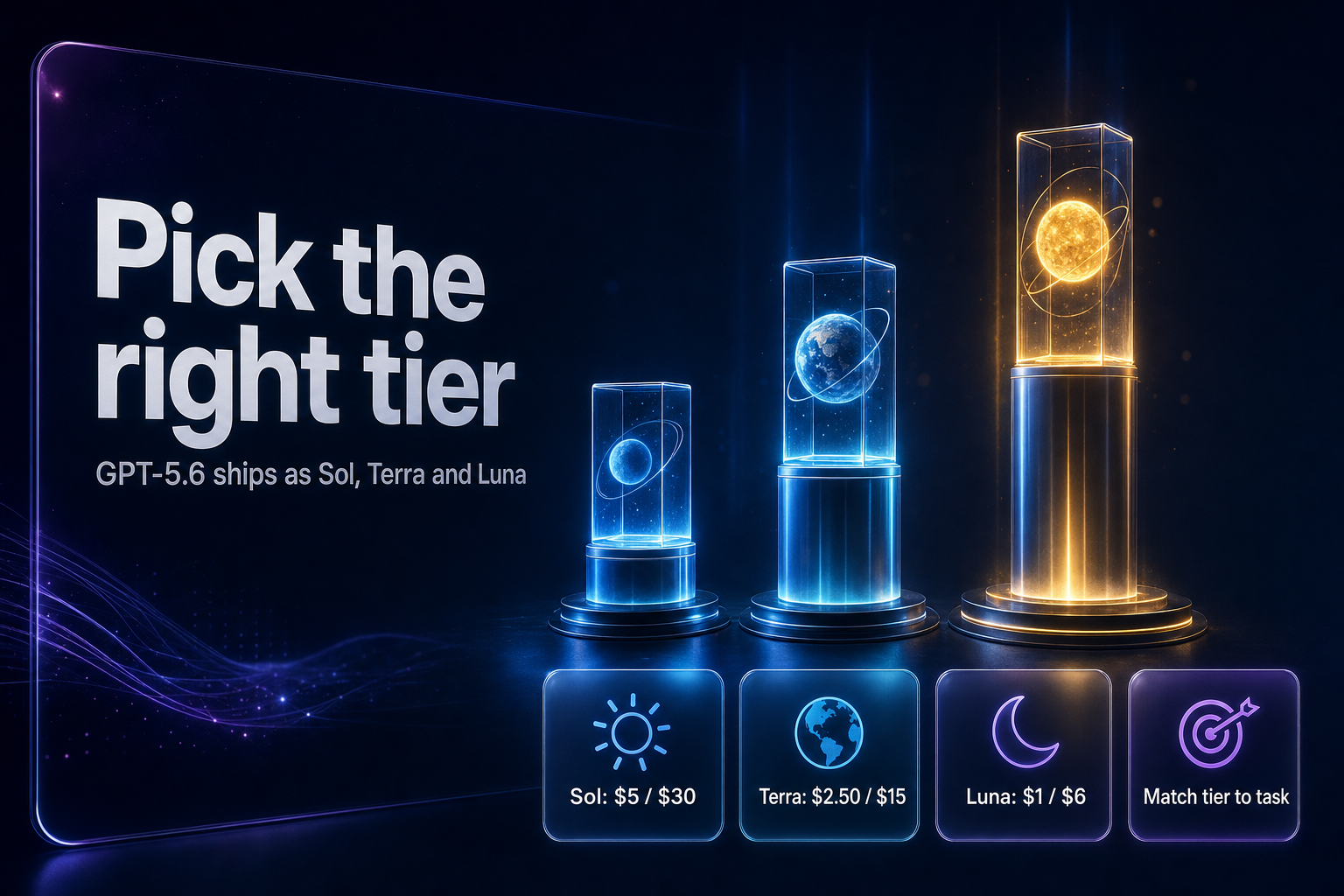
Summary. OpenAI made GPT-5.6 generally available on July 9, 2026, after a preview that began June 26, shipping three models instead of one: Sol, Terra and Luna. They are priced per million tokens at $5 input and $30 output for Sol, $2.50 and $15 for Terra, and $1 and $6 for Luna. The tiers map to jobs: Sol for frontier reasoning and hard coding, Terra for high-volume business work at half Sol's price, and Luna for cheap, fast, routine tasks. OpenAI is also running Sol on Cerebras hardware this July at up to 750 tokens per second for latency-critical work. The decision is no longer which model, but which tier per workload.
Three tiers with a five-times price spread between the cheapest and the dearest changes how you architect an application. Route everything to Sol and your bill is five times what it needs to be for the work Luna could handle. Route everything to Luna and your hardest tasks fail. The win is matching each call to the cheapest tier that clears your quality bar. This guide breaks down the three models, their prices, which workload belongs on which tier, the cost math, and how to route between them.
What OpenAI shipped
GPT-5.6 reached general availability on July 9, 2026, rolling out across ChatGPT, ChatGPT Work, the API, Codex and GitHub Copilot, after a limited preview from June 26, per the GA coverage. The family is three models, not a single flagship: Sol is the frontier tier, Terra balances capability, speed and cost for everyday work, and Luna is the fastest and lowest-cost option, as OpenAI's help documentation describes. The three-model split is the design: OpenAI is telling buyers to route by task rather than pay flagship rates for everything, as Simon Willison noted on the release.
The three tiers and their prices
The pricing is the clearest signal of intent. Terra sits at exactly half Sol's token price while keeping performance competitive with GPT-5.5, which makes it the sensible default for most production work, per Finout's pricing breakdown. Sol's premium buys an extended context window and frontier reasoning for the hardest tasks, and Luna trades the last few percentage points of quality for the lowest price and highest speed, per Vellum's tier comparison.
| Tier | Price per 1M tokens (input / output) | Positioning |
|---|---|---|
| Sol | $5 / $30 | Frontier reasoning, extended context |
| Terra | $2.50 / $15 | Balanced default, near GPT-5.5 quality |
| Luna | $1 / $6 | Fastest and cheapest, high volume |
| Sol on Cerebras | Sol pricing, up to 750 tokens/second | Latency-critical frontier work |
Which tier for which workload
Match the tier to the job, not to the org chart. The hardest tasks justify Sol; most business tasks belong on Terra; and high-volume, low-stakes work belongs on Luna, per OpenAI's positioning.
| Workload | Recommended tier | Why |
|---|---|---|
| Complex coding and extended agent runs | Sol | Frontier reasoning and long context |
| Security research and high-stakes analysis | Sol | Accuracy matters more than cost |
| Customer support at scale | Terra | Strong quality at half Sol's price |
| Document analysis and internal tools | Terra | Everyday production quality |
| Summarisation and drafting | Luna | Cheap, fast, good enough |
| High-volume classification and routing | Luna | Cost and speed over last-percent quality |
| Latency-critical real-time reasoning | Sol on Cerebras | Frontier quality at up to 750 tokens/second |
The cost math
The spread is easy to feel with a concrete volume. Take a workload of 10 million input tokens and 2 million output tokens a day. On Sol it costs about $110 a day; on Terra about $55; on Luna about $22. Same shape of work, a five-times range in cost, decided entirely by tier.
| Daily volume (10M in / 2M out) | Tier | Approximate daily cost |
|---|---|---|
| Frontier tasks | Sol | About $110 |
| Standard production | Terra | About $55 |
| High-volume routine | Luna | About $22 |
| Mixed with routing | Sol plus Luna | Between the two, by task mix |
The judgement worth stating: most teams over-buy. If you route by task and default to Terra, you get near-flagship quality at half the price, and you reserve Sol for the calls that actually need it. We cover measuring this in our note on free tools to measure LLM cost and the wider picture in GPT-5.6 inference cost for enterprise AI.
Sol on Cerebras: speed as a tier
There is a fourth option that is really a latency tier. OpenAI is launching Sol on Cerebras hardware this July at up to 750 tokens per second, aimed at applications where latency is the barrier to adoption, per the tier analysis. For a live coding assistant or a real-time agent, speed at frontier quality can matter more than the token price, so treat Cerebras Sol as the tier for interactive, latency-sensitive frontier work rather than for batch jobs.
How to pick
Set Terra as the default, then escalate or drop per task. Send complex coding, extended agent chains and high-stakes analysis to Sol. Send summarisation, drafting, classification and routing to Luna. Reserve Cerebras Sol for interactive work where latency is the constraint. Then measure: log quality and cost per tier on your own tasks, and move each workload to the cheapest tier that still clears your quality bar. Keep the model behind a routing layer so you can shift traffic without changing application code. For agent-heavy stacks, our guide to enterprise AI agents in production shows where tier choice bites hardest.
India-specific considerations
For Indian teams, tier routing is a direct cost lever. Token prices are in dollars, so a workload that runs fine on Luna at $1 per million input tokens costs a fifth of the same volume on Sol, which is a large difference in rupee terms at scale. Default to Terra or Luna for high-volume Indian-language support and drafting, and reserve Sol for the hardest work. On data, treat any customer information sent to the API under Digital Personal Data Protection Act, 2023, consent and residency rules, regardless of tier. For a model-versus-model view, see our GPT-5.6 versus Claude Sonnet 5 comparison.
The bottom line
GPT-5.6 is a routing decision, not a single upgrade. The three tiers exist so you stop paying flagship prices for routine work: default to Terra, escalate to Sol for the hardest tasks, drop to Luna for volume, and use Cerebras Sol when latency is the wall. Log cost and quality per tier on your own workloads, and let those numbers, not the tier names, decide. Done well, most teams cut spend without losing quality, because they were sending Luna-grade work to a Sol-grade model.
FAQ
How eCorpIT can help
eCorpIT is a Gurugram-based technology consultancy, founded in 2021 and CMMI Level 5 certified, with senior-led AI engineering teams. We build tier-routing layers that send each request to the cheapest GPT-5.6 tier that clears your quality bar, instrument cost and quality per tier, and keep model calls swappable and DPDP-aligned. If you want frontier quality where it matters and low cost everywhere else, talk to us.
References
_Last updated: July 11, 2026._