On this page · 9 sections
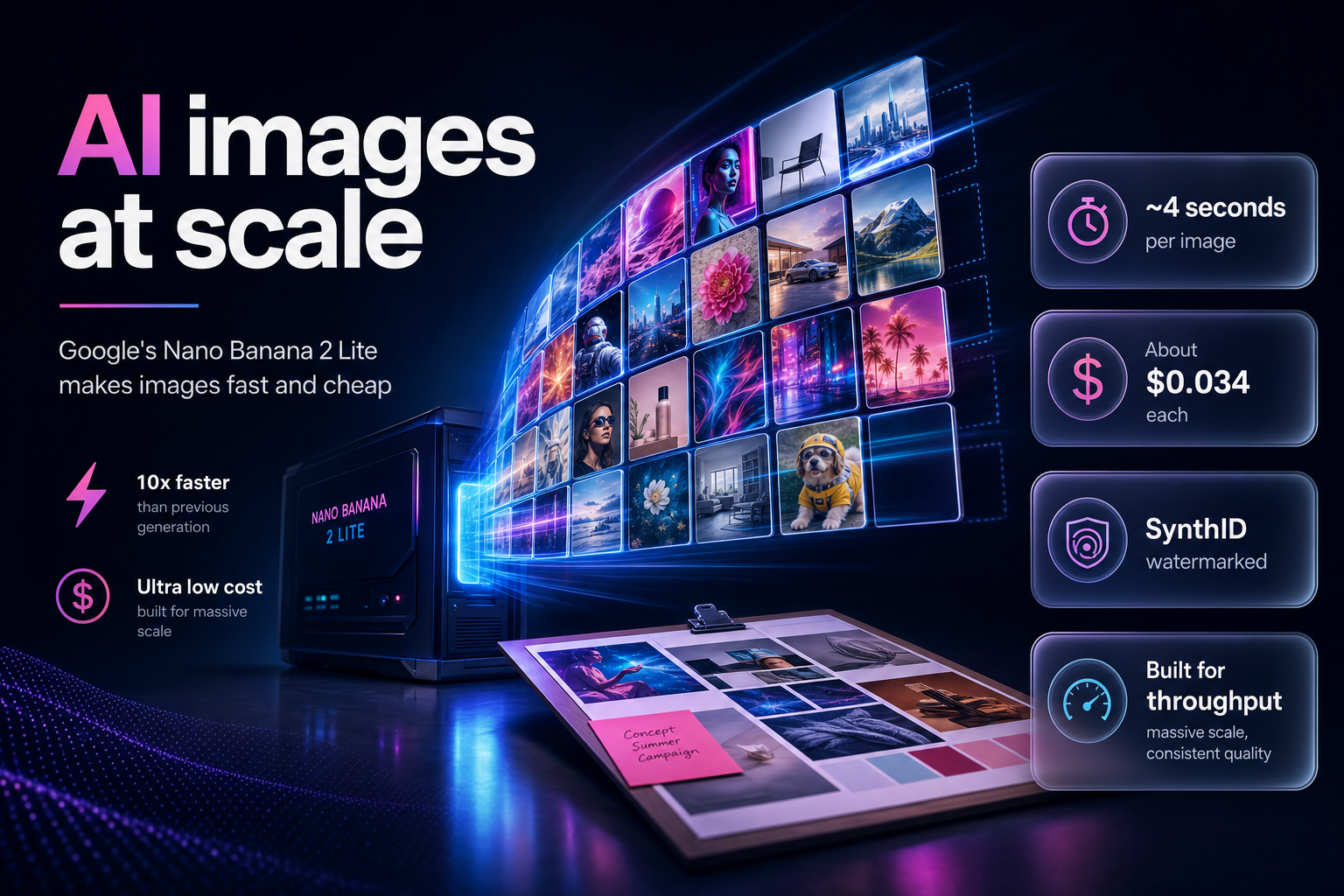
Summary. Google released Nano Banana 2 Lite on June 30, 2026, the fastest and cheapest image model in its Nano Banana family. It generates a text-to-image result in about 4 seconds, five times faster than the 20 seconds of full Nano Banana 2, at roughly $0.034 per 1K image. The API model name is gemini-3.1-flash-lite-image, and it is available in Google AI Studio, the Gemini API and the Gemini Enterprise Agent Platform, with rollout to AI Mode in Search, the Gemini app, Google Photos and Google Ads. Two numbers reset the marketing math: the price makes images almost free at scale, and every output ships with a SynthID watermark, so provenance is no longer optional.
For a marketing team, the interesting part is not that the images look good. It is that they now cost about three cents each and land in four seconds, which turns image generation from a considered task into a tap. That changes what you can afford to try, and it changes what "authentic" has to mean when a competitor can produce ten thousand variations for a few hundred dollars. This article covers the specs, the cost math, the real use cases, where the model falls short, and the provenance question every brand now has to answer.
What Google shipped
Nano Banana 2 Lite is built for rapid generation and editing where speed, throughput and low cost matter more than maximum creative control, per TechCrunch. Google puts the speed at about 4 seconds a result, five times faster than full Nano Banana 2, and the price at roughly $0.034 per 1K image, as gHacks reported. The model, gemini-3.1-flash-lite-image, is available through Google AI Studio, the Gemini API and the Gemini Enterprise Agent Platform, and is rolling out across consumer surfaces including AI Mode in Search, the Gemini app, NotebookLM, Google Photos and Google Ads, per the pricing and API breakdown.
| Attribute | Nano Banana 2 Lite | Full Nano Banana 2 |
|---|---|---|
| Speed per image | About 4 seconds | About 20 seconds |
| Price | Roughly $0.034 per 1K image | Higher per image |
| Best for | Volume, drafts, variations | Hero and high-control work |
| Creative control | Lower | Higher |
| API model name | gemini-3.1-flash-lite-image | Nano Banana 2 |
The cost math for marketing
At roughly $0.034 an image, the budget stops being the constraint. A hundred variations cost about $3.40. A thousand cost about $34. Ten thousand cost about $340. Combined with a four-second render, that makes high-volume, low-stakes image work practical for the first time. The right uses are the ones where you need many acceptable images fast, not one perfect image slowly.
| Marketing task | Why Lite fits | Caveat |
|---|---|---|
| Ad creative variations | Cheap volume for A/B and channel sizing | Human picks the winners |
| Localisation by market | Regenerate visuals per language and region | Check cultural fit per market |
| Social and blog thumbnails | Fast, disposable, high frequency | Keep brand style consistent |
| Product mockups and concepts | Iterate ideas before a full shoot | Not a substitute for real product shots |
| Personalised campaign assets | Generate per-segment at scale | Apply consent rules to any likeness |
The judgement worth stating: cheap images raise the floor, not the ceiling. When everyone can produce a thousand competent visuals, the competitive edge moves to taste, brand consistency and the trust signals on the image, not to volume. We cover the strategy side in our digital marketing strategy for 10x ROI and the content workflow in our content marketing strategy for Gurugram teams.
What it is not for
Google positioned Lite for throughput over control, and that trade-off is real. For a brand hero image, a precise product rendering, or anything with exact text baked into the image, the full model or a human designer is the right call, as review benchmarks note. Lite is a drafting and volume tool. Treating its output as final for high-stakes brand work is how you ship an off-brand campaign quickly rather than a good one slowly.
The trust math: everything is watermarked
Here is the part most cost coverage skips. Every image Nano Banana 2 Lite makes carries a SynthID watermark, because SynthID now ships by default in Google's content-generating products, from Gemini and Imagen to Veo, per the SynthID explainer. More than 10 billion pieces of content had been watermarked with SynthID by May 2026, and the technology moved from a Google feature toward an industry default as OpenAI, ElevenLabs and NVIDIA moved to adopt it, per provenance coverage.
That matters for brands in two directions. Your AI visuals are detectable as AI, so a "shot on location" claim over a generated image is a risk. And the wider provenance stack, C2PA Content Credentials, is now emitted by OpenAI, Adobe Firefly, Microsoft Copilot, TikTok and Meta AI, so signed provenance is becoming the norm buyers and platforms expect, per watermarking analysis. Brands that sign their visuals and document a disclosure policy build a measurable trust lead, as provenance guidance argues.
| Provenance signal | What it is | Who emits it |
|---|---|---|
| SynthID | Invisible Google watermark in the pixels | Google, plus OpenAI, ElevenLabs, NVIDIA adopting |
| C2PA Content Credentials | Signed metadata on origin and edits | OpenAI, Adobe Firefly, Microsoft Copilot, Meta AI |
| Visible disclosure | A label stating an image is AI-made | The publishing brand |
| Editorial charter | Documented rules for AI visual use | The brand's marketing team |
| Camera Content Credentials | Provenance from capture device | Participating camera makers |
We wrote more on this shift in our note on SynthID watermarks and content authenticity for marketers.
India-specific considerations
Three points for Indian marketing teams. First, cost in context: at a few rupees an image, the barrier to high-volume creative disappears, which favours teams with strong brand systems over teams that simply generate more. Second, localisation: Lite makes per-language and per-region visuals cheap, useful across India's markets, but cultural fit still needs a human check. Third, consent and likeness: if a generated asset resembles a real person or uses customer data to personalise, the Digital Personal Data Protection Act, 2023, applies, so treat likeness and personalisation as consent-bound. Disclosure is the safe default, since the SynthID watermark already marks the output as AI-made.
The bottom line
Nano Banana 2 Lite makes competent images almost free and almost instant, which is a genuine unlock for volume work like ad variants, localisation and thumbnails. It is a drafting tool, not a replacement for hero creative or a human's taste. The quieter story is provenance: every output is watermarked, and C2PA credentials are spreading, so the brands that win will pair cheap generation with a clear disclosure policy. Cheap images are the easy part now. Being trusted about them is the edge.
FAQ
How eCorpIT can help
eCorpIT is a Gurugram-based technology consultancy, founded in 2021 and CMMI Level 5 certified, with senior-led digital marketing and engineering teams. We help brands build AI image pipelines that stay on-brand: wiring models like Nano Banana 2 Lite into content workflows, setting disclosure and C2PA provenance policy, and aligning any use of customer data or likeness with DPDP requirements. If you want cheap AI visuals without the brand and compliance risk, talk to us.
References
_Last updated: July 11, 2026._