On this page · 13 sections
- Why AI workloads break the old cluster security model
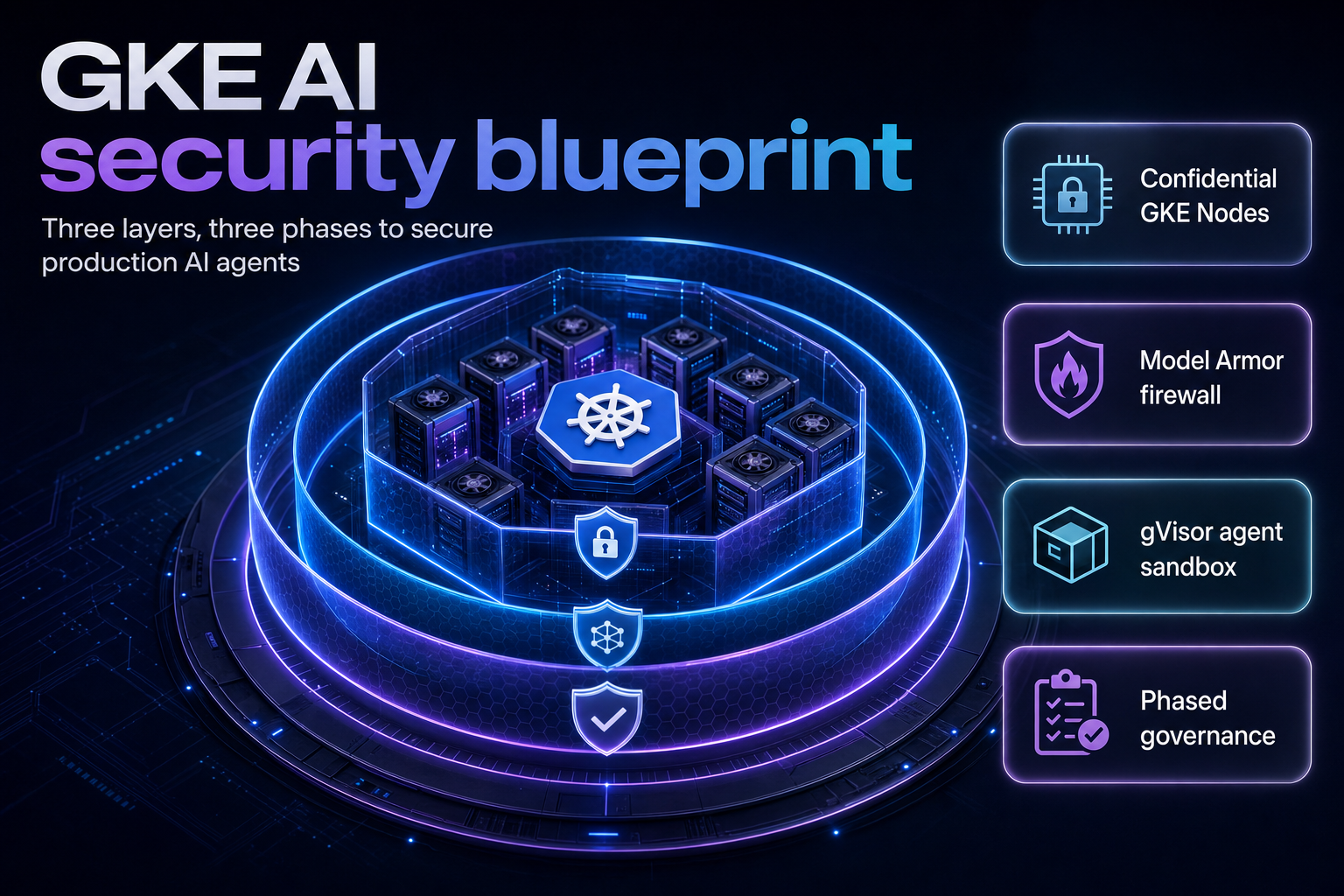
- The blueprint at a glance
- Layer 1: infrastructure, hardware-attested execution
- Layer 2: model security, provenance and integrity
- Layer 3: application security, defending the inference path
- The three phases: Deploy, Operate, Govern
- How GKE compares to AWS and Azure
- The cost and performance reality
- India-specific considerations
- A pragmatic rollout order
- FAQ
- How eCorpIT can help
- References
Summary. On 16 July 2026 Google Cloud published its blueprint for AI workload security on Google Kubernetes Engine (GKE), a control map written by GKE group product manager Glen Messenger and technical writer Shannon Kularathna. It splits the AI stack into 3 layers, infrastructure, model, and application, and recommends a 3-phase rollout: Deploy, Operate, Govern. The stakes are concrete. IBM's Cost of a Data Breach report put the 2025 global average at $4.44 million and the United States average at $10.22 million, and India's DPDP Act 2023 sets a maximum penalty of ₹250 crore (about $30 million) for failing to keep reasonable security safeguards. This guide walks each layer and phase with the exact GKE controls, from Confidential GKE Nodes on NVIDIA H100 accelerators to Model Armor and gVisor sandboxing, so a platform team can enable them in order.
Most Kubernetes security advice was written for stateless web services. An AI agent is a different animal. It holds model weights worth protecting, it accepts free-text prompts that can carry injection payloads, and, increasingly, it executes code and calls third-party tools on its own. Role-based access control and network policies still matter, but a policy that says "this pod may reach that service" says nothing about whether a prompt should run or whether a response is leaking personally identifiable information. That gap is exactly what the GKE blueprint sets out to close.
Why AI workloads break the old cluster security model
A conventional microservice trusts its inputs after authentication and returns deterministic output. An inference service does neither. The input is natural language a user wrote, so the "authenticated" caller can still smuggle instructions into the prompt. The output is generated, so it can disclose training data, secrets pulled into context, or another tenant's information. And an agent that runs generated Python or shells out to a tool is, from the node's point of view, running untrusted code you shipped on purpose.
Messenger frames the job for platform teams plainly: you "need to protect proprietary model weights, defend against novel application-layer threats like prompt injection, and enforce strict regulatory compliance, all without slowing down your AI developers," as reported in InfoQ's coverage of the blueprint. The blueprint's own one-line thesis is blunter: "You can't have a secure AI workload on an insecure cluster."
The Cloud Native Computing Foundation made the same point from the neutral side of the fence in a post InfoQ covered in April 2026: Kubernetes understands orchestration and isolation, but has no built-in concept of whether a prompt should be executed or whether a response leaks sensitive data. Traditional controls remain necessary and are no longer sufficient. So the blueprint does not replace cluster hardening; it stacks AI-specific defenses on top of it.
The blueprint at a glance
The document groups controls into three layers of the AI stack and tells you what to turn on in each of the three rollout phases. Read the grid top to bottom for defense in depth, left to right for the order of work.
| Layer | Protects against | Primary GKE controls | Google Cloud service |
|---|---|---|---|
| Infrastructure | Hypervisor compromise, key theft, data exfiltration | Confidential GKE Nodes, Workload Identity Federation, VPC Service Controls | Compute Engine, IAM, VPC SC |
| Model | Weight tampering, supply-chain drift | k8s-aibom inventory, signed images, Binary Authorization | Artifact Registry, Binary Authorization |
| Application | Prompt injection, PII leakage, agent escape, cost abuse | Model Armor, GKE Inference Gateway, GKE Sandbox (gVisor) | Model Armor, GKE Inference Gateway |
Note one thing before the details: almost every control is a managed Google Cloud feature you enable, not a bespoke system you build. The blueprint's argument for GKE is that you inherit an infrastructure baseline Google has refined for over a decade rather than assembling it yourself.
Layer 1: infrastructure, hardware-attested execution
You cannot run a secure model on an insecure cluster, so the first layer treats the node itself as untrusted territory that must be locked down.
Confidential GKE Nodes extend hardware-level memory encryption and attestation to accelerators, including Confidential GPUs such as the NVIDIA H100 and TPUs. In practice this means the model weights and the data in memory during inference stay encrypted even from the hypervisor and from a cloud operator with host access. For a fine-tuned model that is itself the intellectual property, this closes the "someone scrapes RAM" threat that ordinary encryption at rest and in transit leaves open.
            # Create a cluster with Confidential GKE Nodes and Workload Identity enabled
gcloud container clusters create prod-inference \
  --enable-confidential-nodes \
  --workload-pool=PROJECT_ID.svc.id.goog \
  --machine-type=a3-highgpu-8g \
  --region=asia-south1
Workload Identity Federation for GKE removes long-lived service-account keys. An inference pod fetches its model weights from Cloud Storage using a short-lived, federated identity tied to its Kubernetes service account, so there is no static key file to leak from an image or an environment variable.
            # Bind a Kubernetes service account to a Google service account
apiVersion: v1
kind: ServiceAccount
metadata:
  name: inference-sa
  namespace: serving
  annotations:
    iam.gke.io/gcp-service-account: model-reader@PROJECT_ID.iam.gserviceaccount.com
VPC Service Controls draw a perimeter around the regulated project so that even a valid credential cannot move data to a bucket outside the boundary. This is the control that turns an exfiltration attempt into a blocked API call rather than a breach notification. For teams whose India data must stay in-country, the perimeter is also where you pin serving and storage to a region such as asia-south1.
Layer 2: model security, provenance and integrity
If you deploy your own weights, whether fine-tuned or open source, you own their integrity. The blueprint's insight here is that a normal software bill of materials does not describe an AI system. It lists your container's libraries but says nothing about which base model, which datasets, or which training framework produced the artifact you are serving.
Google's answer is k8s-aibom, an open-source Kubernetes controller that generates an AI bill of materials automatically, inventorying models, datasets, and frameworks so you have supply-chain visibility for the parts that matter. Pair that inventory with image signing and admission control so the cluster refuses to run anything unsigned.
            # Enforce that only signed images run, via Binary Authorization
gcloud container clusters update prod-inference \
  --binauthz-evaluation-mode=PROJECT_SINGLETON_POLICY_ENFORCE \
  --region=asia-south1
With Binary Authorization in enforce mode, a tampered or unknown model server image is rejected at admission time, not discovered after it is already serving traffic. This is the same supply-chain discipline the industry has applied to application code, extended to model artifacts.
Layer 3: application security, defending the inference path
This is where AI-specific threats live, and where the blueprint adds services that sit directly in the request path rather than around it.
Model Armor sits between your application and the inference endpoint and inspects every prompt and every response. It screens for prompt injection, for sensitive data exposure such as PII in a response, and for harmful content generation. Because it is inline, it can block a poisoned prompt before the model ever sees it and redact a leaking response before it reaches the user. Model Armor profiles are tuned per application, which is a Phase 2 task once you know your real traffic.
The GKE Inference Gateway gives you session-level observability and quota enforcement. You set per-user rate limits and watch for abuse patterns, including session manipulation and inference cost abuse, the denial-of-wallet attack where a single user drives your token bill through the roof. For a defense-in-depth view of the prompt-injection problem itself, our guide to AI agent security and prompt-injection guardrails covers the application-side patterns that complement Model Armor.
GKE Sandbox, built on the gVisor isolation technology, is the control for agents that execute generated code or call unverified third-party tools. gVisor puts a user-space kernel between the container and the host, so a container escape hits a sandbox instead of the node. Turning it on is a node-pool setting plus one line in the pod spec.
            # Run an agent that executes generated code inside gVisor
apiVersion: v1
kind: Pod
metadata:
  name: code-agent
spec:
  runtimeClassName: gvisor
  containers:
    - name: agent
      image: REGION-docker.pkg.dev/PROJECT_ID/agents/code-agent:signed
Sandboxing has a real cost: gVisor intercepts system calls, so syscall-heavy workloads pay a latency penalty you should measure rather than assume. The trade is straightforward. Reserve gVisor for the pods that run untrusted or model-generated code, and leave pure inference pods on the standard runtime. If you are designing where agent state and tools live, the patterns in our note on stateful AI agents and sandbox design on Kubernetes map cleanly onto this layer.
The three phases: Deploy, Operate, Govern
Security on GKE compounds, so the blueprint sequences the work instead of asking you to boil the ocean on day one.
| Phase | Goal | What you turn on | Owner |
|---|---|---|---|
| 1. Deploy | A secure-by-default baseline | Workload Identity, Model Armor in front of endpoints, Confidential GKE Nodes for sensitive workloads | Platform team |
| 2. Operate | Production hardening | Binary Authorization signed-image policies, tuned Model Armor profiles, audit logs aggregated for SIEM correlation | Platform + SecOps |
| 3. Govern | Enterprise-scale automation | Organization Policy Service guardrails, admission-time policies via Kubernetes webhooks, automated incident response | Security + governance |
Phase 1 is the fastest security win because the controls are on-off switches with sane defaults. Phase 2 is where you spend real engineering time, because tuning Model Armor and wiring cross-layer audit logs into a SIEM depends on your traffic and your detection stack. Phase 3 is organizational: you push the baseline down as policy so a new team cannot spin up an unprotected cluster by accident. If you run agents at scale, our breakdown of enterprise AI agent governance layers pairs with this phase, and the broader production AI agents playbook sets the context for the whole rollout.
How GKE compares to AWS and Azure
Google is not alone. The three major clouds have converged on layered, AI-specific security models, but they emphasize different parts of the stack.
| Approach | Google Cloud (GKE) | AWS | Microsoft Azure |
|---|---|---|---|
| Framing | 3-layer blueprint on GKE | AWS AI Security Framework, AI on EKS Terraform blueprints | Agent Factory series, identity-first |
| Runtime isolation | GKE Sandbox (gVisor) | Amazon GuardDuty for EKS (eBPF agent) | Container platform plus agent identity |
| Agent identity | Workload Identity Federation | IAM Roles for Service Accounts | Microsoft Entra Agent ID (scoped, short-lived) |
| Inline content defense | Model Armor (prompt and response) | Partner and open-source tooling | Azure AI Content Safety, PyRIT red teaming |
| Supply chain | k8s-aibom, Binary Authorization | Signed images, ECR scanning | Signed images, Defender for Containers |
The instructive critique comes from security vendor ARMO. Its vice president of product management, Yossi Ben Naim, argues that cloud-native identity and audit tools "handle identity, encryption, and control-plane logging well, but they stop at the workload boundary, leaving a blind spot exactly where agentic AI threats happen: inside your containers, at runtime, where agents make autonomous decisions about which tools to call and which data to access," as quoted in InfoQ's reporting. His point applies to every vendor in the table: identity tools answer what an agent is allowed to do, not whether a permitted action is normal for that specific agent. Ben Naim proposes a four-stage loop, observe behavior, assess the gap between granted and used permissions, detect deviations from a baseline, then enforce a tightened policy. Read the GKE blueprint as the platform baseline and behavioral runtime security as the layer that watches what the agent actually does.
Microsoft's angle is worth calling out because it complements rather than competes. Entra Agent ID gives each agent its own scoped, short-lived credential, and PyRIT automates red-teaming before release. Identity per agent plus behavioral detection plus a hardened platform is the shape most mature deployments end up with, regardless of cloud.
The cost and performance reality
Security is not free, but on GKE the direct premium is smaller than teams expect. There is no separate charge for the Confidential GKE Nodes feature itself; you pay the Compute Engine Confidential VM premium for the underlying nodes, on top of standard GKE cluster management, compute, storage, and networking. Memory encryption is handled by a dedicated security processor, which Google describes as adding negligible overhead for most applications, though memory-bandwidth-bound inference is exactly the kind of workload where you should measure rather than trust the label.
The larger costs are operational. Image signing, attestation logic, and stricter CI/CD add engineering effort. gVisor adds latency to syscall-heavy pods. Model Armor adds an inline hop on every request. None of these is large in isolation, and all of them are cheap against a $4.44 million average breach. The FinOps move is to apply the expensive controls selectively: Confidential Nodes for the sensitive workloads, gVisor for the code-executing agents, standard runtime everywhere else. If GPU capacity is your real budget line, our data on H100 and B200 cloud rental pricing in India shows why over-provisioning "just to be safe" is the more expensive mistake.
India-specific considerations
For teams serving Indian users or running under the Digital Personal Data Protection Act 2023, the blueprint's controls line up neatly with the statute. Rule 6 of the DPDP framework defines "reasonable security safeguards" as a technical baseline of encryption, access controls, and one-year log retention. Confidential GKE Nodes and encryption in use cover the first, Workload Identity and VPC Service Controls cover the second, and the Phase 2 requirement to aggregate audit logs for SIEM correlation covers the third if you set retention to at least a year.
The penalties make the case for doing this before an incident, not after. The DPDP Act sets a maximum ₹250 crore penalty for failing to keep reasonable security safeguards that leads to a breach, and ₹200 crore for failing to notify the Data Protection Board and affected users. These are fixed-rupee ceilings assessed per instance, so one incident that breaks several obligations compounds fast. The Board also weighs mitigating factors such as self-disclosure and a prior compliance record, which is a direct argument for the documented, log-backed controls the Govern phase produces. Pinning serving and storage to asia-south1 inside a VPC Service Controls perimeter is also the cleanest way to hold data-residency expectations.
A pragmatic rollout order
If you are starting from a working but unhardened GKE cluster, the sequence that gets you the most protection per hour is roughly this. Enable Workload Identity Federation and delete static keys first, because credential theft is the most common real path in. Put Model Armor in front of your inference endpoints next, since prompt injection and PII leakage are the AI-specific threats you are most likely to meet in week one. Move sensitive workloads onto Confidential GKE Nodes. Then, in Phase 2, turn on Binary Authorization in enforce mode, tune Model Armor to your traffic, and ship audit logs to your SIEM. Add gVisor the moment any agent starts executing generated code. Save Organization Policy Service guardrails for Phase 3, once the pattern is proven on one cluster and ready to become the default for all of them. Teams building this into their software delivery process should also read our guide to secure AI-assisted development and application security.
FAQ
How eCorpIT can help
eCorpIT is an ISO 27001:2022 certified, CMMI Level 5 engineering organization that helps enterprises take AI and agent workloads from prototype to hardened production on Kubernetes. Our senior teams map the GKE blueprint's three layers to your workloads, enable the Deploy, Operate, and Govern controls in the right order, and design DPDP-aligned data residency and logging. See our Kubernetes AI platform managed service and AI agent security guardrails service, or contact us to review your cluster.
References
- Securing AI at enterprise scale: best practices for AI workload security on GKE — Google Cloud documentation (the blueprint).
- GKE Security Blueprint Joins Growing List of Cloud AI Frameworks — InfoQ, 22 July 2026 (Messenger and Ben Naim quotes).
- Google Cloud unveils AI security blueprint for GKE — SecurityBrief.
- k8s-aibom: AI bill of materials for Kubernetes — Google Cloud Platform, GitHub.
- Encrypt workload data in-use with Confidential GKE Nodes — Google Cloud documentation.
- Google Kubernetes Engine pricing — Google Cloud.
- AI on EKS: Terraform blueprints for AI workloads — AWS Labs.
- Cost of a Data Breach 2026: IBM benchmarks — IBM Cost of a Data Breach summary ($4.44M global, $10.22M US).
- DPDP Act penalties and enforcement — TCSA (₹250 crore maximum penalty).
- Microsoft Entra Agent ID — Microsoft Security.
- Securing AI workloads on Kubernetes — InfoQ, April 2026 (CNCF perspective).
_Last updated: 27 July 2026._