On this page · 12 sections
- What Google shipped on 21 July 2026
- Why the sticker price stopped predicting spend
- The three rate cards, side by side
- What the benchmarks let you compare, and what they do not
- A worked cost model for one real workload
- Routing, not choosing
- Measure it on your own traffic
- India-specific considerations
- What to do in the next six weeks
- FAQ
- How eCorpIT can help
- References
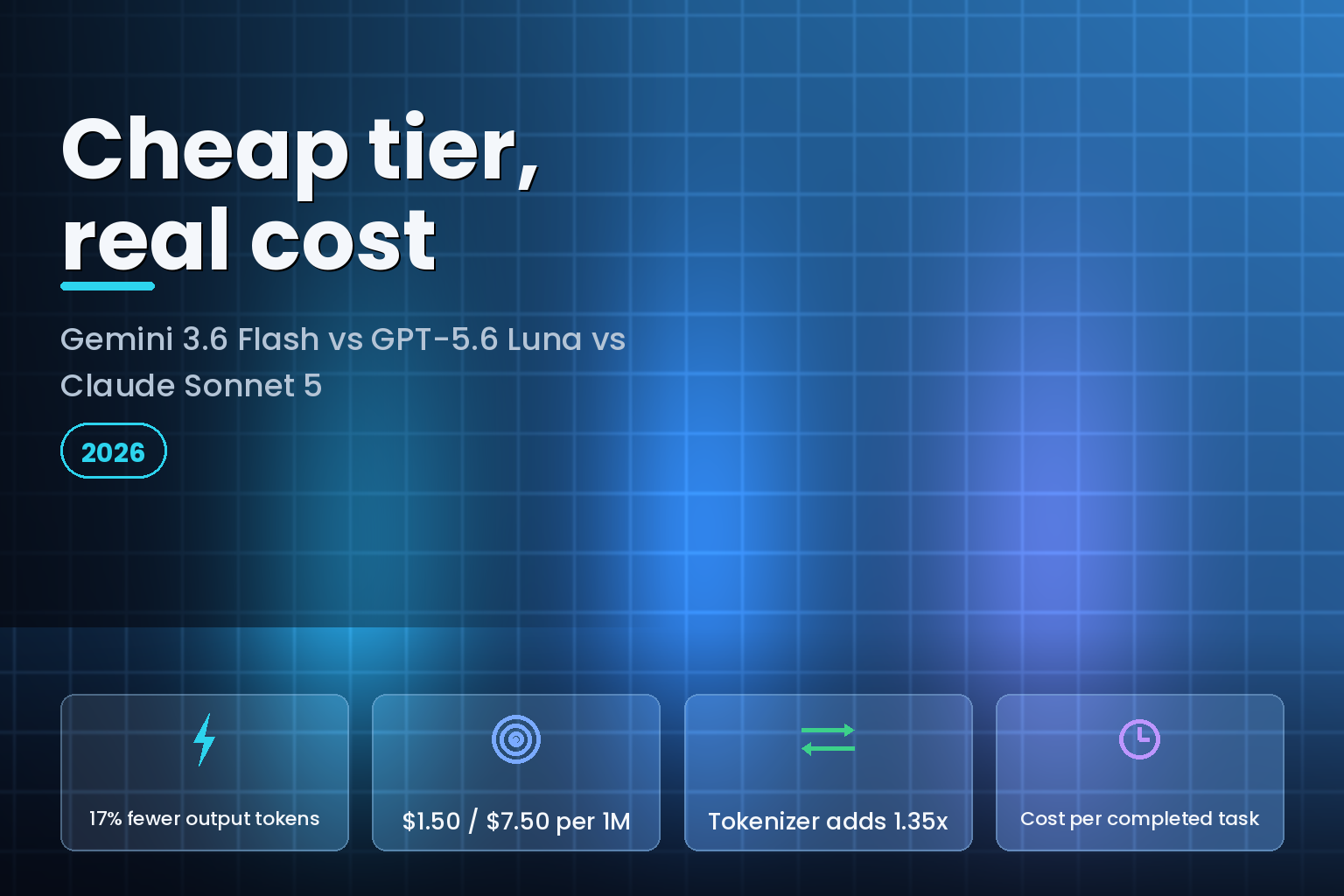
Summary. Google announced Gemini 3.6 Flash on 21 July 2026 at $1.50 per million input tokens and $7.50 per million output tokens, down from $9.00 on 3.5 Flash, and said the model consumes 17% fewer output tokens on the Artificial Analysis Index. Those two changes compound: on a task that previously burned 4,000 output tokens, the cost falls 30.8%, not the 16.7% the price cut alone would give. OpenAI's GPT-5.6 Luna, generally available since 9 July 2026, undercuts it on paper at $1.00 and $6.00 per million. Anthropic's Claude Sonnet 5, released 30 June 2026, sits at an introductory $2.00 and $10.00 per million until 31 August 2026, then moves to $3.00 and $15.00. Three vendors, three rate cards, and three separate mechanisms that make the rate card a poor predictor of the invoice: token efficiency, tokenizer changes, and cache billing.
If you run production agents, the number that matters is cost per completed task. Nobody publishes that. This article reconstructs it from the rates and eval tables the three vendors did publish, and shows where the comparison legitimately breaks down.
What Google shipped on 21 July 2026
Google released three models in one announcement: Gemini 3.6 Flash, Gemini 3.5 Flash-Lite, and Gemini 3.5 Flash Cyber. All three target speed and cost rather than frontier capability.
Gemini 3.6 Flash is priced at $1.50 per million input tokens and $7.50 per million output tokens, against $9.00 per million output on 3.5 Flash. Google attributes the efficiency gain to "fewer reasoning steps and tool calls to accomplish multi-step workflows," and puts the reduction at 17% fewer output tokens per the Artificial Analysis Index. The published eval deltas against 3.5 Flash are: DeepSWE 49% against 37%, MLE Bench 63.9% against 49.7%, GDPval-AA 1421 against 1349, and OSWorld-Verified 83% against 78.4%. Its training data now runs to March 2026 instead of January 2025.
Gemini 3.5 Flash-Lite is the cheaper tier at $0.30 per million input and $2.50 per million output, aimed at high-throughput work such as agentic search and document processing. Against 3.1 Flash-Lite it reports Terminal-Bench 2.1 at 54% against 31%, GDM-MRCR v2 at 72.2% against 60.1%, and GDPval-AA v2 at 1140 against 642. Google also reports it beating Gemini 3 Flash on SWE-Bench Pro, 54.2% against 49.6%, and on OSWorld-Verified, 74.0% against 65.1%.
Gemini 3.5 Flash Cyber is a security model for finding and patching code vulnerabilities, and it powers Google's CodeMender tool with multiple agents. Access is a limited-access pilot for governments and trusted partners, so it is not a procurement option for a typical engineering team this quarter. Google also confirmed that Gemini 3.5 Pro is testing with partners and that pre-training has started for Gemini 4.
Why the sticker price stopped predicting spend
Three mechanisms broke the old habit of ranking models by dollars per million tokens. Each one is documented by the vendor that introduced it.
1. Token efficiency moves independently of price
A price cut and an efficiency gain multiply. Google cut the Flash output rate from $9.00 to $7.50 per million, a 16.7% reduction, and said the model emits 17% fewer output tokens for the same work.
Take a task that produced 4,000 output tokens on Gemini 3.5 Flash. At $9.00 per million that output cost $0.036. The same task on 3.6 Flash produces roughly 3,320 output tokens, and at $7.50 per million that costs $0.0249. The reduction is 30.8%. A procurement spreadsheet that only swaps the unit price understates the saving by nearly half.
The same logic runs in reverse. A model that is 20% cheaper per token and 25% chattier costs you more.
2. Tokenizer changes silently re-price identical text
Anthropic is explicit about this one. Sonnet 5 uses an updated tokenizer, and Anthropic states that "the same input can map to more tokens: roughly 1.0-1.35x depending on the content type," adding that the introductory pricing is set so the move from Sonnet 4.6 is roughly cost-neutral.
Cost-neutral until 31 August 2026. On 1 September the input rate steps from $2.00 to $3.00 per million and the output rate from $10.00 to $15.00. A team that sized its budget on the introductory rate is looking at a 50% rate increase with the tokenizer expansion already inside its token counts. A 20,000-token prompt that expands to 27,000 tokens at the top of Anthropic's stated range costs $0.054 today and $0.081 from September, against $0.060 for the unexpanded text at the standard rate. Content type decides where in that 1.0-1.35x band you land, which means your own corpus is the only reliable test.
3. Cache billing now has its own rate card
OpenAI changed cache economics with GPT-5.6. Cache writes bill at 1.25x the model's uncached input rate, cache reads keep the 90% cached-input discount, and there is a 30-minute minimum cache life with explicit cache breakpoints.
For Luna at $1.00 per million input, a cache write costs $1.25 per million and a cache read costs $0.10 per million. Writing a prefix costs $0.25 more per million than simply sending it, and every subsequent read saves $0.90. Break-even arrives after 0.28 reads, which in practice means the second call to that prefix. The surcharge is not the risk. The risk is prefixes written and never re-read inside the 30-minute window, which is a scheduling problem rather than a pricing one.
The three rate cards, side by side
| Model | Input, per 1M tokens | Output, per 1M tokens |
|---|---|---|
| Gemini 3.5 Flash-Lite (21 Jul 2026) | $0.30 | $2.50 |
| GPT-5.6 Luna (GA 9 Jul 2026) | $1.00 | $6.00 |
| Gemini 3.6 Flash (21 Jul 2026) | $1.50 | $7.50 |
| Claude Sonnet 5, introductory to 31 Aug 2026 | $2.00 | $10.00 |
| Claude Sonnet 5, from 1 Sep 2026 | $3.00 | $15.00 |
| Claude Opus 4.8, for reference | $5.00 | $25.00 |
| GPT-5.6 Sol, for reference | $5.00 | $30.00 |
Rates are the vendors' published figures as of 22 July 2026. Gemini 3.6 Flash carries a 5x input premium over Flash-Lite and a 50% premium over Luna. Sonnet 5 at its standard rate is double Gemini 3.6 Flash on both sides of the meter.
What the benchmarks let you compare, and what they do not
This is where most cheap-tier comparisons go wrong. The three vendors do not report the same evaluations, and where the names look identical the versions often are not.
| Evaluation | Gemini 3.5 Flash-Lite | GPT-5.6 Luna | Comparable? |
|---|---|---|---|
| SWE-Bench Pro | 54.2% | 62.7% | Same eval name, both vendor-run |
| Terminal-Bench 2.1 | 54% | 84.7% | Same version named by both |
| GDPval-AA v2 | 1140 | 1,591.8 | Same version named by both |
| OSWorld | 74.0% (Verified) | 45.6% (2.0) | No, different evaluations |
| DeepSWE | 49% (3.6 Flash, unversioned) | 67.2% (v1.1) | No, version not matched |
The OSWorld row is the trap. Gemini 3.6 Flash scores 83% on OSWorld-Verified while GPT-5.6 Luna scores 45.6% on OSWorld 2.0. Those are different benchmarks, and reading the pair as a 37-point gap is wrong.
Even a single named benchmark shifts under you. Anthropic disclosed that it changed how it runs OSWorld-Verified "to more accurately reflect the model's performance in the real world" and restated Sonnet 4.6's score to 78.5%, and separately restated Sonnet 4.6 on Humanity's Last Exam to 34.6% without tools after updating the grader model. Vendors restating their own prior numbers is normal practice, and it makes any table you build from launch posts a snapshot rather than a fact.
Anthropic also does not publish Sonnet 5 against this cheap-tier field on the same evals at all. It publishes cost-performance curves at different effort levels on BrowseComp and OSWorld-Verified against Sonnet 4.6 and Opus 4.8. Effort level is a pricing decision as much as a quality one, and it has no counterpart in the Gemini or GPT-5.6 tables.
Deepak Singh, VP, Kiro, describes the practical read on Sonnet 5: "Claude Sonnet 5 is a strong agentic-coding model, delivering top-tier accuracy comparable to Opus-class models and a clear step-function improvement over Sonnet 4.6. It conducts thorough explorations and sustains focus noticeably longer on complex tasks."
"Sustains focus noticeably longer" is a capability claim and a token-consumption claim at the same time. That is the whole problem in one sentence.
A worked cost model for one real workload
Assume a support-triage agent: 20,000 input tokens per task, 4,000 output tokens per task, 100,000 tasks per month, no caching. The token counts are ours, chosen to be easy to rescale; the rates are the vendors' published figures.
| Model | Cost per task | Monthly cost, 100,000 tasks |
|---|---|---|
| Gemini 3.5 Flash-Lite | $0.0160 | $1,600 |
| GPT-5.6 Luna | $0.0440 | $4,400 |
| Gemini 3.6 Flash | $0.0600 | $6,000 |
| Claude Sonnet 5, introductory | $0.0800 | $8,000 |
| Claude Sonnet 5, from 1 Sep 2026 | $0.1200 | $12,000 |
The spread between the cheapest and dearest row is 7.5x, and the Sonnet 5 line item grows by $4,000 a month on 1 September 2026 with no change to your code.
Now adjust for the two effects the table ignores. If Gemini 3.6 Flash really does emit 17% fewer output tokens on your workload, its output component falls from $0.030 to $0.0249 per task and the monthly figure drops from $6,000 to $5,490, closing most of the gap to Luna's $4,400. If your prompts sit at the top of Anthropic's 1.0-1.35x tokenizer band, the Sonnet 5 input component rises from $0.040 to $0.054 per task at introductory rates, taking the monthly figure to $9,400 before the September step.
Neither adjustment is knowable from a rate card. Both are measurable in an afternoon against your own traffic.
Routing, not choosing
The useful conclusion from the three rate cards is not a winner. It is that a 7.5x spread across tiers only pays off if you route by task difficulty rather than standardising on one model.
A defensible split for an agent platform in July 2026:
- Classification, extraction, routing, and retrieval reranking go to Gemini 3.5 Flash-Lite at $0.30/$2.50. Google positions it for high-throughput agentic search and document processing, and it beats Gemini 3 Flash on SWE-Bench Pro and OSWorld-Verified.
- Multi-step tool use with terminal or browser work goes to GPT-5.6 Luna, which reports 84.7% on Terminal-Bench 2.1 and 83.3% on BrowseComp.
- Long-context work does not go to Luna. OpenAI's own table puts it at 41.3% on MRCR v2 8-needle at both 256K-512K and 512K-1M, the weakest published figure in the family.
- Sustained agentic coding on messy repositories goes to Claude Sonnet 5, where the effort control lets you buy accuracy per task rather than per token.
- Vulnerability discovery and patching has no cheap-tier answer you can buy today. Gemini 3.5 Flash Cyber is restricted to a limited-access pilot for governments and trusted partners.
We build this routing layer for clients often enough to have a view on it: the real cost is usually the evaluation harness, not the model. Teams that cannot measure cost per completed task will default to the cheapest sticker price and pay for it in retries.
Measure it on your own traffic
The test that settles the argument takes one afternoon. Log the four numbers that actually drive the bill for every task, then divide by tasks completed rather than by calls made.
            # Log per completed task, not per API call.
# Retries and abandoned runs are where cheap models get expensive.
RATES = {  # USD per 1M tokens, published rates as of 22 July 2026
    "gemini-3.6-flash":      {"in": 1.50, "out": 7.50},
    "gemini-3.5-flash-lite": {"in": 0.30, "out": 2.50},
    "gpt-5.6-luna":          {"in": 1.00, "out": 6.00},
    "claude-sonnet-5-intro": {"in": 2.00, "out": 10.00},
}

def task_cost(model, in_tok, out_tok, attempts=1):
    r = RATES[model]
    per_attempt = (in_tok * r["in"] + out_tok * r["out"]) / 1_000_000
    return per_attempt * attempts

def cost_per_completed_task(records):
    spend = sum(task_cost(r["model"], r["in"], r["out"], r["attempts"])
                for r in records)
    completed = sum(1 for r in records if r["completed"])
    return spend / completed if completed else float("inf")
Three rules make the output trustworthy. Count tokens with each vendor's own tokenizer rather than a shared estimate, because Anthropic's 1.0-1.35x expansion will not show up otherwise. Bill retries to the task that caused them. Separate cache writes from cache reads for GPT-5.6, since writes are charged at 1.25x input and reads at 10%.
Our guide to free AI tools that measure LLM costs for engineering teams covers the tooling side, and the enterprise inference cost breakdown for GPT-5.6 works through the tier-selection maths in more detail.
India-specific considerations
For Indian teams the arithmetic carries a currency layer that the vendor pages do not show. All three vendors bill in dollars, so every rate on this page is an unhedged foreign-currency cost. Take an illustrative rate of ₹87 to the dollar and substitute the live rate before you commit a budget: the 100,000-task workload above lands near ₹1,39,200 per month on Gemini 3.5 Flash-Lite, ₹3,82,800 on GPT-5.6 Luna, ₹5,22,000 on Gemini 3.6 Flash, and ₹6,96,000 on Claude Sonnet 5 at introductory rates, with the 1 September step taking Sonnet 5 to roughly ₹10,44,000. The exchange rate moves more often than the model prices do, so budget the currency risk separately from the model choice.
Two other points matter here. Anthropic offers US-only inference at 1.1x pricing for input and output, which is a data-residency control rather than a performance option, and it is the wrong direction for teams whose obligation is to keep processing inside India. Sending personal data to a third-party model provider does not move your accountability. Section 8 of the Digital Personal Data Protection Act, 2023 makes the Data Fiduciary responsible for compliance in respect of any processing undertaken on its behalf by a Data Processor, irrespective of any agreement to the contrary. Whichever of these three models signs the invoice, the duty stays with you. We have written separately on the DPDP engineering playbook for Indian startups.
Batch processing is the cheapest lever available to Indian teams running overnight workloads. Anthropic publishes 50% savings with batch processing and up to 90% with prompt caching, and OpenAI's Batch API halves its rates. A triage queue that tolerates a few hours of latency should not be paying interactive prices.
What to do in the next six weeks
The 31 August 2026 date is the only hard deadline on this page. Sonnet 5's introductory pricing ends and the rate rises by 50% on both sides of the meter.
- Re-run your cost model against standard Sonnet 5 pricing of $3.00 and $15.00 per million before the end of August, not after the first September invoice.
- Measure your own tokenizer expansion on Sonnet 5 against a representative sample of your prompts, and place yourself inside Anthropic's 1.0-1.35x band instead of assuming the midpoint.
- Benchmark Gemini 3.6 Flash against your current model on completed tasks, not on sampled outputs, so the 17% output-token claim is tested where it matters.
- Audit cache hit rates for GPT-5.6 workloads against the 30-minute minimum cache life. Prefixes that are written and never re-read now cost 1.25x.
- Decide routing tiers before the next model launch. On current cadence, with Gemini 3.5 Pro in partner testing and Gemini 4 in pre-training, another rate card is weeks away.
Related reading: our comparison of GPT-5.6 and Claude Sonnet 5 for enterprise agents, the long-context versus RAG cost and latency analysis, and the Copilot migration guide for the Gemini 2.5 Pro and 3 Flash deprecations.
FAQ
How eCorpIT can help
eCorpIT builds and operates model routing, evaluation harnesses and cost instrumentation for teams running production LLM agents, so cost per completed task becomes a number you can see rather than an invoice you explain afterwards. Our senior engineering teams work across the Gemini, OpenAI and Claude platforms, and we design these systems aligned with Digital Personal Data Protection Act 2023 requirements for Indian deployments. We also handle the unglamorous part: tokenizer-accurate measurement, retry accounting and cache-hit auditing. Tell us what your agents cost today at /contact-us/ and we will tell you where the spread is.
References
- Google launches Gemini 3.6 Flash and 3.5 Flash-Lite, teases Gemini 4 - 9to5Google, 21 July 2026, reporting Google's announcement figures.
- Google Releases Gemini 3.6 Flash, 3.5 Flash-Lite, and 3.5 Flash Cyber - MarkTechPost, 21 July 2026.
- Introducing Claude Sonnet 5 - Anthropic, 30 June 2026, pricing, tokenizer note and benchmark restatements.
- Claude Sonnet 5 System Card - Anthropic, methodology for the agentic search evaluations.
- OpenAI Releases GPT-5.6 (Sol, Terra, Luna) - MarkTechPost, 9 July 2026, reproducing OpenAI's published eval table and rates.
- GPT-5.6: Frontier intelligence that scales with your ambition - OpenAI product page for the GPT-5.6 family.
- Prompt caching - OpenAI developer documentation on cache breakpoints and cache billing.
- Effort levels - Claude Platform documentation on the effort control used in Sonnet 5 cost-performance curves.
- Artificial Analysis Intelligence Index - the third-party index Google cites for the 17% output-token reduction.
- OSWorld-Verified - XLang, the computer-use evaluation cited by Google and Anthropic.
- BrowseComp - the agentic search evaluation used in Anthropic's cost-performance charts.
- Claude Platform model overview - model identifiers and platform availability.
- Digital Personal Data Protection Act, 2023, Section 8: general obligations of Data Fiduciary - India Code, official text.
Last updated: 22 July 2026.