On this page · 10 sections
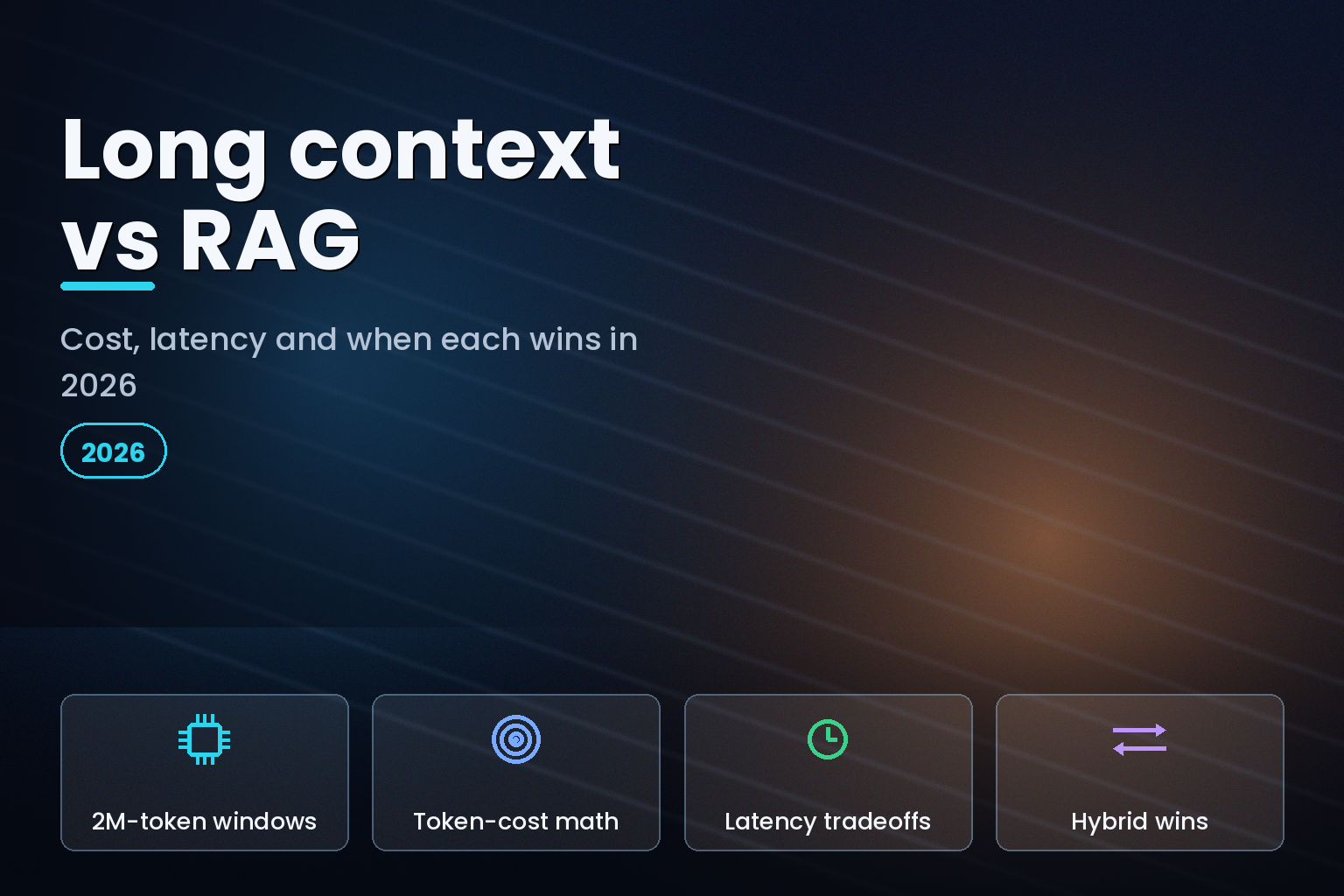
Summary. Google DeepMind released Gemini 3.5 Pro on 18 July 2026 with a 2-million-token context window, roughly double Claude Fable 5's 1 million and GPT-5.6 Sol's 1.05 million. That revived the same question every platform team asks: if the model can read everything, why run retrieval at all? The numbers answer it. On RULER-style tests, most models lose 15 to 30 percent accuracy between 4K and 128K tokens, and buried mid-window facts drop 30 percent or more. RAG can be around 1,250 times cheaper per query than stuffing a full corpus into context. Yet about 60 percent of production LLM apps still use retrieval, and RAG framework usage grew roughly 400 percent between 2024 and 2026. The 2026 answer is not one or the other. It is a per-workload choice between RAG, long context, and a hybrid, decided on cost, latency, freshness and citation needs.
This article is for backend, ML and platform engineers picking a retrieval strategy. It gives the token-cost math with dated prices, the benchmark evidence for where long context breaks, what RAG actually costs, and a decision table you can apply on Monday. Prices are as of July 2026 and every figure is sourced.
The short version if you only read the summary: long context is a bigger whiteboard, RAG is the filing cabinet, and prompt caching quietly changed the economics of both. Design for the workload, not the headline context size.
The 2026 context arms race
Context windows stopped being the bottleneck. Gemini 3.5 Pro arrived on 18 July 2026 with a 2-million-token window and a Deep Think reasoning mode, though Google had not published official pricing at launch. Claude Fable 5 offers a 1-million-token window with 128K maximum output. GPT-5.6 Sol supports about 1.05 million tokens, also with 128K output, and applies higher per-token rates to the entire request once input passes 272K tokens.
The temptation is obvious. If a model can hold your entire product documentation, a quarter of a codebase, or hours of transcripts at once, you can skip the retrieval pipeline, the embedding model, the vector database and the chunking bugs. For a small, stable corpus, that is now a reasonable default. The problem starts when the corpus is large, changes often, or needs auditable citations, because that is where both cost and accuracy turn against you.
Context windows and headline pricing, July 2026
| Model | Context window | Max output | Input $/M | Output $/M |
|---|---|---|---|---|
| Gemini 3.5 Pro | 2,000,000 | not published | ~15 (estimated, unconfirmed) | ~60 (estimated, unconfirmed) |
| Claude Fable 5 | 1,000,000 | 128,000 | 10.00 | 50.00 |
| GPT-5.6 Sol | ~1,050,000 | 128,000 | 5.00 (surcharge above 272K) | 30.00 |
Gemini's numbers are widely reported estimates at roughly ten times Gemini 3.5 Flash and should not be treated as confirmed until Google publishes them. The others are the providers' listed rates as of July 2026.
What long context actually costs
Here is where teams get surprised. Long context is priced per token on every request, so a big window is a recurring bill, not a one-time setup. Take a realistic case: a 400,000-token reference corpus, answered 1,000 times a day.
Feed the whole corpus on every query, with no caching, and the input cost per query is the corpus size times the input rate. On Claude Fable 5 at $10 per million tokens, that is 0.4 million times $10, or $4.00 per query, which is $4,000 a day before you count output tokens. On GPT-5.6 Sol at $5 per million, it is about $2.00 per query, though Sol's above-272K surcharge pushes the effective rate higher. On the estimated Gemini 3.5 Pro rate it is around $6.00 per query.
Prompt caching changes this sharply. As of June 2026 all three major providers discount cached input by about 90 percent. Anthropic charges cache writes at 1.25 times the base rate and cached reads at $1 per million, with break-even after two reads. Google discounts cached tokens to 10 percent of the input rate and adds a storage fee, around $1.00 per million tokens per hour for most models. OpenAI applies a smaller 50 percent discount but with no write surcharge and no storage cost, activating automatically past 1,024 tokens. Cache the 400K corpus once and each query reads it at the cached rate, so Fable 5 falls to about $0.40 per query plus a one-time write.
RAG changes it more. Retrieve the 6,000 most relevant tokens per query instead of all 400,000, and the input cost on Fable 5 is 0.006 million times $10, about $0.06 per query, plus a fixed one-time embedding pass and a vector database. That is the basis for the reported figure that RAG can run roughly 1,250 times cheaper per query than full long-context.
Cost per query on a 400K-token corpus, Fable 5 rates, July 2026
| Strategy | Input tokens per query | Approx cost per query | Approx cost at 1,000 queries/day |
|---|---|---|---|
| Full long context, no cache | 400,000 | $4.00 | $4,000 |
| Full long context, cached read | 400,000 (cached) | $0.40 | $400 plus one-time write |
| Hybrid: retrieve 100K, then reason | 100,000 | $1.00 | $1,000 |
| RAG: retrieve 6K | 6,000 | $0.06 | $60 plus fixed index cost |
These are illustrative calculations on published July 2026 per-token prices, not vendor benchmarks. Output tokens are extra and equal across strategies for the same answer. The shape holds across models: caching cuts long-context cost by an order of magnitude, and retrieval cuts it by two.
What breaks at long context: the accuracy problem
Cost is only half the case. The other half is that a large window does not mean reliable reading. On RULER-style benchmarks, most models lose 15 to 30 percent accuracy as context grows from 4K to 128K tokens. The failure is not random. The lost-in-the-middle effect, tied to how rotary position embeddings encode order, means a fact placed in the middle of a long prompt is recalled far less reliably than one at the start or end, with accuracy dropping 30 percent or more. A 2-million-token window does not fix this. It makes the middle larger.
The benchmarks that vendors quote also flatter the models. Gemini 1.5 Pro reached 99.7 percent recall on single-needle "needle in a haystack" tests, where one fact is hidden in a long document. On realistic multi-fact retrieval, average recall falls to around 60 percent. Newer work such as Haystack Engineering shows synthetic needle tests overstate real-world retrieval by 20 to 40 percent, and multi-needle queries, which is what production workloads actually are, can be overstated by 15 to 40 points versus single-needle scores.
Long-context accuracy findings, 2026
| Finding | Measured effect | Why it matters |
|---|---|---|
| RULER 4K to 128K | 15 to 30 percent accuracy loss | Bigger context is not free accuracy |
| Lost-in-the-middle | 30 percent or more drop for mid-window facts | Placement inside the prompt changes answers |
| Single vs multi-needle | Single-needle overstates by 15 to 40 points | Vendor demos hide multi-fact failure |
| Synthetic vs real | Needle tests overstate by 20 to 40 percent | Your data is harder than the benchmark |
The practical reading: for a single document you need to reason over end to end, long context is excellent. For pulling several specific facts out of a large, mixed corpus, a raw long-context dump is the least reliable option, not the most.
What RAG costs and where it breaks
RAG is not free either, and pretending otherwise is how teams end up with a retrieval pipeline nobody can debug. The costs move from per-query tokens to fixed infrastructure: an embedding pass over the corpus, a vector database to host and query it, and the engineering to chunk, index and re-rank. Choosing the store and the embeddings is a real decision, which we cover in pgvector versus a dedicated vector database and in how to select a 2026 embedding model.
RAG breaks in specific ways. Chunking can split a fact across two chunks so neither retrieves cleanly. Retrieval can miss the relevant passage entirely if the query and the source use different vocabulary, which pure vector search handles poorly without hybrid keyword re-ranking. And RAG is weak exactly where long context is strong: reasoning that needs the whole document at once, such as tracing a contract clause through every later amendment. Pure RAG misses single-document reasoning. Pure long context rots. That is why neither wins outright.
The decision framework
Pick per workload on a few axes: corpus size, how often it changes, your latency budget, cost shape, and whether you need citations an auditor can follow.
When each approach wins
| Workload | Best fit | Reason |
|---|---|---|
| Small, stable corpus under ~200K tokens | Long context with caching | Cache once, sub-second reads, no pipeline to maintain |
| Reason over one long document end to end | Long context | RAG fragments the document; the model needs it whole |
| Large corpus, frequent updates, needs citations | RAG | Freshness and provenance beat a giant static prompt |
| Millions of tokens, multi-fact answers | Hybrid | Retrieve 50K to 200K relevant tokens, then reason |
| Tight per-query cost at high volume | RAG | Two orders of magnitude cheaper per query |
| Low-latency chat over a fixed knowledge base | Cached long context (CAG) | Cached corpus answers in under a second |
Latency follows the same logic. Long context pays a prefill cost that scales with input size, so feeding hundreds of thousands of tokens adds seconds to time-to-first-token unless the prompt is cached. RAG keeps the prompt small, adding only tens to low hundreds of milliseconds for retrieval. Caching collapses the long-context prefill penalty for repeated context, which is why cache-augmented generation, or CAG, now sits beside RAG as a peer pattern rather than a curiosity.
The 2026 default is hybrid, and caching decides the rest
If you want one rule: add prompt caching the moment you have any stable, repeated context, and add RAG the moment freshness, scale and provenance become requirements. Most production systems in 2026 land on a hybrid. Retrieve 50,000 to 200,000 relevant tokens with RAG, then let a long-context model reason over that focused set. You get RAG's cost and freshness with long context's whole-passage reasoning, and you keep the model out of the mid-window dead zone where accuracy rots.
For self-hosted stacks the caching calculus differs again, since you control the KV cache directly; if you run models yourself, our guide to local LLM serving with vLLM, Ollama and LM Studio covers where that pays off. And if raw inference cost is the constraint, the GPT-5.6 inference cost breakdown for enterprise AI shows how the surcharge tiers change the math.
India-specific considerations
Two things matter for Indian teams. First, cost sensitivity is sharper: a workload that is tolerable at $4,000 a day in a US budget is often a non-starter here, which pushes Indian builds toward RAG and caching earlier than the global default. Second, data residency and privacy. A RAG store holds your source data, so its location and access controls fall under the Digital Personal Data Protection Act, 2023. Sending an entire corpus to a frontier API on every query also moves more sensitive data across the wire than retrieving a few chunks, so long context can raise the compliance surface as well as the bill. Our DPDP engineering playbook covers the data-handling patterns that apply to a retrieval store.
FAQ
How eCorpIT can help
eCorpIT is a Gurugram-based technology company, founded in 2021 and assessed at CMMI Level 5, that builds retrieval and long-context systems for teams that care about cost and accuracy, not just demos. Our senior engineers benchmark long context, RAG, caching and hybrid designs against your real queries and budget, then build the one that fits. If you are choosing a strategy, see our RAG knowledge assistant service or contact us to scope a proof of concept.
References
_Last updated: 19 July 2026._