On this page · 11 sections
- What Google shipped, and the twist
- The benchmark that has AppSec talking
- Reading the benchmark honestly
- Why Google gated it: the dual-use problem is not hypothetical
- What you can actually use in 2026
- What this signals for AppSec strategy
- India-specific considerations: patch velocity meets the breach clock
- An action framework for the next quarter
- FAQ
- How eCorpIT can help
- References
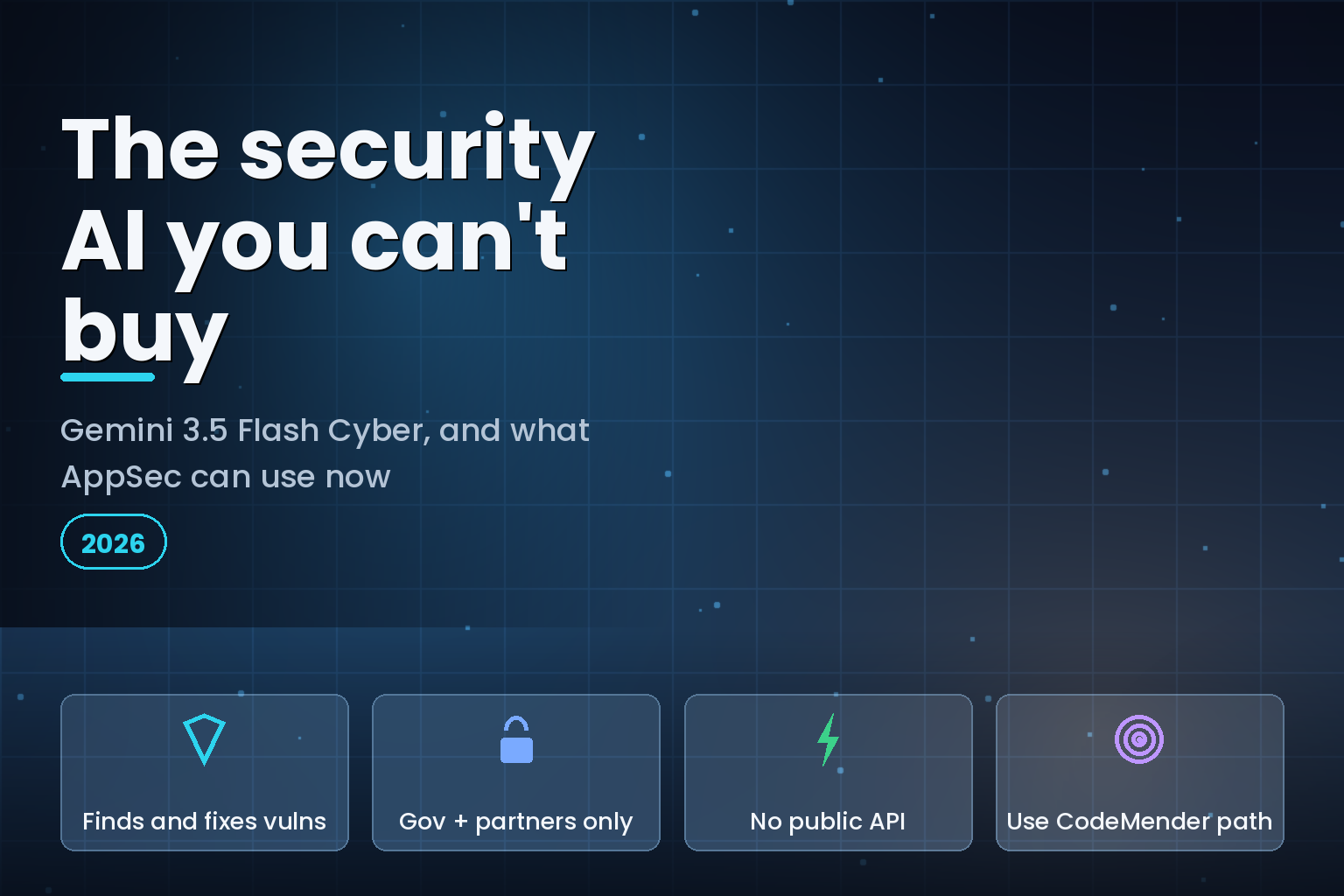
Summary. On July 21, 2026, Google DeepMind introduced Gemini 3.5 Flash Cyber, a lightweight model fine-tuned to find, validate, and patch software vulnerabilities. On a test against the V8 JavaScript engine, it found 55 unique confirmed issues, about 53% more than Anthropic's Claude Opus 4.6 at 36 and ahead of mainline Gemini 3.5 Flash at 47, including 10 that neither of the other two caught. Then Google did something unusual: it did not sell it. Flash Cyber ships only to governments and trusted partners through the CodeMender agent, with no public API and no pricing. For defenders, the stakes are concrete. An unpatched flaw that leads to a breach can draw penalties up to Rs 250 crore under India's DPDP Rules 2025. This piece explains what the gated launch signals, and the CodeMender path enterprises can actually use in 2026.
If you run application security, the interesting news here is not that an AI model found bugs. Models have been doing that for two years. The news is the deployment decision. Google built a security model that beat a frontier general model at finding real vulnerabilities, then restricted it, citing the dual-use problem: the same capability that helps a defender patch faster helps an attacker exploit faster. That decision, and what it leaves available to ordinary enterprises, is the story worth your time.
What Google shipped, and the twist
Gemini 3.5 Flash Cyber is built on top of Gemini 3.5 Flash and fine-tuned for three tasks: finding vulnerabilities, validating them, and patching them. Google's argument for a small model is counter-intuitive but sound. Finding deep flaws means exploring an enormous execution search space, and one expensive call to a giant model is a bottleneck. A fast, cheap model can be invoked many times, so an agent scans far more code paths and then produces a single, high-quality report. Speed and low cost are what let it slot into frequent scans, launch gates, and commit-scanning pipelines.
The twist is distribution. The authors of Google DeepMind's announcement, Raluca Ada Popa and Four Flynn, wrote that "given the dual-use nature of this technology, we have taken an intentional approach to how we deploy 3.5 Flash Cyber." In practice that means a limited-access pilot: the model is available only to governments and trusted partners, delivered through CodeMender, and expanding over time. There is no public endpoint and no published price. You cannot put it on a purchase order.
That is a deliberate break from how frontier models usually ship, which is broadly and fast. It also lands in a specific context. Google released two other models the same day, Gemini 3.6 Flash and 3.5 Flash-Lite, both generally available. If you are weighing the mainline options for agent work, our note on Gemini 3.6 Flash token efficiency and agent cost covers those. Flash Cyber is the one you cannot have.
The benchmark that has AppSec talking
Google published results across several evaluations. The headline number is the V8 engine test, but the pattern across benchmarks matters more than any single figure.
| Test or dimension | Gemini 3.5 Flash Cyber | Comparison point | Source |
|---|---|---|---|
| V8 engine unique confirmed issues | 55 | 47 for mainline 3.5 Flash, 36 for Claude Opus 4.6 | Google DeepMind |
| Issues the others missed | 10 | not caught by 3.5 Flash or Opus 4.6 | Google DeepMind |
| CyberGym (real-world vulnerabilities) | Competitive with much larger models | CodeMender calls it up to 5 times per report | Google DeepMind |
| Big Sleep evaluation (Chrome, Safari) | Significantly surpassed mainline Flash | 3.5 Flash and 3.6 Flash | Google DeepMind |
| Chrome production commit pipeline | Significant uplift | Contamination-free, undisclosed bugs | Google DeepMind |
| Google Cloud red-team run | RCE plus a memory-corruption flaw in 2 hours | reliable exploit bypassing ASLR and W^X | Google DeepMind |
Two things stand out for a practitioner. First, the value is not raw score but unique coverage: a weaker security model gets stuck rediscovering the same issue, while Flash Cyber cast a wider net and found flaws the others structurally missed. Second, and quietly important, Google noted that model versions released after Claude Opus 4.6 refuse these tasks because of built-in safety guardrails, so they do not appear in the charts at all. The best general models are increasingly declining to hunt exploits, which is exactly why a purpose-built, access-controlled model exists.
Reading the benchmark honestly
A vendor's own benchmark deserves a skeptical read, and Google's disclosures make that possible. Google noted that the competitor results are drawn from providers' self-reported scores, so the comparison is not a fully controlled head-to-head. A lab running Claude Opus 4.6 with its own harness and prompt scaffolding might post a different number, so treat the 55-to-36 gap as directional rather than precise.
Two design choices make the results harder to dismiss. The Chrome production commit-scanning test used vulnerabilities that were not publicly disclosed, which keeps the benchmark free of training-data contamination for both Gemini and competitor models. That matters, because a model can look strong on public benchmarks simply by having seen the answers during training. A contamination-free test on live, undisclosed bugs is much closer to the job an AppSec team actually needs done.
The second is the unique-issue framing. Google's stronger claim is not that Flash Cyber scores higher but that it finds different bugs. Weaker security models loop on the same finding while missing others, so the 10 issues Flash Cyber caught that the other two models did not is the real signal. For a defender, coverage of distinct, genuine flaws is worth more than a leaderboard position. Read the numbers as evidence that a small, specialized model can rival a large general one at this narrow task, not as a precise ranking you could reproduce on your own codebase without Google's harness and training data.
Why Google gated it: the dual-use problem is not hypothetical
The clearest evidence for the restriction is Google's own red-team result. Its Cloud Vulnerability Research team pointed Flash Cyber at internal systems and, in about 2 hours, uncovered remote code execution vulnerabilities in public APIs and a memory-corruption flaw in a sensitive production service. It then generated a fully reliable exploit that bypassed standard mitigations including Address Space Layout Randomization (ASLR) and Write XOR Execute (W^X).
Read that as a defender and it is a gift: your own team finds and fixes an exploitable bug in an afternoon. Read it as a CISO thinking about the threat model and it is the reason for the gate: the same two-hour workflow, in the wrong hands, produces a working exploit against a live service. Google is already running Flash Cyber inside CodeMender across Chrome, Android, Cloud, Ads, and YouTube, and early testers include Wiz and Google's own Cloud CISO security engineering group. The capability is real, which is precisely why broad release would hand attackers a scaled advantage. This is the same asymmetry we described in our analysis of AI-assisted cyberattacks and enterprise defense: the tooling that compresses a defender's week compresses an attacker's week too.
What you can actually use in 2026
Here is the part that matters for planning, because "you cannot buy the model" is not the same as "there is nothing for you." Google split the release deliberately.
| Capability | Status for a typical enterprise | Notes |
|---|---|---|
| Gemini 3.5 Flash Cyber, direct access | Not available | Governments and trusted partners only, via CodeMender, no public API |
| CodeMender agent capabilities | Available | Foundational capabilities are coming to customers through the Gemini Enterprise Agent Platform on generally available Gemini models |
| Mainline Gemini 3.5 and 3.6 Flash | Generally available | Usable for security tasks, but measurably weaker than Flash Cyber |
| OSV.dev vulnerability database | Public | Google-run database spanning more than 700,000 open-source vulnerabilities |
| OSS-Fuzz results | Public | More than 10 years of fuzzing findings across open-source projects |
The practical route is CodeMender through the Gemini Enterprise Agent Platform. CodeMender is Google's code-security agent that finds and fixes vulnerabilities. It reasons about code with debuggers, static analysis, and code browsers, produces a proof-of-concept in an isolated customer-managed sandbox to confirm exploitability, then generates a tested patch as a diff for developer review. It had already patched dozens of flaws before Flash Cyber, keeps a human in the loop for final approval, and runs in CI/CD or locally through a command-line interface. Enterprises on Google Cloud get the foundational version powered by generally available Gemini models, not the gated Flash Cyber, but the workflow is the same one Google runs internally.
For teams not on Google Cloud, the honest answer is that you keep your existing static and dynamic analysis in the pipeline, use mainline models where they help, and treat this launch as a signal rather than a product you deploy this quarter. The AI-agent security patterns we cover in hardening MCP servers against CVEs and the patch-velocity discipline in the SharePoint RCE enterprise patch guide are the durable moves regardless of which model you can access.
What this signals for AppSec strategy
Three implications follow, and none of them depend on getting your hands on Flash Cyber.
First, patch velocity is now the game. When an AI can find an exploitable bug in a couple of hours, the window between discovery and exploitation shrinks toward zero. The teams that win are not the ones with the cleverest scanner but the ones that can review, test, and ship a fix fastest. Commit-scanning at pull-request time, not quarterly pen tests, is where AI vulnerability discovery pays off.
Second, expect the defender-side tooling you can buy to be one notch below the frontier by design. Vendors will keep the most offensive-leaning capabilities behind access controls, and the best general models will keep refusing exploit-generation tasks on safety grounds. Plan around GA models plus agent orchestration, not around a single super-model you can call.
Third, the sandbox and human-in-the-loop matter as much as the model. CodeMender's design, isolated proof-of-concept generation and mandatory developer approval before a commit, is the template. Any AI-assisted remediation you adopt should validate exploitability in a contained environment and never auto-merge a security patch without review.
India-specific considerations: patch velocity meets the breach clock
For Indian security teams, this launch collides with a tightening regulatory calendar. Under the DPDP Rules 2025, notified by MeitY on November 13, 2025, breach-notification obligations phase in through 2027, and non-compliance can draw penalties up to Rs 250 crore. A vulnerability that becomes a breach is now a reportable, potentially expensive event, which raises the value of finding and fixing flaws before an attacker does.
Enterprises on Google Cloud in India can access the CodeMender workflow through the Gemini Enterprise Agent Platform on generally available models, keeping code review and patch generation inside their existing cloud governance. The practical program is unglamorous: wire vulnerability scanning into the commit pipeline, shorten the review-to-fix loop, and map the whole flow to your DPDP breach-response plan so that discovery, remediation, and notification are one process rather than three. Teams building that plan can start from our DPDP engineering playbook for Indian startups.
An action framework for the next quarter
Match the move to your situation rather than chasing the model you cannot buy.
| If you are | Do this now | Because |
|---|---|---|
| On Google Cloud | Pilot CodeMender via the Gemini Enterprise Agent Platform | The foundational capability is generally available |
| Not on Google Cloud | Keep SAST and DAST in CI, use mainline models to triage | Flash Cyber is gated and has no API |
| A regulated Indian firm | Tie AI-assisted fixing to your DPDP breach plan | The notification clock rewards fast remediation |
| Any AppSec team | Move scanning to commit time and cut review-to-fix time | AI shrinks the discovery-to-exploit window |
| Security leadership | Track how vendors gate offensive-leaning tools | Access control is now part of the product, not an afterthought |
The uncomfortable truth in this launch is that the security-model frontier is moving behind a velvet rope. That is defensible, and probably wise, but it means your advantage will come from process, not from owning the single best model. Fast, disciplined remediation beats a clever scanner you cannot deploy.
FAQ
How eCorpIT can help
eCorpIT is a Gurugram-based technology consultancy, founded in 2021 and certified for CMMI Level 5, ISO 27001:2022, and MSME, that helps engineering teams put AI-assisted security into their real pipelines rather than their slide decks. We wire vulnerability scanning into commit and pull-request workflows, set up sandboxed validation and human-approved remediation, and design applications aligned with DPDP breach-response requirements so discovery and notification are one process. If your team wants to move on this, our secure AI-assisted development service can help you build it. Start a conversation at /contact-us/.
References
- Introducing Gemini 3.5 Flash Cyber — Google DeepMind, July 21, 2026.
- Introducing CodeMender: an AI agent for code security — Google DeepMind.
- Find and fix software vulnerabilities with CodeMender — Google Cloud.
- Google launches Gemini 3.5 Flash Cyber to find and fix software vulnerabilities — The Hacker News, July 2026.
- Google is launching three new AI models, including a security tool to rival Anthropic — Quartz, July 21, 2026.
- Google released Gemini 3.5 Flash Cyber AI, a specialized model for vulnerability hunting — Security Affairs, July 2026.
- Google releases three new Gemini models, but no 3.5 Pro — TechCrunch, July 21, 2026.
- Google Big Sleep agent — Google Cloud.
- OSV.dev open-source vulnerability database — Google, accessed July 2026.
- OSS-Fuzz — Google, accessed July 2026.
- Google launches CodeMender AI agent to find, validate, and patch vulnerabilities — Cyber Security News.
- Digital Personal Data Protection Rules, 2025 — overview and timeline, accessed July 2026.
_Last updated: July 31, 2026._