On this page · 10 sections
- Where enterprise AI actually stalls
- Lesson 1: Treat the POC-to-production gap as the real project
- Lesson 2: Buy the model, build the system around it, keep it swappable
- Lesson 3: Evals are the product, not an add-on
- Lesson 4: Agent security is a Tier-1 problem, so design for prompt injection
- Lesson 5: Data foundations and governance decide ROI, especially under DPDP
- India-specific considerations
- How eCorpIT can help
- FAQ
- References
Summary. Roughly 95% of enterprise generative AI pilots delivered no measurable return in 2025, according to MIT's Project NANDA study of 300 deployments published in August 2025. Gartner put a matching number on the other end of the funnel: at least 30% of generative AI projects are abandoned after proof of concept, and its single deployments run $5 million to $20 million. By April 2026 Gartner reported that most AI projects still stall before meaningful ROI, and it expects 40% of agentic AI projects to be cancelled by the end of 2027. Production deployment still trails experimentation across the industry. These five lessons come from eCorpIT's delivery work through 2026, and each one maps to a specific point where builds break between a demo and a system people trust.
The pattern behind the numbers is consistent. The model is rarely the problem. The gap sits in data, evaluation, security, and the operational plumbing that a proof of concept skips and production cannot. Rita Sallam, Distinguished VP Analyst at Gartner, framed it plainly in July 2024: "After last year's hype, executives are impatient to see returns on GenAI investments, yet organizations are struggling to prove and realize value. As the scope of initiatives widen, the financial burden of developing and deploying GenAI models is increasingly felt."
eCorpIT is a Gurugram technology consultancy founded in 2021, and our senior engineering teams have shipped AI features into enterprise systems across retail, healthcare, and financial workflows. What follows is not a maturity model. It is the short list of decisions that decided whether a build reached users or joined the 95% that quietly stalled.
Where enterprise AI actually stalls
Before the lessons, it helps to see the failure points as stages rather than one cliff. Most projects die at a predictable handoff.
| Stage | What breaks | Sourced signal (2025 to 2026) |
|---|---|---|
| Pilot to production | Demo works, but no data contract or monitoring exists | 30% abandoned after POC (Gartner, July 2024) |
| Value proof | No measurable P&L impact after launch | 95% of pilots show no return (MIT Project NANDA, Aug 2025) |
| Agent rollout | Autonomy added before controls | 40% of agentic projects to be cancelled by 2027 (Gartner) |
| Security review | Prompt injection and over-broad tool access | Injection is OWASP's top LLM risk in 2026 |
| Data and governance | Weak data foundation, unclear consent basis | Data quality is the top-cited blocker (Deloitte, 2026) |
The lessons below attack these stages in order.
Lesson 1: Treat the POC-to-production gap as the real project
A proof of concept proves the model can do the task once, on clean input, with a human watching. Production means it does the task ten thousand times a day, on messy input, with nobody watching. Those are different engineering problems, and the second one is where the money goes.
Gartner's data makes the gap concrete. At least 30% of generative AI projects are abandoned after the proof of concept, and full deployments cost between $5 million and $20 million depending on approach, according to its July 2024 analysis. By April 2026 the firm reported that infrastructure and operations AI projects continue to stall before returns arrive. MIT's Project NANDA study, covered by Fortune in August 2025, found that despite $30 billion to $40 billion in enterprise spending, 95% of organisations saw no business return, and only 5% of pilots extracted real value.
The expensive part is almost never the model. It is the data contract, the eval harness, and the rollback plan. Our rule is to scope a build for production from the first sprint: define the input schema, the failure behaviour, and how a bad answer gets caught, before anyone celebrates the demo. A pilot that cannot describe its own monitoring is not close to done. It is at the start. Teams weighing an AI partner should read our note on AI agent use cases that reached production in 2026 for the same argument applied to agents.
Lesson 2: Buy the model, build the system around it, keep it swappable
The MIT NANDA research found a split that should shape every build plan. Buying models and capabilities from specialised vendors and building on partnerships succeeded about 67% of the time, while internal-only builds succeeded roughly a third as often. The lesson is not "never build." It is "do not rebuild the frontier model." The value your team adds is the system around the model: the data pipeline, the retrieval layer, the guardrails, and the product surface.
Price movement reinforces this. Frontier API prices fell sharply from 2025 to 2026 as competition intensified, and list prices now vary by more than an order of magnitude across vendors.
| Model | Input, USD per 1M tokens | Output, USD per 1M tokens |
|---|---|---|
| Claude Haiku | 0.25 | 1.25 |
| Claude Sonnet | 3.00 | 15.00 |
| Claude Opus | 5.00 | 25.00 |
| GPT-5 class | 2.50 | 15.00 |
| Gemini Flash-Lite | 0.10 | 0.40 |
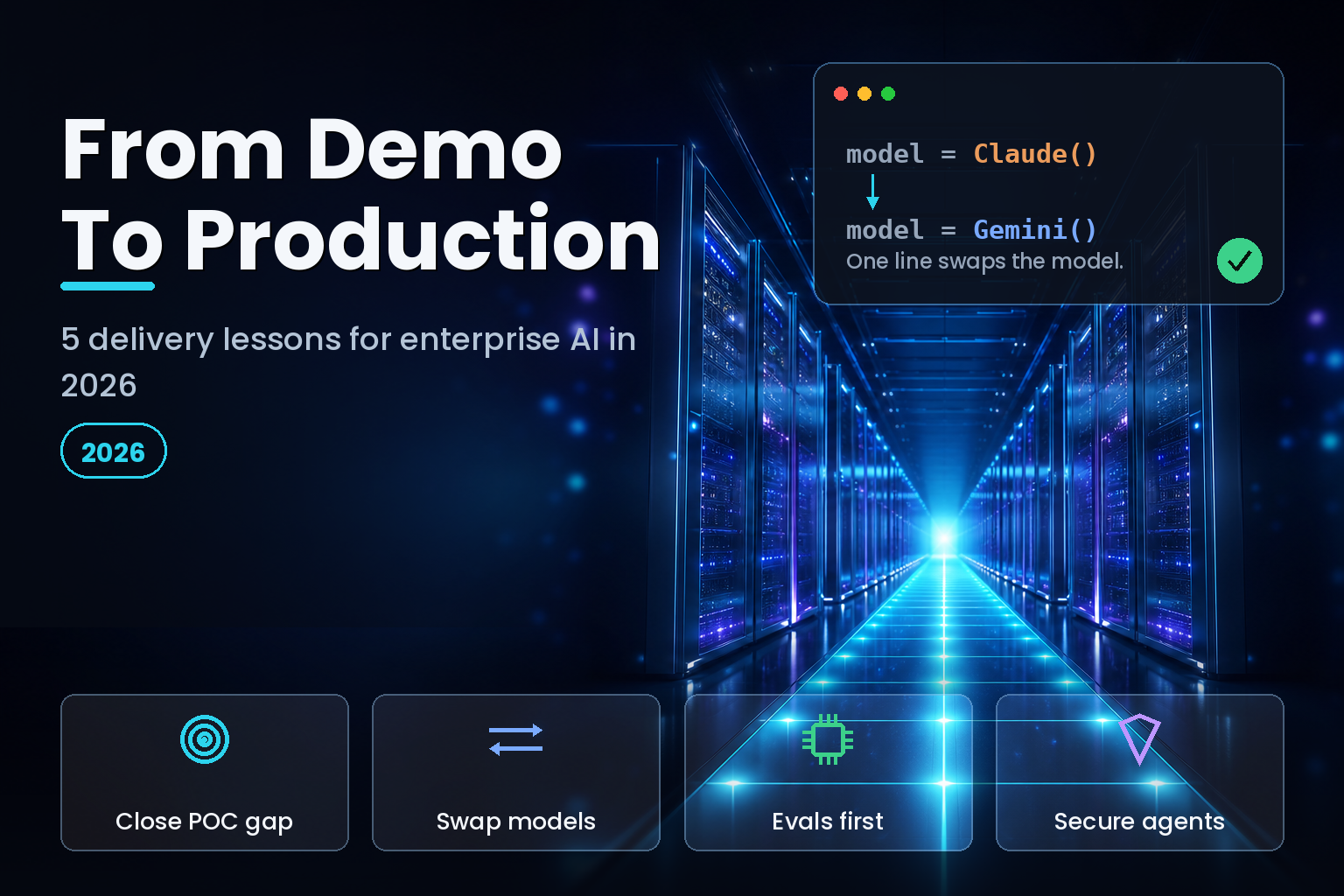
List prices compiled from pricepertoken.com and CloudZero, as of June 2026; verify current rates with each vendor before you commit. When a cheaper model of equal quality appears every few months, the teams that win are the ones who can switch providers by changing one configuration value, not one that hard-wired a single vendor into a hundred call sites. Put the model behind one interface, keep prompts and evals in version control, and treat the provider as a swappable dependency. For the cost-tracking side of this, our guide to AI cost tools that cut LLM spend covers the tooling.
Lesson 3: Evals are the product, not an add-on
Ask a team how they know their AI works and the answer separates the 5% from the 95%. If the answer is "we tried a few prompts and it looked good," the system has no way to detect a regression. Change a prompt, upgrade a model, or edit a retrieval step, and quality can drop with no alarm.
The 2026 standard has moved to eval-driven delivery. Teams keep an offline test set of real inputs with graded expected behaviour, and they run it on every change before shipping. In production they sample traces, score them with automated checks and LLM-as-a-judge evaluators, and keep every trace where a hallucination check fires above threshold or a user gives negative feedback, as described in current LLM observability practice. This is the difference between a system you can improve and one you can only hope about.
The practical order matters. Build the eval set before the feature, not after the incident. An eval set of 100 to 300 graded examples is enough to catch most regressions, and it turns a subjective argument about quality into a number that either went up or down. Without it, every model upgrade is a gamble, and Gartner's June 2026 warning that more than 70% of mainframe-exit projects will fail on overestimated GenAI capability is what happens when teams trust a demo instead of a measurement.
Lesson 4: Agent security is a Tier-1 problem, so design for prompt injection
The moment a system can take actions, not just produce text, its security profile changes. An agent that reads email, queries a database, or calls an API can be steered by whatever text it processes. Prompt injection is the top entry on OWASP's LLM risk list in 2026, and the OWASP GenAI exploit round-up reports it appearing across a large share of production deployments. Help Net Security reported in June 2026 that injection still drives most agentic security failures, and that many organisations run agents without human-in-the-loop review, kill switches, or network isolation.
Indirect injection is the dangerous variant: instructions hidden inside a document, web page, or email that the agent reads and obeys. The defence is architectural, not a single clever prompt. Give each agent the narrowest tool set it needs, require human approval for high-impact actions such as payments or data deletion, filter inputs and outputs, and assume any single layer can fail. We treat write access as a privilege an agent earns for a specific task, not a default. The governance side of this, including approval flows and audit trails, is covered in our enterprise AI agent governance layers piece.
Lesson 5: Data foundations and governance decide ROI, especially under DPDP
Every failure survey lands on the same root cause. Across enterprise AI programmes in 2026, data quality is the most-cited blocker to deployment, and Deloitte's State of AI in the Enterprise work through 2026 shows governance maturity lagging far behind experimentation. A model trained or grounded on inconsistent, poorly labelled, or non-consented data will produce confident, wrong, and sometimes non-compliant output.
For teams operating in India, this now has a hard legal edge. The Digital Personal Data Protection Rules, 2025 were notified on 13 November 2025, and obligations phase in over roughly 18 months, with the Consent Manager framework operational from November 2026 and full compliance expected by mid-2027, per Securiti's DPDP analysis. Penalties reach up to ₹250 crore for failing to maintain reasonable security safeguards. An AI feature that ingests personal data without a clear consent basis is not just a quality risk, it is a liability. Our DPDP consent manager readiness guide walks through the checklist, and the privacy-first AI architecture piece covers the engineering pattern.
The five lessons at a glance
| Lesson | Failure it prevents | First concrete step |
|---|---|---|
| Close the POC-to-production gap | Abandoned pilots (30% per Gartner) | Define input schema, failure behaviour, monitoring in sprint one |
| Keep the model swappable | Vendor lock-in as prices fall | Put the model behind one interface in version control |
| Make evals the product | Silent quality regressions | Build a 100 to 300 example graded eval set first |
| Secure agents as Tier-1 | Prompt injection and data exfiltration | Least-privilege tools, human approval for high-impact actions |
| Fix data and consent first | No ROI, DPDP exposure | Audit data quality and consent basis before grounding |
India-specific considerations
Indian enterprises face the same delivery physics with two added constraints. First, DPDP compliance is now a build requirement, not a later checkbox, and the November 2026 Consent Manager milestone means data flows should be designed for consent capture and withdrawal now. Second, cost discipline matters more when budgets are set in rupees against dollar-denominated API bills. A workload that looks affordable at $3 per million tokens can surprise a team when volume scales, which is why the swappable-model discipline from Lesson 2 pays off fastest here. Grounding AI features on Indian-language and India-specific data also demands local evaluation sets, because a model tuned on English-first benchmarks will miss failure modes that only appear in production with real users.
How eCorpIT can help
eCorpIT designs and ships enterprise AI systems built for production, not demos: data pipelines, evaluation harnesses, agent guardrails, and applications aligned with DPDP requirements. Our senior engineering teams work as an extension of yours, from architecture through deployment and monitoring. If you are weighing an AI build and want a partner who scopes for the 5% that reaches value, contact us to talk through your use case and constraints.
FAQ
References
_Last updated: 2 July 2026._