On this page · 8 sections
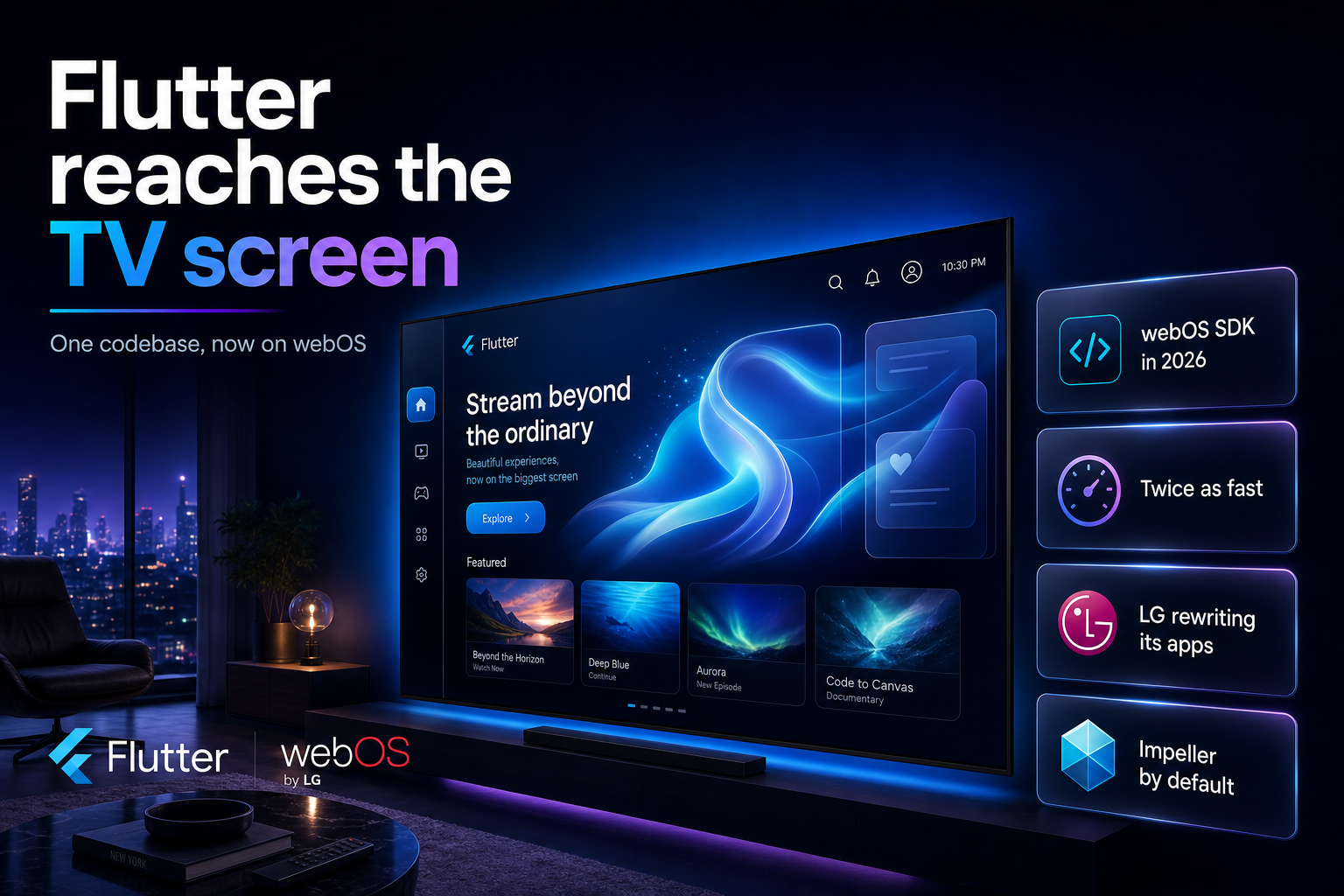
Summary. Flutter, Google's cross-platform UI toolkit, now targets LG webOS smart TVs. Developers can build, package, and run Flutter apps on webOS TV devices through the flutter-webOS SDK, with a public release expected in the first half of 2026. This is not a demo: LG is rewriting its own core webOS TV apps in Flutter, and its Flutter-based electronic program guide launched about twice as fast as the previous version while using less runtime memory. The move lands alongside Flutter 3.44 and Dart 3.12 from Google I/O 2026, which made Impeller Vulkan the default renderer on Android 10 and above and added agentic tooling. For a cross-platform team, the TV becomes a fifth screen from one Dart codebase, after Android, iOS, web, and desktop. This guide covers what the webOS SDK enables, where a TV build fits, and the constraints to plan for.
The pitch for Flutter has always been one codebase, many screens. In 2026 that list credibly includes the living-room TV, and a hardware vendor betting its own apps on it is the strongest signal yet.
What the webOS SDK actually delivers
Flutter for webOS TV lets you compile a Flutter app to run on webOS TV devices, packaged as a native webOS app. The flutter-webOS SDK reached beta with partners including Codemate, featured at Google I/O 2025, and a public SDK release is expected in H1 2026, per Rebel App Studio and the webOS TV developer site. The effort grew out of an experiment LG documented in July 2024, now a shipping direction.
The credibility comes from LG using it on itself. Rather than only enabling third-party Flutter apps, LG is rewriting core webOS TV apps in Flutter, as Easy Flutter and the Flutter show document. The reported EPG rewrite launched roughly twice as fast as its predecessor with lower memory use, which matters on the constrained hardware inside a TV. When a platform owner replaces its own JavaScript apps with your framework, the framework is production-ready on that platform.
Where TV fits in Flutter's platform story
Flutter 3.44 sharpened the whole target matrix. Here is where the platforms stand in 2026.
| Platform | Flutter support in 2026 | Notes |
|---|---|---|
| Android | Impeller Vulkan default on 10+ | Skia removed on Android 10 and above |
| iOS / macOS | Impeller, Swift Package Manager default | SPM now the default |
| Web | WASM, stateful hot reload default | Near-native experience |
| Desktop | Windows, macOS, Linux | Stable |
| LG webOS TV | Public SDK expected H1 2026 | LG rewriting its own apps |
| Apple TV | No official Flutter support | Community efforts only |
Two facts frame the decision. First, webOS is a real, supported target with a vendor behind it, unlike Apple TV, where there is no official Flutter support. Second, the underlying engine matured underneath all of this: on Android 10 and above, the Skia backend is gone and pure Impeller Vulkan is the default, removing shader-compilation jank, per the Flutter 3.44 release notes. A smoother renderer helps most on the big screen, where animation stutter is obvious.
When a webOS TV build is worth it
TV is not a target every app needs. It earns its place for a specific set of products.
Media and streaming apps are the obvious fit: a D2C brand, broadcaster, or OTT service that already has a Flutter mobile app can reach the living-room screen from the same codebase instead of hiring a separate webOS JavaScript team. Content-forward apps, fitness, education, dashboards, and retail catalogs meant to be viewed at a distance also translate well. Transactional, text-heavy, or input-heavy apps translate poorly, because a TV has no touch, no keyboard by default, and a viewer sitting three metres away. If your app's value collapses without fine pointer input, TV is the wrong screen. We compare framework choices in our Jetpack Compose versus Flutter guide and cover the engine shift in our Impeller analysis.
| Result reported | Flutter on webOS | Why it matters |
|---|---|---|
| EPG app launch time | About 2x faster | Faster time to interaction on TV hardware |
| Runtime memory | Reduced versus prior | Critical on embedded devices |
| Public SDK | Expected H1 2026 | Plan pilots around availability |
| LG's own apps | Being rewritten in Flutter | Vendor commitment signal |
The constraints to design for
Building for TV is not just resizing a phone layout. Three constraints dominate. Navigation is remote-first: every interactive element needs a clear focus state and must be reachable with a directional pad, so build and test focus traversal from day one. Layout is ten-foot: type, touch targets, and spacing scale up for a viewer across the room, not a hand at arm's length. And hardware is constrained: a TV SoC has far less headroom than a flagship phone, so the memory and startup wins LG reported are not luxuries but requirements. Profile on real devices early through the webOS TV early-access program, because an emulator hides the performance ceiling that matters most.
India-specific considerations
For Indian product teams, the connected-TV opportunity is large and growing, and Flutter lowers the cost of reaching it. A D2C or OTT brand that built a Flutter app for Android and iOS can extend to LG webOS without standing up a separate TV team, which matters when engineering budgets are tight. The same discipline that governs the mobile app carries over: any personal data the TV app handles still falls under the Digital Personal Data Protection Act, 2023 (DPDP), including viewing data and account details, so consent and data-handling design travel with the code. Reuse the mobile app's data layer and compliance work rather than rebuilding it for the living room. Our Flutter app development guide covers the shared-codebase approach.
FAQ
How eCorpIT can help
eCorpIT (eCorp Information Technologies Private Limited, founded 2021, Gurugram) builds Flutter applications across mobile, web, and now the big screen. Our senior-led teams design shared-codebase apps that extend from Android and iOS to LG webOS TV, adapt navigation and layout for the ten-foot experience, and reuse your data and compliance work so a TV build does not duplicate effort. We align data handling with DPDP Act requirements. To scope a cross-platform or webOS TV project, contact us.
References
_Last updated: July 13, 2026._