On this page · 10 sections
- What "Flutter web with WebAssembly" actually means
- The performance case, and where the numbers come from
- Browser support and the fallback math in 2026
- Turning it on: the build flag and the headers you actually need
- The SEO trade-off nobody should skip
- When Flutter web plus Wasm is the right call
- India-specific considerations
- FAQ
- How eCorpIT can help
- References
Summary. Flutter shipped WebAssembly (Wasm) compilation to its stable channel with Flutter 3.22 and Dart 3.4 at Google I/O in May 2024, and by mid 2026 more than 90% of global browser sessions run the WasmGC standard that the build depends on. The payoff is speed. Kevin Moore, Google's Flutter and Dart product manager, put early gains at "1.5 to, in some cases, 3 times" the performance of the JavaScript build, and later community benchmarks report roughly 41% faster scrolling and up to 2x faster frame rendering. The cost is reach and search. Wasm needs WasmGC (Chrome 119, Firefox 120, Safari 18 and later), and the canvas output is close to invisible to Google's crawler. For a Gurugram or global team paying a mid-level Flutter developer $20 to $30 an hour (about 1,200 to 2,500 rupees), against $100 to $150 in the United States, the build flag is really a product decision. This guide covers the renderers, the browser math, the server headers, and the one trade-off that decides whether Wasm belongs in your stack.
Flutter web has three questions behind it, and teams usually conflate them. The first is whether to use Flutter for the web at all. The second is which renderer draws your pixels. The third, newer question is whether to compile Dart itself to WebAssembly instead of JavaScript. This guide is about the third, because that is where the 2026 gains and the 2026 gotchas both live. If you are still on the first question, our comparison of Jetpack Compose and Flutter and our note on the Impeller renderer becoming mandatory on Android and iOS set the wider context.
What "Flutter web with WebAssembly" actually means
Flutter web offers two build modes and two renderers, and the names get mixed up constantly. The two build modes are the default JavaScript build and the WebAssembly build. The two renderers are canvaskit and skwasm. They are not the same axis.
In the default build mode, Dart compiles to JavaScript, and rendering runs through canvaskit, which is Skia compiled to WebAssembly. That copy of Skia adds about 1.5MB to the download. So even the ordinary Flutter web build already ships some Wasm, just for graphics. What changed in 2024 is that Dart code, and the Flutter framework itself, can now compile to Wasm too.
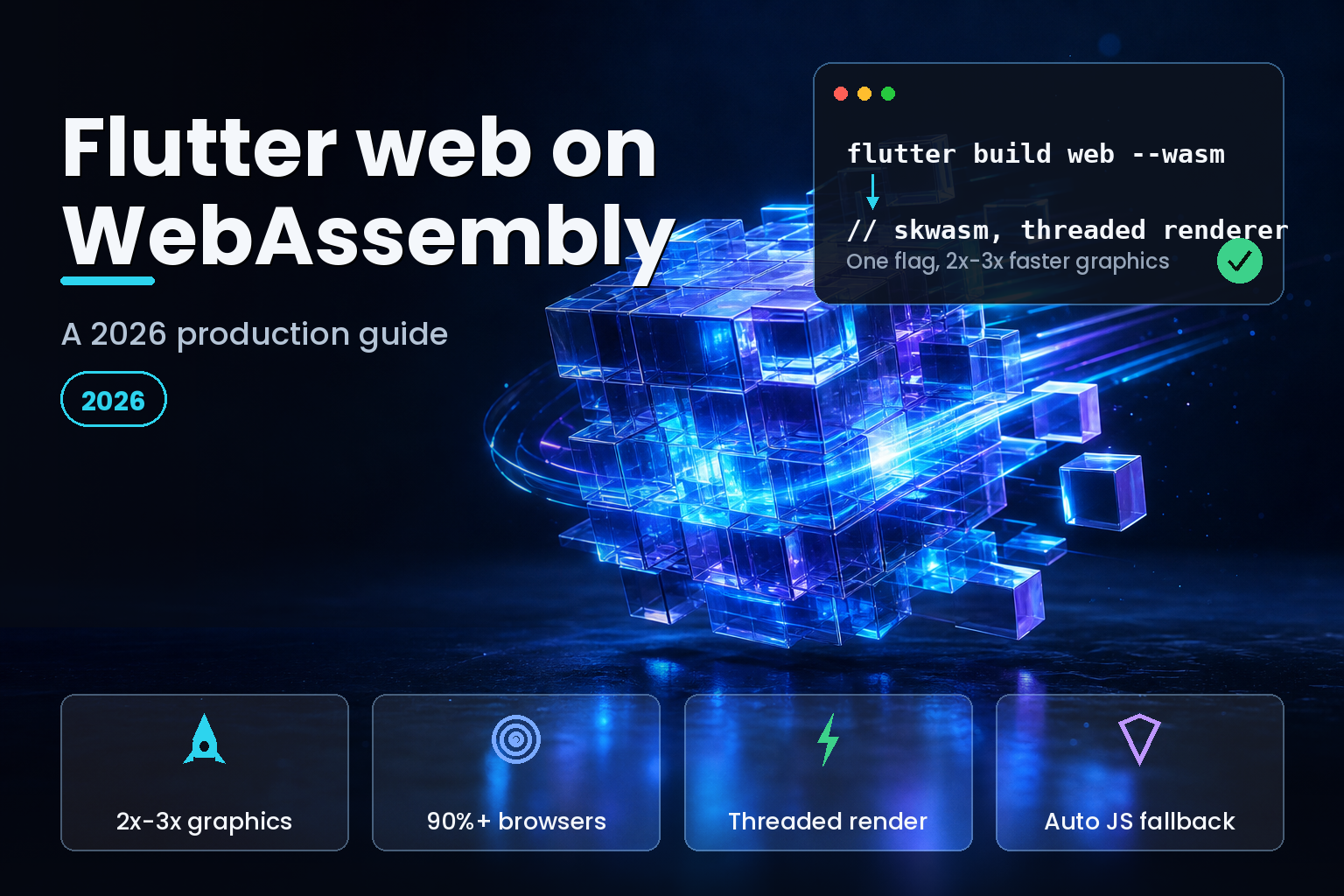
When you build with flutter build web --wasm, the whole application compiles to WebAssembly rather than JavaScript, and Flutter selects the skwasm renderer at runtime. Skwasm is a more compact build of Skia, around 1.1MB, and it can render on a separate thread using web workers when the browser allows SharedArrayBuffer. If the browser cannot run skwasm, Flutter falls back to canvaskit automatically. So the WebAssembly build is not one switch. It is a Dart-to-Wasm compilation, a preference for the threaded skwasm renderer, and a fallback path for older browsers, wired together by the build tool.
The dependency underneath all of this is WasmGC, WebAssembly with garbage collection. Dart is a managed, garbage-collected language, so it cannot target plain Wasm efficiently. The Chrome team worked with the Dart team to define WasmGC, which is now a finalized standard with runtime support in Chromium 119 and Firefox 120 and later. Without WasmGC in the browser, the Wasm build does not run, which is why the fallback matters.
The performance case, and where the numbers come from
The reason to bother is frame time and start-up. WebAssembly skips the JavaScript engine's parse-and-warm-up cost and gives more predictable execution, which shows up most in compute-heavy screens and long scrolls.
Kevin Moore, Google's Flutter and Dart product manager, framed the early results at Wasm I/O in Barcelona in 2023: the team was "seeing 1.5 to, in some cases, 3 times" the performance of compilation to JavaScript, and he was careful to call that "very limited benchmarking" at the time. The honesty in that quote is the useful part. The gain is real but workload-dependent, not a flat multiplier you can promise a client.
Independent write-ups since then land in the same range. One 2026 developer benchmark of the Wasm build measured about 41% faster performance on average while scrolling, up to 2x faster frame rendering, and up to 3x improvement on the 99th-percentile worst case, compared with the JavaScript build. Treat these as directional. The right way to read them is that graphics-heavy and animation-heavy Flutter web apps get the biggest lift, and simple content pages get almost none.
| Dimension | JavaScript build (canvaskit) | WebAssembly build (skwasm) |
|---|---|---|
| Dart compilation target | JavaScript | WebAssembly (WasmGC) |
| Default renderer | canvaskit (about 1.5MB) | skwasm (about 1.1MB) |
| Multi-threaded rendering | No | Yes, with SharedArrayBuffer |
| Reported graphics speed-up | Baseline | About 2x to 3x in graphics benchmarks |
| Browser requirement | All modern browsers | WasmGC (Chrome 119, Firefox 120, Safari 18) |
| Fallback | Not needed | Falls back to JavaScript build |
Browser support and the fallback math in 2026
WasmGC support decides who gets the fast path. As of 2026, more than 90% of global browser usage supports it, but the distribution matters for your specific audience.
| Browser | WasmGC support | Notes for the Wasm build |
|---|---|---|
| Chrome / Chromium | Version 119 and later | First to ship WasmGC; broadest support |
| Firefox | Version 120 and later | Full support alongside Chromium |
| Edge | Version 119 and later | Chromium-based, tracks Chrome |
| Safari (macOS) | Version 18 and later | Added WasmGC; an early bug blocked Flutter's Wasm renderer |
| Browsers on iOS | Via WebKit only | All iOS browsers use WebKit, so behaviour follows Safari |
Two caveats deserve emphasis because they trip up production launches. First, Safari added WasmGC in Safari 18, but a Safari bug initially blocked compatibility with Flutter's Wasm renderer, so real-world Safari behaviour lagged the version number for a while. Track the open Flutter issue on WasmGC and Safari before you promise Wasm to a Safari-heavy audience. Second, every browser on iOS is required to use WebKit, so "Chrome on iPhone" is Safari underneath. The upside is that Flutter's tooling handles this for you: build with --wasm, and the loader serves the WebAssembly version to browsers that support WasmGC and the JavaScript version to those that do not. You ship one build; users get the best path their browser allows.
Turning it on: the build flag and the headers you actually need
The compile step is one line:
flutter build web --wasm
That produces a build that prefers skwasm and falls back to canvaskit and JavaScript. The part teams miss is that the fast, multi-threaded skwasm path needs SharedArrayBuffer, and SharedArrayBuffer needs your page to be cross-origin isolated. That is a server configuration, not a Flutter setting.
Cross-origin isolation requires two response headers on the document: Cross-Origin-Opener-Policy: same-origin and Cross-Origin-Embedder-Policy: require-corp. Every cross-origin resource the page loads then has to carry CORP or CORS headers, or the browser blocks it. If require-corp is too strict for third-party assets, credentialless is a looser COEP value that strips credentials from cross-origin requests instead of blocking them.
            # Serve the Flutter web build cross-origin isolated so skwasm can use threads
add_header Cross-Origin-Opener-Policy "same-origin";
add_header Cross-Origin-Embedder-Policy "require-corp";
If you cannot control server headers, for example on some static hosts, you can set the same headers from a service worker, which the browser honours for isolation. Skip this step and the app still works, but skwasm runs single-threaded and you leave part of the performance gain on the table. This is the most common reason a team reports "Wasm did nothing for us": the build was Wasm, but the headers were missing, so threading never turned on.
One more migration note. The move to Wasm went along with a cleaner Dart-JavaScript interop model. package:web replaces the old dart:html, and dart:js_interop replaces package:js. If your web code still imports dart:html, budget time to migrate it before you expect a clean Wasm build.
The SEO trade-off nobody should skip
Here is the decision that overrides the benchmarks. Flutter web, in both canvaskit and skwasm modes, paints your interface into a canvas. To a person, that looks like a normal website. To Googlebot and other crawlers, the text is pixels inside a WebGL context, not HTML text nodes with headings and links. The DOM they need is mostly not there.
The practical result: Flutter web is a weak choice for anything where organic search is a top metric. Long-form articles, multi-language content, and the structured data an SEO team optimizes do not translate to a canvas rendering model, and while Googlebot can run JavaScript, indexing of canvas apps stays inconsistent. If search traffic is the business, this is close to disqualifying, and no amount of Wasm speed fixes it.
The workaround that ships is architectural, not a flag. Keep your crawlable, content-first surfaces, the marketing site, blog, and documentation, on ordinary HTML from a static site generator or CMS, and deep-link into the Flutter app for the authenticated, app-like flows. Our ultimate guide to SEO in 2026 and the breakdown of AEO, GEO, and SEO cover how to structure those public pages so they earn rankings and AI citations, work the Flutter canvas cannot do for you.
When Flutter web plus Wasm is the right call
Match the build to the surface, not to the hype. Flutter web with Wasm is strongest for app-like experiences where shared code and frame performance beat crawlability.
| Surface | Recommended approach | Why |
|---|---|---|
| Internal dashboard or admin tool | Flutter web with --wasm |
No SEO need; heavy UI and charts gain from threading |
| SaaS product behind login | Flutter web with --wasm |
App-like, shared codebase with mobile, search irrelevant |
| Data-heavy PWA | Flutter web with --wasm |
Compute and animation benefit most from Wasm |
| Marketing site or blog | HTML from a CMS or SSG | Canvas rendering blocks indexing; search is the KPI |
| Documentation portal | HTML, not Flutter | Crawlability and deep-linkable text matter more than shared UI |
| Mixed product plus marketing | HTML shell, deep-link into Flutter app | Get rankings on public pages, app performance behind auth |
This table is the whole argument in one place. If a route needs to rank, keep it HTML. If a route needs to feel like an app and reuse your mobile widgets, Wasm is a real upgrade over the JavaScript build. Teams choosing between Flutter and other cross-platform stacks for these decisions may also find our comparison of Expo and React Native useful for the mobile side of the same codebase.
India-specific considerations
For teams building from India, the economics sharpen the choice. A mid-level Flutter developer bills roughly $20 to $30 an hour (about 1,200 to 2,500 rupees), and a senior around $50 to $60, against $100 to $150 for comparable skills in the United States. Full-cycle Flutter projects from Indian agencies commonly run a blended 2,000 to 5,000 rupees an hour. A single Flutter codebase that serves Android, iOS, and an app-like web target stretches that budget further than maintaining three separate front ends, which is the strongest business reason to use Flutter web at all.
Data protection does not change with the renderer. If your Flutter web app collects personal data from users in India, the Digital Personal Data Protection Act 2023 (DPDP) applies the same way it would to a JavaScript or native front end. Client-side Wasm keeps processing in the browser for some workloads, which can reduce what you transmit, but it does not remove consent, purpose-limitation, or breach-notification duties. Design the consent and data flows the same way you would for any production web app.
The talent point cuts both ways. Flutter and Dart skills are widely available in the Indian market, but deep WebAssembly, cross-origin isolation, and web performance experience is rarer. The gap that slows most Wasm launches is not writing Dart; it is the server headers, the Safari testing, and the SEO architecture around the app. Budget for that reviewer, whether in-house or a partner.
FAQ
How eCorpIT can help
eCorpIT is a CMMI Level 5, Gurugram-based engineering organisation that ships Flutter across mobile and web with senior-led teams. We help you make the build-mode call route by route, wire up cross-origin isolation and the fallback path correctly, and keep your public, search-facing pages on a crawlable HTML stack so a Wasm app never costs you rankings. If you are planning a Flutter web build or debugging one that underperformed, talk to our team and we will map the fastest safe path for your product.
References
_Last updated: 7 July 2026._