On this page · 10 sections
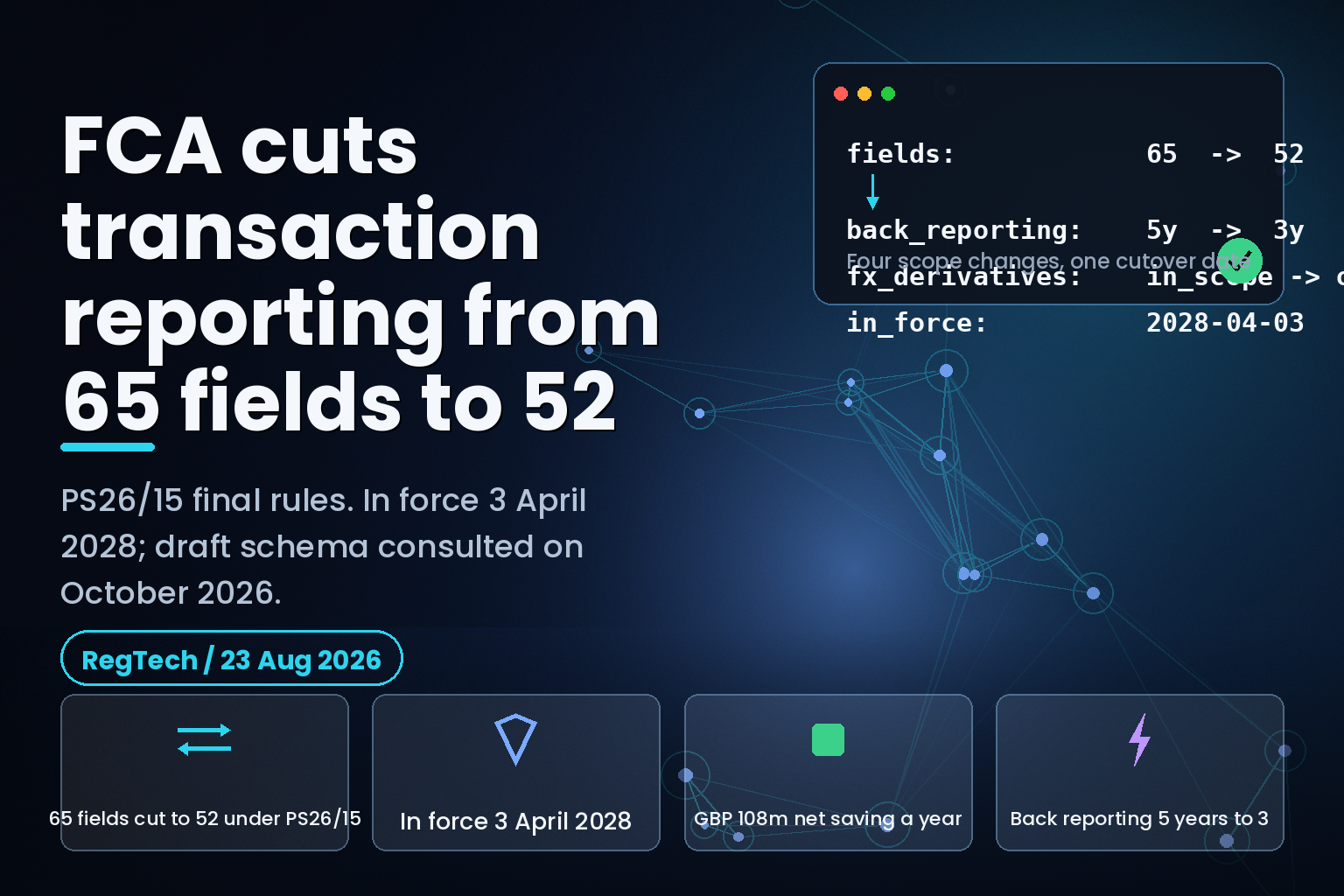
Summary. The Financial Conduct Authority published PS26/15 with final rules that cut UK MiFIR transaction reporting from 65 fields to 52, take foreign exchange derivatives out of scope for more than 400 UK firms, and drop roughly 7 million EU-venue-only instruments from the reporting perimeter. The FCA puts the current annual industry cost of MiFID transaction reporting at £493m, falling to about £385m — a net saving of £108m a year, of which about £32m comes from the EU-instrument removal alone. The new regime comes into force on 3 April 2028. A flexible supervisory approach runs from 3 August 2026 until that date. The draft schema, validation rules and guidelines do not exist yet: they go out for consultation in October 2026. So firms have been told to start planning against a 52-field specification that has not been published, while the 5-year back reporting window they use to fix historical errors is being cut to 3.
What actually changed
The Markets in Financial Instruments Regulation transaction reporting rules were implemented in 2018. The Treasury has committed to repealing and replacing them with rules in the FCA Handbook, and PS26/15 is the FCA's final position on what those rules contain. The policy statement lists four substantive changes.
| Change | Before | After | Effect the FCA quantified |
|---|---|---|---|
| Report fields | 65 | 52 | 13 fields removed from every report |
| FX derivatives | In scope | Out of scope | Cost reduction for over 400 UK firms |
| EU-venue-only instruments | Reportable | Not reportable | ~7 million instruments; ~£32m saved a year |
| Default back reporting period | 5 years | 3 years | Resubmitted reports fall by a third |
Therese Chambers, joint executive director of enforcement and market oversight at the FCA, framed it as relief rather than retreat: "By taking a smarter, streamlined approach to reporting, we're giving firms meaningful cost relief while ensuring we continue to receive the accurate, high-quality data that keeps UK markets clean and competitive."
The £108m figure is a net number. The FCA's own arithmetic in the press release is £493m today against approximately £385m after. That is the steady-state running cost. It does not include the cost of getting there, and the FCA has not published a build estimate.
The three dates, and why the middle one is awkward
Most coverage will report one date. There are three, and they do not line up.
| Date | What it is | What a firm can actually do |
|---|---|---|
| 3 August 2026 | Flexible supervisory approach begins | Move early on some areas, at your own risk assessment |
| October 2026 | Consultation on draft schema, validation rules, guidelines, transitional provisions | Read the spec for the first time |
| 3 April 2028 | New regime in force | Mandatory cutover |
The awkwardness sits in the gap between the first two. The FCA's flexible supervisory approach has been running since 3 August 2026, and the policy statement tells firms to "begin planning now" — specifically to consider the scope and field changes and to prepare for "the revised schema, validation rules and guidance." That guidance does not exist. It is the subject of the October 2026 consultation, which will also cover transitional provisions and consequential Handbook amendments.
For an engineering team this is a familiar and unpleasant shape: a firm commitment on the business outcome, a fixed compliance deadline 19 months after the spec is even consulted on, and an interim period where going early is permitted but unspecified. Anything you build between now and the October consultation is built against the policy intent, not the field list. Field 41 of 52 does not have a number yet.
The change most likely to hurt: 5 years to 3
Three of the four changes reduce work. The fourth reduces your remediation window, and it is the one to model first.
Under the current regime the FCA's transaction reporting guidance is explicit: "The trade date within a transaction report cannot be earlier than 5 years before the submission date. As such, from 3 January 2023 onwards, transaction reports submitted with a trade date of more than 5 years ago will not be accepted." That is the hard stop the Market Data Processor enforces today. PS26/15 cuts the default back reporting period to 3 years, which the FCA expects to reduce resubmitted reports by a third.
Read that from the firm's side rather than the regulator's. A reporting defect you discover in 2027 that dates to 2023 is, under today's rules, something you back-report. Under a 3-year default it may fall outside the window entirely. Fewer resubmissions is a cost saving for the FCA's processing and for your ARM bill. It is also a permanent gap in the audit trail, and it does not remove the obligation to notify.
That obligation is separate and unchanged in the current text. The FCA's guidance states that errors and omissions notifications "should continue to contain details of when the error or omission first occurred and the number of transaction reports impacted, even if this extends beyond 5 years. Firms should then indicate how many of the impacted transaction reports will be back reported." Notification scope and back-reporting scope have never been the same thing. Shortening one does not shorten the other, and a firm that reads the £108m headline as "less to disclose" has misread it.
If your firm has a known back-reporting backlog, the sequencing question is concrete: is it cheaper to clear it under a 5-year window before 3 April 2028, or to let part of it age out and carry the notification? That is a decision with a date on it, and it is the reason to open PS26/15 now rather than in 2027.
How to tell whether this is you
The FCA's scope test has not changed. Transaction reports are required under Article 26 of UK MiFIR, supplemented by RTS 22. The firms in scope, per the FCA's own list:
- UK MiFID investment firms, excluding collective portfolio management investment firms
- Operators of a trading venue — recognised investment exchanges, MTFs and OTFs
- UK branches of third-country investment firms
- Small authorised UK AIFMs holding MiFID permissions
For principal firms with appointed representatives, the reporting obligation sits with the principal for any reportable activity the AR conducts. Under Article 26(7) of UK MiFIR only three parties may submit: the investment firm reporting directly to the FCA's Market Data Processor, an Approved Reporting Mechanism acting on the firm's behalf, or a trading venue submitting for entities executing through its systems.
That third column matters for the 2028 project plan. If you report through an ARM or a venue, your cutover is not yours alone — it is gated on their schema readiness, and the October 2026 consultation is the first point at which any of the three parties can size the work.
| Reporting route | Who builds to the 52-field schema | Your dependency on 3 April 2028 |
|---|---|---|
| Direct to the FCA Market Data Processor | Your firm | Your own release calendar |
| Approved Reporting Mechanism | The ARM, plus your feed into it | ARM's delivery date, contractually |
| Trading venue submits on your behalf | The venue | Venue's delivery date; least control |
The reconciliation problem the FCA already flagged
There is a second, quieter reason to treat this as an engineering project rather than a compliance memo. In Market Watch 74 the FCA reported that it had "identified and contacted certain firms who have not been making regular data extract requests" from the Market Data Processor Entity Portal. Some firms did not know the portal existed. Others were relying on extracts supplied by their ARM.
The FCA's position is that neither is sufficient: firms are required to reconcile front-office records against data samples provided by the FCA under Article 15(3) of RTS 22. RTS 22 Article 15(1)(g) and (h) separately require mechanisms to avoid reporting transactions with no reporting obligation and to identify unreported transactions that should have been reported. Both of those mechanisms are field-aware. A firm that removes FX derivatives from scope in 2028 without touching its over-reporting controls will start filing reports that no longer have an obligation behind them — the exact failure Article 15(1)(g) is written against.
The regime is also getting a longer-term review. The FCA and the Bank of England established a cross-industry Transaction and Post-trade Reporting Industry Harmonisation Taskforce, which held its inaugural meeting in July 2026. Harmonisation of transaction and post-trade reporting is live policy work, so 3 April 2028 is a milestone in a longer sequence rather than the end of it.
What to do before the October 2026 consultation
Nothing here requires the schema, and all of it is cheaper now than in 2027.
- Inventory your 65 fields against the four scope changes. You cannot map to 52 yet, but you can identify which of your populated fields sit in FX derivatives or EU-venue-only instruments, and size the volume that leaves scope.
- Quantify the EU-venue-only share. The FCA put the removal at ~7 million instruments and ~£32m of industry cost. Your share of that is a query against your own reference data, not an estimate.
- Age your back-reporting backlog. Every open item with a trade date older than three years is a decision that expires on 3 April 2028.
- Confirm your ARM's or venue's position in writing. Their 2028 delivery date is your 2028 delivery date, and the contract is easier to amend now than after the consultation closes.
- Check you are actually pulling MDP Entity Portal extracts yourself. Market Watch 74 says a meaningful number of firms are not, and the reconciliation obligation under Article 15(3) of RTS 22 is unchanged by PS26/15.
- Put a reviewer on the October 2026 consultation. Transitional provisions are where the dual-running rules for 3 August 2026 to 3 April 2028 will be written down.
Teams building regulated financial products in the UK and India face the same underlying problem — a reporting pipeline whose field list is set by a regulator on a fixed date. Our fintech app development practice does this reporting-pipeline work, and the same discipline applies to account aggregator integration in India, where the schema is likewise externally owned.
What is still unknown
The FCA has not published the 52 fields. It has not published validation rules, and it has not published transitional provisions for the 3 August 2026 to 3 April 2028 window. It has not put a figure on implementation cost against the £108m of annual saving, so the payback period is unknown. The FCA also documented, on 22 August 2026, that its Handbook API does not expose historic rule versions, which means firms cannot automate a diff of the old rules against the new ones from the FCA's own API — the comparison remains manual until that changes.
FAQ
How eCorpIT can help
eCorpIT builds and maintains regulatory reporting pipelines for financial services clients, including the reference-data joins, field-level validation and reconciliation jobs that transaction reporting depends on. Our senior engineering teams work to externally-owned schemas on fixed regulatory dates, which is the shape of the 3 April 2028 cutover. We are CMMI Level 5 and ISO 27001:2022 certified. If you need to size the 65-to-52 migration or age a back-reporting backlog before the window shortens, book a reporting-pipeline review.
References
Last updated 23 August 2026.