On this page · 10 sections
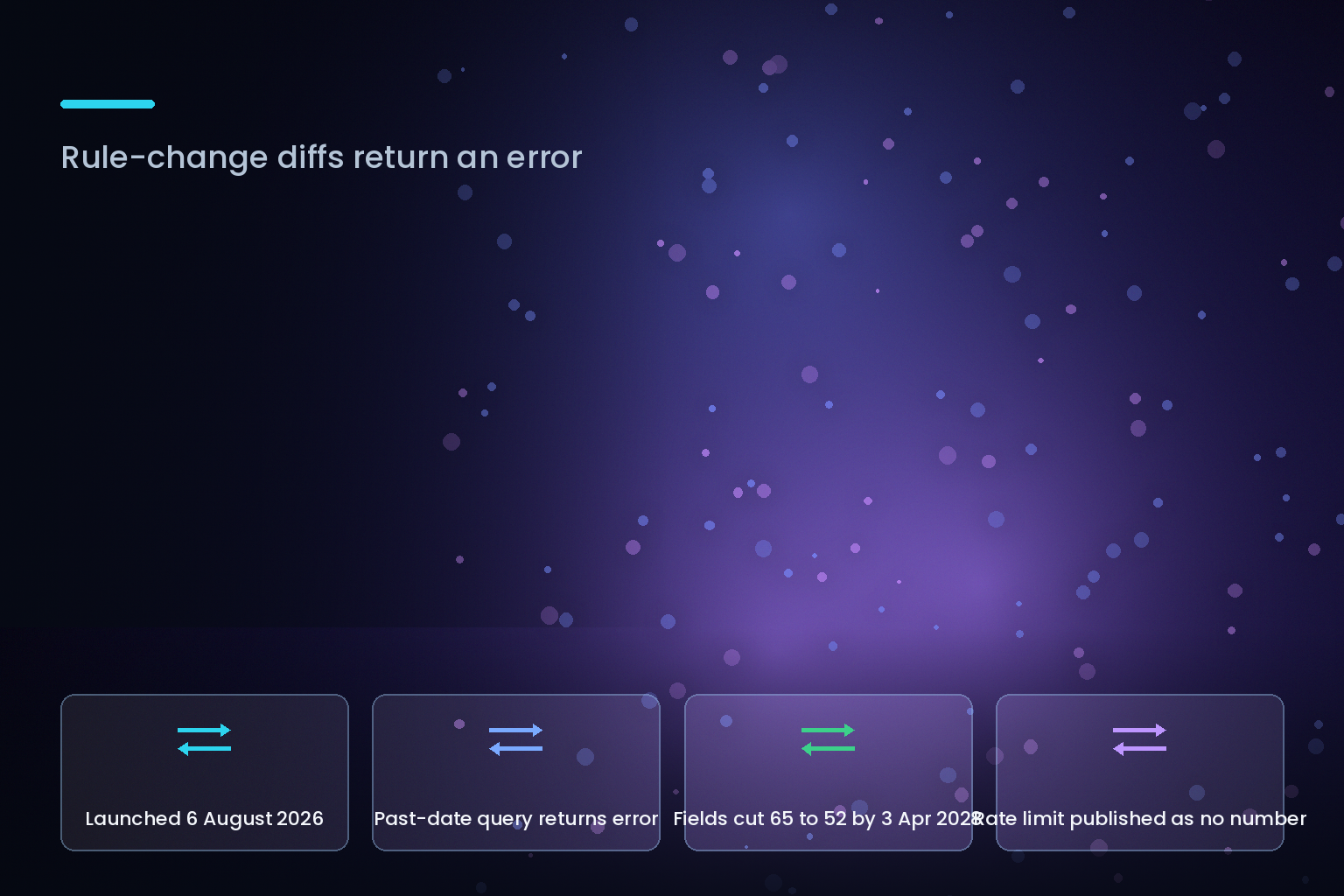
Summary. The Financial Conduct Authority published a free, machine-readable Handbook API and announced it in a blog on 6 August 2026, listing "keeping track of rule changes" among the benefits. The FCA's own launch FAQ on handbook.fca.org.uk says the opposite about the data needed to do that: "No. The API does not provide past versions of Handbook content. Attempting to extract information from a past date using the API will return an error message." A diff needs a before and an after. The API only serves the after. Teams planning to automate regulatory change management against it in the same year the FCA is rewriting transaction reporting rules, cutting reported fields from 65 to 52 and cutting an estimated £108m a year off a £493m annual bill from 3 April 2028, will find the change-detection half of that job is still manual. The 2 access routes the FCA names are Postman and RapidAPI, and the only published change alert is a monthly email.
What the FCA actually shipped
Access to Handbook, Technical Standards and Glossary data is now available through an API, announced 6 August 2026 at £0 to registered users. The FCA Handbook launch notice states it "is free to use" and that "the Handbook API is available to all users who have registered for a free account on the website." Two access details matter before anyone budgets a sprint for it.
First, there is no browser sandbox. The launch FAQ is explicit: "Users cannot interact with the API directly through our website but instead must use compatible external applications, such as Postman or RapidAPI." The API documentation itself sits behind the sign-in wall on the Handbook API page, which renders only a login prompt to an unauthenticated client.
Second, the currency model is single-version. The FAQ says the API "automatically extracts content from the latest version of the Handbook. As such, it retrieves the most current information." There is no point-in-time parameter that resolves, because there is no historical corpus behind it.
Alex Smith, the FCA's Head of Cross-cutting Policy & Strategy, wrote in the launch blog that "having access to current and future versions of Handbook content may help firms to track, compare and flag rule updates so that they can respond more quickly." The word doing the work there is "compare." Comparison is the thing the stated data model cannot support without a second corpus that the firm keeps itself.
What breaks
A regulatory change-management pipeline usually has four stages: fetch the current rule text, compare it against the last known text, classify what changed, then route the change to the owning team. The Handbook API covers stage one well and stages two through four not at all.
| Capability | Handbook API | Handbook website |
|---|---|---|
| Current rule text, machine-readable | Yes | No, HTML only |
| Glossary and Technical Standards | Yes | Yes |
| Past-dated version of a provision | No, returns an error | Yes, via Timeline |
| Marked-up change between versions | No | Yes, via Track Changes |
| Programmatic access without a browser | Yes | No |
| Published numeric rate limit | Not stated | Not applicable |
The uncomfortable reading of that table: for change tracking specifically, the machine-readable route is weaker than the HTML route it was meant to improve on. The FCA refreshed the Handbook website with "advanced search capability, new track changes tools and improved context-setting across Handbook content," per the launch blog. Those tools are on the website. They are not in the API.
So the pattern that works is not the one most teams reach for. You cannot ask the API what changed. You have to build your own history: snapshot every provision you care about on a schedule, store the snapshots, and diff your own archive. The API becomes a fetch endpoint feeding a store you own. The real cost is the archive and its retention policy, not the integration.
There is a second gap worth planning around. The FAQ says "Protected endpoints are rate-limited per authenticated user and endpoint path. If the rate limit is exceeded, the API will return an error." No number is published. A nightly snapshot job across a large module set is exactly the traffic shape that discovers an unpublished limit in production, and the failure mode is a partial archive with silent holes in it, which is worse than no archive because the diffs it produces look valid.
How the FCA handles this elsewhere
The FCA has shipped machine-readable data before, and its older services solved change detection directly. The FCA Financial Instruments Reference Data System technical specification, dated July 2020, describes two file types: a full file consolidated before a 21:00 CET cut-off, and a "delta file" that "contains all records of instrument reference data for which a change has occurred (addition, modification, deletion) since the generation of the last set of files."
That is a delta feed. It is precisely what the Handbook API does not offer.
| FCA data service | Change-detection mechanism | Limits published |
|---|---|---|
| Handbook API, 2026 | None, latest version only | Rate-limited, no number given |
| FCA FIRDS, July 2020 spec | Delta files listing additions, modifications, deletions | Rate limited, file downloads exempt |
| Register Extract Service, April 2026 handbook | Subscription with a support and change-management process | Documented in the subscribers' handbook |
| Handbook website | Timeline and Track Changes in the UI | Not applicable |
| Handbook email alerts | Monthly update mailing list on account signup | Monthly cadence |
The FIRDS specification even carves out an exemption the Handbook API does not appear to have: "the individual file download links will not be subject to throttling as they are served via a separate solution." Bulk retrieval was treated as a separate concern there. On the Handbook API there is one throttled surface.
The notification fallback is a mailing list. The launch FAQ says that on creating an account, "you will be automatically enrolled into a mailing list which will provide monthly Handbook updates." Monthly email is the FCA's supported change notification. For a firm whose obligation moves on a board-instrument cycle, that is a human in a loop, not a pipeline.
Why 2026 is a bad year to have no rule diff
The FCA is changing the rules underneath firms right now. On 3 August 2026 it published Policy Statement PS26/15, "Improving the UK transaction reporting regime," a 191-page document setting final rules. Therese Chambers, joint executive director of enforcement and market oversight, said in the accompanying press release: "Transaction reports are the backbone of our market oversight work - they help us catch financial crime, monitor market stability and supervise firms effectively."
The scale of the edit is the point. PS26/15 sets out these changes.
| Change | Detail | Effective |
|---|---|---|
| Reporting fields cut | 65 fields reduced to 52 | 3 April 2028 |
| FX derivatives removed | Out of scope, affects over 400 UK firms | 3 April 2028 |
| EU-venue instruments dropped | 7 million instruments, about £32m saved a year | 3 April 2028 |
| Back reporting period | Default cut from 5 years to 3 years | 3 April 2028 |
| Trading venue fields | Fewer fields for over 2,200 international firms | 3 April 2028 |
The FCA puts the current annual cost of MiFID transaction reporting to industry at £493m, estimates the new regime at roughly £385m, and describes a net annual saving of £108m. PS26/15 also exempts most corporate actions from reporting and creates a framework for Conditional Single-Sided Reporting. The FCA says the 3 April 2028 date gives firms time "to prepare, test and implement updated reporting systems," with a flexible supervisory approach for firms ready sooner.
Every one of those lines lands in the Handbook as edited provisions between now and April 2028. A firm that wants to know which of its controls a given board instrument touched still has to diff the text. The API will hand over today's text on demand. It will not tell you that yesterday's was different.
What to do
Build the archive first, then the integration. Register a free Handbook account, take a baseline snapshot of every module in scope, and store it with the retrieval timestamp before writing any classification logic. Without a baseline, the first genuinely useful diff is a full Handbook review cycle away.
Rate-limit yourself deliberately. Since no numeric ceiling is published, treat throttling as expected: back off on errors, checkpoint progress per provision, and make partial runs resumable rather than restarting the sweep. Record which provisions failed, and never let a failed fetch be recorded as "unchanged."
Keep the website in the loop for adjudication. Timeline and Track Changes remain the authoritative view of what altered and when, so a compliance analyst confirming a machine-flagged change should be sent to the Handbook page, not to a rendered diff of your own snapshots.
Do not retire whatever you use today on the strength of the launch. The monthly mailing list and the existing Handbook website tooling are the FCA's supported change-notification path, and the API does not replace either.
India-specific considerations
Indian technology and RegTech suppliers building for UK-authorised clients inherit this gap and one more. A snapshot archive of Handbook text held on Indian infrastructure is a data store with a retention policy, an access-control model and an audit trail, so it falls inside the same engineering discipline as any other regulated corpus, including the obligations arising under the Digital Personal Data Protection Act 2023 where any personal data is joined to it. Handbook rule text is public, but the mapping layer that ties provisions to a client's products, customers and controls usually is not, and that mapping is the asset worth protecting. Teams already handling consent and residency design for Indian financial clients through account aggregator integration for fintech builders will recognise the pattern. The DPDP Act engineering playbook for Indian startups covers the storage and access-log side, and the corporate IT compliance auditing guide covers the evidence trail an auditor will ask for. Firms sizing the wider programme cost should read the DPDP compliance cost analysis for Indian startups alongside it.
What is still unknown
The numeric rate limit is not published, so capacity planning is guesswork until a real sweep measures it. The API documentation is behind authentication, so the endpoint list, response schema, pagination model and error codes cannot be assessed from outside. Whether "future versions" means instruments already made but not yet in force, and how far ahead that reaches, is not stated in the launch FAQ. The FCA says the ways firms use the API "will help shape the future of financial services regulation," which leaves open whether historical access arrives later.
FAQ
How eCorpIT can help
We build the snapshot archives, scheduled fetch workers and diff pipelines that sit between a regulator's API and a compliance team's controls, including the resumable back-off logic an undocumented rate limit demands. Our fintech app development teams work on regulated financial products and design applications aligned with the relevant regulatory requirements. eCorpIT is CMMI Level 5, MSME Certified and ISO 27001:2022 certified. To scope a regulatory change-tracking pipeline against the Handbook API, talk to our compliance engineering team.
References
- FCA Financial Instruments Reference Data System technical specification, Financial Conduct Authority
Last updated: 23 August 2026.