On this page · 12 sections
- What the Commission actually decided
- The 11 features, grouped as the Commission grouped them
- The timeline you should be planning against
- Five of the eleven features sit behind a certification gate
- If you build apps, not assistants, the work is App Functions
- App Functions, Computer Control and MCP are not interchangeable
- What this changes for EU product strategy
- India-specific considerations
- A twelve-month build plan
- FAQ
- How eCorpIT can help
- References
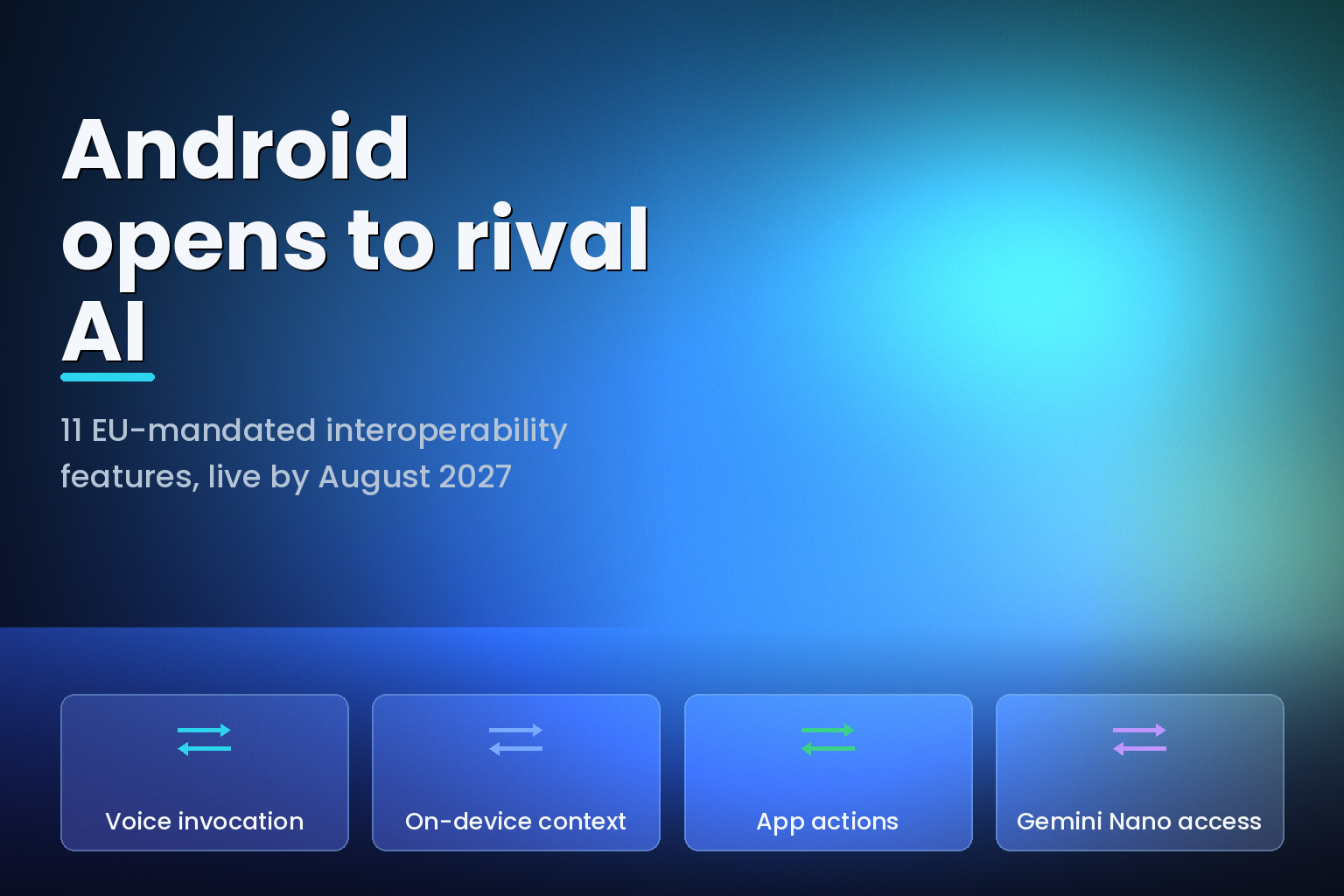
Summary. On 16 July 2026 the European Commission adopted two binding specification decisions against Google under the Digital Markets Act. The first orders Google to give competing AI assistants the same access to 11 Google Android features that Gemini already has. Google must ship those changes in Android 18 by 1 August 2027 at the latest, with concurrent wake-word support following in Android 19 by 1 August 2028. Around 60% of European mobile users are on Android, and the Commission's stated reason for stepping in is that features like voice invocation, cross-app actions and on-device context are today "almost exclusively available to Gemini". The second decision, on Google Search data, starts biting from January 2027. Neither decision carries a fine: specification proceedings sit outside the non-compliance track that produced the €500 million penalty against Apple and the €200 million penalty against Meta on 23 April 2025.
For anyone shipping an Android app or an assistant in the EU, this is a dated engineering deadline, not a policy story. The APIs that will carry most of this traffic already exist in preview. The teams that treat the next twelve months as build time will be indexed and testable when the doors open.
What the Commission actually decided
The Commission opened specification proceedings against Google on 27 January 2026 under Article 6(7) of the DMA, which requires a gatekeeper to provide free and effective interoperability with hardware and software features controlled by its operating system. It published proposed measures for third-party feedback on 16 April 2026 and 27 April 2026, then adopted the final decision on 16 July 2026.
Google Android was designated a core platform service on 6 September 2023, and Google has been required to comply with the DMA in respect of its designated services since 7 March 2024. Specification proceedings do not assess whether a gatekeeper is already compliant; they spell out how an obligation must be implemented. As the Commission puts it in its own press material, these proceedings "do not provide for the imposition of fines". That distinction matters commercially: the pressure here is a deadline and a monitoring regime, not an immediate financial penalty.
Henna Virkkunen, Executive Vice-President for Tech Sovereignty, Security and Democracy, framed the intent plainly: "Thanks to these measures we hope to see emerging alternatives to Google Search and Google's AI services, such as Gemini, and that users in the EU can enjoy greater choice of services. All developers, large and small, are welcome to explore these new opportunities, which will certainly benefit users too."
The decision does not specify the exact technical implementation. It specifies outcomes. If Google adds a new capability to any covered feature, it must be made available to third parties at the same moment it becomes available to Google's own services on the device.
The 11 features, grouped as the Commission grouped them
The Commission sorted the 11 features into four building blocks: invocation, context, actions on apps and the OS, and access to resources. The table below maps each feature to what it unlocks for a third-party assistant and, where the Commission named one, the Android mechanism that implements it today.
| Feature | What a rival assistant gains | Android mechanism named in the decision |
|---|---|---|
| Long-press home button / navigation handle | Contextual invocation from the central home control; access points can no longer be reserved for Google | Circle to Search entry point |
| Always-on hotword detection | Wake-word activation with the screen off, in battery saving mode or standby | "Hey/OK Google" hotword pipeline |
| Centralised access to on-device app data | Cross-app search and retrieval in one call instead of app by app | AppSearch |
| Context-aware intelligence | Proactive suggestions from screen contents and sensor signals, with consent | Magic Cue proactive suggestions |
| Ambient data | Real-time microphone, camera, screen and speaker streams under Google's own consent conditions | Core sensor input and output streams |
| Structured on-device integration | Invoking "send a message", "create a note", "schedule a meeting" inside other apps | App Functions |
| Screen automation | Multi-step task completion in a separate virtual window while the user does something else | Computer Control |
| System integration | Changing brightness, media playback, Do Not Disturb, Bluetooth | OS settings surfaces |
| System-level on-device models | Calling the preinstalled on-device models shipped with the OS, at Google-equivalent performance | Gemini Nano on-device models |
| On-device model implementation | Installing and running your own on-device model under Google's hardware and background-execution conditions | Third-party ODM hosting |
| Background execution | Acting for the user when the app is not in the foreground or the screen is off | Background execution policy |
Two entries in that list deserve emphasis. Structured on-device integration explicitly includes access to Gmail, Calendar, Drive, Docs, Maps, YouTube, Messages and Phone through operating-system-level integration channels. That is Google's own app estate, opened to rivals. And screen automation, delivered through Computer Control, is the capability that turns an assistant from a chatbot into something that completes a supermarket order end to end.
The timeline you should be planning against
| Date | What must happen | Who has to act |
|---|---|---|
| 16 July 2026 | Both specification decisions adopted and binding | European Commission |
| End August 2026 | Search data eligibility application form submitted; beneficiary webpage published | Alphabet |
| January 2027 | Google must start sharing Search data with eligible search engines | Alphabet |
| 1 February 2027 | Draft terms of the Android eligibility programme published for consultation | |
| 1 May 2027 | Final eligibility terms published; certification applications accepted | Google, then applicants |
| July 2027 | EU users start seeing the Android changes | |
| 1 August 2027 | All 11 features available to qualified rivals in Android 18 | |
| 1 August 2028 | Concurrent hotword detection available in Android 19 |
The gap between 1 May 2027 and 1 August 2027 is the practical window for an assistant vendor. Applications open on 1 May 2027, and the Commission requires that an assessment be finalised within four weeks of receipt. An assistant that applies in the first week of May and passes should be certified well before the features light up.
Five of the eleven features sit behind a certification gate
The Commission allowed Google to impose objective, non-discriminatory eligibility conditions on the more sensitive features, given what they expose. No further commercial requirements may be attached. Certification is carried out by Google together with independent third parties.
| Feature | Gated behind certification | Why the Commission treated it as sensitive |
|---|---|---|
| Screen automation | Yes | Imitates user behaviour across arbitrary apps |
| Structured on-device integration | Yes | Executes real actions inside other apps, including Google's |
| System integration | Yes | Changes device settings and media state |
| Centralised access to apps' data stored on device | Yes | Reads data across the installed app estate |
| Context-aware intelligence | Yes | Consumes screen contents and sensor signals continuously |
| Invocation, ambient data, on-device models, background execution | No | Covered by the general measures and user consent |
If you are building an assistant, the certification programme is the long pole, not the code. Draft terms land on 1 February 2027 and final terms on 1 May 2027, which leaves a three-month read of the criteria before anyone can apply. Non-AI services will be able to request access through a separate process.
Device makers are not on the hook for any of this. The Commission was explicit that implementation sits with Google, that Google cannot push the effort onto manufacturers, and that the measures do not require new hardware: voice activation obligations only apply to devices already carrying the necessary chip. Manufacturers keep the right to pre-install apps, set out-of-box defaults and monetise that placement.
If you build apps, not assistants, the work is App Functions
Most teams reading this ship a product, not an assistant. The relevant question is different: when four or five assistants can take actions inside apps on an EU Android phone, does yours expose anything for them to call?
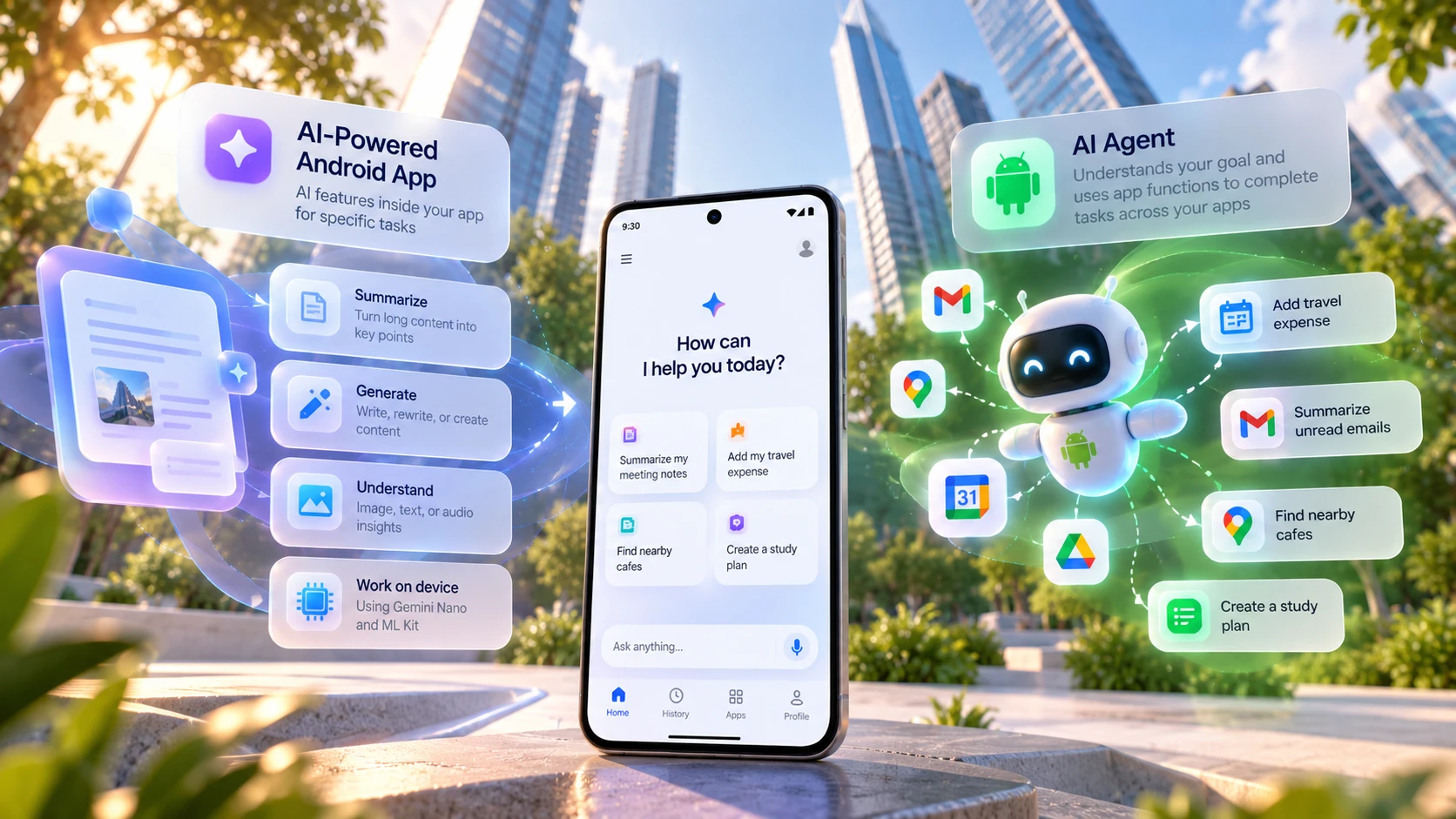
Google's answer is AppFunctions, and the documentation is unusually direct about the analogy. AppFunctions is a platform API with a Jetpack library that, in Google's words, lets apps "behave like on device MCP servers, contributing functions that act as tools" for agents and assistants. It is available on devices running Android 16 or higher. It is also still marked experimental, and as of May 2026 the integration with Gemini was in private preview with trusted testers.
The integration itself is small. Your project needs compileSdk at API level 36 or higher, plus three dependencies and a KSP argument:
            ksp {
  arg("appfunctions:aggregateAppFunctions", "true")
}

dependencies {
  implementation("androidx.appfunctions:appfunctions:1.0.0-alpha09")
  implementation("androidx.appfunctions:appfunctions-service:1.0.0-alpha09")
  ksp("androidx.appfunctions:appfunctions-compiler:1.0.0-alpha09")
}
From there you annotate the capability you want an agent to reach. The KDoc is not decoration: with isDescribedByKDoc = true, the description is encoded into the AppFunctionMetadata the agent reads to decide whether and how to call your function.
            /**
 *   Adds a new note to the app.
 *
 *   @param appFunctionContext The context in which the AppFunction is executed.
 *   @param title The title of the note.
 *   @param content The note's content.
 */
@AppFunction(isDescribedByKDoc = true)
suspend fun createNote(
    appFunctionContext: AppFunctionContext,
    title: String,
    content: String
): Note
Two implementation details save time later. An AppFunction runs on the Android UI thread by default, so anything long-running must be a suspend function that switches to a suitable dispatcher. And functions can be gated at runtime: set isEnabled = false on the annotation, then flip it with setAppFunctionEnabled once you have verified the user's account state or feature flag.
Verification is a single command:
adb shell cmd app_function list-app-functions | grep --after-context 10 $myPackageName
Callers need the EXECUTE_APP_FUNCTIONS permission to discover or execute your functions, which is the permission boundary that will separate certified assistants from everything else on an EU device. Google also runs an Early Access Program for teams that want the end-to-end agentic experience before general availability.
App Functions, Computer Control and MCP are not interchangeable
Teams that have already built a remote MCP server often assume it covers them here. It does not, and the difference is architectural.
| Dimension | App Functions | Computer Control | Remote MCP server |
|---|---|---|---|
| Where it runs | On device, inside your app process | On device, driving your UI in a virtual window | Cloud, over HTTP |
| What you implement | Annotated Kotlin functions plus KDoc | Nothing; the agent drives your existing screens | A server, hosting and auth |
| Failure mode | Wrong parameters, handled by typed exceptions | Brittle against UI changes | Network latency and outages |
| Platform reach | Android 16 and above only | Android only | Any client that speaks MCP |
| Who is gated | Caller needs EXECUTE_APP_FUNCTIONS | Certification-gated under the EU decision | Your own auth |
The honest read: Computer Control means an assistant can operate your app whether or not you do anything. App Functions is how you make that operation deliberate, typed and observable instead of an agent guessing its way through your UI. That is the argument for doing the work rather than waiting.
Google's own guidance on what to expose is worth following: pick tasks that are easier to say than to tap through, give the agent the narrowest access that completes the request, keep highly personal data out of the surface, and put your own confirmation step in front of anything destructive. System agents may process user queries on the server, so treat every parameter you accept as data that leaves the device.
What this changes for EU product strategy
Three consequences follow from the decision, and only one of them is about Android.
The first is distribution. The Commission's own framing is that developers whose apps might be used by an AI service, naming email, ride sharing and messaging apps, "will also benefit from more engagement and discoverability through integration with alternative AI services". A capability exposed as an AppFunction is discoverable by every certified assistant on the device, not just Gemini. For categories where an assistant is a plausible front door, that is a new acquisition surface with no store listing attached.
The second is the shape of the competitive set. Once ChatGPT, Claude or a European entrant can hold the hotword, read on-device context and drive apps, the assistant layer stops being a single-vendor question. Product decisions that assumed a Gemini-only integration path need revisiting on a 2027 horizon. We have written separately about how the same DMA pressure has reshaped Siri's EU availability planning, and the pattern is consistent: assume plural assistants, not one.
The third is that the deadline is soft in one specific way that teams keep misreading. Specification decisions are legally binding, and the Commission will require Google to report regularly on progress over the coming two years. But the enforcement path if Google underdelivers runs through a separate non-compliance case, which is what produced the €500 million and €200 million fines against Apple and Meta on 23 April 2025. That is a slower instrument. Plan for the features arriving on time; do not plan for a rapid enforcement backstop if they do not.
India-specific considerations
None of this binds Google in India. The measures apply to the Google Android ecosystem for EU users, and Indian users get whatever Google ships globally.
The practical effect for Indian product and engineering teams is still real, for two reasons. First, Indian software services and product companies building for EU clients now have a dated compliance and capability roadmap they can sell against, and the certification programme opening on 1 May 2027 is a concrete engagement trigger. Second, the underlying API work is not EU-specific: AppFunctions runs on any Android 16 device, so a Bengaluru or Gurugram team can implement, test and ship agent-callable surfaces today and have them work wherever assistants become capable of calling them.
For teams handling Indian user data through an assistant surface, the Digital Personal Data Protection Act 2023 applies to what your AppFunction returns, exactly as it applies to any other data path out of your app. An agent request that pulls a user's order history is a processing activity with a purpose and a consent basis, and the fact that a model triggered it changes nothing about that. Keep the narrow-access principle: return the field the request needs, not the record.
Indian teams shipping to Google Play should also keep the parallel platform deadlines in view alongside this one, including the Android developer verification requirements and the Android 17 target SDK migration. Those land sooner and block releases; the DMA work does not.
A twelve-month build plan
Work backwards from 1 August 2027.
Between now and the end of 2026, pick the three to five capabilities in your app that a user would rather say than tap, and implement them as AppFunctions against compileSdk 36. Write the KDoc as if a model is the only reader, because it is. Register interest in the Early Access Program if your category is likely to be an early assistant target.
Through the first quarter of 2027, read the draft eligibility terms when they publish on 1 February 2027 and work out whether your product is an applicant or a callee. Most product teams are callees and do not need certification at all. Assistant vendors should treat 1 February 2027 as the date their compliance work starts, not 1 May 2027.
From May 2027, use the testing rights the decision gives you. Google must provide complete documentation, allow third parties to test the interoperability solutions including via beta, and supply technical assistance. Those are obligations, not favours, and they are the cheapest way to find out that your function schema does not survive contact with a real agent.
The real cost here is usually the surface design, not the code. Deciding which twelve actions in a mature app are safe to hand to a model takes longer than annotating them.
FAQ
How eCorpIT can help
eCorpIT is a CMMI Level 5 certified technology organisation in Gurugram with senior engineering teams building Android and cross-platform products for Indian and global clients. We help product teams work out which capabilities are worth exposing to AI assistants, implement them as AppFunctions with schemas and KDoc an agent can actually use, and put the consent and confirmation controls around anything an agent can trigger. If you are planning an EU release against the August 2027 window or want your Android and Kotlin build to be agent-callable from day one, talk to our team.
References
- European Commission, Commission provides guidance to Google for AI interoperability on Android and sharing of Google Search data under the Digital Markets Act, 16 July 2026.
- European Commission, Alphabet specification proceedings: interoperability for AI services (Questions and Answers), 16 July 2026.
- European Commission, Alphabet specification proceedings: sharing of Google Search data (Questions and Answers), 16 July 2026.
- Insight EU Monitoring, full text of the Commission press release IP/26/1634 with quotes from Teresa Ribera and Henna Virkkunen, 16 July 2026.
- European Commission, Commission opens specification proceedings to assist Google in complying with interoperability and online search data sharing obligations, 27 January 2026.
- European Commission, Commission seeks feedback on measures to ensure interoperability of Google's Android under the Digital Markets Act, 27 April 2026.
- European Union, Article 6(7), Regulation (EU) 2022/1925 (Digital Markets Act).
- Android Developers, Overview of AppFunctions, last updated 21 May 2026.
- Android Developers, Add the AppFunctions API to your app, last updated 12 May 2026.
- Android Developers, Computer Control.
- Android Developers, AppFunctions Jetpack library release notes.
- European Commission, Commission finds Apple and Meta in breach of the Digital Markets Act, 23 April 2025.
- Model Context Protocol, Introduction to MCP.
Last updated: 23 July 2026.