On this page · 8 sections
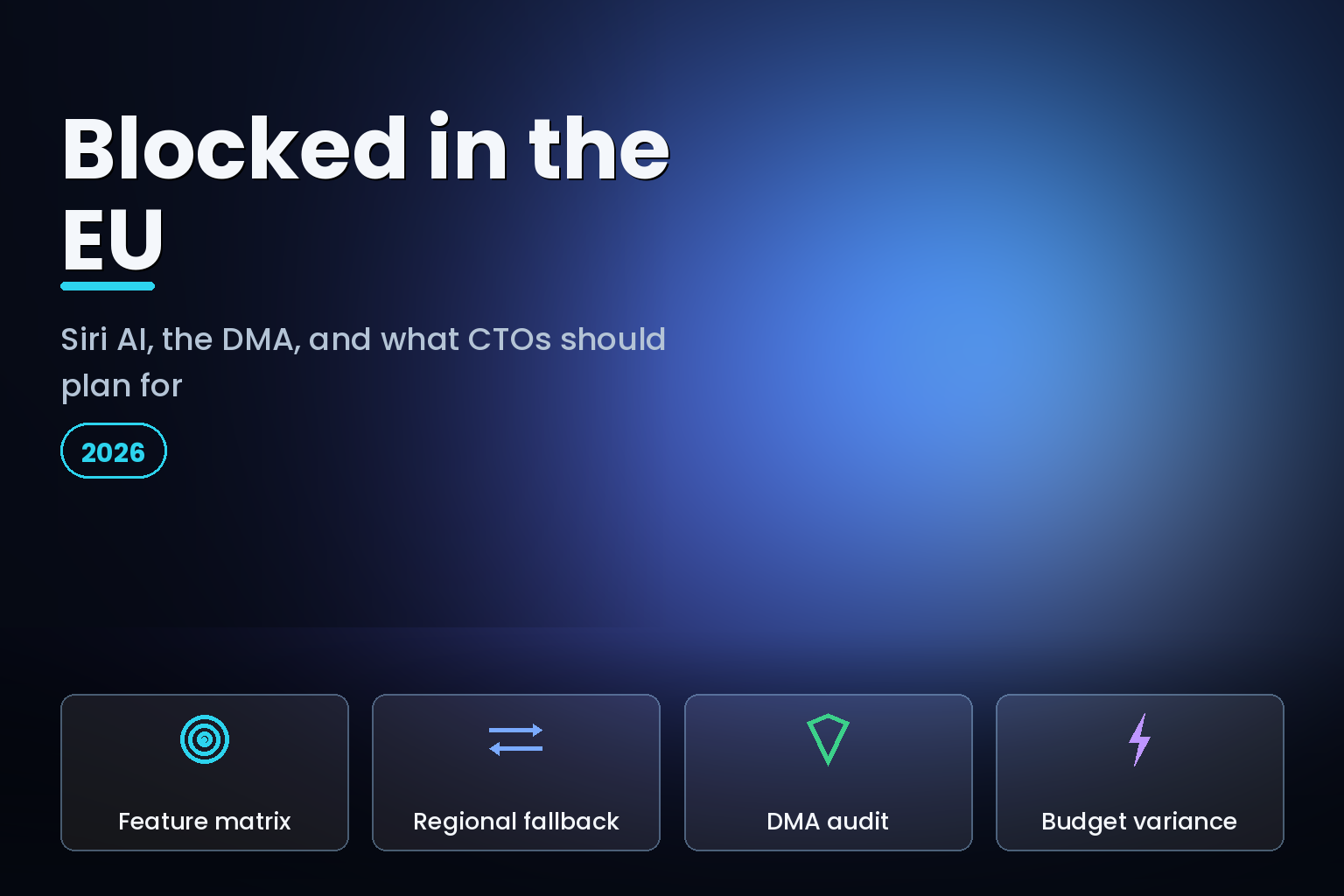
Summary. On June 8, 2026, Apple unveiled Siri AI, a rebuilt assistant powered by a custom Google Gemini model, then said it will not ship on iOS 27 or iPadOS 27 in the European Union because of the Digital Markets Act, with no timeline for when EU users will get it. The same feature will reach EU users on Mac and Apple Vision, which the DMA does not designate. The split is the story for any CTO with EU users. Apple blames the DMA's interoperability mandate, which it says would force it to give any third-party assistant deep access to read messages, make payments, and act across apps. The European Commission counters that the DMA never blocked the launch and that Apple chose to delay. The stakes are large on both sides: the Gemini deal is reported at about $1 billion per year for a 1.2 trillion parameter model serving 1.5 billion daily users, while DMA fines run from 4% to 20% of global annual turnover, a Meta-scale precedent that risk teams model near 30 billion euros. This is the second time Apple Intelligence has been delayed in the EU. Here is what happened, whether the EU will actually get Siri AI, and four moves to plan for.
What Apple announced, and what the EU will not get
Apple introduced Siri AI on June 8, 2026 as the centerpiece of its 2026 software, built on the January 12, 2026 partnership in which Google's Gemini became the foundation for a rebuilt Siri and the next wave of Apple Intelligence. Bloomberg's Mark Gurman reported the arrangement at roughly $1 billion per year, using a 1.2 trillion parameter Gemini model tuned for Apple, about eight times larger than Apple's prior 150 billion parameter cloud model. The assistant is built to act across your apps with personal context, the capability that makes it useful and, in the EU, controversial.
The regional split is unusual and worth stating precisely, because it shapes every product decision that follows.
| Platform | United States | European Union |
|---|---|---|
| iPhone (iOS 27) | Siri AI available | Blocked, no timeline |
| iPad (iPadOS 27) | Siri AI available | Blocked, no timeline |
| Mac (macOS) | Siri AI available | Available |
| Apple Vision | Siri AI available | Available |
| Underlying model | Custom Gemini | Custom Gemini |
The pattern is that Siri AI is unavailable precisely on the platforms the DMA designates as core platform services, iOS and iPadOS, and available on the platforms it does not. That is the clue to what is really going on. eCorpIT analyzed the immediate fallout in the Siri AI EU DMA impact for CTOs, and the Gemini arrangement in Gemini-powered Siri enterprise questions.
Why the DMA blocks it, and why both sides have a point
The dispute is about interoperability. The DMA requires designated gatekeepers to open core features to rivals, and Apple's position is that honoring that for Siri AI means giving any third-party assistant the same deep access Siri AI has. In Apple's newsroom statement, under what it calls regulators' "extreme interpretation," it would have to let any assistant read and send messages, make purchases, access files, and act across apps autonomously, without the user's ongoing visibility. Apple says it built a privacy-preserving intermediary, a "Trusted System Agent," and proposed shipping Siri AI in the EU while rolling that solution out over 18 months. EU regulators did not accept its proposals.
The Commission's side is not a footnote. It has stated that the DMA never blocked the launch and that Apple chose to withhold the feature, a reading several analysts summarize as both sides being right at once: the law does not literally ban Siri AI, but compliance as the Commission interprets it raises the cost of shipping it enough that Apple declined. Dirk Auer of the International Center for Law and Economics put the market reading bluntly: "No company lightly withholds a flagship feature from its best-selling devices in one of the world's wealthiest markets." He added that "European consumers are left with fewer choices and a less capable iPhone than users elsewhere." Defenders of the DMA respond that contestability sometimes has short-term costs and that interoperability protects competition and user choice over time. A CTO does not have to resolve that debate. The job is to plan for the outcome it produces: feature fragmentation by region.
The DMA's reach is broad enough that this will recur. The Commission has designated seven gatekeepers, Meta, Alphabet, Amazon, ByteDance, Apple, Booking, and Microsoft, across 23 core platform services, and translating its principles of interoperability, anti-steering, and data portability into working technical standards has repeatedly produced feature delays as firms reconcile compliance with performance and security. Apple is the visible case this month because Siri AI is a flagship, but the underlying friction, opening deeply integrated AI features to rivals on the regulator's terms, applies to every gatekeeper shipping AI in Europe. Planning for one delayed feature is really planning for a steady stream of them.
Will the EU actually get Siri AI?
History argues yes, eventually, but on the regulator's clock rather than Apple's. Apple withheld its first Apple Intelligence features from EU iPhones when they launched in the United States in October 2024, citing regulatory uncertainty, then shipped them in the EU with iOS 18.4 in April 2025 after months of negotiation, a delay of roughly six months. The current standoff is the second instance of the same pattern, but with one difference that matters: this time Apple has given no timeline at all, and the talks have reportedly reached a dead end.
The realistic planning assumption is a delay measured in quarters, not weeks, with a non-trivial chance it stretches longer because the interoperability question here is harder than the steering and default-setting fights that preceded it. Granting deep, autonomous system access to arbitrary assistants is a genuinely different security proposition from letting users change a default browser. For planning purposes, treat EU Siri AI on iPhone as unavailable through at least the iOS 27 cycle, treat Mac and Vision as the near-term EU home for the feature, and watch for a negotiated middle path resembling Apple's Trusted System Agent. Do not build a roadmap that assumes EU iPhone parity on a fixed date, because no such date exists.
There is also a tail scenario worth naming in a board update: if Apple concludes the EU access requirements are irreconcilable with its security model, EU iPhone users could be left with a narrower assistant or pointed to the Mac and Vision versions indefinitely. That outcome is not the likeliest one, given the April 2025 precedent of eventual delivery, but a roadmap that has quietly assumed eventual parity should at least acknowledge that the strongest version of the feature might remain a non-iPhone experience in Europe for the foreseeable future.
Four moves CTOs should make now
The Siri AI delay is a specific instance of a general problem: AI features built on gatekeeper platforms now ship differently in the EU. Whether or not your product touches Siri, these four moves prepare you for it.
| Move | Owner | Core artifact | First checkpoint |
|---|---|---|---|
| 1. Build a feature-availability matrix | Product | Region-by-platform feature map | Every AI feature has a known EU status |
| 2. Design for regional degradation | Engineering | Graceful-fallback UX patterns | No EU flow assumes a blocked feature |
| 3. Audit your own DMA exposure | Legal / platform | Interoperability impact assessment | Gatekeeper-dependent features identified |
| 4. Budget for divergent compliance | CTO / finance | Per-region roadmap and cost line | EU variance funded, not assumed away |
Move 1: build a feature-availability matrix
Stop treating "launched" as a single global state. Maintain a living matrix of every AI feature you depend on or ship, mapped against region and platform, with its current EU status and the gatekeeper dependency it rests on. The Siri AI split shows why platform granularity matters: the same feature is blocked on iOS but available on macOS in the same country. If your product assumes an Apple Intelligence or Siri capability is present, the matrix tells you exactly where that assumption fails today.
Move 2: design for regional degradation
Build EU flows that degrade without breaking. If a feature relies on a gatekeeper AI capability that may be unavailable in the EU, the product needs a designed fallback, not an error or an empty state. This is the same engineering instinct that good teams already apply to model continuity: assume the capability can be absent and make the experience acceptable when it is. The parallel to export-control model suspensions is direct, and we cover that continuity pattern in the enterprise AI export-control compliance playbook.
In practice this means three things for an EU build: detect the capability at runtime rather than assuming it, present a working alternative path when it is absent, and tell the user plainly what differs in their region instead of failing silently. A summarization feature that leans on a gatekeeper assistant, for example, should fall back to your own server-side model or a manual flow in the EU, not show a greyed-out button. Designed degradation is the difference between a product that feels region-aware and one that feels broken.
Move 3: audit your own DMA exposure
If you build on a gatekeeper platform, the interoperability mandate can reach your features too. Any AI capability you deliver through iOS, iPadOS, or another designated service inherits the same compliance surface that delayed Siri AI: does your feature's data architecture and access model satisfy the DMA's interoperability and data obligations. Run an interoperability impact assessment on your EU-facing AI features now, while it is a design review rather than a regulator's inquiry. The questions to answer are concrete. Does the feature read or write data the DMA would treat as a user's to port or share. Does it gate a capability a rival service could claim interoperable access to. Does it depend on a default or a system integration that the anti-steering and self-preferencing rules touch. If the answer is yes anywhere, document how the design meets the obligation or where it is exposed, and route that to legal before the EU release rather than after a complaint. Most teams find they have only one or two such features and can address them cheaply when they look early.
Move 4: budget for divergent compliance
Treat EU divergence as a funded line in the roadmap, not a surprise. Per-region feature variance carries real cost in engineering, legal review, and ongoing maintenance, and the downside of getting it wrong is quantified in the DMA's penalties of 4% to 20% of global annual turnover. You are not a gatekeeper, but your platform partners are, and their compliance posture becomes your release schedule. Plan the variance, staff it, and price it.
India-specific considerations
For Indian companies and global firms serving India, the immediate lesson is structural rather than local: a flagship AI feature can be present in one market and absent in another for regulatory reasons that have nothing to do with your product. India's own framework, the Digital Personal Data Protection Act, 2023, is creating a similar pattern of region-specific data obligations, running cross-border personal-data transfers against a government-maintained permitted-country list. A product team serving EU, US, and Indian users should expect three different feature-and-data configurations and design for that from the start rather than retrofitting it. Our DPDP consent-manager readiness guide covers the India side in detail.
What to watch next
Three signals will tell you which way EU Siri AI breaks. First, any Apple move reviving a phased rollout like its Trusted System Agent, which would suggest a negotiated path within the iOS 27 cycle. Second, a formal Commission specification of what interoperability it actually requires for AI assistants, which would turn the current standoff into a concrete engineering target. Third, parallel pressure on Google, whose own AI features face the same interoperability questions on its designated services, and which now sits on both sides of this story as the model supplier to Apple and a gatekeeper in its own right.
For your own roadmap, the safe posture is to assume EU iPhone parity does not arrive on a date you can plan around, to keep Mac and Vision as the near-term EU home for any Siri-dependent flow, and to revisit the feature-availability matrix each quarter. The cost of over-preparing is a little extra design work. The cost of under-preparing is an EU launch that ships broken in a market the DMA fines reach up to 20% of global turnover.
How eCorpIT can help
eCorpIT (eCorp Information Technologies Private Limited) is a senior-led technology consultancy in Gurugram, founded in 2021 and assessed at CMMI Level 5. We help CTOs and product leads plan for regional feature fragmentation: feature-availability matrices, graceful-degradation UX, DMA interoperability assessments, and DPDP-aligned data designs for EU, US, and Indian users. We design systems aligned with DMA and DPDP requirements rather than claiming certifications we do not hold. To map your gatekeeper-platform exposure before your next EU release, contact our team.
FAQ
References
Last updated: June 29, 2026.