On this page · 12 sections
- Why enterprises are piloting visionOS now
- What visionOS 26 changed for enterprise
- What a visionOS app costs in 2026
- Windowed versus immersive: choosing the scope
- Where the ROI is real
- How to scope a spatial pilot
- How eCorpIT builds a visionOS pilot
- Common pitfalls in a first spatial build
- India-specific considerations
- FAQ
- How eCorpIT can help
- References
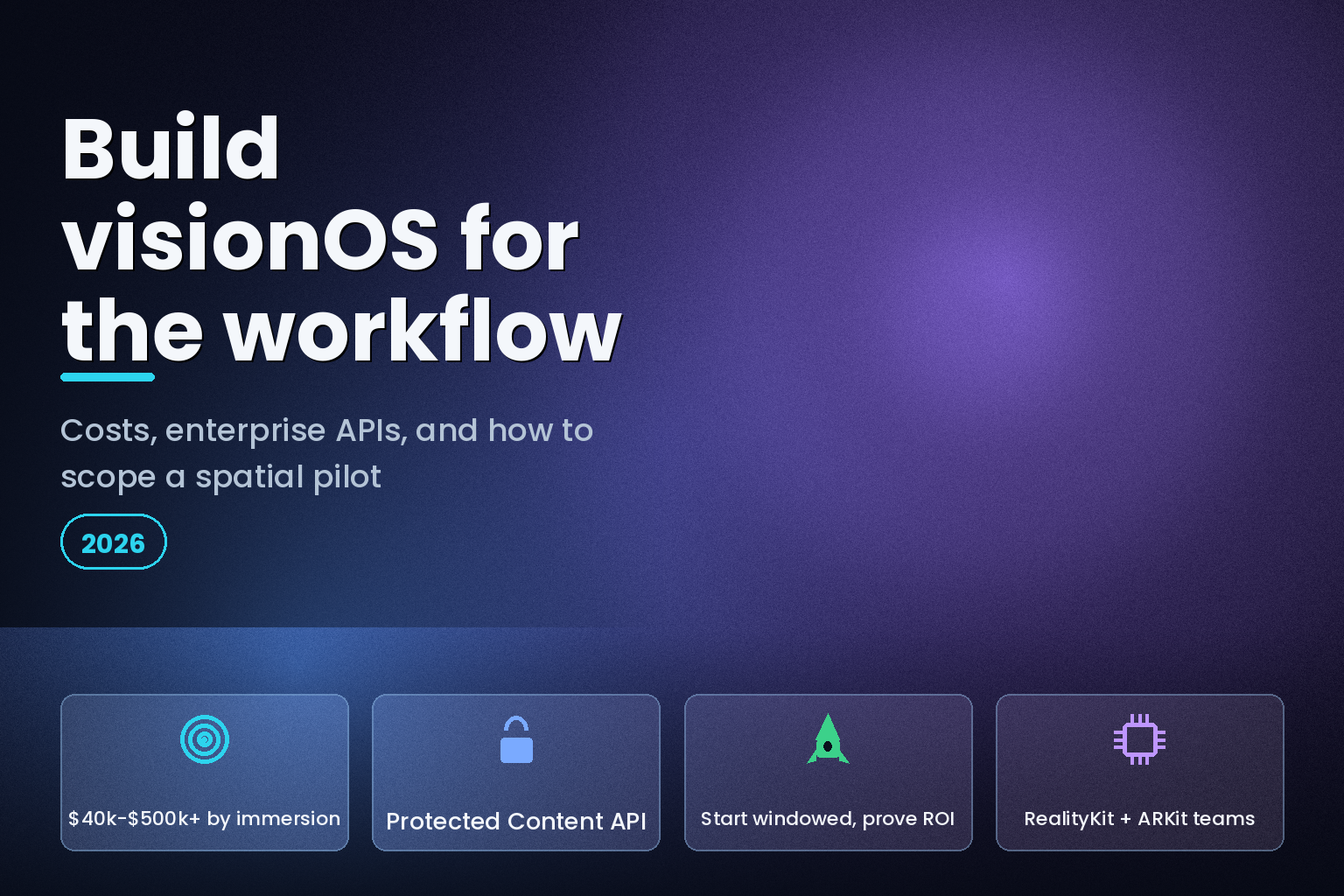
Summary. Apple Vision Pro has sold an estimated 475,000 units since its 2024 launch, and roughly 75% went to enterprise buyers, which is why spatial computing is now a real budget line rather than a demo. visionOS 26, released on 15 September 2025, added the enterprise pieces that were missing: a Protected Content API that blocks screenshots of confidential material, team device sharing for managing a shared pool of headsets, and a Spatial Scene API that Zillow and Dassault Systèmes already ship against. The second-generation Vision Pro, on Apple's M5 chip, launched in February 2026 at a reported $2,499. Building for it is not cheap: a windowed app runs $40,000 to $80,000, and a fully immersive experience runs $200,000 to $500,000 or more, over 2 to 12 months. This guide covers what those numbers buy, where the return is proven, and how eCorpIT scopes a pilot so you spend on the right immersion level the first time.
Why enterprises are piloting visionOS now
The install base is small, but its composition is the point. With about three in four Vision Pro units in enterprise hands, the device is being bought to do a job, not to sit in a demo room. Apple names real deployments: Dassault Systèmes uses its 3DLive app to let engineers review 3D designs together in person and over FaceTime, and Zillow built Zillow Immersive on the Spatial Scene API so buyers can see homes with real depth. Dozens of the largest global enterprises have bought in for design, training, and guided procedures.
As Mike Rockwell, Apple's vice president of the Vision Products Group, put it, "Apple Vision Pro has defined what's possible in this new era of spatial computing, and with visionOS 26, we're excited to push the boundaries even further." For a CTO, the question is no longer whether the platform is real. It is whether a specific workflow, surgical training, industrial design review, remote maintenance, justifies a build at these costs.
What visionOS 26 changed for enterprise
Earlier visionOS was consumer-first. visionOS 26 closed the enterprise gaps that kept IT and security teams cautious.
The Protected Content API ensures that only people granted access can see confidential materials such as medical records or business forecasts, and it blocks copying, screenshots, and screen sharing. That single control is what lets a regulated workflow onto the headset at all. Team device sharing lets an organization set up and manage a shared pool of devices, and a user can save eye and hand data, vision prescription, and accessibility settings to an iPhone running iOS 26 and carry them to another Vision Pro, which makes a shared fleet practical. The Spatial Scene API gives developers the generative-depth rendering Zillow uses, and shared spatial experiences let several Vision Pro users in the same room work over the same 3D content. Logitech Muse adds precise spatial input for collaboration apps. Underneath, the same Apple frameworks an iOS team already knows, SwiftUI, RealityKit, and ARKit, are what you build with, which is why an experienced Swift team can move onto visionOS faster than the platform's newness suggests.
What a visionOS app costs in 2026
Cost is driven mostly by immersion level, not features. Industry estimates for 2026 cluster into clear bands.
| App type | Indicative cost (2026) | Timeline | Immersion | Best-fit use |
|---|---|---|---|---|
| Ported iOS or iPad app | $25,000 to $150,000 | 6 to 10 weeks | 2D window | Existing app on Vision Pro |
| Windowed 2D app | $40,000 to $80,000 | 2 to 4 months | 2D window | Dashboards, training content |
| Mixed reality app | $90,000 to $180,000 | 4 to 8 months | Passthrough plus 3D | Guided procedures, design review |
| Shared multi-user session | Add 20% to 40% on the base | Add 4 to 6 weeks | Shared space | Team collaboration, remote review |
| Fully immersive Full Space | $200,000 to $500,000 or more | 6 to 12 months | Full Space | Simulation, immersive training |
The full 2026 range across all app types runs roughly $25,000 to $500,000 or more. A simple port of an existing iOS app is the cheapest entry, at $25,000 to $150,000, because the window and logic already exist and the work is adaptation rather than new spatial design. A Full Space experience with hand-tracked interaction and custom RealityKit scenes sits at the top because it is, in effect, a bespoke 3D application. The lesson for a first build is to match ambition to the workflow, because the gap between a windowed pilot and a full immersion build is a factor of five or more in both cost and time.
Windowed versus immersive: choosing the scope
The most expensive mistake in a first spatial project is building a Full Space experience when a windowed or mixed-reality app would have proven the value at a fraction of the cost. A windowed app at $40,000 to $80,000 puts existing dashboards, checklists, and training material into the headset with spatial widgets and shared viewing, and it ships in 2 to 4 months. That is usually enough to test adoption, measure whether staff will wear the device for the task, and build the internal case for more. A mixed-reality app that overlays 3D guidance on the real workspace, at $90,000 to $180,000, is the right step once a windowed pilot has proven demand. Reserve the $200,000-plus Full Space build for workflows where full immersion is the point, such as simulation or high-fidelity training.
Where the ROI is real
Spatial computing does not return value everywhere. It returns value where a task is spatial, hard to prototype physically, or expensive to train for. Spatial training environments have been shown to cut onboarding time by 20% to 40% and remove the need for physical prototypes, which is the clearest and most repeatable return. Manufacturing and healthcare lead adoption on that evidence: surgical training, industrial digital twins, remote maintenance, and design review are the most developed use cases. The healthcare augmented-reality market alone is projected to reach about $4.2 billion by 2026, up from roughly $610 million in 2018, and about 40% of healthcare providers already use virtual reality for treatment or staff training. In manufacturing, the economic value of augmented-reality IoT is projected at $40 billion to $50 billion by 2025 and $90 billion to $110 billion by 2030. For a manufacturer, the case sits in our work on Industry 4.0 and manufacturing AI; for a provider, it connects to healthcare app development. If the workflow is not spatial, a tablet is cheaper and the ROI case is weaker.
How to scope a spatial pilot
A disciplined pilot starts with the workflow, not the headset. Pick one task with a measurable baseline, such as onboarding hours, error rate, or travel cost for expert supervision. Choose the lowest immersion level that can test it, which is usually a windowed or mixed-reality app. Design for the enterprise controls from day one: Protected Content for confidential data, team device sharing for a managed fleet, and a plan for who administers the devices. Build on RealityKit and ARKit with the same Swift discipline as a production iOS app, because the same iOS and Swift engineering practices that ship App Store apps carry directly onto visionOS. Instrument the pilot so the ROI number is real at the end, then decide on a deeper build from evidence. This is the same fleet-readiness thinking we set out in the iOS 27 enterprise fleet-readiness guide, applied to a headset, and it pairs with on-device spatial work like iOS 27 spatial reframing.
How eCorpIT builds a visionOS pilot
Our engagement model is built to keep the first cheque small and the evidence real. It runs in four stages. A discovery workshop picks one workflow and a measurable baseline, such as onboarding hours or supervised-training cost, and rejects any use case that a tablet would serve as well. A windowed or mixed-reality prototype puts that workflow on the headset at the lowest immersion level that can test it, typically in the $40,000 to $80,000 band over 2 to 4 months. A measured pilot runs the prototype on a small pool of shared devices, provisioned through team device sharing, with the Protected Content API and the data flow set up before any confidential material loads. A decision gate then compares the measured result against the baseline, so a larger mixed-reality or immersive build is approved on evidence, not enthusiasm.
The team is deliberately small and senior: Swift engineers who already ship App Store apps, a RealityKit and ARKit developer for the spatial layer, and a spatial interaction designer who owns comfort and session length. Building on frameworks an iOS team already knows is what keeps a visionOS pilot from carrying a research-project price tag. We work as a multi-disciplinary organisation, not a single specialist, so device management, security review, and the App Store submission path are handled alongside the build.
Common pitfalls in a first spatial build
The failures in early visionOS projects repeat. Over-scoping to a Full Space experience when a windowed app would have proven the value is the most expensive, because it multiplies cost and time by five or more before anyone knows whether staff will use the device. Leaving the enterprise controls until late is the second: Protected Content, team device sharing, and who administers the fleet should be designed in from the first sprint, not retrofitted before launch. Treating the app as a games project rather than a workflow tool, with no baseline metric, means the pilot ends without a number to justify the next build. Underestimating comfort matters too, because staff will not wear a headset for hours, so a workflow that needs a long continuous session is a poor first candidate. And forgetting the data flow, eye and hand data plus camera passthrough of a real workspace, turns a promising pilot into a compliance problem under the DPDP Act.
India-specific considerations
For Indian enterprises, two issues shape a visionOS project. First, the data. Vision Pro captures eye and hand data, and an enterprise app may process camera passthrough of a real workspace, which can include people and documents. Under the Digital Personal Data Protection Act 2023 (DPDP), that biometric and personal data carries consent, purpose-limitation, and storage obligations, and the Protected Content API and on-device processing help but do not remove them. Design the data flow before the demo. Second, the cost in rupee terms. A windowed pilot at $40,000 to $80,000 is roughly ₹34 lakh to ₹67 lakh, so a staged approach that proves value on a windowed build before committing to immersion matters more when the device install base in India is still thin. eCorpIT builds these applications aligned with DPDP requirements and scopes the pilot to the workflow that justifies it.
FAQ
How eCorpIT can help
eCorpIT is a Gurugram-based technology company, founded in 2021 and certified to CMMI Level 5, MSME, and ISO 27001:2022, with senior iOS and Swift teams who build on the same RealityKit and ARKit frameworks visionOS runs on. We scope a spatial pilot to the workflow that justifies it, start at the lowest immersion level that can prove value, and design the enterprise controls and data flow, aligned with DPDP requirements, from day one. If you are weighing a Vision Pro build, we can size it honestly against a windowed, mixed-reality, or immersive path. To scope a visionOS pilot, contact eCorpIT.
References
_Last updated: 1 August 2026._