On this page · 10 sections
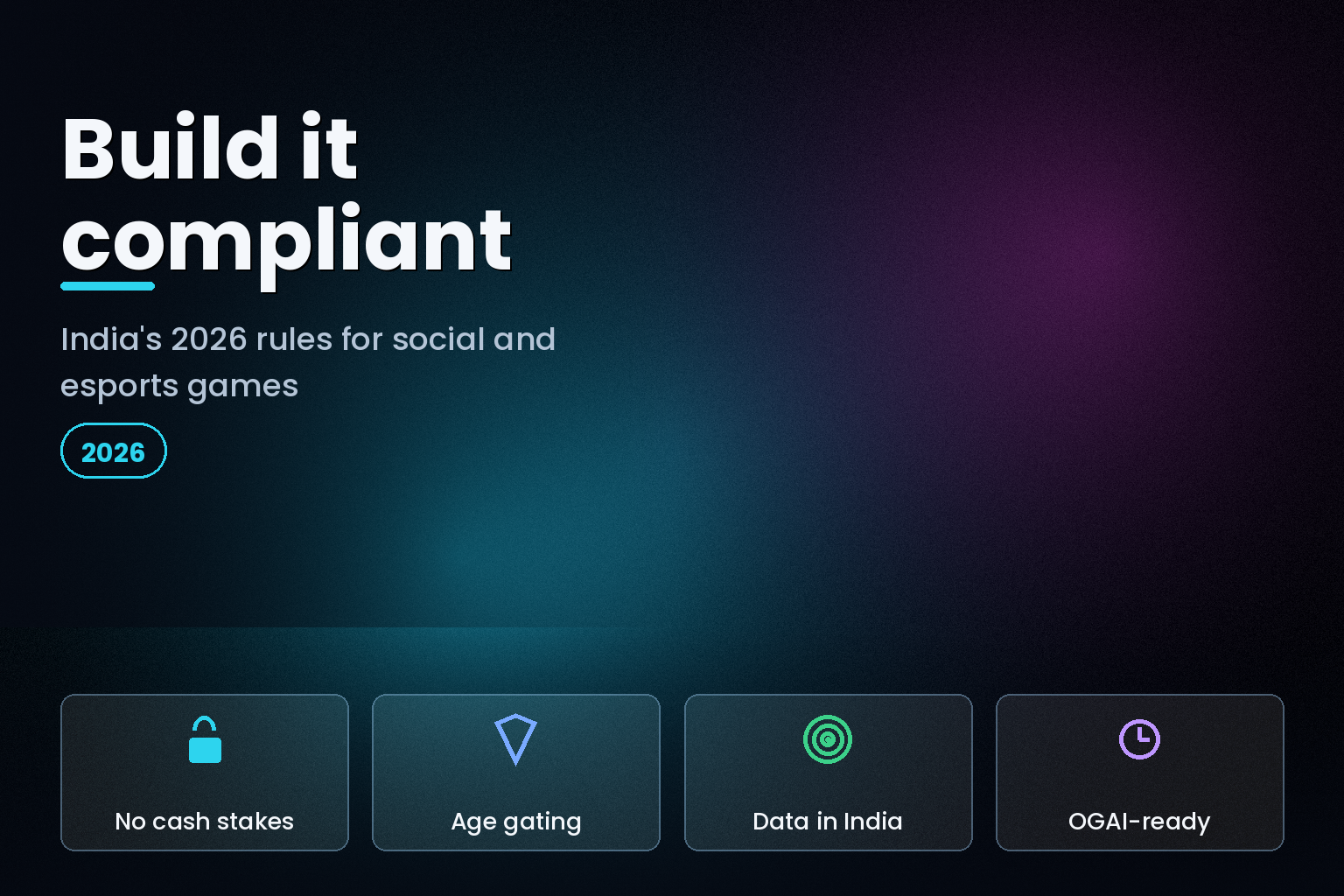
Summary. India's Promotion and Regulation of Online Gaming (PROG) Act, 2025 and its Rules, 2026 took effect on 1 May 2026, after publication on 22 April 2026. The framework bans every online money game outright, whether based on skill, chance, or both, and bars banks and payment systems from processing money for them; offering one can draw up to three years in prison and a fine up to ₹1 crore. The same law explicitly promotes online social games and esports, which is where the money and the opportunity now sit. India's gaming market is near $5.02 billion in 2026 and projected to reach $9.89 billion by 2031 at a 14.52% growth rate, and the government itself valued the sector at ₹23,200 crore heading to ₹31,600 crore by 2027. For founders and studios, the question changed on 1 May 2026 from "can we run a real-money game" to "how do we ship a social, casual, or esports title that clears the Online Gaming Authority of India." This guide answers that, and eCorpIT builds these apps.
What changed on 1 May 2026
The PROG Act was passed by Parliament in August 2025, and the Promotion and Regulation of Online Gaming Rules, 2026 brought it into force on 1 May 2026. The law does one clean thing: it splits online games into three buckets and treats them very differently. It also created a central regulator, the Online Gaming Authority of India (OGAI), to maintain banned lists, issue codes, handle grievances, and enforce compliance.
The dividing line is money staked in expectation of winning money. An online money game is any game, skill or chance or both, played by paying a fee or depositing a stake in expectation of a monetary return. Those are banned, along with their advertising and any payment facilitation. Everything built purely for entertainment, recreation, or skill development, with no stake and no cash prize, is an online social game and is allowed. Esports, played competitively without wagering, is allowed and encouraged.
| Category | Real-money stake or cash prize | Status under PROG | OGAI registration |
|---|---|---|---|
| Online money game | Yes | Banned outright | Not available |
| Online social game | No | Permitted | Usually not required |
| Esports | No (prize pools via sponsors, not user stakes) | Permitted and promoted | Required, via sports recognition |
| Advertising a money game | Any | Banned | Not applicable |
| Payment processing for a money game | Any | Banned for banks and PSPs | Not applicable |
If your revenue model depends on users depositing money to win money, there is no compliant version of it in India after 1 May 2026. If it does not, you have a clear runway.
What you can build
The permitted space is large and it is where the growth is. Casual and hyper-casual titles held roughly a third of India's 2025 gaming revenue on short, ad-supported sessions, and the esports segment alone is estimated near $240.3 million in 2026, growing at about 18% a year toward $765.3 million by 2033, per market research from IMARC. Concretely, you can build and monetise:
Social and casual games, from puzzle and word games to hyper-casual arcade titles, monetised with advertising, a subscription, a one-time access fee, or cosmetic in-app purchases. A subscription or access fee is allowed because it is not a stake and carries no expectation of winning money.
Esports titles and platforms, where players compete for recognition and sponsor-funded prize pools rather than staking their own cash. To be registered as esports, a title must be recognised under the National Sports Governance Act, 2025.
Skill-development, educational, and social-play experiences, including multiplayer social games, that sit in the residual permitted category, any online game that is neither a money game nor esports.
The monetisation rule is the one to internalise, so put it in a table your product and finance teams both sign off on.
| Monetisation method | Allowed under PROG | Note |
|---|---|---|
| In-app advertising | Yes | The backbone of casual and hyper-casual revenue |
| Subscription fee | Yes | Permitted, it is not a stake |
| One-time access or unlock fee | Yes | Permitted, no expectation of monetary winning |
| Cosmetic in-app purchases | Yes | Skins and items with no cash-out value |
| Battle pass or season pass | Yes | Content unlock, not a wager |
| Entry fee to win a cash prize | No | This is an online money game, banned |
| Real-money deposits and withdrawals for play | No | Banned, payment processors barred |
The compliance you have to engineer in
Permitted does not mean unregulated. The Rules attach user-safety duties to social games and esports, and several of them are engineering work, not policy documents. A game that ignores them can be fined up to ₹10 lakh by OGAI, and its registration suspended or cancelled. Build these in from the first sprint rather than bolting them on before launch.
| Requirement | What to implement | Applies to |
|---|---|---|
| Age verification and gating | Verifiable age checks at onboarding, not a self-declared checkbox | All permitted games |
| Parental controls | Guardian consent and controls for minors' accounts | Games accessible to minors |
| Usage time limits | Session and daily play-time caps with in-app prompts | All permitted games |
| Grievance redressal | In-app reporting and a defined resolution workflow | All permitted games |
| Counselling and safe-play support | Access to help resources and safe-play messaging | All permitted games |
| Fair-play and integrity | Anti-cheat, matchmaking integrity, dispute handling | Esports and competitive social games |
| Data localisation | Retain traffic data and metadata on computing resources in India | Social games and esports |
Two of these deserve emphasis because they change your architecture. Age verification has to be real, so you need an onboarding flow that checks age in a verifiable way and gates content and spending accordingly, which also intersects the Digital Personal Data Protection Act 2023 when a child's data is involved. Data localisation means the traffic data and metadata for your social game or esports title must sit on computing resources located in India, so your hosting region, logging pipeline, and analytics stack all have to keep that data onshore. Both are far cheaper to design in than to retrofit, which is a large part of what a DPDP-ready app development engagement handles.
Who actually needs to register with OGAI
Registration is not a blanket burden, and getting this right saves months. Under the Rules, mandatory registration applies to titles seeking recognition as esports and to specific social games the Centre notifies based on risk, scale, or origin. Most ordinary online social games can operate without compulsory registration and classification, though every permitted game still carries the user-safety and data duties above.
When registration does apply, operators submit a digital application to OGAI covering the game category, revenue model, target age group, user-safety measures, grievance mechanism, and compliance details, and the authority may review gameplay mechanics, payment structures, and platform architecture before approving. That review is the reason your monetisation design and your data flows need to be clean and documented before you apply, not negotiated afterward.
The market case for building now
The regulatory reset cleared a crowded real-money field and left the permitted categories with room and government backing. India's gaming market sits near $5.02 billion in 2026 on its way to $9.89 billion by 2031, per Mordor Intelligence, and the government has pegged the sector at ₹23,200 crore rising to ₹31,600 crore by 2027, per TalkEsport's coverage of the official valuation. Public money is behind the content side too, through the government's Animation, Visual Effects, Gaming and Comics (AVGC) initiative that funds studios and skilling for exactly the permitted categories you can build.
For a founder, that combination, a cleared field, a growing market, and state support for exactly the categories you can legally build, is the opening. The teams that move first with compliant social, casual, and esports titles get to a market that lost many of its incumbents overnight.
India-specific considerations
Two India rules shape the build beyond PROG itself. The DPDP Act 2023 governs personal data and children's data, which your age-verification and parental-control flows touch directly, and it pushes you toward data-minimising design and clear consent. The PROG data-localisation duty then requires the traffic data and metadata of your social or esports game to stay on computing resources in India, which affects your cloud region choice, your logging, and your analytics vendors. Designing for both at once, one age and consent layer, one onshore data plane, avoids reworking the app twice. For teams weighing where and how to build, our comparison of India versus US app development cost covers the delivery-model trade-offs.
How we build compliant game apps
eCorpIT designs the compliance into the product from the start: an age-verification and parental-control layer, session and time-limit controls, an in-app grievance and safe-play workflow, anti-cheat and fair-play systems for competitive titles, and an India-resident data plane for traffic and metadata. We build the games themselves in the stacks that fit your target, native Android with Android app development or cross-platform with Flutter app development, and we structure monetisation, ads, subscriptions, cosmetics, so it never crosses into a stake. If registration applies, we prepare the platform architecture and documentation OGAI expects to see. The result is a title you can ship in India without a compliance rebuild after launch.
FAQ
How eCorpIT can help
eCorpIT is a Gurugram-based, senior-led engineering organisation, founded in 2021 and certified for CMMI Level 5, MSME, and ISO 27001:2022, that builds social, casual, and esports game apps designed to meet India's 2026 online gaming rules. We engineer the required safeguards, age verification, parental controls, time limits, grievance and safe-play flows, fair-play systems, and an India-resident data plane, and we design personal-data handling aligned with DPDP Act 2023 requirements. If your title needs OGAI registration, we prepare the platform architecture and documentation to support it. To scope a compliant build, talk to our team.
References
- Promotion and Regulation of Online Gaming Rules, 2026, MeitY Digital India — official notification and in-force date.
- Promotion and Regulation of Online Gaming Rules, 2026, Press Information Bureau — government summary of the framework and categories.
- Promotion and Regulation of Online Gaming Act, 2025, Wikipedia — Act text summary, definitions, and penalties.
- Promotion and Regulation of Online Gaming Rules, 2026, Drishti IAS — analysis of the ban and permitted categories.
- Promotion and Regulation of Online Gaming Rules, 2026, Mondaq — compliance, registration, and safety obligations.
- India's online gaming law goes live May 1, India Briefing — operator obligations and data localisation.
- Government of India publishes new online gaming regulations, iGaming Business — mandatory user-safety measures.
- India esports market size and forecast, IMARC Group — esports market value and growth rate.
- India gaming market size and analysis, Mordor Intelligence — overall market size and 2031 projection.
- India government pegs online gaming market at ₹23,200 crore, TalkEsport — official sector valuation.
- Playing by the rules: India's Online Gaming Act and Rules explained, Bar and Bench — legal explainer on categories and registration.
_Last updated: 28 July 2026._