On this page · 9 sections
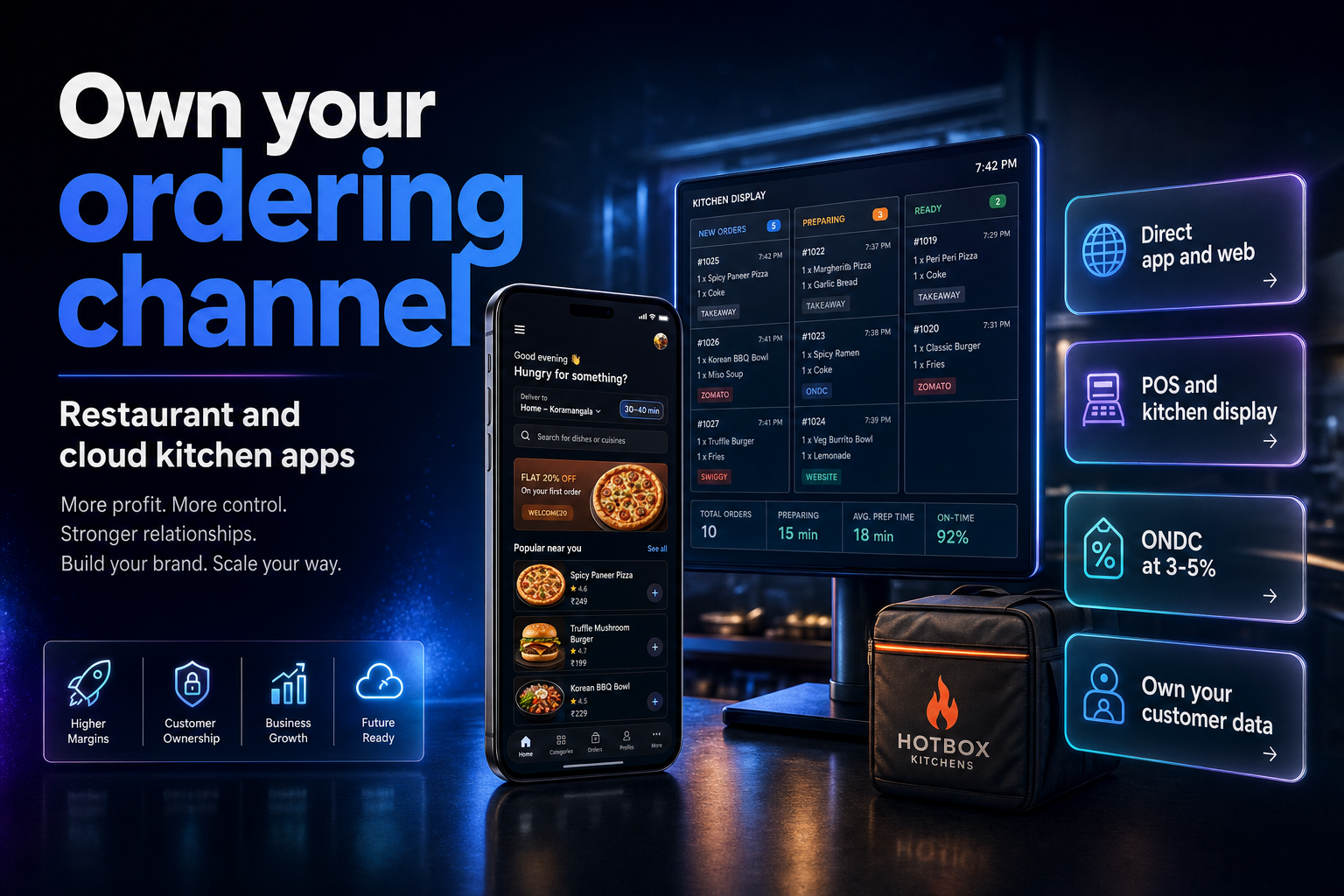
Summary. In 2026 a restaurant or cloud kitchen on Swiggy or Zomato hands over a lot per order: Swiggy takes roughly 18-25% and Zomato 15-30%, and after payment-gateway charges, ad spend, discount funding and GST on the platform fee, effective deductions often land in the 25-35% band, per restaurant-tech operators Petpooja and DineOpen. The Open Network for Digital Commerce (ONDC) runs food-delivery commission at about 3-5%, and it lets the restaurant keep its customer data. That gap is why a direct ordering channel, your own app, a web storefront, POS and kitchen-display integration, delivery, and an ONDC seller connection, is now a margin decision, not a vanity project. India's cloud kitchen market is estimated between roughly $1.1 billion and $2.9 billion across 2024-2026 depending on the research firm, and Zomato alone reports more than 60% delivery share and over 17 million monthly transacting customers. This guide covers what to build, how the channels compare, and where eCorpIT fits.
"For dine-ins, these platforms are doing little more than connecting us to the customer, yet they charge hefty commissions," said Sagar Daryani, president of the National Restaurant Association of India (NRAI). Aggregators still drive real discovery and volume, so the answer is rarely to leave them. It is to add channels you control so you are not renting your entire customer base.
The math: why a direct channel pays back
Start with one order. On a 400 rupee order at an effective 30% deduction, the aggregator keeps 120 rupees before you pay for food, packaging, and rider incentives. Move that same order to your own app or to ONDC at 3-5%, and you keep 100 or more of those rupees. The first few hundred direct orders a month usually cover the build.
| Channel | Typical commission | Customer data | Discovery and reach |
|---|---|---|---|
| Your own app and web | 0% (only payment-gateway fees) | You own it | You drive it (needs marketing) |
| Swiggy | about 18-25% | Held by platform | High, built-in |
| Zomato | about 15-30% | Held by platform | High, built-in |
| ONDC network | about 3-5% | Restaurant keeps access | Growing, open network |
| WhatsApp ordering | 0% (messaging and gateway fees) | You own it | Repeat and loyal customers |
The point is not to abandon aggregators, which supply genuine top-of-funnel demand. It is to route your repeat and loyal customers, who already know your brand, to channels where you keep the margin and the data. Daryani's public complaint that aggregators collect detailed restaurant data but do not share it is the other half of the case: your regulars are your asset, and a direct channel is how you keep them.
What a full restaurant or cloud kitchen stack includes
A direct channel is only as good as the operations behind it. A production build for a chain or cloud kitchen usually covers:
- Customer ordering: a native iOS and Android app plus a fast web or PWA storefront, menu and catalog management, live item availability, offers and a loyalty programme.
- Payments: UPI, cards and wallets through a gateway, with reconciliation.
- Kitchen operations: POS integration, a kitchen-display system (KDS), and real-time inventory so a sold-out item disappears from the menu instantly.
- Delivery: your own rider app, or integration with third-party logistics, plus live tracking.
- ONDC: a seller-side integration so you appear on the open network at 3-5% and reach buyers across ONDC apps.
- Data and analytics: first-party customer profiles, cohorts, repeat rate, and item-level margin, all under your control.
Cloud kitchens add one more axis: multiple virtual brands running out of one physical kitchen. The software has to route orders per brand, keep separate menus and analytics, and still hit one KDS and one inventory system. Teams building the delivery-heavy, dark-store style of operation will recognise the patterns in our note on quick commerce and dark-store app development.
The India market in 2026
Estimates for India's cloud kitchen market vary because firms measure it differently, so treat any single number with care.
| Source | Cloud kitchen market estimate | Note |
|---|---|---|
| IMARC Group | around $2.9 billion by 2026 | India-specific |
| Markets and Data | $1.24 billion in 2025, $3.69 billion by 2034 | 12.28% CAGR |
| Various 2024 estimates | about $1.13 billion in 2024 | methodology differs |
What is consistent is direction and demand: strong double-digit growth, aggressive expansion into 10-minute delivery, and the ONDC network operating across 600-plus cities with more than five lakh sellers, giving restaurants a lower-commission route to customers. For a full-stack build that also handles payments and settlements, our fintech and payments app development work covers the money side, and WhatsApp-first ordering ties into our WhatsApp and RCS business messaging service.
Driving orders to your own channel
A direct app does not fill itself. Aggregators supply discovery; your own channel needs a reason for the customer to return to it. The tactics that work are cheap relative to a 30% commission:
- Fund the switch with the saving. A first-order discount on your app costs less than the commission you were paying, so the math still favours you.
- Put a QR code on the table, the bill, and the delivery packaging that opens your app or web menu, not a third-party listing.
- Run a simple loyalty programme: points, a tenth-order reward, or member pricing that aggregators cannot match.
- Use WhatsApp for repeat orders and re-engagement, with consent, so a regular can reorder in two taps.
- Keep the menu, photos, and item availability identical across channels so the direct experience never feels second-best.
The goal is not to win every order back on day one. It is to move the customers who already know you, your repeat base, onto a channel where the margin and the data stay with you.
Common mistakes when going direct
Most direct-ordering projects that stall make the same errors:
- Cutting aggregator listings too early, before the direct channel has traction, and losing discovery volume in the process.
- Launching with no marketing budget, then concluding "direct does not work" when the real issue was zero demand generation.
- Skipping POS integration, which forces staff to key orders twice and creates errors during a rush.
- Treating delivery as an afterthought: without your own riders or a logistics integration, the promise breaks at the door.
- Ignoring DPDP consent, so the first-party data you collect cannot be used for the marketing that justified the build.
Avoiding these is mostly sequencing and operations, which is where an experienced build partner earns its keep.
What we build and how we engage
eCorpIT (eCorp Information Technologies Private Limited), founded in 2021 in Gurugram, is a CMMI Level 5 and MSME-certified engineering organisation with senior-led mobile and backend teams and partnerships across AWS, Microsoft, Google, and Shopify. We build direct ordering products for restaurants and cloud kitchens: customer apps, web storefronts, POS and KDS integrations, delivery and logistics, ONDC seller connections, and the analytics layer that keeps your customer data yours.
Our process is straightforward: a short discovery to map your menu, kitchens, and current channels; a phased build that ships a working ordering channel first, then adds delivery, ONDC, and loyalty; and a support model after launch. We design data handling aligned with the Digital Personal Data Protection Act, 2023 (DPDP), so customer profiles and order history are collected and stored with a lawful basis. We do not promise a fixed commission saving without seeing your numbers, and engagement is scoped to your stage, whether you are a single cloud kitchen or a multi-brand chain. The build is typically cross-platform, and teams comparing frameworks can see our Flutter app development approach.
How eCorpIT can help
If aggregator commissions are eating your margin and you want a direct channel you control, eCorpIT builds the full stack: a branded ordering app and web storefront, POS and kitchen-display integration, delivery, and an ONDC connection at 3-5%, with DPDP-aligned handling of your first-party customer data. We are a senior-led, CMMI Level 5, MSME-certified team based in Gurugram and founded in 2021, and we scope each build to your stage rather than a template. Talk to us to plan a restaurant or cloud kitchen app.
FAQ
References
_Last updated: July 26, 2026._