On this page · 12 sections
- Why this matters now
- The two numbers that drive every decision: RTO and RPO
- The four disaster-recovery strategies
- What failover covers, and what it does not
- How eCorpIT delivers resilience
- What resilience costs
- Common resilience mistakes we see
- Multi-region or multicloud: which problem are you solving
- India-specific considerations
- FAQ
- How eCorpIT can help
- References
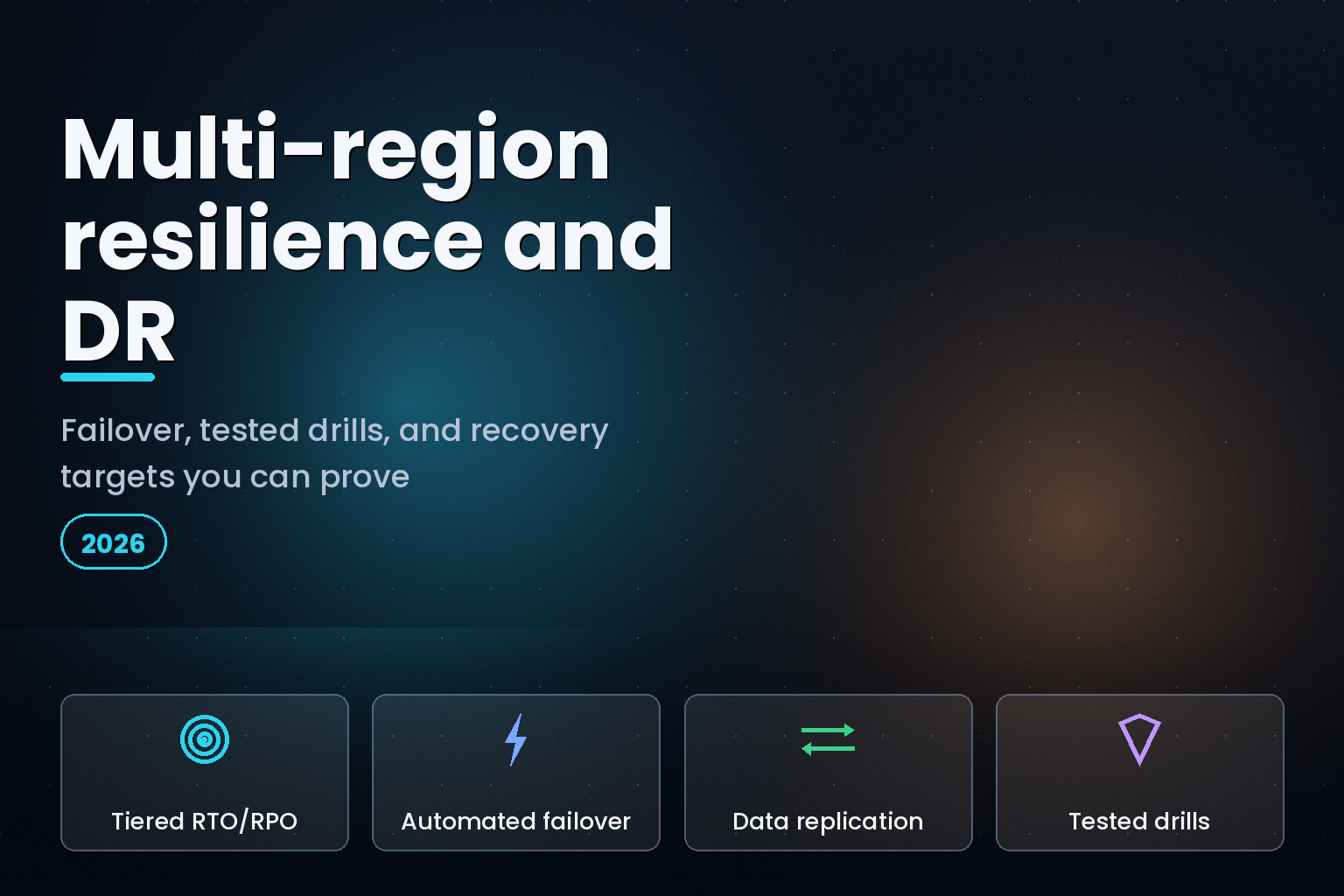
Summary. A single hour of downtime costs more than $300,000 for over 90 percent of midsize and large enterprises, per ITIC's hourly-cost-of-downtime survey, and Gartner's long-standing baseline is about $5,600 per minute, roughly $336,000 an hour. That the risk is real was clear on July 15, 2026, when a power and cooling failure took Google Cloud's europe-west4 region offline for 14 hours and 55 minutes. Resilience is not one switch; it is a choice among four disaster-recovery strategies, each with a different recovery point (RPO), recovery time (RTO) and cost. eCorpIT, a Gurugram engineering organisation founded in 2021 and certified for CMMI Level 5 and ISO 27001:2022, designs, builds and tests multi-region resilience on AWS, Microsoft Azure and Google Cloud. This article explains the four strategies, what failover does and does not cover, and how we deliver a DR posture whose RTO and RPO you can actually prove.
Why this matters now
Downtime is expensive in a way that is easy to underestimate until it happens. ITIC's survey puts one hour of outage above $300,000 for more than 90 percent of midsize and large firms; Gartner's older but still-cited figure is about $5,600 per minute. Those are averages across industries, and for a payments, healthcare or ecommerce platform the real number is higher, because lost transactions and regulatory exposure stack on top of idle infrastructure.
The other half of the problem is that a cloud region is not a guarantee. On July 15, 2026, an electrical fault on the utility grid feeding a Google data centre in the Netherlands cut power and disabled cooling; the europe-west4 region was unavailable for 14 hours and 55 minutes, from 16:39 PST on July 15 to 07:34 PST on July 16. Services including Google Cloud VMware Engine, Bare Metal Solution and Google Cloud NetApp Volumes were affected. The lesson was not that regions fail, which everyone knows, but that the failure can be partial and hard to see from the outside. Biswajeet Mahapatra, principal analyst at Forrester, told The Register: "The real issue is transparency: customers are generally told to use multiple zones and regions for resilience but are rarely given visibility into whether a particular managed service has a single-datacenter dependency within a zone."
That is the gap a deliberate resilience design closes: instead of trusting one region's promises, you decide in advance how fast you must recover and how much data you can afford to lose, then build to those numbers.
The two numbers that drive every decision: RTO and RPO
Every disaster-recovery choice comes down to two targets. Recovery time objective (RTO) is how quickly you must be serving again after a failure. Recovery point objective (RPO) is how much recent data you can afford to lose. A stock-trading platform may need an RTO and RPO measured in seconds; an internal reporting tool may be fine losing an hour of data and recovering the next morning. The mistake is applying one target to everything, which either overspends on non-critical systems or under-protects the ones that matter. The first thing we do is tier your workloads by business impact and assign each an honest RTO and RPO.
The four disaster-recovery strategies
Cloud providers converge on four strategies, from cheapest and slowest to fastest and dearest. The AWS resilience guidance frames them clearly, and the same shapes apply on Azure and Google Cloud.
| DR strategy | RPO / RTO | Relative cost | Best for |
|---|---|---|---|
| Backup and restore | RPO hours / RTO up to 24 hours | Lowest | Non-critical, dev and test workloads |
| Pilot light | RPO minutes / RTO hours | Moderate | Important systems that can tolerate a wait |
| Warm standby | RPO seconds / RTO minutes | Higher | Business-critical applications |
| Active-active (multi-site) | RPO near zero / RTO near zero | Highest | Systems that cannot go down |
Backup and restore keeps periodic backups and rebuilds in a second region only after a failure; it is cheapest and slowest. Pilot light keeps a minimal core of infrastructure always running in the secondary region with continuous replication, then scales it up on failover. Warm standby runs a scaled-down but fully working copy in the second region, so failover is fast. Active-active runs both regions live at once for the lowest possible recovery times, at the highest cost. Lower recovery times cost more, so the discipline is to match the strategy to each workload's tier rather than buying active-active for everything.
What failover covers, and what it does not
A common and costly assumption is that "multi-region" means "safe." Modern platform failover, such as Google Cloud Run's automated cross-region failover that reached general availability in July 2026, moves the stateless compute tier to a healthy region automatically. It does nothing for your data tier. If your primary database was in the failed region, the compute can fail over perfectly and the application still breaks because it has nowhere to read and write.
| Layer | Fails over automatically? | What it needs |
|---|---|---|
| Stateless compute | Yes, with a multi-region load balancer | A health check that tests real dependencies |
| Relational database | No | A cross-region replica and a promotion runbook |
| Object storage | Depends on configuration | Multi-region or dual-region buckets |
| Session and in-memory state | No | Externalise it, or accept loss on failover |
Cross-region database replicas typically use asynchronous replication, so a failover has a non-zero RPO: some recent writes can be lost unless you run synchronous, active-active data at higher cost and complexity. Getting this right is the difference between a resilience design that holds and one that looks good on a diagram. For the compute side of this pattern in detail, our guide to Cloud Run cross-region failover walks through the load-balancer setup and the same data-tier caveat.
How eCorpIT delivers resilience
We treat resilience as an engineering project with a measurable outcome, not a product to install. A typical engagement moves through four stages.
First, an assessment. We map your application portfolio, tier each workload by business impact, and set an honest RTO and RPO for each. We also look for the hidden single points of failure the Forrester analysis warns about, including managed services with a single-facility dependency inside a zone.
Second, a design. We select the DR strategy per workload, backup and restore, pilot light, warm standby or active-active, and design the compute failover, the data replication, and the network routing to match. We work across AWS, Azure and Google Cloud, so a multicloud or cross-region design uses each provider's native failover primitives rather than a lowest-common-denominator wrapper.
Third, implementation. We build the multi-region deployment, the health checks that test real dependencies, the database replication and promotion path, and the observability to see a failover as it happens. Where cost control across regions matters, we fold the second region's always-on footprint into a FinOps review from the start.
Fourth, drills. A DR plan that has never been tested is a hypothesis. We run game days that actually fail a region and a data path, measure the recovery, and write down the RTO and RPO you achieved, not the ones you hoped for. Those measured numbers are what belong in your SLA.
We position ourselves honestly: eCorpIT is a senior-led, multi-disciplinary organisation, CMMI Level 5, MSME and ISO 27001:2022 certified, and a partner of AWS, Microsoft and Google. We design systems aligned with the availability and data-protection requirements our clients operate under; we do not claim certifications we do not hold. Related work sits in our cloud FinOps managed service and cloud migration and modernization service, and this resilience work clusters under our broader approach to cutting and controlling cloud spend for Indian teams.
What resilience costs
Resilience has a running cost, and being honest about it up front avoids nasty surprises. The main lines are a second region's compute (warm standby and active-active keep instances running there), cross-region data replication and transfer, and a multi-region load balancer. On Google Cloud, for example, a global external load balancer's forwarding rule runs about $0.025 per hour with data processing at $0.008 per GiB each way; a cross-region internal load balancer carries a three-proxy minimum of about $0.075 per hour. Those are small next to a $300,000 hour of downtime, but they are real monthly lines, and the point of tiering workloads is to spend them only where the recovery target justifies it. We size this deliberately so you are not paying active-active prices for a reporting dashboard.
Common resilience mistakes we see
Most failed recoveries trace back to a handful of avoidable errors, and naming them is half the fix.
The first is treating backups and replication as the same thing. They solve different problems and you need both. Replication copies your data to another region continuously, which protects against losing a region, but it also faithfully copies a bad write or an accidental deletion to the replica within seconds. Backups, taken at points in time, are what let you roll back corruption. A design with replication but no backups is one fat-fingered query away from losing data in both regions at once.
The second is never testing failover. A plan that has not been exercised is a hypothesis, and the AWS resilience guidance is blunt about running game days that actually fail a Region and checking the result against your stated RTO and RPO. We have seen well-drawn architectures fail their first real drill because a security group, a certificate, or a database promotion step was never validated under load.
The third is one RTO for everything. Applying a single recovery target across the whole estate either overspends on systems that could tolerate a slower recovery or, worse, under-protects the ones that cannot. Tiering by business impact is what makes the budget defensible.
The fourth is ignoring the data tier, covered above: platform failover moves compute, not your database. The fifth is the hidden single-facility dependency inside a zone that the Forrester analysis flags, where a managed service you assumed was zone-redundant turns out to lean on one building. The sixth is a health check that only asks "is the process alive" rather than "can this instance reach a writable database," which tells a load balancer to keep routing traffic into a region that cannot serve it. We check for all six in the assessment stage, because each one quietly converts a resilience investment into theatre.
Multi-region or multicloud: which problem are you solving
Teams often conflate two different resilience strategies, and they carry very different costs. Multi-region means running in two regions of the same cloud provider. It protects against a regional outage like the July 2026 Netherlands event, it uses the provider's native failover primitives, and it is the right first move for almost everyone because the operational surface stays inside one platform.
Multicloud means running across two providers, for example AWS and Google Cloud. It protects against a provider-wide failure or against strategic lock-in, but it roughly doubles the operational surface: two identity models, two networking stacks, two sets of tooling, and data-transfer costs between them. It is justified by specific concentration-risk or regulatory reasons, not adopted by default. When it is the right call, the design has to be deliberate about cost and security; our analysis of an AWS and Google Cloud multicloud cost architecture and the multicloud security posture decision guide work through those trade-offs. In most engagements we recommend getting multi-region resilience right first, then treating multicloud as a separate, heavier decision with its own business case.
India-specific considerations
For teams operating in India, resilience and data residency intersect. Google Cloud offers asia-south1 (Mumbai) and asia-south2 (Delhi), and AWS and Azure both run Indian regions, so an in-country multi-region design keeps both copies of data inside India, which matters for latency and for expectations under the Digital Personal Data Protection Act (DPDP), 2023. If your recovery model needs wider geographic separation than two Indian regions provide, pairing an Indian region with a distant one changes both your latency budget and your data-residency position, so it is a deliberate design decision, not a default. We help you make that trade-off explicitly, and we keep the cross-region transfer cost, which is charged even when traffic never leaves the country, inside the FinOps plan from day one.
FAQ
How eCorpIT can help
eCorpIT designs, builds and tests multi-region resilience and disaster recovery on AWS, Azure and Google Cloud. We tier your workloads, set honest RTO and RPO targets, implement compute failover and data-tier replication, and run the game days that prove your recovery numbers before you need them. As a Gurugram-based, senior-led, CMMI Level 5 and ISO 27001:2022 certified organisation, we build resilience that is sized to your risk, not sold by the tier. To scope a resilience review or a DR rollout, talk to our cloud engineering team.
References
_Last updated: July 31, 2026._