On this page · 11 sections
- What "legaltech" actually covers in 2026
- The reliability problem you are designing around
- Build vs buy: the decision that matters
- The India-specific build
- How a legal-AI feature should be architected
- A phased way to build without betting the firm
- What to check before you build or buy
- What changes by firm size
- How eCorpIT can help
- FAQ
- References
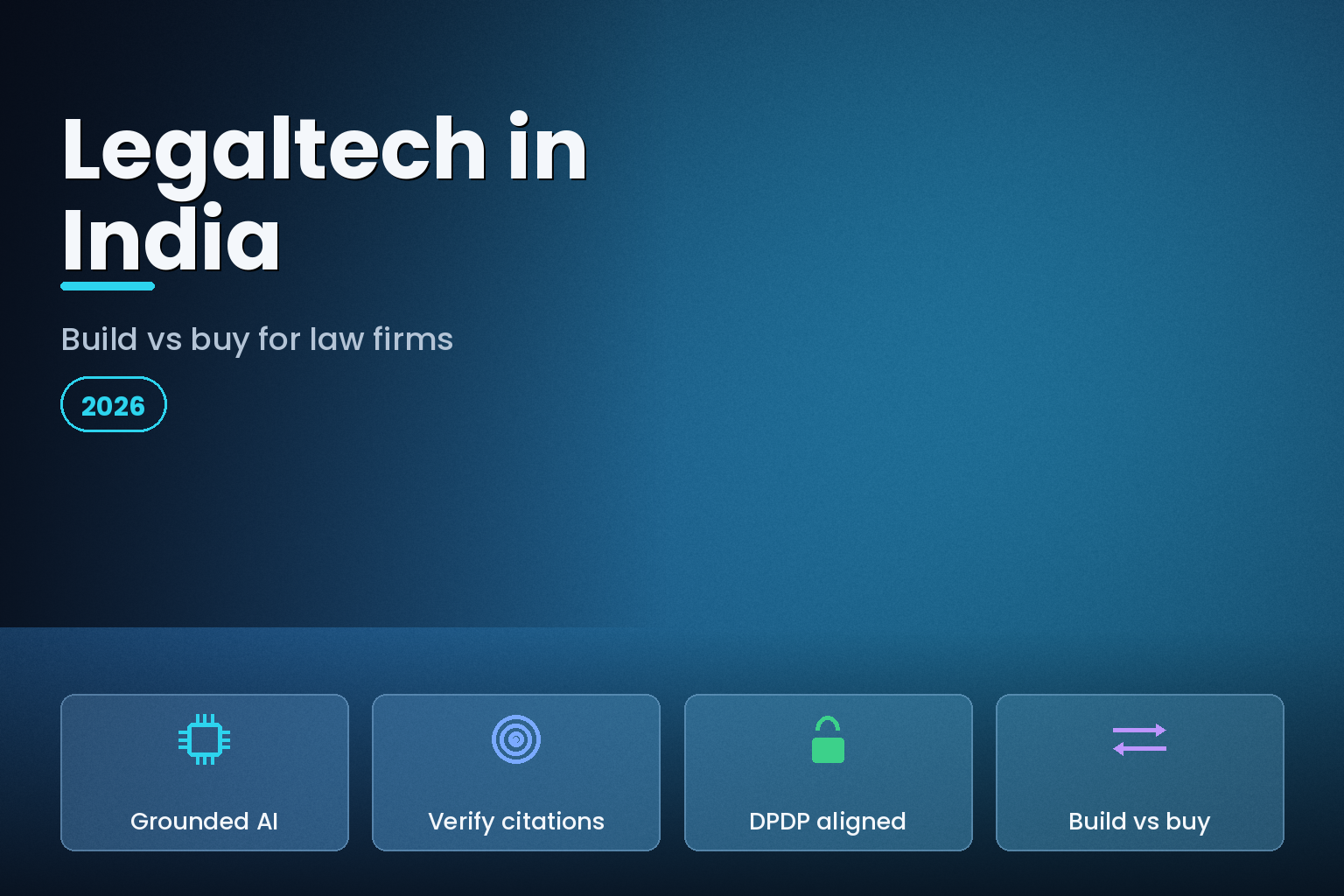
Summary. Legal work is document work, and document work is now software. India's broader legaltech market is estimated at about 1.28 billion dollars for 2026, growing near a 15.2 percent compound annual rate through 2030, according to one market analysis, while the narrower India legal-AI segment is far smaller, valued around 29.5 million dollars and projected to pass 106.3 million dollars by 2030 in a separate estimate. The pull is obvious; the risk is specific. Independent testing at Stanford found that leading legal AI research tools still hallucinate on roughly 17 to 33 percent of queries, and purpose-built tools clear 90 percent accuracy on standard clause identification only for well-established document types, with accuracy dropping on complex sets and on documents beyond about 200,000 tokens. That gap decides what a firm should buy off the shelf and what it should build and control. This guide, written for Indian law firms, in-house legal teams, and legaltech founders, sets out the categories, the reliability problem, a build-versus-buy table, and where personal data under the Digital Personal Data Protection Act 2023 raises a penalty ceiling of 250 crore rupees. eCorpIT, a Gurugram engineering organisation founded in 2021, builds this software; the last section covers how.
Legaltech is not one product. It spans practice and matter management, contract lifecycle management, AI-assisted legal research, document automation, e-discovery, online dispute resolution, and secure client portals. The enterprise mobile app development guide covers the general build discipline; here the focus is the legal-sector specifics that change the decision.
What "legaltech" actually covers in 2026
A useful way to scope a legaltech build is by workflow, not by buzzword. Matter and practice management is the system of record: clients, matters, time, billing, deadlines. Contract lifecycle management runs a document from draft through negotiation, signature, and renewal. Legal research and drafting is where large language models now sit, summarising authorities and proposing clauses. Document automation turns templates and intake answers into first drafts. E-discovery and review classify large document sets. Client portals give the people a firm serves a secure window into their own matters.
Most firms already buy several of these. The design question is not whether to adopt software, it is which parts are commodity and which carry the firm's own advantage. A generic e-signature flow is commodity. A review workflow tuned to a firm's practice areas, sitting on its own matter history, is not.
The reliability problem you are designing around
Any legal-AI feature has to be built against a hard fact: current tools are wrong often enough that unverified output is a liability. The Stanford study that tested vendor research assistants reported hallucination on roughly 17 to 33 percent of queries even for tools grounded in real legal databases. Purpose-built systems do better on narrow tasks, clearing 90 percent accuracy on clause identification for standard contract types, but that number falls on unusual clauses, interconnected contract sets, and very long documents.
The engineering response is not a better prompt. It is architecture. A reliable legal-AI feature retrieves from a trusted, current corpus rather than relying on the model's memory, shows the source passage next to every generated claim, and verifies each citation against the source before it reaches a lawyer. The human stays responsible for the filing; the software's job is to make verification fast and to make an unsupported claim visible, not to hide it. Any vendor or internal team that markets "hallucination-free" is overselling, and the Stanford numbers are the reason to design for verification rather than trust.
Build vs buy: the decision that matters
Buy the commodity, build the differentiator. Buy where a mature vendor already solves a standard problem at lower total cost than you could: e-signature, standard word-processing add-ins, general-purpose research subscriptions. Build where the workflow is specific to your practice, where your own data is the advantage, or where an integration into Indian systems does not exist off the shelf. The table below compares the two paths on the vectors that decide total cost of ownership.
| Vector | Buy (off-the-shelf) | Build (custom) |
|---|---|---|
| Time to market | Days to weeks | Weeks to a few months |
| Upfront cost | Low, subscription-based | Higher, one-time engineering |
| Ongoing maintenance | Vendor-managed | Your team or a partner |
| Data control and residency | Vendor terms | Full control, India region |
| Fit to your workflow | Generic | Exact |
| DPDP handling | Vendor-dependent | Designed to your duties |
| AI on your own corpus | Rare | Yes |
The pattern most Indian firms and legal teams land on is a hybrid: buy the commodity layers, then build a thin, owned layer on top where the advantage lives, the matter data, the practice-specific review logic, the India integrations, and the client experience. A contract-heavy corporate team, for example, buys e-signature and builds a clause library plus a review assistant grounded on its own executed agreements. This is the same logic behind a lean SaaS MVP build: spend engineering only where it compounds.
| Layer | Usually buy | Usually build |
|---|---|---|
| E-signature | Yes | No |
| General legal research | Yes | Rarely |
| Matter and billing core | Sometimes | Often, for fit |
| Contract review on own data | No | Yes |
| Client portal and branding | No | Yes |
| India integrations (eSign, courts) | No | Yes |
The India-specific build
Building for the Indian market adds requirements a global tool rarely covers. Aadhaar-based e-signature is the accepted digital execution path for many domestic documents, and integrating it well, with proper consent and audit, is India-specific work. Court and filing integrations, multilingual handling for documents and search, and data residency inside an India region all sit outside a generic imported product. These are exactly the parts worth building, because they are where an off-the-shelf tool falls short and where a custom web application earns its cost.
Data protection is not optional here. A law firm is among the most sensitive data fiduciaries there is: client files, financials, and case strategy are personal and confidential data under the DPDP Act 2023. The Act sets penalties up to 250 crore rupees for a failure of reasonable security safeguards that leads to a breach, and its Rules were notified on 13 November 2025 with substantive compliance due by 13 May 2027. A legaltech build should therefore treat consent, retention limits, access logging, and redaction of personal data before it reaches any hosted model as core requirements, not add-ons. eCorpIT designs applications aligned with DPDP requirements and builds the same controls into DPDP-ready applications across sectors.
How a legal-AI feature should be architected
The safe pattern for a drafting or research assistant has four parts. Ground it: retrieve from a maintained corpus of authorities, templates, and the firm's own executed documents, so the model works from real text. Cite it: attach the exact source passage to every generated statement. Verify it: check each citation resolves to a real, current source before display, and flag anything that does not. Protect it: redact personal data before the prompt leaves your boundary, and keep an audit trail of what was processed. That last control matters because pasting a client record into a general model is both a reliability risk and a data-protection one. Retrieval-grounded generation with citation verification is the difference between a demo and a tool a partner will sign off on.
A phased way to build without betting the firm
The safe way to build legaltech is to avoid replacing everything at once. Start with a short discovery that maps the highest-value workflow and its data, usually contract review, intake, or matter tracking, and agree what good looks like before any code. Then build a thin vertical slice: one workflow, end to end, on real data, so lawyers use it and give feedback early instead of at the end. Add integrations next, e-signature, the systems of record, and any court or filing endpoints, once the core earns trust. Finish with hardening: access controls, audit logging, retention rules, and a data-protection review, then a handover the firm's own team can run. This sequence keeps spend tied to value and lets a firm stop at any point with something usable.
For a legal-AI feature specifically, budget for evaluation, not just the build. A grounded assistant needs a test set of real queries with known-good answers, run on every change, so a model or prompt update that quietly raises the hallucination rate is caught before a lawyer sees it. Treat citation verification as a gate that fails closed: if a cited authority cannot be resolved to a current source, the assistant should say so rather than present it. This is the discipline behind reliable SaaS MVP delivery, applied to a setting where a wrong answer carries professional consequences.
What to check before you build or buy
Whether you buy a tool or commission a build, the same questions separate a safe choice from a costly one. The table names the criteria that matter most in a legal setting.
| Criterion | Why it matters |
|---|---|
| Data residency | Sensitive matter data should sit in a region you control, not an unspecified location |
| Grounding and citations | AI output must trace to a real source, verified before display |
| Export and no lock-in | Your matters and templates must be yours to leave with |
| Audit logging | You must show who accessed what, a DPDP accountability duty |
| Access control | Matter-level permissions, not all-or-nothing access |
| Integration roadmap | E-signature, courts, and systems of record must connect |
| DPDP alignment | Consent, retention, and redaction designed in, not bolted on |
A vendor that cannot answer these, or a build plan that skips them, is a risk regardless of how good the demo looks. Owning the differentiated layer means these controls are yours to set.
What changes by firm size
The right build differs by who you are. A boutique or solo practice gains most from automating intake and document assembly, which removes hours of repetitive drafting, and usually buys research and e-signature rather than building them. A mid-size firm often needs a matter and billing core that fits its practice mix, plus a review assistant grounded on its own precedents. A large firm or an in-house corporate team typically has the document volume to justify a legal-AI layer over its own contract history, tighter access controls across teams, and deeper integrations into enterprise systems. Matching the build to the firm, rather than copying another firm's stack, keeps the investment proportionate.
How eCorpIT can help
eCorpIT builds custom legaltech applications for Indian law firms, in-house legal teams, and legaltech founders: matter and contract systems, retrieval-grounded legal-AI assistants with citation verification, Aadhaar e-signature and court integrations, and secure client portals. Founded in 2021 and based in Gurugram, we are a CMMI Level 5, MSME, and ISO 27001:2022 certified engineering organisation, and our senior-led teams work with AWS, Microsoft, and Google cloud platforms to ship production software with data residency, access control, and applications designed aligned with DPDP Act 2023 requirements. We help you decide what to buy and what to build, then build the part that carries your advantage. To scope a legaltech build, contact us.
FAQ
References
_Last updated: 1 August 2026._