On this page · 10 sections
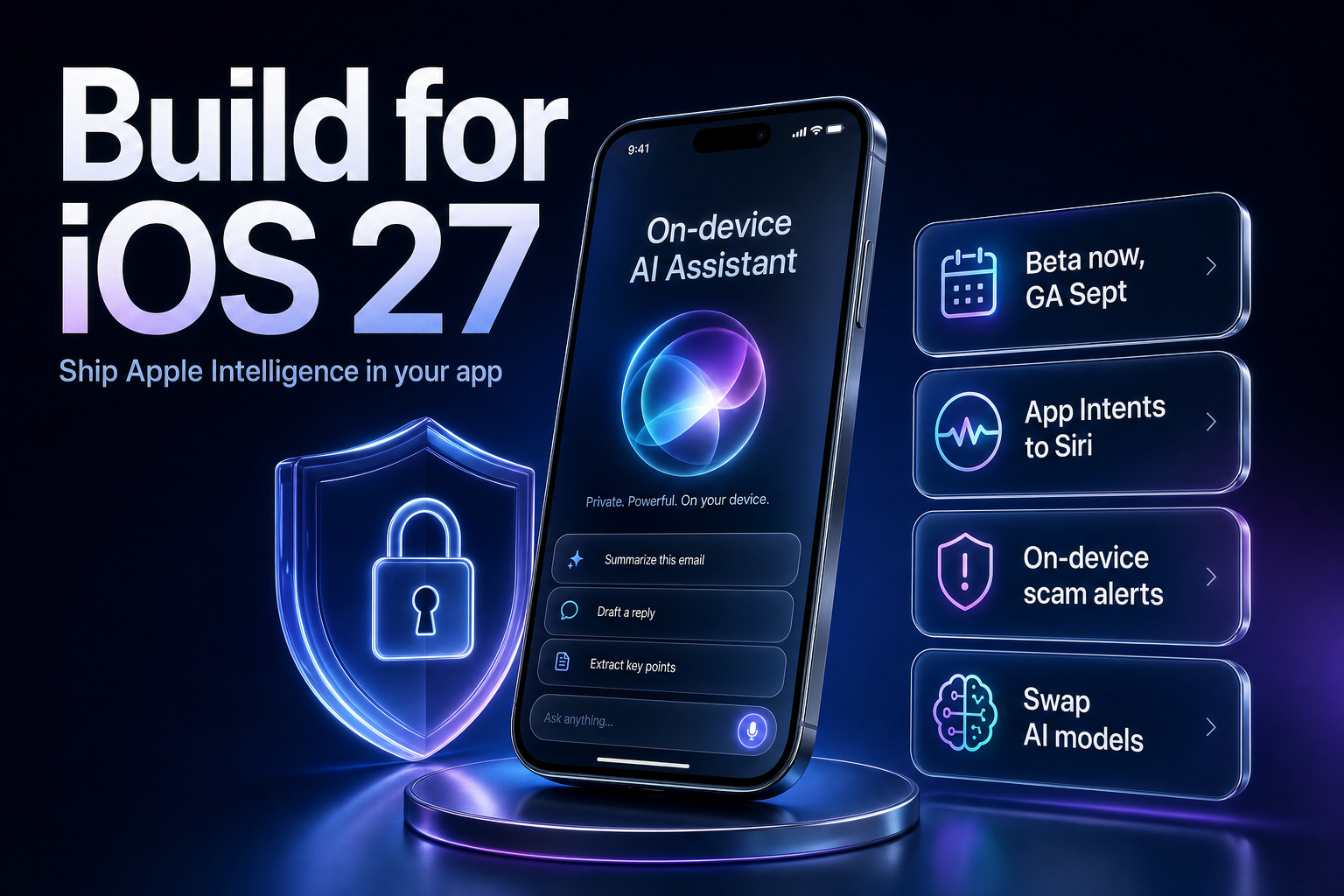
Summary. iOS 27's first public beta arrived in mid-July 2026, running on every iPhone from the iPhone 11 onward, with general release expected around September 2026. For enterprise app teams, three changes matter most. App Intents is now the only way Siri can call into a third-party app, so any brand that wants a voice or assistant presence must adopt it. The Foundation Models framework adds a new LanguageModel protocol that lets developers swap between Apple, Claude, and Gemini models without changing downstream code. And a new on-device Trust Insights framework helps apps detect social-engineering scams in real time, a direct answer to fraud that cost US consumers about $15.9 billion in 2025, including $3.5 billion to imposter scams, per the Federal Trade Commission. Apple Intelligence still needs an iPhone 15 Pro or newer. This playbook covers what to build, the timeline to plan around, and how eCorpIT ships iOS 27-ready enterprise apps.
What is new for developers in iOS 27
iOS 27 pushes Apple toward an AI-first operating system where users talk to Siri in natural language and Siri acts inside apps. At WWDC 2026, Apple detailed the frameworks that make that possible, and the newsroom laid out the developer story in June 2026.
| Framework | What it does | Enterprise use |
|---|---|---|
| App Intents | The only path for Siri to call into your app | Voice actions, shortcuts, assistant presence |
| Foundation Models | On-device intelligence; LanguageModel protocol | Private, offline AI features; model swap |
| Trust Insights | On-device scam and social-engineering detection | Fraud protection in fintech and comms apps |
| Core AI | Deploy custom on-device models | Domain-specific models on device |
| Xcode 27 | Agentic coding across the codebase | Faster SwiftUI builds and localisation |
The through-line is on-device intelligence with privacy by design, which suits enterprises that cannot send user data to a cloud model without a compliance review.
The App Intents mandate
The single change no enterprise can ignore is that Apple made the expanded App Intents framework the only way Siri can call into a third-party app. If your app has no App Intents, it has no Siri presence in iOS 27, full stop. That turns App Intents from a nice-to-have into table stakes for any brand that wants users to reach its functions by voice or through Siri's on-screen awareness and personal context.
Adopting App Intents means modelling your app's key actions and entities so Siri can understand and trigger them. Done well, a banking app lets a user say a natural request and have Siri complete it inside the app; done not at all, the app is invisible to the assistant layer. Our iOS 27 enterprise rollout plan covers sequencing this alongside a fleet upgrade.
Foundation Models and model flexibility
The Foundation Models framework lets apps ship intelligent features that run on device, with multimodal image input and a new LanguageModel protocol. The protocol is the strategic part: it lets developers swap between Apple, Claude, and Gemini models without rewriting downstream code. For enterprises, that means you can start with Apple's on-device model for privacy-sensitive tasks and route heavier work to a cloud model, changing providers later without re-architecting.
This flexibility pairs with Writing Tools, Image Playground, visual intelligence, and contextual suggestions across Messages, Mail, and Calendar, all features an enterprise app can build on. Xcode 27 adds agentic coding workflows that plan changes, build SwiftUI views, and localise string catalogs, which shortens delivery.
Trust Insights: a fraud-protection opening
Trust Insights is the feature with the clearest enterprise value, especially for banking, fintech, and communications apps. It helps apps detect when a user may be getting scammed in real time across voice calls, texts, and emails, and it does so mostly on device by analysing interaction patterns, timing, context, and basic sensor data.
The privacy model is the selling point. Trust Insights does not inspect the contents of Photos, Messages, or Mail. It analyses behavioural signals on device, discards the underlying data immediately, and sends only a single output value to Apple's servers. When it detects risk, it can assign a medium or high level, and your app can add a warning, a delay, or an extra verification step. Against a fraud problem that cost US consumers roughly $15.9 billion in 2025, a well-designed intervention is both a safety feature and a trust differentiator. Our note on testing iOS 27 scam-detection features for enterprises covers the QA side.
What enterprises should build now
Map features to frameworks and to your product, rather than adopting everything at once.
| Build this | Using | Best for |
|---|---|---|
| Voice actions and Siri shortcuts | App Intents | Any consumer-facing app |
| On-device private AI features | Foundation Models | Regulated data, offline use |
| Real-time scam interventions | Trust Insights | Banking, fintech, telecom, comms |
| Model-flexible AI features | LanguageModel protocol | Teams avoiding provider lock-in |
| Writing and image features | Apple Intelligence APIs | Productivity and content apps |
The timeline to plan around
iOS 27's public beta is live now, and general release is expected around September 2026, following Apple's usual autumn pattern. That gives enterprise teams a working window: build and test against the beta through the summer, and be ready for day-one support when users update in September. Every iPhone from the iPhone 11 runs iOS 27, but Apple Intelligence and the new Siri require an iPhone 15 Pro or newer with the A17 Pro chip, so plan feature availability by device tier. Our Apple Intelligence day-one features guide for India covers what ships first.
India-specific considerations
For Indian enterprises, two factors shape the plan. Language: Apple Intelligence reached India with iOS 18.4 in March 2025, and Siri handles English mixed with Hindi and several regional languages, but full regional-language support tends to arrive in a staggered rollout rather than at launch, so validate which languages your users actually get. Privacy and compliance: on-device processing in Foundation Models and Trust Insights is an advantage under the Digital Personal Data Protection Act, 2023, because sensitive analysis stays on the device, but you still need consent and clear purpose for any data you do collect. For fintech apps, Trust Insights aligns well with anti-fraud obligations while keeping user data local.
How eCorpIT can help
eCorpIT is a Gurugram technology consultancy, founded in 2021, with senior iOS and Swift engineers who build Apple Intelligence-ready enterprise apps. We model your app's actions as App Intents so it works with the new Siri, ship on-device features with the Foundation Models framework and its model-flexible LanguageModel protocol, and integrate Trust Insights for real-time fraud protection in banking and fintech apps. We design data handling aligned with Digital Personal Data Protection Act, 2023 requirements, taking advantage of on-device processing. Engagements usually start with an iOS 27 readiness assessment and a prioritised feature plan, then build and test against the beta so you are ready for the September general release. This suits enterprises that want a genuine assistant presence and fraud protection, not a checkbox. To plan your iOS 27 build, contact us.
FAQ
References
- WWDC26 Apple Intelligence guide — Apple Developer
- Inside Apple Intelligence and Xcode: special presentation, WWDC26 — Apple Developer
- FTC data show people reported losing $3.5 billion to imposter scams in 2025 — Federal Trade Commission
- iOS 27 public beta is coming soon — MacRumors
- How to get Apple Intelligence in India — Apple Support
_Last updated: July 14, 2026._