On this page · 11 sections
- Why the beta is your security test window
- Feature 1: Trust Insights, real-time scam detection
- Feature 2: Lockdown Mode you can now monitor from MDM
- Feature 3: Background Security Improvements, silent patches between updates
- Feature 4: Device.system.health, hardware integrity you can query
- Feature 5: stricter TLS enforcement that can break your MDM
- A CTO test checklist for the July beta
- India-specific considerations
- FAQ
- How eCorpIT can help
- References
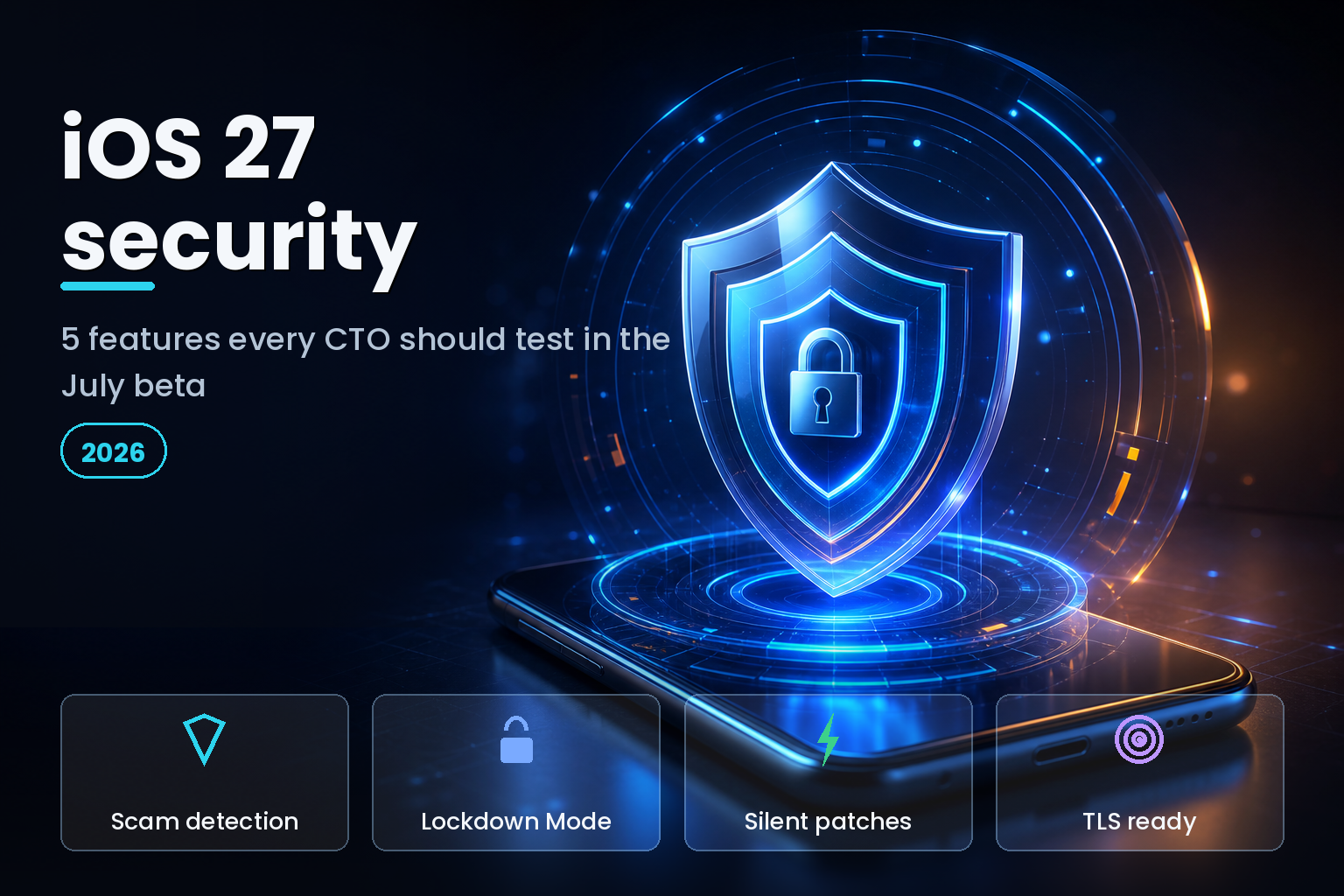
Summary. iOS 27, announced at WWDC 2026 on June 9, 2026, ships several security changes that matter to an enterprise, and the public beta expected around July 14, 2026 is the window to test them before the September 2026 release. Five stand out: Trust Insights, a framework that flags scam coercion in real time; Lockdown Mode that MDM can now monitor through a new status item; Background Security Improvements that patch silently between updates; Device.system.health, which reports hardware integrity; and a stricter TLS requirement that can break your MDM if your servers are not ready. The context is not gentle: United States consumers reported $15.9 billion in fraud losses in 2025, running a managed fleet costs $3.25 to $9 per device each month, and iOS 27 now enforces TLS 1.2 or later, with 1.3 recommended, on the very processes that run device management. This guide covers what each feature does and exactly what a CTO or security lead should validate during the beta.
One of these five, the TLS change, can silently break enrolment and updates if your servers lag. The other four are protections you want to turn on with confidence. Both reasons point to the same action: test on the beta now, not after the fleet upgrades in September.
Why the beta is your security test window
Security features are the ones you least want to discover on launch day. The two months between the July public beta and the September general release give a security team time to validate behaviour on a small set of enrolled test devices, confirm that new controls work with your MDM, and fix the one change that can break enrolment before it reaches the fleet. Apple's WWDC26 device management updates document the enterprise-facing changes, and most reward early testing rather than launch-day surprise.
For a broader rollout structure around these tests, see our iOS 27 enterprise rollout plan, which stages the whole upgrade from beta to launch.
Feature 1: Trust Insights, real-time scam detection
Trust Insights is a new iOS 27 framework that helps an app detect, in real time, when a user is being coached through a scam. It runs mostly on-device, reads behavioural signals rather than message content, and assigns a medium or high risk level so your app can add a warning, a delay, or extra verification, per 9to5Mac. It covers five operation categories, from payments to account changes, and does not inspect the contents of Photos, Messages, or Mail, per AppleMagazine.
For a CTO whose company ships a consumer or fintech app, this is a direct control on authorised-payment fraud, the kind that backend checks miss because the user is logged in and acting themselves. Test it against your riskiest flows during the beta, and design the intervention so a real coercion signal triggers friction without annoying legitimate users.
Feature 2: Lockdown Mode you can now monitor from MDM
Lockdown Mode is Apple's extreme-protection setting for high-risk users, and iOS 27 makes it more useful to an enterprise in one specific way: on supervised devices, device management can subscribe to a new security.lockdown-mode status item that reports whether Lockdown Mode is on, per Apple's deployment updates. For the first time, IT can see this state proactively rather than asking the user.
Ivan Krstić, Apple's head of Security Engineering and Architecture, has framed the feature's purpose plainly: "While the vast majority of users will never be the victims of highly targeted cyberattacks, we will work tirelessly to protect the small number of users who are." For an enterprise, the executives, finance staff, and administrators who are worth targeting are exactly that small number. Test the new status item in the beta so you can confirm Lockdown Mode is active on the accounts that most need it.
Feature 3: Background Security Improvements, silent patches between updates
Background Security Improvements, the mechanism Apple built to replace the older Rapid Security Response, deliver lightweight security patches between full software updates for components such as Safari, the WebKit stack, and other system libraries, per Apple's support documentation. They install quickly and can be undone if a patch causes problems, which is why they reach devices faster than a full update.
The enterprise question is whether your management policy allows them. Test during the beta that background security patches install on your managed devices and that your update policy does not inadvertently block them. A patch that ships in hours rather than weeks is a meaningful reduction in exposure window, but only if your configuration lets it land.
Feature 4: Device.system.health, hardware integrity you can query
iOS 27 adds a device.system.health status item that reports the status and genuineness of hardware components, including the baseband, camera, Face ID, Touch ID, NFC, and Ultra Wideband, on iPhone and iPad, per MacObserver's WWDC 2026 summary. For a security team, this is a way to detect tampered or non-genuine components on a managed device, which matters for high-value fleets and for devices returned from repair.
Test what your MDM surfaces from this signal during the beta, and decide how you will act on a device that reports a hardware anomaly. Building the alerting now means a compromised or tampered device is visible on day one of the launch, not after an incident.
Feature 5: stricter TLS enforcement that can break your MDM
This is the one that can hurt if ignored. Starting with the 27.0 operating systems, select system processes enforce stricter network security, and the affected processes are the ones that run device management: MDM, declarative device management, Automated Device Enrollment, configuration profile installation, app installation, and software updates. Per AppleInsider, administrators must ensure servers support TLS 1.2 or later, with TLS 1.3 recommended, using cipher suites and certificates that meet App Transport Security requirements.
If your MDM or enrolment servers do not meet the new requirement, enrolment and updates can fail on iOS 27 devices. Test this first. Point a beta device at your management infrastructure and confirm enrolment, profile installation, and update flows all complete. Fixing a server TLS configuration takes coordination with your MDM vendor and your network team, so start in July, not September.
| Feature | What it protects | What to test in the beta |
|---|---|---|
| Trust Insights | Scam and coercion in app flows | Risk signals on your riskiest actions |
| Lockdown Mode status | High-value targeted users | The new status item in MDM |
| Background Security Improvements | Fast patching of Safari and libraries | Patches install on managed devices |
| Device.system.health | Hardware integrity and tampering | What your MDM surfaces and alerts on |
| Stricter TLS | Enrolment and update channels | Servers support TLS 1.2 or later |
A CTO test checklist for the July beta
Run these in order, because the TLS check gates everything else. If enrolment breaks, you cannot test the rest.
| Priority | Test | Why it comes first |
|---|---|---|
| 1 | Confirm servers meet TLS 1.2 or later | Broken enrolment blocks the whole plan |
| 2 | Validate MDM reads Lockdown Mode status | Confirms visibility on key accounts |
| 3 | Confirm background patches install | Keeps the fast-patch window open |
| 4 | Check device.system.health alerting | Surfaces tampered hardware |
| 5 | Test Trust Insights in your app flows | Reduces authorised-payment fraud |
India-specific considerations
For CTOs and security leads in India, three points apply. First, the TLS change is region-agnostic and urgent: any MDM or enrolment server, wherever hosted, must meet TLS 1.2 or later before iOS 27 devices connect, so put this on the July checklist regardless of location. Second, Trust Insights maps directly onto local fraud, where coercion scams such as fake-bank callers and digital-arrest fraud are common, which makes it a high-value feature for Indian consumer and fintech apps. Third, the Digital Personal Data Protection Act, 2023 (DPDP) governs the employee and customer data on managed devices; the new security features are largely on-device and privacy-preserving, which helps, but you still owe clear consent and sound handling for the account data in scope. Our enterprise rollout plan covers the management side in detail.
FAQ
How eCorpIT can help
eCorpIT is a Gurugram-based technology organisation with senior-led engineering and security teams. We can run your iOS 27 security validation in the public beta: confirm your MDM servers meet the new TLS requirement, wire up Lockdown Mode and hardware-health monitoring, and integrate Trust Insights into your consumer or fintech app. If you want the launch-blocking TLS check and the new protections validated before September, contact us. You can also browse the eCorpIT blog or read about our team.
References
_Last updated: July 5, 2026._