On this page · 6 sections
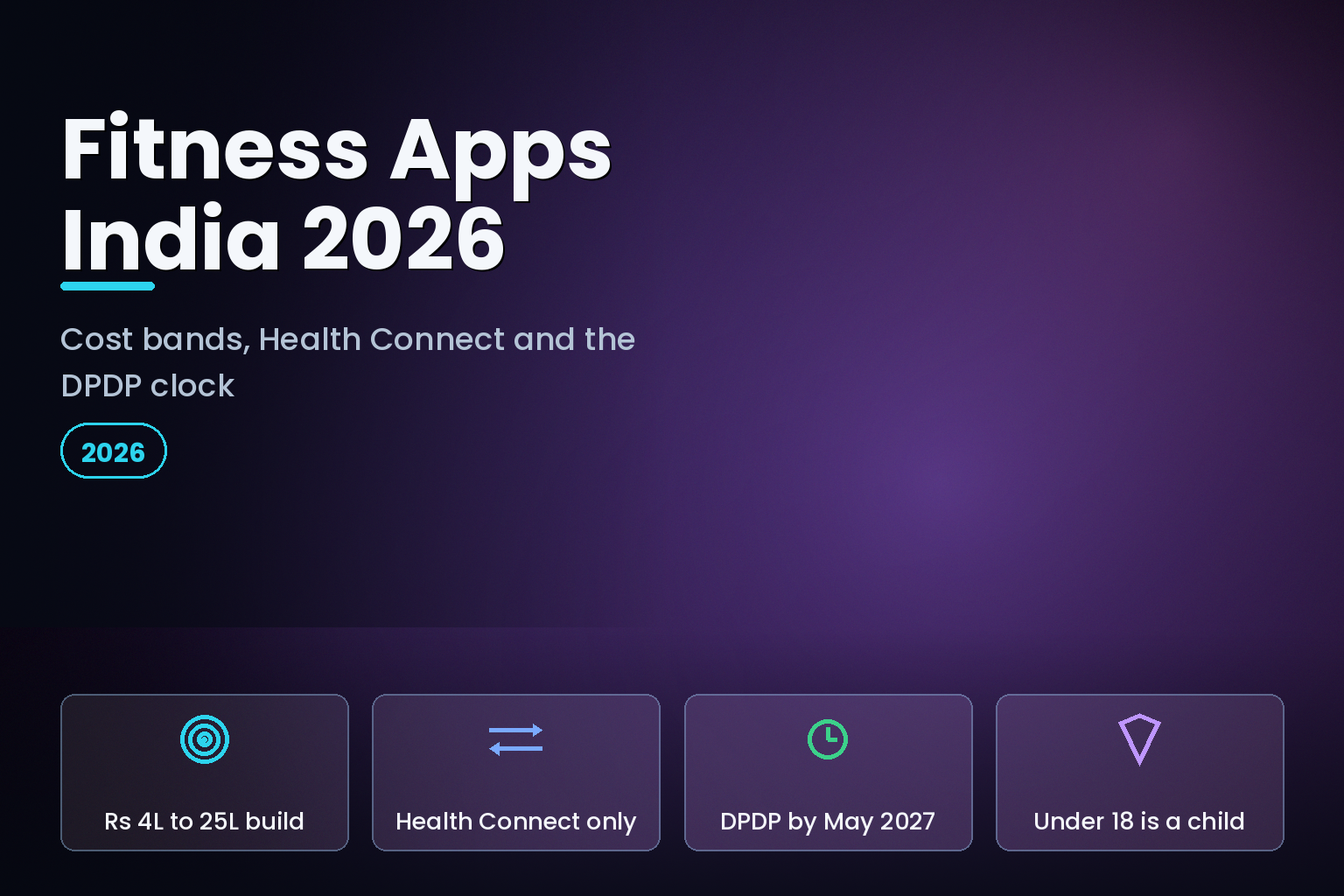
Summary. India's fitness app market reached $521 million in 2025 and is projected to hit $2.91 billion by 2034, a compound annual growth rate of 18.69% on IMARC's estimate. Android holds about 72.5% of that usage. Building a consumer fitness or wellness app in India in 2026 typically costs ₹4,00,000 to ₹25,00,000 (roughly $5,000 to $30,000) for a first version, with AI-heavy platforms running higher. Two forces reshape the build this year. Google Fit's APIs are deprecated through 2026, pushing every Android app to Health Connect, while Apple HealthKit stays the iOS path. And under the Digital Personal Data Protection (DPDP) Act 2023, anyone under 18 is a child, so a fitness app that tracks a minor's steps or sleep runs straight into the Act's ban on tracking children, with penalties up to ₹250 crore per instance. That Act stopped being theoretical on 14 November 2025, when MeitY notified the DPDP Rules, 2025 with an 18-month phased compliance timeline running to mid-May 2027 — comfortably inside the life of whatever you build this year. This guide covers the cost, the feature set, the wearable plumbing and the compliance design.
The domestic market already has scaled players. Cult.fit has raised about $666.6 million and HealthifyMe around $145.3 million, with HealthifyMe reporting over 40 million users, per Storyboard18 and PrivateCircle. A new entrant does not need their budget, but it does need to clear the same three bars: a genuinely useful feature set, clean wearable data, and a lawful approach to health data. Those three bars are also the honest test of any fitness app development company you shortlist: ask how they handle Health Connect conflict resolution and under-18 consent before you ask what they charge, because the second answer means very little without the first two.
The India fitness app opportunity in 2026
Demand is real and growing. Estimates differ by source, which is normal for a fast-moving market: IMARC puts the market at $521 million in 2025 heading to $2.91 billion by 2034, while Statista tracks user penetration rising from about 10.10% in 2025 toward 12.28% by 2029. Both point the same way: up. India's smartphone base of roughly 850 to 900 million users, most on Android, is the engine.
The winning model has settled on freemium plus subscription. IBEF notes HealthifyMe reported a 150% rise in premium subscriptions between 2022 and 2023, and the paid tier is where AI personalisation and India-specific content depth pay off. If you are building, design the paywall and the retention loop from day one, not as an afterthought.
What a fitness or wellness app must do in 2026
Scope creep kills fitness app budgets. The practical approach is to ship a focused first version, then earn each feature with usage data. The tiers below map features to what buyers actually fund.
Build tier | Core features | Indicative India cost ---|---|--- MVP (single platform) | Onboarding, goal setup, workout library, activity tracking, basic subscription | $15,000 to $30,000 Growth (cross-platform) | Wearable sync, nutrition logging, reminders, offline sync, analytics dashboard | $35,000 to $60,000 Premium (AI-driven) | AI coaching and recommendations, community, live classes, multi-tier billing | $120,000 and up Ongoing | Maintenance, OS and SDK updates, content refresh, support | 15% to 20% of build per year Compliance add-on | Consent management, parental consent flow, audit logging | Scoped per data model
Cost bands above are drawn from 2026 industry estimates in Developer Bazaar and BetaTest Solutions. India development rates of $15 to $30 an hour, against $100 to $250 in the United States, are why the same product ships for a fraction of the Western budget, a gap we break down in our India versus US app development cost analysis. Cross-platform frameworks like React Native can cut build cost 30% to 40% versus two native apps, though the wearable layer still needs platform-specific work, which we cover in the React Native versus Flutter hiring decision framework.
Wearables and health data: Health Connect, HealthKit and the Google Fit sunset
This is the part teams underestimate. The Google Fit APIs are being deprecated through 2026, and Google closed new sign-ups on 1 May 2024. Google's Fit migration guide is direct: "we recommend migrating to Android Health APIs now to help provide uninterrupted service for your users." The replacement is Health Connect, a unified Android layer that stores health and fitness data on-device and reads from sources like Samsung Health and Fitbit.
There is no single cross-platform shortcut. A production app needs Health Connect on Android and Apple HealthKit on iOS, built as two integrations against the same internal data model, plus the Fitbit Web API where you need server-side fitness data. Plan the sync architecture, conflict resolution and offline behaviour early, because retrofitting them after launch is expensive. This is a build-versus-buy decision worth making deliberately, the same way we frame it in the enterprise mobile app development guide.
Platform layer | 2026 integration | Notes ---|---|--- Android wearable data | Health Connect | Google Fit APIs deprecated through 2026 iOS wearable data | Apple HealthKit | Native, no Health Connect equivalent Server-side fitness data | Fitbit Web API | For web or cross-device sync Data storage model | Shared internal schema | One model, two native integrations Sync design | Offline-first with conflict rules | Decide before build, not after
DPDP and building for under-18 users
The compliance clock now has a date on it. When this page was first written the DPDP Act 2023 was law without operative rules, which let a lot of teams treat it as a future problem. That ended on 14 November 2025, when the Ministry of Electronics and IT notified the Digital Personal Data Protection Rules, 2025. The government's own announcement describes the notification as "marking the full operationalisation of the DPDP Act, 2023" and confirms the Rules "provide an 18-month phased compliance timeline, allowing organisations time for smooth transition." Eighteen months from that notification lands in mid-May 2027. For a fitness app being scoped in August 2026, that is not a distant horizon — it is inside the lifespan of the version you are about to build. Design for it now and it costs you architecture decisions; retrofit it in 2027 and it costs you a re-platform.
One provision in the Rules has a direct engineering consequence that is easy to miss. Consent Managers — the entities that let a person manage permissions across services — must be Indian companies. If your consent architecture assumes an offshore consent or preference-management vendor, check that assumption before you build against its SDK.
The DPDP Act 2023 changes how a fitness app must be designed, not just how it writes a privacy policy. Under the Act, any person under 18 is a child, a stricter line than the GDPR's 13 to 16 or COPPA's 13. A data fiduciary must obtain verifiable parental consent before processing a child's personal data, and the Act prohibits tracking, behavioural monitoring, and targeted advertising directed at children, per legal analysis from King Stubb & Kasiva and Law.asia.
For a fitness app that is exactly the tension: step, sleep and heart-rate tracking is behavioural monitoring. Clinical establishments and healthcare professionals are exempt, but a consumer fitness app is not a clinical establishment, so the prohibition applies to your under-18 users unless you build a compliant parental-consent path. Non-compliance carries penalties up to ₹250 crore per instance. The engineering answer is age assurance at onboarding, a verifiable parental-consent flow, data minimisation, and consent records you can produce on demand. We design applications aligned with DPDP Act requirements and build these controls in from the start, an approach detailed in our DPDP-ready app development work. Note this is distinct from clinical software: a wellness tracker and a regulated health app carry different obligations.
FAQ
References
- Fitness apps, India — Statista
- Fitness tech startups and Cult.fit funding — Storyboard18
- Cult.fit vs HealthifyMe: fitness and wellness in India — PrivateCircle
- Cost to develop a fitness app in 2026 — Developer Bazaar
- App development cost in India 2026 — BetaTest Solutions
- Fit migration guide — Android Developers
- Google Fit REST API — Google for Developers
- Child data protection under DPDP Act: parental consent rules — King Stubb & Kasiva
- Government notifies DPDP Rules to empower citizens and protect privacy — Press Information Bureau, Ministry of Electronics & IT, 14 November 2025
_Last updated: 22 August 2026._