On this page · 11 sections
- What the labs actually concluded
- The FDE model, defined honestly
- The four options, priced by what you actually spend
- When a partner genuinely beats hiring
- The gap the $11.5 billion does not cover
- What eCorpIT does, specifically
- What to ask any AI implementation partner
- India-specific considerations
- FAQ
- How eCorpIT can help
- References
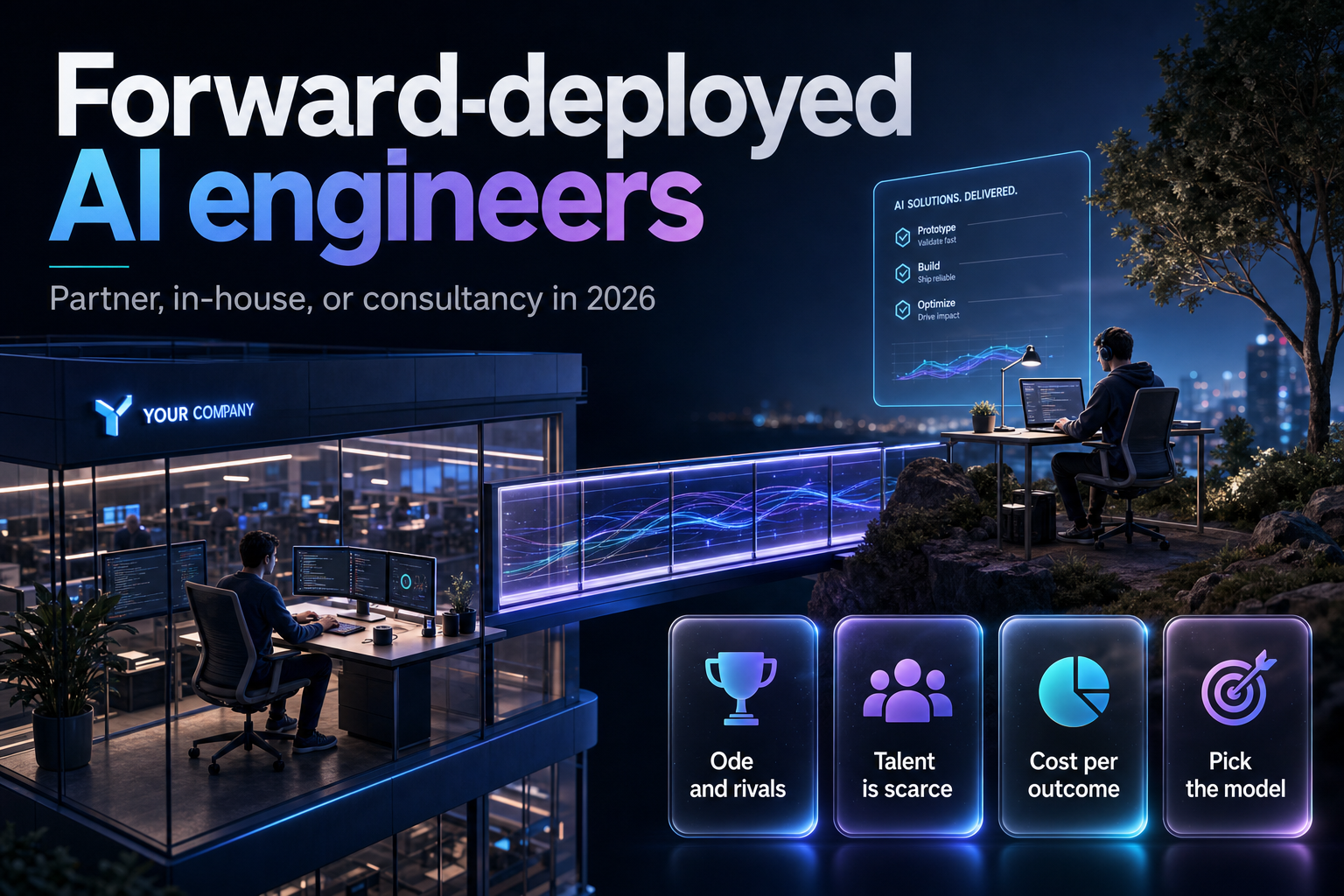
Summary. On May 4, 2026, Anthropic announced a joint venture valued at $1.5 billion, including a $300 million commitment each from Anthropic, Blackstone and Hellman & Friedman, as TechCrunch reported. Hours earlier, Bloomberg reported OpenAI was finalising a rival venture raising $4 billion from 19 investors against a $10 billion valuation. Anthropic's is now named Ode with Anthropic; it employs 100 engineers, acquired the startup Fractional AI, and works on problems that are "the top one or two priority for the CEO of the company," its CEO Chris Taylor told TechCrunch on July 15, 2026. Roughly $11.5 billion of enterprise value now rests on a single claim: the hard part of enterprise AI is not the model, it is the implementation. That claim is correct. The conclusion most readers draw from it is not.
Because here is what those two ventures are not doing: taking your call, unless you are a portfolio company of Blackstone, Hellman & Friedman, Goldman Sachs, TPG, Brookfield, Advent or Bain Capital.
What the labs actually concluded
The most useful sentence in six months of AI services coverage came from Eddie Siegel, Ode's chief technologist and a Fractional co-founder:
"I think model selection matters, but it's not where the majority of calories are spent. It's one ingredient in a system that has to be engineered. It's like the choice of programming language when you build a piece of software […] I would not define an enterprise transformation in terms of whether they choose Python or Java."
Sit with that. A company whose entire commercial existence depends on Anthropic's models is saying model choice is roughly as decisive as picking Python over Java. Ode operates under a "Claude-first" principle and will use rival AI products if needed — and its own chief technologist calls the model one ingredient.
If the lab closest to the model says the model is not the bottleneck, the endless model-comparison spreadsheet on your desk is not the bottleneck either. We have argued the same thing from the delivery side in our decision framework for hybrid LLM routing: the routing and the engineering around the model decide the outcome far more than the leaderboard does.
Taylor's framing of the customer is equally clarifying: "non-AI companies are going to be among the big winners of this whole AI moment if they adopt the technology the right way." The catch, in his words: "That requires top-caliber applied AI talent, which is not something most companies have."
The FDE model, defined honestly
The forward-deployed engineer model was popularised by Palantir. An engineer embeds inside the customer's organisation, sits with the people doing the work, and builds against the real workflow instead of a requirements document.
Anthropic described it this way in its own announcement: "An engagement might begin with the company's engineering team sitting down with clinicians and IT staff to build tools that fit into the workflows that staff already use… Engagements like this will run across mid-sized companies across industries, each shaped by the people closest to the work."
Ode's people describe the staffing bar precisely. The team is elite generalist software engineers, over half of them former founders — the kind who can, per Siegel, "juggle a really challenging technical problem, but also own something end-to-end." One Blackstone executive called them a team of "grown-up" engineers, the "special forces" rather than an army of forward-deployed engineers.
And several people involved in the venture told TechCrunch the same thing: demand for such FDE teams far outstrips supply.
That is the sentence a CTO should act on. Not the $1.5 billion. The supply constraint.
The four options, priced by what you actually spend
| Option | What you get | The real constraint |
|---|---|---|
| Hire in-house | Permanent capability, full context | The talent Taylor says "most companies" don't have; 3-9 month hiring cycles |
| Lab joint venture (Ode, OpenAI's) | Elite generalists, lab access | Access is gated by investor portfolios; sized for CEO-priority programmes |
| Global consultancy FDE practice | Scale, procurement familiarity | Deloitte and Accenture built these to compete; you get the pyramid, not the special forces |
| Boutique implementation partner | Senior engineers on your workflow | Capacity; you must vet actual delivery, not a deck |
| Do nothing yet | No spend | Competitors adopting now compound a lead you pay for later |
Ode's competition runs past OpenAI's venture to "consulting giants like Deloitte and Accenture, which have created their own FDE teams." Accenture launched a Microsoft forward-deployed engineering practice; Deloitte announced forward-deployed engineering of its own. So the FDE label is now on the market at every price point, and it means different things at each.
The honest read on the middle two rows: a boutique gives you seniority and a consultancy gives you scale, and the failure mode of each is the other's strength. Choose against your actual constraint.
When a partner genuinely beats hiring
Four conditions. If three or more hold, hire the partner.
Your first AI project is not your tenth. The engineering patterns that make an agent survive production — evaluation harnesses, guardrails, fallback routing, human handoff — are learned expensively. A team building them for the first time will rediscover failures that are already documented, including the ones we covered in AI agent evals and silent failures in CI/CD. Paying someone to skip that is usually cheaper than the rediscovery.
The problem is workflow-shaped, not model-shaped. If the work is "sit with the ops team for two weeks and understand why they keep three spreadsheets," an FDE engagement fits. If it is "fine-tune something," it does not.
You need it working this quarter. A 3-to-9-month senior hiring cycle against a quarterly objective is not a plan. And the market is what Siegel describes: scarce, with demand outstripping supply.
You do not need the capability permanently. If AI implementation will not be a standing function, a permanent team is the wrong instrument.
The converse holds too, and we will say it against our own commercial interest: if AI is core to your product, if you have senior engineers who have shipped inference systems, and if you have twelve months — hire. Build it in-house. A partner who tells you otherwise is selling.
The gap the $11.5 billion does not cover
Ode currently employs 100 engineers. Its ideal customer is one "whose CEO buys into the promise," working on what Taylor describes as "the most important product feature that the company is going to build over the course of the next two years, or it's reworking the most important business process they have."
Both ventures were structured around alternative asset managers to create new channels for enterprise AI deals. The ventures get preferred sales access to their investors' portfolio companies; the investors capture more value from the resulting contracts. That is the deal. It is a rational deal. It also means the addressable market for Ode is, substantially, a list of portfolio companies.
So who serves the mid-sized Indian manufacturer, the D2C brand with 40 people, the hospital group running on eight-year-old systems, the SaaS company whose AI project is important but not the CEO's top-two? Not a 100-engineer venture aimed at CEO-level transformations. Not, at a workable price, the global consultancies either.
That gap is where the actual volume of AI implementation work sits in 2026, and it is where eCorpIT works.
What eCorpIT does, specifically
We are eCorp Information Technologies Private Limited, founded in 2021, headquartered in Gurugram, and assessed at CMMI Level 5. We are MSME certified, and we work with AWS, Microsoft, Google, Shopify and Kaspersky. We are an organisation of senior-led, multi-disciplinary engineering teams, not a body shop and not a lab-backed joint venture.
What an engagement looks like:
We start with the workflow, not the model. The first week is spent with the people who do the work, in the same spirit as the Anthropic description above. We map where an AI system can remove real cost and, more usefully, where it cannot. Some of these conversations end with us telling you not to build the thing.
We build the system around the model. Evaluation harnesses before shipping. Guardrails and prompt-injection hardening as a design input, not a patch. Fallback routing so a single provider's availability decision does not stop your product — a live concern in 2026, not a hypothetical. The patterns are in our work on enterprise AI agent governance layers and production use cases for enterprise AI agents.
We build for handover. The engagement is designed to end. Your engineers hold the pager and understand the system, because a partner you cannot fire is not a partner.
We design aligned with the frameworks that apply to you — DPDP requirements for Indian personal data, and sector rules where they bite. We design applications aligned with those requirements; we do not claim to certify you against them.
Where this typically starts: a RAG knowledge assistant over documentation nobody can search, or a scoped enterprise AI agent build against one workflow with a measurable baseline. Engagements are scoped to a defined outcome with a named senior engineer accountable for it, and priced per engagement after the scoping conversation, because a number quoted before we understand your workflow is a number we would have to walk back.
What to ask any AI implementation partner
Use these on us as readily as on anyone else.
- Who specifically is doing the work, and what have they shipped to production? Ode's answer is elite generalists, over half former founders. A vendor who cannot name the engineers is selling you a pyramid.
- What is your evaluation approach before go-live? "We'll test it" is not an answer.
- What happens when the model provider changes availability, pricing, or terms mid-engagement? In June 2026 Anthropic suspended access to Fable 5 and Mythos 5 for non-US entities. The Fable 5 restriction was later lifted; Mythos 5 access remains limited. This is a real risk, not a theoretical one.
- How does the engagement end, and what do we hold afterwards?
- What would you tell us not to build?
If a partner cannot answer the fifth, the first four do not matter.
India-specific considerations
India is the second-largest market for Claude.ai and ranks first globally in the share of AI use going to software-related tasks, at 45.2%, per Anthropic's India Country Brief of February 16, 2026. Anthropic has partnered with Infosys and Tata Consultancy Services to scale enterprise deployments, and opened a Bengaluru office in February 2026 where its India team offers applied AI expertise to enterprise customers, digital natives and startups.
Two things follow. First, the applied-AI talent Taylor calls scarce is disproportionately in India, and disproportionately already employed by the IT services majors. A mid-sized Indian company is competing for those engineers against Infosys, TCS and Cognizant, the last of which is deploying Claude to 350,000 employees globally. Hiring your way out of this is harder here than the salary numbers suggest.
Second, the same brief shows the opportunity is unevenly claimed: Maharashtra, Tamil Nadu, Karnataka and Delhi account for over half of India's Claude.ai use, and India ranks 101st of 116 countries on per-capita use despite ranking 2nd in absolute use. If you are outside those four states, your competitors are probably not doing this yet.
The proof that it works at Indian scale is already public. Air India uses Claude Code to help developers ship custom software faster and at lower cost. CRED reports 2x faster feature delivery and 10% better test coverage with Claude Code. Emergent reached $25 million in annual recurring revenue and two million users in under five months, built entirely with Claude. None of those are pilots.
FAQ
How eCorpIT can help
The labs have now spent roughly $11.5 billion agreeing with something our senior engineering teams see on every project: the model is one ingredient, and the engineering around it decides whether anything reaches production. eCorpIT builds AI systems for companies that will never be routed to a lab's joint venture — mid-sized Indian and global businesses with a real workflow problem and no in-house applied AI team. We start by mapping where AI removes cost and where it does not, build the evaluation and guardrails before the demo, and hand the system to your engineers at the end. If you are weighing a partner against a hire, contact us and we will tell you which one your situation actually calls for.
References
- Anthropic, Blackstone bet the next trillion-dollar AI business is implementation, not just models — TechCrunch, July 15, 2026.
- Anthropic and OpenAI are both launching joint ventures for enterprise AI services — TechCrunch, May 4, 2026.
- Anthropic nears $1.5 billion joint venture with Wall Street firms — The Wall Street Journal.
- OpenAI finalizes $10 billion joint venture with PE firms to deploy AI — Bloomberg, May 4, 2026.
- Anthropic's enterprise AI services company announcement — Anthropic, May 2026.
- India Country Brief: The Anthropic Economic Index — Anthropic, February 16, 2026.
- Anthropic opens Bengaluru office and announces new partnerships across India — Anthropic, February 16, 2026.
- Announcing forward deployed engineering — Deloitte.
- Accenture launches Microsoft forward deployed engineering practice — Accenture Newsroom, 2026.
- Anthropic's Claude Tag is learning your company one Slack message at a time — TechCrunch, June 23, 2026.
- As Anthropic suspends access to new models, India debates its AI future — TechCrunch, June 13, 2026.
- Trump drops restrictions on Anthropic's Mythos and Fable models — TechCrunch, June 30, 2026.
- Anthropic starts localizing Claude pricing for India — TechCrunch, July 13, 2026.
- Accelerating the next phase of AI — OpenAI, March 2026.
Last updated: July 16, 2026.