On this page · 9 sections
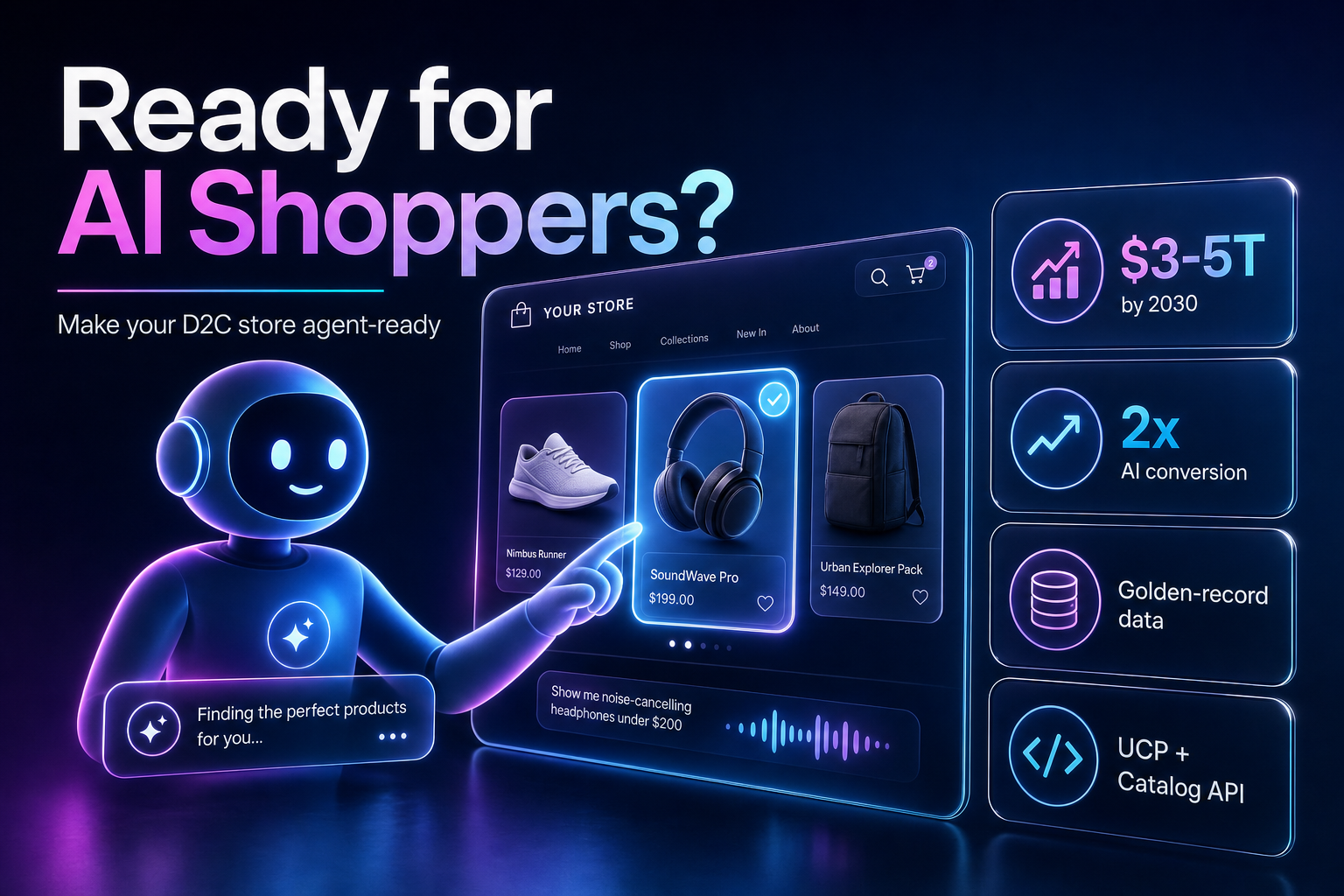
Summary. Shopping is shifting from people browsing stores to AI agents buying on their behalf, and the money behind it is large. McKinsey projects agentic commerce will drive $3 trillion to $5 trillion globally by 2030. The plumbing is already here: Shopify and Google co-developed the Universal Commerce Protocol, endorsed by more than 20 retailers and platforms including Amazon, Meta, Microsoft, and Stripe, and Shopify's Catalog API turns product data into structured infrastructure that AI agents can query. ChatGPT's Instant Checkout has run since September 2025 across a base of about 900 million weekly users, and Shopify merchants can now sell directly inside AI Mode in Google Search. The stakes for direct-to-consumer brands are concrete: stores with near-complete product data see 3 to 4 times higher visibility in AI recommendations, and AI searches on structured Catalog data convert at twice the rate of scraped data. This guide covers what to fix, and how eCorpIT helps D2C brands get AI-ready.
What agentic commerce is
Agentic commerce is a model where AI agents handle discovery, comparison, and purchase for a shopper, rather than the shopper clicking through a store. You describe what you want to ChatGPT, Gemini, Perplexity, or Copilot, and the agent finds products, compares them, and completes checkout. The store that the agent recommends and buys from wins; the store with poor data is skipped.
Two standards make this work. Google announced its agentic commerce protocol in January 2026 with Walmart, Target, Shopify, and other partners, and the Universal Commerce Protocol co-developed by Shopify and Google is the open standard for how agents transact with merchants. On top of that, Shopify's Catalog API turns billions of products from millions of merchants into structured, queryable data across AI surfaces. For a D2C brand, this is the moment the shelf moved from a search results page to an AI answer.
Why D2C brands should care now
The opportunity is disintermediation. For years, direct-to-consumer brands paid Amazon for reach. Agentic protocols can route a high-intent shopper straight to your own checkout, reducing that dependence, but only if your product data, schema, and checkout are flawless. Get the data right and an agent recommends you directly; get it wrong and the agent picks a competitor with cleaner attributes.
This is the same discipline as being cited in AI search, applied to products. Our guide to AI shopping agents and agentic commerce covers the strategy, and our Google AI search optimisation guide covers the content side that feeds the same engines.
The readiness checklist
Getting AI-ready is specific work across four areas. Treat it as an engineering project, not a marketing campaign.
| Area | What to fix | Why it matters |
|---|---|---|
| Product data completeness | Fill every attribute: size, material, compatibility, shipping | Sparse data gets skipped by agents |
| Structured data and schema | Product, Offer, and review schema on every page | Tells engines what each product is |
| Feed freshness | Move from nightly to near-real-time feeds | AI Mode prefers live price and stock |
| Conversational attributes | Add product Q&A, compatible and substitute items | New Merchant Center fields for agents |
| Checkout readiness | Support agent checkout via UCP | Lets the agent complete the purchase |
Google has added new Merchant Center attributes built for conversational commerce, including answers to common product questions, compatible accessories, and substitute products. Feed freshness now matters more than it did for traditional shopping, because AI Mode prefers live data and a nightly feed can leave you wrong all day.
Structured data is the moat
The single highest-use investment is product data quality. The industry calls a near-complete record a golden record, and the visibility difference is stark.
| Product data quality | AI recommendation visibility |
|---|---|
| Sparse or incomplete attributes | Baseline, often skipped |
| Near 99.9% attribute completion | 3 to 4 times higher visibility |
| Structured Catalog data vs scraped | Converts at 2 times the rate |
If your feed has incomplete attributes, vague shipping information, or missing compatibility details, an agent will pass over you for a competitor whose data is complete. This is winnable work: unlike ad auctions, clean data is a durable asset that keeps paying across every AI surface at once.
The surfaces that matter
D2C discovery is now a multi-surface problem, and the same clean product data can feed all of them.
| Surface | Shopping status in 2026 |
|---|---|
| ChatGPT | Instant Checkout live since September 2025 |
| Google AI Mode and Gemini | Native Shopify shopping rolling out |
| Perplexity | AI-driven shopping discovery |
| Microsoft Copilot | Emerging shopping surface |
| Shop App | Shopify's own agentic surface |
The lesson is to build product data once, to the UCP and Catalog standard, and let it power every surface rather than optimising each channel by hand.
India-specific considerations
For Indian D2C brands the opportunity is the same, with two local constraints. Payments and checkout must fit Indian rails and regulations, so confirm how agent checkout interacts with your UPI and card flows before going live. Data protection applies: customer and order data are personal data under the Digital Personal Data Protection Act, 2023, so build consent capture, purpose limitation, and residency into any agent-connected checkout. Indian brands that get clean, structured product data live early can win AI recommendations in a market where most competitors have not started.
How eCorpIT can help
eCorpIT is a Gurugram technology consultancy, founded in 2021, and a Shopify partner that helps direct-to-consumer brands become AI-shoppable. Our senior-led teams audit and complete your product data to golden-record quality, implement Product, Offer, and review schema, connect Catalog API and Universal Commerce Protocol checkout, and move you from nightly feeds to near-real-time so AI Mode sees live price and stock. We design consent and data handling aligned with Digital Personal Data Protection Act, 2023 requirements for India. The engagement typically starts with a readiness audit and a prioritised fix plan, then implementation and measurement of your visibility across AI surfaces. It suits D2C brands on Shopify that want to reduce marketplace dependence and be recommended by AI shopping agents. Our GEO and AEO optimisation service pairs naturally with this work. To get your store AI-ready, contact us.
FAQ
References
- Building the Universal Commerce Protocol (2026) — Shopify Engineering
- Agentic commerce developer documentation — Shopify
- Shopify Spring 2026 edition: agentic commerce, UCP and Catalog — Digital Applied
- Agentic commerce readiness: a 2026 checklist for stores — Digital Applied
- The complete product data optimization guide for Google's AI shopping (2026) — eFulfillment Service
_Last updated: July 14, 2026._