On this page · 14 sections
- The aggregate picture
- Customer Service: the most-transformed function
- IT Operations: high adoption, measurable risk reduction
- Marketing: 48% adoption, measurable productivity lift
- Sales: 12% revenue uplift on AI-assisted accounts
- Finance and Accounting: rapid AI uptake on operational tasks
- Human Resources: from screening to engagement
- Supply Chain: forecasting, optimisation, autonomous logistics
- Product, Engineering and R&D
- Where to start: a function prioritisation framework
- What good cross-function AI looks like at the operating level
- FAQ
- How eCorpIT can help
- References
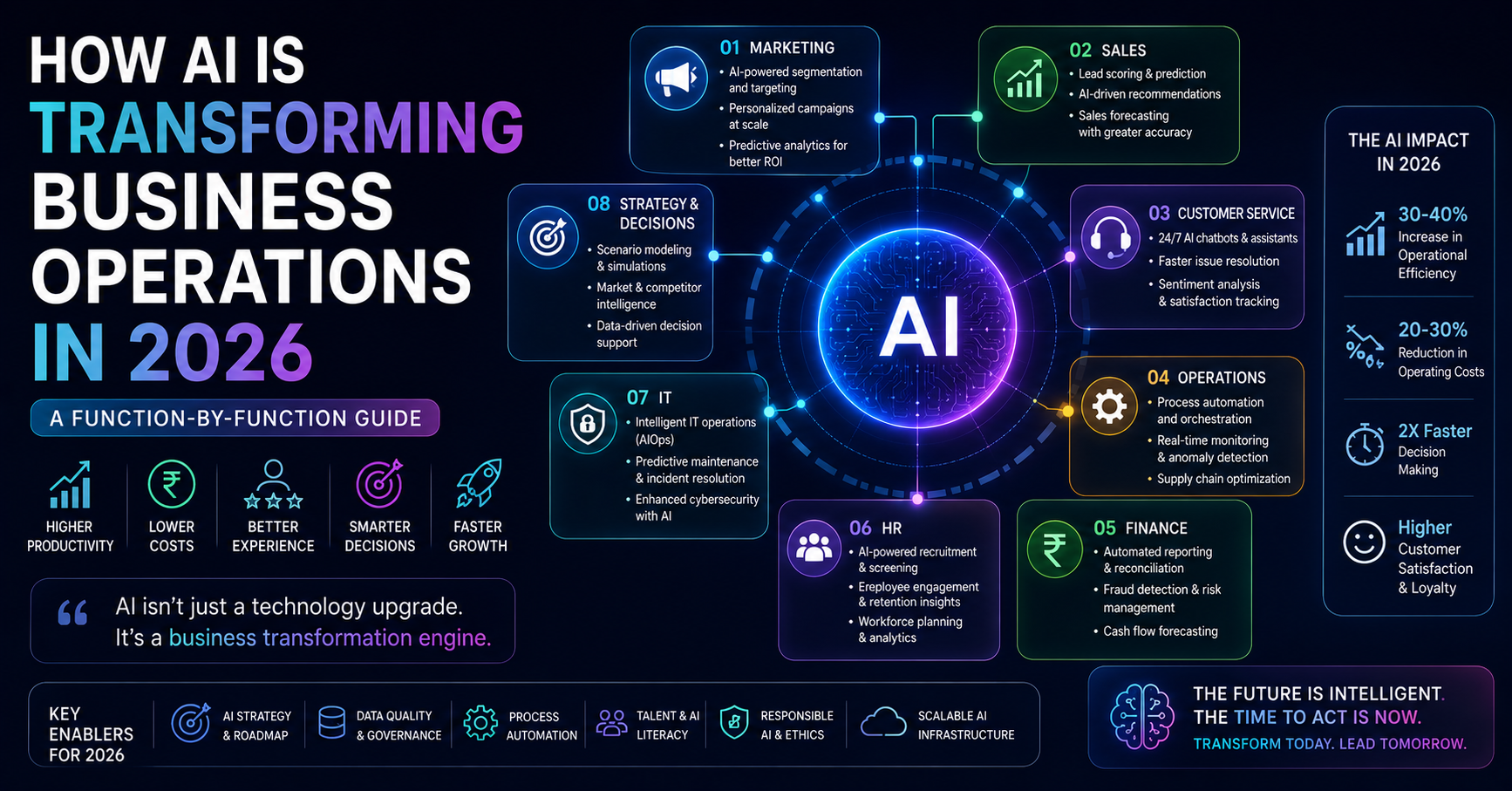
Summary. Ninety-one percent of businesses now use AI in at least one capacity, up from 78% in 2024 and 55% in 2023. Almost 79% report using AI agents inside core operational workflows. Enterprises measuring honestly see roughly 40% productivity improvement on AI-augmented knowledge work, 12x cost reduction on customer service interactions, and 12% revenue uplift on AI-assisted sales. This guide walks through what AI is actually doing inside business operations in 2026 — function by function, with the measured numbers and what good implementation looks like.
The headline shift in 2026 is from "is AI useful" to "where is AI useful enough to justify the rebuild." Most enterprises have already crossed the proof-of-concept bridge. The strategic work now is choosing which functions to transform first, in what order, and to what depth — a decision shaped less by curiosity and more by where the financial impact actually lands.
This guide is built for COOs, business unit leaders and operations directors deciding where to put AI investment over the next 12-18 months. The numbers come from McKinsey, Deloitte, Gartner, NVIDIA's State of AI report and a cross-section of industry surveys. The implementation patterns come from production deployments across India, the United States and the United Kingdom.
The aggregate picture
A few numbers anchor the rest of the article.
Adoption: 91% of businesses use AI in some capacity, per recent industry research. 79% report use of AI agents in core operations. 75% of large enterprises plan to increase AI investment in 2026, per PwC's 2026 AI Predictions. 88% of executives plan to increase AI budgets specifically because of agentic AI initiatives.
Productivity: enterprises see an average 40% productivity improvement on AI-augmented knowledge work. Federal Reserve research as summarised at UC Today quantifies generative AI's time savings at 5.4% of work hours — roughly 2.2 hours per 40-hour week for the average knowledge worker. ROI evidence: 60% of executives say AI boosts efficiency, 55% report improved customer experience, 66% of agent users see measurable productivity gains.
What is most operationally interesting is that the gains are not evenly distributed across functions. Some functions have moved much further than others, and the leaders in each function look very different from the laggards. The next sections walk through what AI is doing in each major business function, with the verified numbers.
Customer Service: the most-transformed function
Customer service leads enterprise AI adoption at approximately 56%, the highest of any function. AI handles roughly 30% of customer interactions today, projected to reach 50% by 2027.
The economics are stark. A human-handled support interaction costs roughly $6 on average. An AI-handled chatbot interaction costs roughly $0.50. That is a 12x difference. Gartner projects contact-centre labour savings of roughly $80 billion globally by 2026. Enterprises deploying AI in support typically report 30-40% reductions in overall support costs and 37% improvement in support response time.
What good implementation looks like in 2026: AI handles tier-1 enquiries autonomously, escalates to humans with full context when needed, and uses memory of prior interactions to reduce repetitive effort. Sentiment analysis routes frustrated customers to senior agents. Real-time agent assist tools surface knowledge base content while the agent is on the call, cutting average handle time. eCorpIT's earlier coverage at /ai-chatbots-customer-service-cost-reduction-2026/ walks through the deployment economics in detail.
What poor implementation looks like: dropping a generic chatbot into the website without retrieval over your knowledge base, no escalation handoff, no measurement of containment rate or customer satisfaction. The result is customers angrier than they were before AI and a return to the original cost structure within six months.
IT Operations: high adoption, measurable risk reduction
IT operations sits at roughly 51% adoption, the second-highest function. The measured impact is concrete: organisations using AI in IT operations report 31% fewer critical incidents and 28% faster mean time to resolution (MTTR).
AI in IT operations does five distinct things well. Anomaly detection on logs and telemetry surfaces incipient incidents earlier. Intelligent alerting reduces noise and helps teams focus on what actually matters. Automated runbook execution resolves common incidents without human intervention. Predictive maintenance anticipates infrastructure failures. Capacity planning combines historical patterns with current trends to right-size cloud resources.
The patterns that distinguish good implementation: AI is integrated with the existing observability stack (Datadog, New Relic, Splunk, Grafana) rather than a parallel tool. Alert escalation logic is conservative, so the AI does not page humans for noise. Automated remediation is gated by approval until enough evidence accumulates that the AI can be trusted with autonomous action.
The pattern that fails: deploying AI for IT operations as a separate system without integration into existing tooling and runbook discipline. The result is another dashboard nobody looks at.
Marketing: 48% adoption, measurable productivity lift
Marketing sits at roughly 48% adoption, with teams using AI reporting 37% productivity improvement — compared to only 12% from traditional automation. AI in marketing produces content 59% faster than traditional production cycles.
The high-impact uses in 2026 are content production at scale (blog posts, landing pages, email sequences, social posts), creative variant testing (generating dozens of ad creatives and testing which perform), audience targeting and segmentation, lead scoring and routing, and SEO/AEO content optimisation. The newer frontier is agentic marketing — agents that plan and execute multi-step campaigns, optimise budget allocation across channels in real time, and report up to leadership.
What good implementation looks like: the AI is integrated with the marketing technology stack (HubSpot, Marketo, Salesforce Marketing Cloud, Adobe), uses your brand voice through fine-tuning or careful prompt engineering, and is governed by human approval on anything customer-facing. Measurement is in revenue attribution and pipeline velocity, not in volume of content produced.
What fails: using AI to produce more low-quality content faster, which clutters channels and damages brand. The 2026 lesson is that AI multiplies whatever your marketing strategy already produces — both the good and the bad.
Sales: 12% revenue uplift on AI-assisted accounts
Sales teams using AI report an average 12% revenue uplift on AI-assisted accounts. The mechanism is not what early hype suggested.
AI does not replace the seller. It augments three specific parts of the sales workflow. First, pre-call intelligence — AI summarises everything known about the account, the contacts and recent interactions before the seller picks up the phone. Second, real-time call assist — AI transcribes calls, surfaces relevant context and suggests next-best actions while the conversation is happening. Third, post-call work — AI drafts follow-up emails, updates CRM, schedules next steps and prepares the seller for the next call.
The cumulative effect is that sellers spend more time talking to customers and less time doing administrative work. Conversion rates lift because the seller arrives at every conversation prepared, and forecast accuracy improves because CRM data is current.
Good implementation: AI is in the seller's existing tools (Salesforce, HubSpot, Microsoft Dynamics, Gong, Outreach), the seller never has to switch context to use it, and adoption is tracked separately from outcome. Bad implementation: a separate AI tool that the seller has to remember to use, which 30% of the team uses and 70% ignores, producing no consistent measurable lift.
Finance and Accounting: rapid AI uptake on operational tasks
Finance functions are seeing rapid adoption on operational tasks — accounts payable, accounts receivable, expense management, financial close, regulatory reporting and audit preparation. AI handles invoice processing, GL coding, anomaly detection on transactions, variance analysis and reconciliation work that previously occupied finance teams for days each month.
The productivity numbers in finance are dramatic on the operational side. Companies deploying AI on accounts payable report 60-80% straight-through processing rates, freeing finance staff for analysis work. Month-end close timelines that ran to 8-10 working days compress to 3-5 working days. Audit preparation time drops similarly.
The harder, slower work in finance is AI on FP&A (financial planning and analysis), forecasting, scenario planning and capital allocation. These use cases require more careful design because the outputs feed strategic decisions, but they also produce some of the largest leadership benefits when they work.
Good implementation: AI is integrated into the ERP and financial systems (SAP, Oracle NetSuite, Microsoft Dynamics 365 Finance, Workday Financials, Zoho Books) rather than running parallel. Audit trails are explicit and reviewable. Compliance with relevant accounting standards (Ind AS, IFRS, GAAP) is verified.
Human Resources: from screening to engagement
HR adoption is broad but uneven. AI is widely used for resume screening, candidate sourcing, interview scheduling, performance review preparation, learning recommendation and employee help desk. The deeper, slower work — AI on succession planning, talent analytics, organisation design and workforce strategy — is starting to emerge in 2026 but remains a frontier.
Gartner predicts that by 2027, 75% of hiring processes will include certifications and testing for workplace AI proficiency during recruiting. The implication is that "AI-proficient" is becoming a baseline workforce attribute rather than a specialised skill.
Good HR implementation in 2026: AI assists rather than decides. Resume screening surfaces candidates and explains why; a human makes the interview decision. Performance reviews are drafted by AI based on multiple data sources, then edited by managers. Employee help desk AI handles policy questions, then escalates anything sensitive (health, family, conflict) to humans immediately.
The risk to avoid: deploying AI on candidate selection or termination decisions without explicit human review. The discrimination liability is real and growing — multiple US, EU and Indian regulators are now examining these uses specifically.
Supply Chain: forecasting, optimisation, autonomous logistics
Supply chain functions use AI for demand forecasting, inventory optimisation, supplier risk assessment, logistics routing and warehouse automation. The 2026 frontier is agentic supply chain — agents that monitor disruption indicators, reroute shipments, negotiate with vendor systems and optimise inventory positions autonomously within human-set guardrails.
The measurable impact varies by sub-function. Demand forecasting accuracy improvements typically run 10-25% over traditional methods. Inventory carrying cost reductions run 15-30%. Logistics route optimisation produces 5-15% cost savings on fleet operations. Supplier risk monitoring catches disruptions weeks earlier than manual review.
For Indian manufacturers and distributors, the supply chain AI opportunity is particularly strong because of the complexity of multi-tier sourcing (small suppliers across many states), variable transport infrastructure (rail, road, port reliability shifts seasonally), and demand variability (festival cycles, monsoon, regional consumption patterns). AI handles this complexity better than spreadsheet-based planning.
Product, Engineering and R&D
Engineering teams using AI report 55% reduction in coding time and 40% productivity improvement on knowledge work tasks broadly. AI in engineering covers code generation (GitHub Copilot, Cursor, Codeium), code review, debugging assistance, documentation generation, test generation, infrastructure-as-code authoring and incident postmortem drafting.
The 2026 leading practice is that AI is in the developer's existing tooling (VS Code, JetBrains, terminal, GitHub) rather than a separate workflow. The most impactful use is on the unglamorous parts of engineering — writing tests, updating documentation, refactoring older code — rather than the glamorous parts (architectural design, novel algorithm work) where engineering judgment remains the bottleneck.
R&D functions in pharma, materials, automotive and electronics are using AI for literature search and synthesis, hypothesis generation, lab notebook search, regulatory document drafting and experiment design optimisation. The productivity numbers vary widely by industry but cluster around 25-40% on knowledge work tasks similar to other functions.
Where to start: a function prioritisation framework
For a COO or business unit leader deciding where to put AI investment first in 2026, four questions matter.
Where is the largest cost base that AI can address? Functions with high transaction volume and repetitive work (customer service, finance operations, IT operations) usually offer the fastest cost-side returns.
Where is the data already clean and accessible? Functions with mature systems of record (CRM, ERP, ITSM) give AI the data it needs to be useful. Functions whose data lives in spreadsheets and emails require data work before AI work.
Where is the leadership ready to commit? Function leaders who will personally sponsor AI deployment, set the metric and accept accountability are far more important than the technology choice. Functions whose leaders are skeptical or distracted usually fail regardless of tooling.
Where is the failure mode tolerable? Functions where AI mistakes are contained (a wrong invoice category gets caught) are safer first deployments than functions where mistakes are public (a wrong customer email under your brand name).
The combination usually points to customer service or finance operations as the right first function for most enterprises, followed by IT operations or marketing as the second.
What good cross-function AI looks like at the operating level
Five operational disciplines distinguish enterprises getting AI right from those getting AI wrong.
Single source of governance. One Agentic Governance Council, with cross-functional membership, that holds decision rights over every production AI deployment regardless of function. No shadow agents.
Common observability stack. Every production AI has prompt logging, retrieval logging, tool-call logging and outcome tracking in a shared system the security and engineering teams can review.
Common evaluation discipline. Each function defines success metrics before deployment and pre-commits to discontinuation criteria. No infinite pilots.
Common cost accounting. Every AI deployment has a clear cost-of-ownership model that includes model API costs, infrastructure, engineering time, governance overhead and training. The CFO sees true total cost, not just licence fees.
Common skills programme. Every function has an AI-proficiency development path for its staff. AI literacy is becoming a baseline operating skill, not a specialised role.
FAQ
How eCorpIT can help
eCorpIT helps enterprises across India, the US and the UK transform business operations with AI — from strategy and architecture through deployment and governance. We work with COOs, CIOs, CFOs and Heads of Operations at growth-stage companies, mid-market enterprises and global brands.
If you are planning AI investment across functions in 2026 — or moving specific functions from pilot to production — our engineering and AI team can help. Reach us at ecorpit.com/contact-us/ or contact@ecorpit.com.
References
- McKinsey — "The state of AI in 2025": mckinsey.com
- Deloitte — "The State of AI in the Enterprise — 2026 AI report": deloitte.com
- PwC — "2026 AI Business Predictions": pwc.com
- Gartner — "40% of Enterprise Apps Will Feature Task-Specific AI Agents by 2026": gartner.com
- UC Today — "AI Productivity Reports 2026": uctoday.com
- Accelirate — "Agentic AI Statistics 2026": accelirate.com
- NVIDIA — "State of AI Report 2026": blogs.nvidia.com
- Orbilon Tech — "AI Automation Stats 2026": orbilontech.com
- eCorpIT — "AI Chatbots for Customer Service: Real Cost Savings in 2026": ecorpit.com
- eCorpIT — "Generative AI Enterprise Strategy 2026": ecorpit.com
Last updated 8 June 2026 by the eCorpIT Editorial team. We will refresh this article when McKinsey and Deloitte publish their year-end State of AI updates.