On this page · 11 sections
- One checkpoint, three modes
- The real-hardware numbers, at a single query
- When it pays off, and when it does not
- Serving it: SGLang, one line to switch
- Why one set of weights can do both
- Benchmark it yourself before you commit
- Accuracy: the trade you are actually making
- India-specific considerations
- FAQ
- How eCorpIT can help
- References
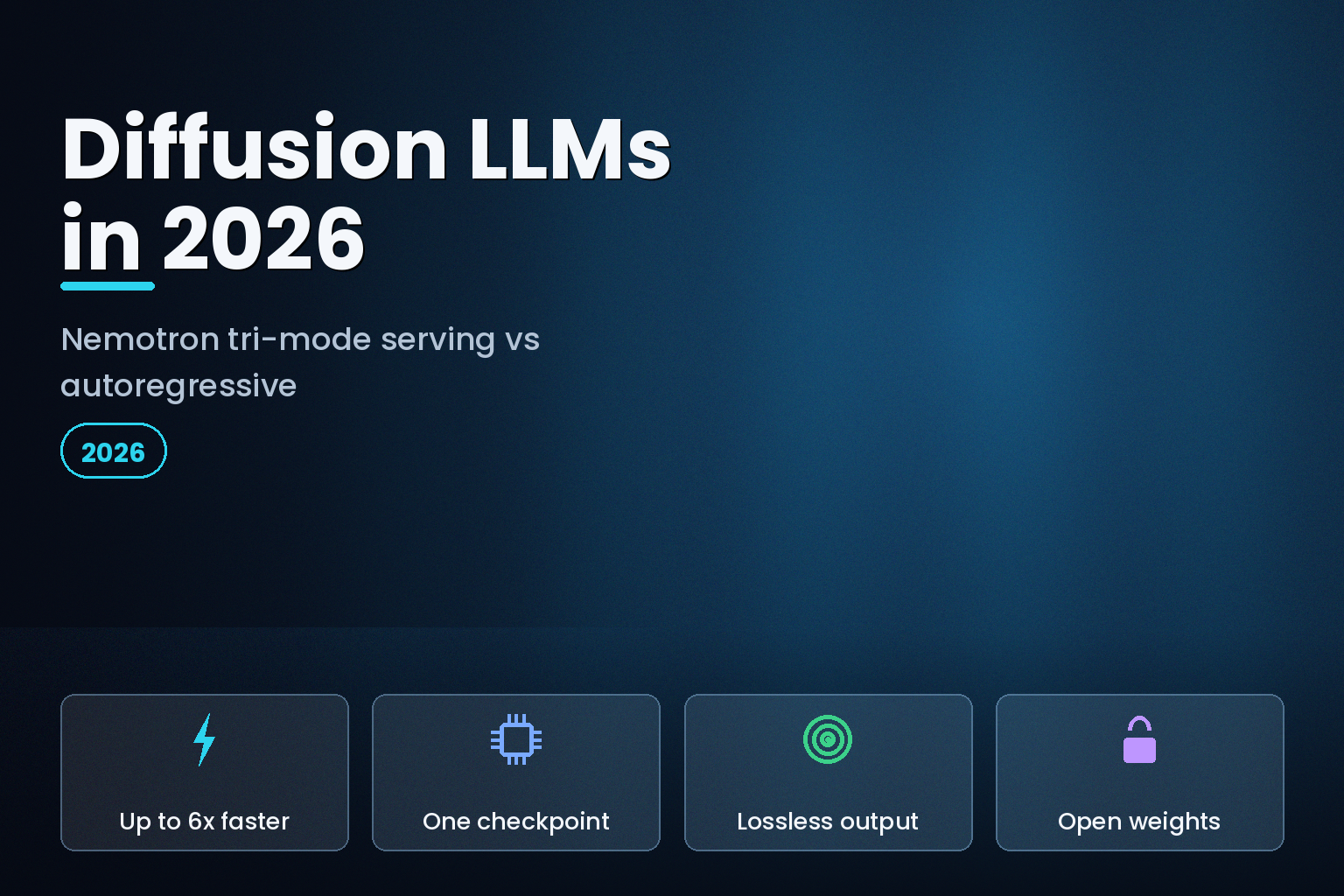
Summary. NVIDIA's Nemotron-Labs Diffusion, released in May 2026, is an open-weight language model family at 3B, 8B, and 14B parameters that serves one checkpoint three ways: plain autoregressive, diffusion, and self-speculation. On a tokens-per-forward basis the 8B model runs self-speculation at up to 6 times autoregressive throughput, generating 5.9 times more tokens per pass than Qwen3-8B at comparable accuracy. On real hardware at a single query, an 8B model reaches 850 tokens per second on a GB200 against 253 for autoregressive, a 3.3 times gain, and 112 against 41.8 on a DGX Spark, a 2.7 times gain. After AWS raised reserved GPU capacity prices about 20% in July 2026, a reserved B200 runs about $12.36 per accelerator-hour, so a 3.3 times throughput gain is close to a 3.3 times cut in serving cost per token. The catch is that those numbers are measured at low concurrency, so the decision is not "diffusion is faster" but "faster for which workloads." This guide answers that.
For a decade, most production language models have generated text the same way: one token at a time, each token conditioned on the tokens before it. That autoregressive approach is stable to train and simple to serve, and it is why it dominates. It also has a hard floor. Every new token needs a full model pass, and every weight has to be read from memory before the compute starts. At small batch sizes the GPU spends most of its time moving weights, not doing math, which is why a single-user chatbot leaves most of a B200 idle.
Diffusion language models attack that floor by generating a block of tokens in parallel and then refining them over a few steps. NVIDIA's release folds both styles into one set of weights. "Autoregressive and diffusion generation should not be separate model families. They should be capabilities of the same model," NVIDIA wrote in the Nemotron-Labs Diffusion release. That single design decision is what makes this worth a serious look for inference teams, because you can adopt it without giving up the autoregressive path you already trust.
One checkpoint, three modes
The model exposes three generation modes, and the mode is a deployment-time setting, not a separate model. Switching between them changes almost nothing at the application level.
Autoregressive mode runs left to right like any causal model. It is the correctness reference and the compatibility path. Diffusion mode, which NVIDIA is FastDiffuser, fills a 32-token block at a time by iteratively denoising it, with a confidence threshold deciding which tokens are good enough to commit each step. Self-speculation mode, served as LinearSpec, drafts a block with the diffusion path and then verifies it with the autoregressive path, committing whatever prefix matches. At temperature 0 the self-speculation output is lossless against autoregressive, which is the property that makes it safe to turn on in production.
| Mode or comparison | How it generates | Throughput result |
|---|---|---|
| Autoregressive | One token per forward pass, left to right | 1x (baseline) |
| Diffusion (FastDiffuser) | A 32-token block per step, refined by denoising | Parallel decode, faster than AR |
| Self-speculation (LinearSpec) | Diffusion drafts, autoregressive verifies, lossless at temp 0 | Up to 6x tokens per forward |
| Self-speculation vs Qwen3-8B, no MTP | Same accuracy, more tokens per pass | 5.9x tokens per forward |
| Self-speculation vs Qwen3-8B with Eagle3 | One shared KV cache, no separate draft model | 2.2x speed-up, 3x acceptance |
Tokens per forward is a hardware-agnostic count of how many output tokens each model pass produces. It is the cleanest way to compare decoding efficiency because it strips out the GPU. It is not the number your users feel. For that you need wall-clock throughput on real silicon, which is where the picture gets more honest.
The real-hardware numbers, at a single query
NVIDIA published device measurements for the 8B model at concurrency 1, the hardest case for autoregressive serving and the friendliest for diffusion. The self-speculation path is the one to watch, because it is lossless and therefore the one most teams can actually ship.
| Hardware (8B, concurrency 1) | Autoregressive | Nemotron self-speculation (speed-up) |
|---|---|---|
| DGX Spark (w4a16) | 41.8 tok/s | 112 tok/s (2.7x) |
| GB200 | 253 tok/s | 850 tok/s (3.3x) |
| GB200 with custom CUDA kernels | 253 tok/s | 1015 tok/s (4x) |
| GB200, Eagle3 reference | 253 tok/s | 360 tok/s (1.4x) |
| B200 speedbench (LinearSpec) | baseline | about 865 tok/s (about 4x) |
Two things stand out. First, self-speculation beats the strong speculative-decoding baseline, Eagle3, by a wide margin: 850 tokens per second against 360 on the same GB200, because it drafts with a real parallel decoder instead of a small draft model. NVIDIA reports 3 times higher acceptance length and a 2.2 times speed-up over Qwen3-8B with Eagle3 in SGLang. Second, custom kernels add another 20%, taking the GB200 to 1015 tokens per second, a 4 times gain over autoregressive on identical hardware.
The reason the gain exists is a shift in what bounds the work. NVIDIA describes it plainly: generation moves "from a memory-bound regime toward a compute-bound regime," because the weights are loaded once and reused to compute several tokens. On a modern accelerator with far more compute than memory bandwidth, that is exactly the trade you want, but only when you were memory-bound to begin with.
When it pays off, and when it does not
Here is the senior-engineer read. Every headline number above is at concurrency 1. That is not a trick, it is the point: diffusion and self-speculation win biggest when autoregressive serving is memory-bound, which is the low-concurrency, latency-sensitive, single-user regime. As you raise batch size, autoregressive serving becomes compute-bound on its own by amortizing weight loads across many sequences, and the relative advantage of parallel decoding shrinks. So the decision turns on your real traffic shape, not on a benchmark.
| Scenario | Recommended mode | Why |
|---|---|---|
| Latency-critical, batch size 1 | Self-speculation (LinearSpec) | Largest lossless speed-up when memory-bound |
| High-throughput, large batches | Autoregressive, then measure | AR is already compute-bound at scale |
| Output must match AR exactly | Self-speculation at temperature 0 | Lossless versus autoregressive |
| Fill-in-the-middle or revision | Diffusion | Can revise tokens; AR cannot |
| Correctness reference or debugging | Autoregressive | The stable baseline to check against |
The practical rule: if you run interactive, single-user or low-concurrency workloads on B200 or GB200-class hardware, self-speculation is close to free throughput, and at roughly $12.36 per accelerator-hour for reserved B200 capacity, a 3.3 times gain is a direct cut in cost per token. If you batch hundreds of requests, benchmark before you switch, because your autoregressive server may already be extracting most of the compute the GPU can give. This is the same logic our teams apply in any inference cost-per-token comparison: the winning configuration is the one measured at your concurrency, not the vendor's.
Serving it: SGLang, one line to switch
Nemotron-Labs Diffusion runs on SGLang, with support landing in the main branch and available today through an open pull request. The same checkpoint serves all three modes, chosen by one setting in the algorithm config: ar_mode=true for the autoregressive reference, the FastDiffuser path for raw diffusion throughput, and LinearSpec for lossless self-speculation. The model card also documents vLLM and Transformers paths, so the model drops into a stack most teams already run. That low switching cost is the real story: you can serve autoregressive today, benchmark self-speculation on the same weights next week, and flip the flag only where the numbers justify it. Our guide to running a local LLM in production with vLLM and SGLang covers the surrounding serving setup.
Because the weights ship under the NVIDIA Nemotron Open Model License, a commercially usable license, you can self-host without an API contract. That matters most for teams already weighing self-hosting against a metered API. The break-even math is the same one we walk through for self-hosted versus API GPU cost: a throughput multiplier changes the number of GPUs you need to hit a latency target, which changes the whole build-versus-buy line. A 3.3 times serving gain can move a workload from "too expensive to self-host" to "cheaper than the API" without any change to the model's quality.
Why one set of weights can do both
Diffusion language models have circled research for years but stumbled on three practical barriers: lower accuracy than strong autoregressive models, harder training, and poor compatibility with KV caching. The Efficient-DLM work changed the path by showing that a pretrained autoregressive model can be converted into a diffusion language model through continued pretraining and a switch to block-wise attention, which preserves the autoregressive capabilities while enabling KV-cache-friendly parallel decoding. Nemotron-Labs Diffusion builds on that: it was trained with a joint autoregressive and diffusion objective on 1.3 trillion pretraining tokens plus a 45-billion-token supervised fine-tuning phase, so the same weights keep the autoregressive behaviour you trust and add parallel drafting on top. That shared history is why self-speculation can use one checkpoint and one KV cache for both drafting and verification, rather than bolting on a separate draft model.
Benchmark it yourself before you commit
The honest way to size the gain is to measure it on your own traffic, because every published number here is NVIDIA's, on NVIDIA's hardware, at concurrency 1. The model card ships the exact entry points, so a benchmark is a short job, not a research project.
Serve the checkpoint on SGLang or vLLM, then compare three runs on your own prompt set: ar_generate for the autoregressive baseline, generate with block_length=32 and threshold=0.9 for diffusion mode, and linear_spec_generate for lossless self-speculation. Measure three things, not one. Wall-clock tokens per second at your real concurrency is the number your users feel. The count of function evaluations, which the model returns as NFE, tells you how many model passes each answer cost and is the cleanest signal of decoding efficiency. And task accuracy on your own evaluation set confirms the diffusion sampler has not moved your outputs, since only self-speculation at temperature 0 is guaranteed lossless.
Two knobs matter. The diffusion confidence threshold trades speed for quality: a lower threshold commits more tokens per step and runs faster, a higher one is more conservative. An optional LoRA adapter on the diffusion drafter, shipped with the model, raises the acceptance length in self-speculation mode, which is where the extra throughput comes from. Start with the defaults, confirm the lossless property holds on your prompts, then tune the threshold only if your latency target demands it. Wire the whole comparison into a repeatable script so a model or driver update cannot quietly regress your serving path, the same discipline behind any hybrid LLM routing and API spend decision.
Accuracy: the trade you are actually making
Speed that costs accuracy is not a bargain. NVIDIA reports the 8B model matching Qwen3-8B accuracy while generating 5.9 times more tokens per forward pass, and self-speculation at temperature 0 is lossless against the model's own autoregressive output. That second point is the one to hold onto: LinearSpec does not approximate the autoregressive answer, it reproduces it, then accelerates how fast you get there. Diffusion mode, being a different sampling process, can diverge from the autoregressive output, so treat it as a distinct decoder to evaluate on your own tasks rather than a drop-in that is guaranteed to match. For model selection beyond raw speed, our enterprise model scorecard frames the wider trade-offs.
India-specific considerations
For Indian teams, the serving-cost angle is sharper than the latency one. GPU capacity is the dominant line item in most inference budgets here, and a lossless throughput multiplier is a rare lever that cuts cost without cutting quality or requiring a new model. An open-weight model under a commercial license also sidesteps cross-border data questions under the Digital Personal Data Protection Act 2023, because you can run it inside your own boundary rather than sending prompts to a foreign API. The decision framework is the same one in our self-hosting break-even guide: a higher tokens-per-GPU number lowers the utilization you need to beat an API's per-token price, which is where most Indian self-hosting cases are won or lost.
FAQ
How eCorpIT can help
eCorpIT helps teams decide where an open-weight model like Nemotron-Labs Diffusion actually lowers cost, and then deploys it. As an ISO 27001:2022 certified and CMMI Level 5 organisation, our senior engineering teams benchmark self-speculation against your current autoregressive serving at your real concurrency, size the GPU footprint, and stand up the SGLang or vLLM path inside your own boundary, aligned with DPDP Act 2023 data-handling requirements. If you are weighing a throughput gain against a self-hosting build, we can run the break-even numbers with you. Start at /contact-us/.
References
- NVIDIA on Hugging Face, Nemotron-Labs-Diffusion-8B model card, 2026.
- NVIDIA, Nemotron-Labs Diffusion model collection, 2026.
- Fu et al., NVIDIA, Nemotron-Labs-Diffusion technical report, 2026.
- NVIDIA, Nemotron Open Model License.
- Alibaba, Qwen3 model family.
- NVIDIA, Nemotron open model family.
- NVIDIA Developer, SGLang and NVIDIA inference stack.
- MarkTechPost, NVIDIA AI releases Nemotron-Labs Diffusion: a tri-mode language model with 6x tokens per forward over Qwen3-8B, 20 May 2026.
_Last updated: 31 July 2026._