On this page · 10 sections
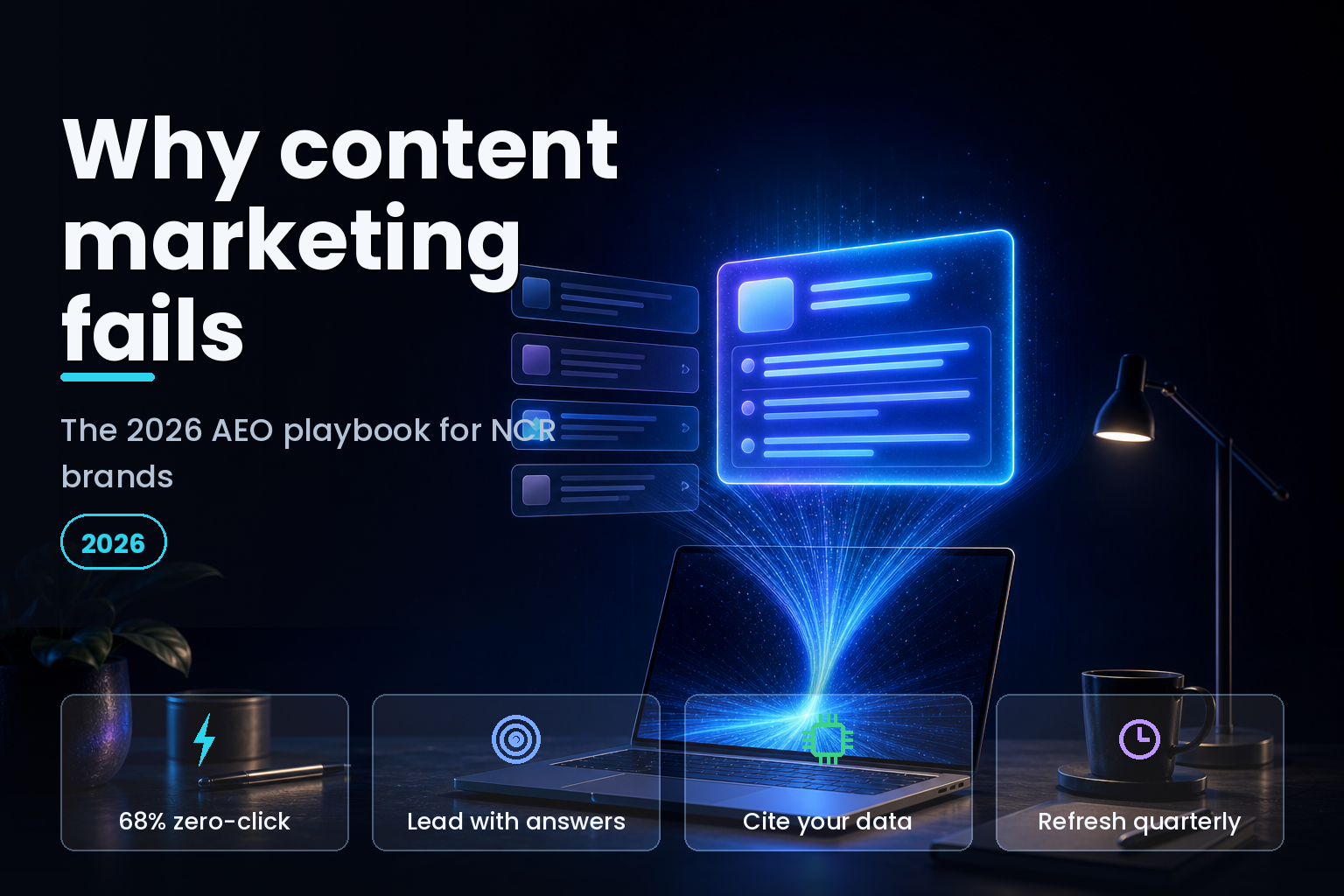
Summary. Most content marketing in Gurugram fails in 2026 for one reason: it is built to win clicks in a search world that has stopped sending them. SparkToro's 2026 study found 68% of US Google searches ended without a click, up from 60.45% in 2024. Google AI Overviews now appear on roughly 48% of tracked queries, per BrightEdge, and Seer Interactive measured organic click-through on AI Overview queries falling from 1.76% to 0.61% between June 2024 and September 2025, a 65% collapse. Bain and Company reported 73% of B2B websites lost meaningful traffic between 2024 and 2025. Meanwhile India's digital advertising market keeps climbing, projected to reach roughly ₹62,000 crore by 2026 at about 25% annual growth, so NCR brands are spending more to publish content that AI answers absorb without a visit. The fix is Answer Engine Optimization, or AEO: structuring content so Google AI Overviews, ChatGPT, Perplexity, and Claude cite it as a source. This is the diagnosis and the playbook.
The uncomfortable part for founders and marketing leads is that the content is often good. It ranks, it reads well, and it still loses, because ranking and traffic have come apart from revenue. For the fuller framework, our AEO vs GEO vs SEO guide and 2026 SEO guide go deeper; this piece is the Gurugram-specific version of the argument.
Why content marketing in Gurugram fails in 2026
The failure is not creative, it is structural. A decade of content advice optimised for one goal, a click from a search result to your site, and that click is disappearing. Rand Fishkin, founder of SparkToro, put the shift bluntly for marketers: "Your SEO still matters as much or more than ever before, it just won't earn you traffic the way it once did." When an AI Overview answers the query on the results page, the searcher rarely clicks through, and a page written only to be visited has nothing left to do.
| The zero-click shift | Figure | Source |
|---|---|---|
| US Google searches ending without a click, 2026 | 68% | SparkToro |
| Queries showing an AI Overview | About 48% | BrightEdge |
| Organic CTR on AI Overview queries | Fell 1.76% to 0.61% | Seer Interactive |
| Position-one CTR drop when an AI Overview appears | About 58% | Ahrefs |
| B2B sites that lost meaningful traffic, 2024 to 2025 | 73% | Bain and Company |
| Extra organic CTR for pages cited inside an AI Overview | 35% more | Seer Interactive |
Read the last row carefully, because it holds the strategy. Being the source an AI Overview cites is now more valuable than ranking below it. That single reframe, from earning the click to earning the citation, is what most Gurugram content programs have not made.
The failure patterns behind the numbers
Four patterns show up again and again in NCR content that underperforms. First, optimising for rankings, not answers: pages that bury the answer under an introduction, so an AI engine cannot extract a clean response and looks elsewhere. Second, no evidence: claims with no data, dates, or sources, which answer engines are built to distrust and skip in favour of pages that cite proof. Third, staleness: content published once and never refreshed, in a system where recency is a ranking signal for citation. Fourth, measuring the wrong thing: teams reporting sessions and keyword positions while the metric that now maps to revenue, whether an AI answer names your brand, goes untracked.
None of these is a Gurugram-specific weakness. The reason it bites here is timing and spend. India's digital ad market is growing at roughly 25% a year, so more budget flows into content each quarter, and if that content is structured for the old model, the extra spend buys diminishing returns. The teams that adjust first will take citations from the teams that do not.
The AEO playbook that fixes it
Answer Engine Optimization is the discipline of structuring content so AI answer engines select it as a cited source. It is not a rewrite of everything; it is a set of moves applied to the pages that matter. Frase, HubSpot, and AirOps converge on the same core, and AirOps' research quantifies why each move works.
| AEO move | What to do | Why it works |
|---|---|---|
| Lead with the answer | Open every section with a direct 40 to 60 word answer | AI engines extract the first one or two sentences of a section |
| Structure the headings | Use a clean H2, then H3, then H4 hierarchy | AirOps found a 2.8x citation lift for sequential heading structure |
| Show your evidence | Add dated statistics, prices, and named sources | Answer engines favour claims backed by verifiable proof |
| Add schema | Mark up FAQPage, Article, Organization, and Author | Reinforces entities, intent, and credible authorship |
| Refresh on a cadence | Update key commercial pages every quarter | 83% of AI citations for commercial queries come from pages updated within 12 months |
| Build off-site authority | Earn presence on LinkedIn, YouTube, and review sites | Answer engines assemble answers from many sources, not one page |
The through-line is that answer engines reward pages that answer directly, prove the claim, are easy to parse, and were updated recently. AirOps also found that pages not refreshed quarterly are about three times more likely to lose their AI citations than recently updated ones, which is why a refresh cadence, not a one-time publish, is now the backbone of the playbook. Encouragingly, almost all of this also lifts traditional rankings, so AEO and SEO pull in the same direction rather than competing.
What this means for Gurugram and Delhi NCR businesses
For an NCR founder, the practical shift is to treat content as an answer library, not a traffic funnel. Take the twenty questions your best customers actually ask, and publish a page for each that opens with a clear, sourced answer, carries a comparison table or a dated figure, and states who wrote it. That structure is what an answer engine can lift and attribute. A focused Gurugram brand can compete here in a way it could not in the old link-and-domain-authority game, because answer engines reward specific, well-sourced answers over sheer domain size.
The local intent layer still matters. When someone searches for a service in Gurugram or Delhi NCR, entity clarity, consistent name, address, and category, plus genuine local detail, helps both Google and AI engines place you. Pair the AEO structure above with real local specificity, and you cover both the answer-engine citation and the local-search result, which is where NCR service businesses win.
How to measure success now
If the old scoreboard is broken, replace it rather than stare at it. The metrics that matter in 2026 are different from the ones most dashboards still lead with.
| Metric | Old goal | New goal for 2026 |
|---|---|---|
| Visibility | Rank in the top three | Get cited in the AI answer |
| Demand | Organic sessions | Branded search volume |
| Content coverage | Keywords targeted | Customer questions answered directly |
Traffic still counts, but it is now a lagging, partial signal. Seer Interactive found that pages cited inside an AI Overview earn 35% more organic click-through than uncited competitors on the same query, so the citation is both the brand impression and the path to the remaining clicks. Track whether your brand appears in AI answers for your key questions, watch branded search as a proxy for the awareness those answers create, and measure how many of your customers' real questions you answer directly on the page.
India-specific considerations
Two India-specific factors sharpen the case. The first is spend velocity: with the digital ad market projected near ₹62,000 crore in 2026 and growing about 25% a year, the cost of running content on the old model compounds quickly, because you are paying more each quarter for output that AI answers increasingly intercept. The second is language and entity signals. NCR audiences search in English and in Hindi-English mixes, and answer engines rely on consistent entity data to attribute a source, so a clear Organization and Author identity, consistent across your site and profiles, does more for citation than another thin blog post. For the broader enterprise view of adopting AI in your stack, our generative AI enterprise strategy guide sits alongside this marketing shift.
A 30-day AEO start for an NCR team
You do not need a rebuild to begin, and starting small beats waiting for a perfect strategy. In the first week, list the twenty questions your best customers ask before they buy, and pull the five existing pages that already rank for any of them. In the second week, rewrite the opening of each of those five pages so the first two sentences answer the question directly, in 40 to 60 words, before any preamble; this is the single move that most changes whether an answer engine can quote you.
In the third week, add the evidence and the structure: a dated statistic or a comparison table on each page, a clean H2 to H3 to H4 hierarchy, and FAQPage plus Article and Organization schema that mirrors the visible content. In the fourth week, set the maintenance habit that the data says matters most, a quarterly refresh of these commercial pages, and add one off-site signal, such as an author profile on LinkedIn that matches the bylines on your site, so entity attribution lines up. That is a month of focused work on a handful of pages, not a year-long program, and it targets exactly the signals AirOps and Seer identified as driving citations. Do this for your top five pages, measure whether your brand starts appearing in AI answers for those questions, and then widen to the next five. The teams in Gurugram that treat AEO as an operating habit rather than a one-time campaign are the ones that will hold their share of attention as clicks keep shrinking.
FAQ
How eCorpIT can help
eCorpIT is a CMMI Level 5 technology company founded in 2021 in Gurugram, and our senior teams help NCR founders rebuild content for the answer-engine era. We restructure pages to lead with cited answers, add schema and data, and set a quarterly refresh cadence, the same AEO approach we detail in our AEO vs GEO vs SEO guide and 2026 SEO guide. To audit your content for AI citation, contact our team.
References
- SparkToro, "In 2026, Less than One Third of Google Searches Still Send a Click": sparktoro.com
- Search Engine Land, "Google zero-click searches reach 68% in early 2026: Study": searchengineland.com
- Seer Interactive, "AIO Impact on Google CTR: September 2025 Update": seerinteractive.com
- dotdigital, "The state of search in 2026: a discussion with Rand Fishkin": dotdigital.com
- TheStacc, "Google AI Overviews in 2026: 48% of Searches Have Them" (BrightEdge data): thestacc.com
- Omnibound, "AI SEO Statistics 2026" (Ahrefs and Bain and Company data): omnibound.ai
- AirOps, "Answer Engine Optimization (AEO): Your Complete Guide for 2026": airops.com
- Frase, "Answer Engine Optimization: The Complete AEO Guide 2026": frase.io
- HubSpot, "Answer engine optimization trends in 2026": blog.hubspot.com
- Expert Market Research, "India Digital Marketing Market Size and Forecast": expertmarketresearch.com
- Omnibound, "Zero-Click Search Statistics 2026": omnibound.ai
_Last updated: July 1, 2026._