On this page · 11 sections
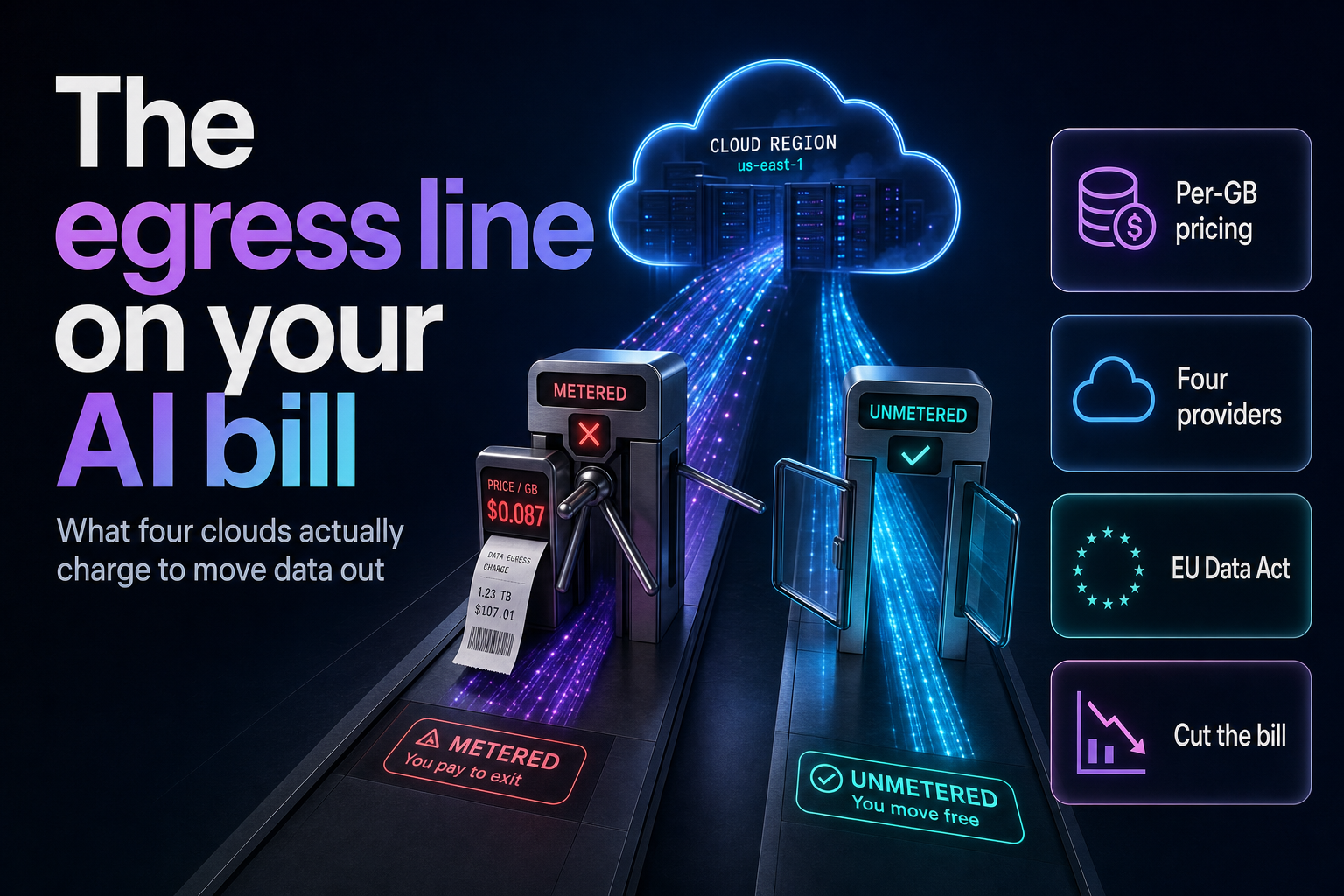
Summary. Moving 5 TB out to the internet in a month costs $451.80 on AWS, $436.74 on Microsoft Azure and $573.33 on Google Cloud Premium Tier, and $0.00 on Cloudflare R2, per pricing verified in June 2026. Entry rates are $0.090/GB on AWS, $0.087/GB on Azure and $0.120/GB on GCP Premium, against $0.00/GB on R2 and $0.0085/GB on Oracle Cloud after its 10 TB monthly free allowance. The spread across tracked providers reaches 127x. Two things make this worth an hour of your attention in 2026. First, the headline per-GB rate is not where the money goes: an AWS NAT Gateway adds $0.045/GB of processing on top, and cross-AZ traffic bills $0.01/GB, so an architecture mistake costs more than a provider choice. Second, the EU Data Act, in force since 11 January 2024 and applicable across the EU since 12 September 2025, bans switching charges outright from 12 January 2027. That deadline is widely misread. It abolishes the fee to leave, not the fee to serve your users.
What egress actually costs as a share of your bill
Be careful with the percentages that circulate here, because they vary enormously by workload and the eye-catching ones are outliers.
Cloudflare's research found that reducing or eliminating egress fees can save customers between 7.5% and 27% of their total monthly bill. That is a savings range from a vendor that sells zero-egress storage, so read it as an upper-bound marketing figure, not a neutral median.
The honest answer is that egress is a single-digit to mid-teens percentage of a typical cloud bill, and a much larger share for data-heavy and media-serving workloads. If someone quotes you a precise universal figure for what egress costs "the average company", ask them for the sample. Your own bill is the only number that matters, and it is one query away in your cost explorer.
The four-provider breakdown
Rates below are standard internet egress from US regions, free tiers deducted, as verified in June 2026 against official provider pricing documentation.
| Provider | Entry rate | 5 TB/month | Annual | Free tier |
|---|---|---|---|---|
| Cloudflare R2 | $0.00/GB | $0.00 | $0.00 | Unlimited |
| Wasabi | $0.00/GB | $0.00 | $0.00 | Included |
| Backblaze B2 | $0.010/GB | $51.20 | $614.40 | 3x stored data |
| Microsoft Azure | $0.087/GB | $436.74 | $5,241 | 100 GB/mo |
| Amazon Web Services | $0.090/GB | $451.80 | $5,422 | 100 GB/mo |
| Google Cloud (Premium) | $0.120/GB | $573.33 | $6,880 | 1 GiB/mo |
Three observations a sales deck will not volunteer.
Azure is the cheapest hyperscaler below 50 TB, at $0.087/GB for the first 10 TB and $0.083/GB for the next 40 TB, then it matches AWS above that. AWS runs $0.090/GB for the first 10 TB, dropping to $0.085/GB for the next 40 TB, $0.07/GB for the next 100 TB and $0.05/GB above 150 TB. So the ranking flips with volume, and the answer to "which is cheaper" is "at what scale".
Google Cloud Premium Tier is the most expensive of the big three at $0.120/GB, but GCP is the only one of them offering a documented cheaper network tier: Standard Tier starts at $0.085/GB and undercuts both rivals. If your workload is not latency-sensitive, that switch is a rate cut with no architectural change.
The free tiers are not comparable. AWS and Azure both give 100 GB per month. GCP's Premium Tier rate table gives 1 GiB per month, and the 100 GB figure often cited for GCP belongs to Cloud Storage rather than the networking table. Oracle Cloud gives 10 TB per month free, which is 100x the AWS and Azure allowance, then charges a flat $0.0085/GB.
| Provider | Free egress | Note |
|---|---|---|
| Oracle Cloud | 10 TB/mo | Always-free, not a trial |
| Cloudflare R2 | Unlimited | Pay for storage and operations only |
| AWS | 100 GB/mo | Aggregated across services and regions |
| Azure | 100 GB/mo | Zone 1 pricing |
| Google Cloud | 1 GiB/mo | Premium Tier rate table |
| Backblaze B2 | 3x stored data | Free via Cloudflare Bandwidth Alliance |
The charges that dwarf the headline rate
This is the part that actually decides your bill, and it is why provider-shopping on the per-GB rate is usually the wrong first move.
On AWS, a NAT Gateway adds $0.045/GB of data processing on top of egress. That is half the internet egress rate again, applied to traffic that may never leave the region. Cross-AZ transfer bills $0.01/GB each way, and the same cross-zone rate applies on Azure and GCP. Meanwhile S3 to CloudFront is free, which means the same bytes can cost $0.09/GB or nothing depending on the path you route them through.
Put plainly: a chatty microservice spread across three availability zones can generate more billable transfer talking to itself than your application ever sends to customers. The provider comparison table is a rate negotiation. The architecture is the bill.
The published comparison above deliberately excludes NAT Gateway processing, cross-AZ transfer and load balancer fees, because those vary by architecture. Yours will not.
Why AI inference sharpens this
Inference workloads move data in a pattern that egress pricing punishes. Model weights get pulled to wherever compute is available. Embeddings travel to a vector store that may sit in another service or another cloud. Retrieval-augmented generation reads a corpus on every request. Responses stream out to users. Each hop crosses a boundary someone meters.
The structural fix is old and still correct: move compute to the data, not data to the compute. If your vector store, your object storage and your inference endpoint sit in three different providers because each was individually the best tool, you are paying a transfer tax on every request to keep that opinion.
The rate you negotiate matters less than the number of boundaries your request path crosses. Count the boundaries first.
What the EU Data Act actually changes in 2027
This is the most misreported item in cloud cost planning right now, so here is the precise version.
Regulation (EU) 2023/2854, the Data Act, was adopted on 13 December 2023, entered into force on 11 January 2024, and has been applicable across the EU since 12 September 2025. Cloud switching sits in Chapter VI, Articles 23 to 31.
Article 29 phases out switching charges on a schedule. Cost-covering switching charges are permitted until 12 January 2027. From 12 January 2027, switching charges are completely prohibited.
Here is the distinction everyone drops. The Data Act abolishes charges for switching provider, which includes the egress incurred in moving your data out. It does not abolish operational egress, meaning the bytes you serve to your own users every day. If you read a headline saying the EU banned egress fees from 2027, it is wrong in the way that matters to your monthly bill. Your inference traffic will still be billed at $0.09/GB on 13 January 2027.
What else Chapter VI requires is worth knowing, because it is use you already have:
| Provision | Requirement | Article |
|---|---|---|
| Notice period | Maximum two months | Art. 25(2)(d) |
| Transitional period | Usually 30 days, extendable to 7 months in exceptional cases | Art. 25(2)(a), 25(4) |
| Switching charges | Cost-covering only until 12 Jan 2027, prohibited after | Art. 29(2) |
| Functional equivalence | IaaS providers must enable a minimum level of functionality after the switch | Art. 30(1) |
| Open interfaces | Provided free of charge, with sufficient documentation | Art. 30(5) |
| Obstacles to switching | Pre-commercial, commercial, technical, contractual and organisational obstacles prohibited | Art. 23, 24, 27 |
Providers may still charge for services that go beyond the Data Act minimum, such as converting data into a specific format or accelerating the switch. Deloitte Legal notes that the precise boundary between a premium service and a prohibited switching charge still needs to be established, so expect that line to be argued over through 2027.
AWS, Azure and Google all waived egress fees for customers fully exiting back in 2024, ahead of the regulation. That was the concession. It is not the same as free egress.
What to actually do
In order of payback.
- Measure before you shop. Pull egress as a line item from your own cost tooling. If it is under 5% of your bill, this whole article is a footnote for you and your effort belongs elsewhere.
- Audit the path, not the provider. Find NAT Gateway processing charges and cross-AZ transfer first. At $0.045/GB and $0.01/GB respectively, these are usually the bigger number and they are fixable without leaving anyone.
- Put a CDN in front of anything served repeatedly. S3 to CloudFront is free; serving the same asset from object storage directly is not.
- Check whether you need Premium Tier on GCP. Standard Tier at $0.085/GB is a rate cut for latency-tolerant traffic.
- Move egress-heavy storage, not everything. Cloudflare R2 and Wasabi at $0.00/GB, or Oracle's 10 TB free allowance, are worth it for media and asset serving. They are not a reason to replatform your compute.
- Use the Data Act if you are in the EU. Until 12 January 2027 a provider may only charge cost-covering switching fees, and after that nothing. Get your exit terms in writing now, while the rule is on your side.
The honest summary: provider choice is a rate decision worth low single-digit percentages, and architecture is a structural decision worth multiples of that. Fix the second first.
India-specific considerations
Three things sharpen this for Indian teams.
Cloud is billed in dollars and paid in rupees, so egress is exposed to currency movement on top of volume growth. A $5,422 annual AWS egress line at 5 TB per month is a rupee liability that moves without anyone changing a config. That makes structural waste more expensive here than the dollar figure suggests.
Data residency changes which of these options are actually available. The Digital Personal Data Protection Act 2023, which received presidential assent on 11 August 2023, governs how personal data is handled, and residency requirements can rule out the cheap-egress provider precisely because it lacks a suitable region. Cost and compliance are decided together or not at all. We design applications aligned with DPDP Act 2023 requirements so that constraint lands before the architecture, not after.
The EU Data Act does not apply to an Indian company serving Indian users. If you serve EU customers through an EU region, Chapter VI reaches those contracts. Know which of your accounts are in scope before you plan a 2027 exit around a rule that may not cover you.
Our guide to cutting cloud spend for Indian teams covers the wider lever set, our note on GPU spend as the top FinOps concern covers the accelerator side, and teams wanting this run for them can compare our cloud FinOps managed service.
The verdict
Egress pricing is a real cost and a bad reason to pick a cloud. The gap between the cheapest and most expensive hyperscaler at 5 TB per month is $136.59, which is roughly two hours of a senior engineer's time. The gap between a well-routed architecture and a badly-routed one is a multiple of the entire egress line.
Zero-egress providers are genuinely cheaper for egress-heavy storage, and that is a narrow, real use case worth taking. Treat the 2027 Data Act deadline as what it is: an exit-cost change that improves your negotiating position, not a rebate on your traffic.
FAQ
How eCorpIT can help
eCorpIT is a CMMI Level 5, MSME-certified, senior-led engineering organisation in Gurugram that runs cloud cost reviews across AWS, Azure and GCP for Indian and global teams. We start by measuring your actual egress line rather than quoting an industry average, trace the NAT Gateway and cross-AZ charges that usually exceed it, and price the architectural fixes against the provider-switching ones. We design applications aligned with DPDP Act 2023 requirements so residency is settled before the cost model. To scope a review priced in rupees, contact our team.
References
- Cloud Egress Pricing Comparison: AWS vs Azure vs GCP vs Alternatives - EgressCost.com, pricing verified June 2026 against official provider documentation.
- What are data egress fees? - Cloudflare Learning Center.
- Cloud switching under the EU Data Act - Christopher Eduard Bosch and Dr. Till Contzen, Deloitte Legal, 12 September 2025.
- The Data Act: Switching Requirements for Cloud Services Providers - Alston and Bird, September 2025.
- The Data Act's changes to cloud services contracts - Travers Smith.
- New requirements for cloud portability in the EU Data Act - Advokatfirman Lindahl.
- Appendix N: Egress fees and free switching programmes - UK Competition and Markets Authority.
- Azure Egress Cost Calculator - EgressCost.com.
- Cloud Egress Cost Calculator: AWS, Azure, GCP, Cloudflare - EgressCost.com.
- The Digital Personal Data Protection Act, 2023 - Ministry of Electronics and Information Technology, Government of India.
Last updated: 16 July 2026.