On this page · 8 sections
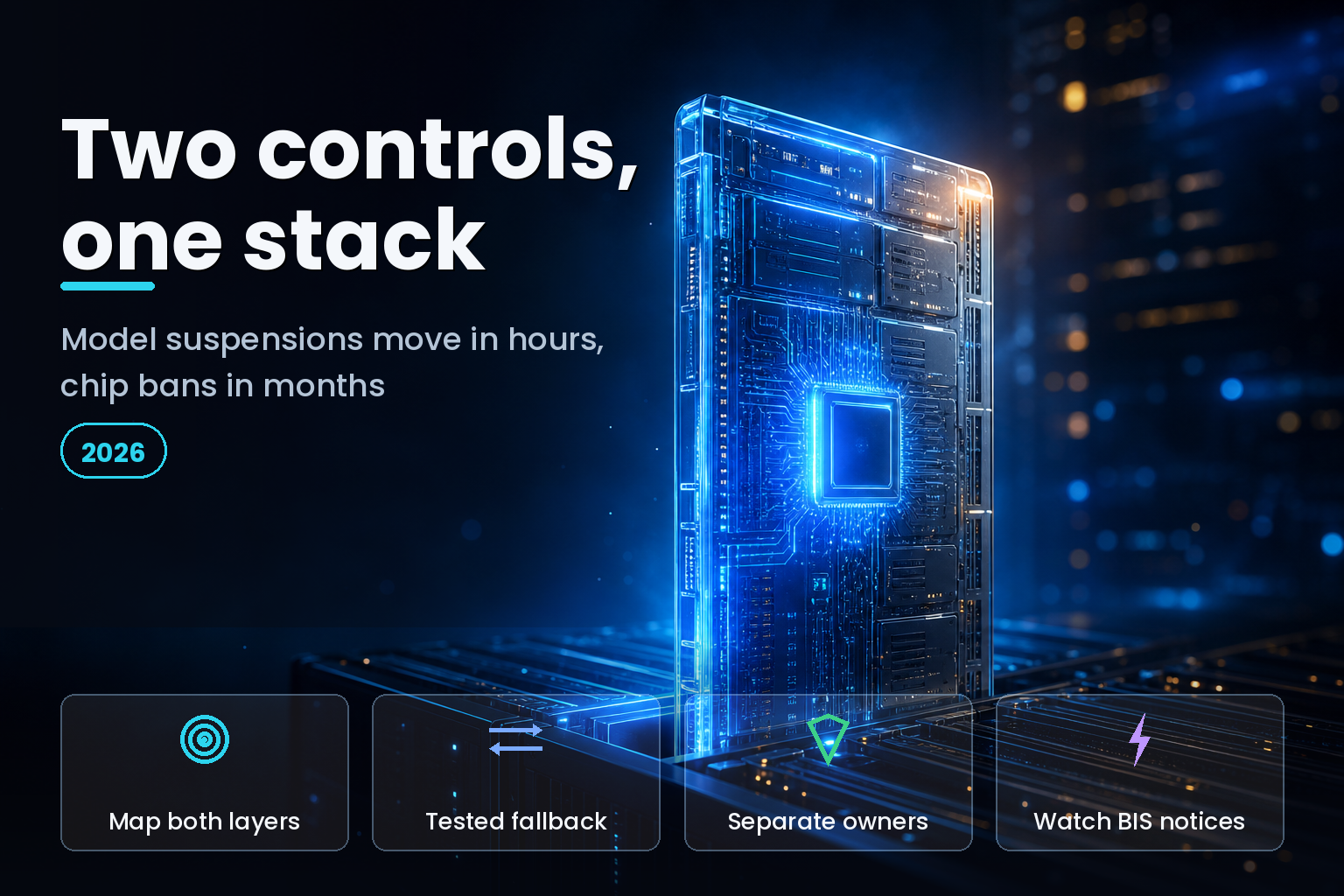
Summary. US export control now reaches two layers of the AI stack, and they behave nothing alike. On June 12, 2026, at 5:21 p.m. ET, a Bureau of Industry and Security order forced Anthropic to suspend Claude Fable 5 and Mythos 5 worldwide within hours, the first time a live commercial model was pulled on national-security grounds. Chip controls work on a slower clock: the US first restricted Nvidia A100 and H100 exports to China on August 26, 2022, tightened them with the AI Diffusion Rule in January 2025, then reversed course on January 13, 2026 by allowing capped H200 sales. One control removes a model from production with no notice; the other reshapes where you can buy compute over months. Treating them as the same risk is the mistake. A hardware restriction affects procurement decisions made weeks or months ahead; a model suspension removes active capability with no planning period. For founders and CTOs assessing continuity risk, that gap, plus a reported $160 million in smuggled Nvidia chips and a planned 250% rise in 2026 China AI compute, is the story. This guide prices each risk and shows how to carry both on one register.
Two export controls, one stack
Export control used to be a hardware conversation. The Export Administration Regulations, the rulebook BIS enforces, were built around physical items: chips, tools, and the source code to build them. In January 2025 the rules stretched to cover advanced AI model weights above a training-compute threshold, which law firms including Sidley and King & Spalding flagged as a turn toward software. The Fable 5 order in June 2026 went further and applied the same framework to a deployed commercial model in production, through a one-to-one "Is Informed" letter rather than a published rule.
The result is that an enterprise AI program now sits on top of two distinct export-control surfaces. The lower surface is silicon: the GPUs you rent or buy to train and serve models. The upper surface is the model itself: the hosted frontier system your application calls. A control event on either surface can stop you, but the shape of the disruption, the warning you get, and the moves available to you differ enough that one risk line on a register cannot represent both. eCorpIT mapped the compliance response to the model-layer event in our enterprise AI export-control compliance playbook; this piece is about telling the two risks apart so you can size each one.
| Dimension | Chip ban (hardware layer) | Model suspension (model layer) |
|---|---|---|
| What is controlled | GPUs and computing hardware | A hosted frontier model in production |
| Typical speed | Weeks to months | Hours; Anthropic acted the evening of June 12, 2026 |
| Advance notice | Telegraphed; draft rules, comment periods | None; an "Is Informed" letter with no public rule |
| What it hits | Future compute supply and capex | Live operational capability today |
| Planning horizon | Procurement cycles you can re-plan | Zero; the model is gone now |
| Main mitigation | Alternate suppliers, regional capacity | Tested fallback model, abstraction layer |
| Who feels it first | Infra and finance teams | Product and customers, immediately |
The chip-ban risk you already knew
Hardware controls have a decade of precedent, and that history is the reason most risk teams already account for them. The US informed Nvidia of restrictions on A100 and H100 exports to China on August 26, 2022, then widened the net through 2023 with rules in the Federal Register covering advanced computing and supercomputing end use. In January 2025 the AI Diffusion Rule set global performance thresholds that blocked flagship parts like the H100 and H200 from reaching China and tiered the rest of the world.
The pattern is slow and visible. Draft rules leak, industry comments, and shipments adjust over quarters. Even reversals follow that rhythm: on January 13, 2026, Commerce published a regulation permitting capped H200 sales to China, with reporting describing a ceiling near 1 million H200 units and analysis estimating the move could lift installed China AI compute in 2026 by about 250% versus a domestic-only path. Nvidia then prepared up to 80,000 H200 chips for China ahead of the Lunar New Year, reportedly under a 25% US tax on those sales. The black market tells you the controls bite: CNBC reported roughly $160 million in export-controlled Nvidia GPUs allegedly smuggled into China in late 2025.
Hardware controls also leak at the edges, which shapes how much protection they actually buy. The Council on Foreign Relations called the January 2026 China chip policy "strategically incoherent and unenforceable," arguing that volume caps and tariffs are hard to police once chips enter a global resale market. For an enterprise buyer, the lesson is that chip-supply risk is real but gradual: you see tier changes and price moves coming, and you adjust orders, regions, and reserved capacity across planning cycles. The exposure is to cost and lead time, not to a same-day loss of a running system. That is the line that separates it from the model layer.
For an enterprise, chip-ban risk is a supply and cost problem. It shows up as longer lead times, regional capacity limits, and capex planning, not as a service that stops at dinnertime. You manage it the way you manage any supply chain: diversify suppliers, secure capacity early, and model the cost of regional constraints. It rarely surprises you on a Friday.
The model-suspension risk you did not price in
The Fable 5 order introduced a faster, sharper failure mode. The models had launched on June 9, 2026, and three days later a letter signed by Commerce Secretary Howard Lutnick, citing the Export Control Reform Act of 2018 (50 U.S.C. § 4817), required a license before any foreign national could use them. Under the EAR "deemed export" rule, granting access to any foreign national counts as an export, so Anthropic could not keep the models running for anyone and took them down globally that evening. By June 26, Commerce eased the Mythos 5 controls for an approved-entity list, while Fable 5 stayed offline.
This is a runtime risk, not a supply risk. It does not give you a procurement cycle to adjust. The capability your product depended on at 5:00 p.m. is unavailable at 5:21, with no restoration SLA, because a government order has neither the credits nor the timeline of a vendor outage. The Cloud Security Alliance research note framed the qualitative shift directly: the same framework that governs chips can now make any frontier model with dual-use capabilities a controlled item. Prasanto Roy, a technology policy analyst in New Delhi, drew the broader lesson: "Even if this is corrected or reversed, the Anthropic episode shows there's no such thing as a geopolitically neutral foreign LLM. American AI models are bound to American geopolitics."
The reason this risk went unpriced is that it had no precedent until June 2026. Risk registers carried vendor outage, data breach, and cost overrun. They did not carry "our primary model becomes illegal for our vendor to serve, worldwide, today." Now they have to.
Why a model suspension is harder to plan for
The hard part is the absence of a planning horizon. With chips, the control and your response live on the same slow clock, so the same quarter that brings a restriction also brings time to re-source. With a model suspension, the event is instant and your response is only as fast as the fallback you built beforehand. If you had not already evaluated and contracted a second model, June 12 was not a planning day, it was an outage you could not end.
Gartner, advising CXOs after the suspension, said the episode "emphasizes the need for enterprises to be intentional about sovereignty dependencies and, where possible, to design model-agnostic architectures." The advice lands because architecture is the only lever that works at the speed of the event. You cannot negotiate, re-source, or appeal fast enough; you can only route to a model you already trust. The compliance burden is also moving up the stack: the Cloud Security Alliance research note describes exposure now running through your AI service providers, not only your own activity, so a provider's controlled status becomes your operational problem.
This forces a board-level decision most teams have deferred: how much capability are you willing to trade for continuity. The strongest frontier model is often a single-vendor dependency, and the safest fallback is usually a slightly weaker model from a different jurisdiction or an open-weight system you can self-host. Pretending you can have maximum capability and zero suspension risk is how programs end up with no plan. The honest call is to accept a small, measured quality gap on critical paths in exchange for a switch you can execute in minutes. That trade-off should be written down, costed, and signed off, not left implicit in an architecture diagram.
What this changes for enterprise AI risk
Carry both risks, separately, on the register. They have different owners, horizons, and mitigations, and collapsing them hides the faster one.
| Risk line | Owner | Time to impact | Primary mitigation | Leading signal |
|---|---|---|---|---|
| Compute supply (chip ban) | Infra and finance | Months | Multi-supplier and regional capacity | BIS draft rules, diffusion-tier changes |
| Model continuity (suspension) | AI platform and product | Hours | Tested fallback, model-agnostic gateway | "Is Informed" letters, vendor advisories |
| Vendor concentration | Architecture | Hours to days | Second model in a different jurisdiction | Single-vendor share of critical workflows |
| Data sovereignty | Security and governance | Varies | Residency matrix, regional or self-hosted | DPDP transfer rules, sovereignty policy |
The practical program is small and specific. Give every critical workflow a named primary and secondary model from different vendors and, where you can, different national jurisdictions. Route model calls through an internal gateway so a switch is a configuration change, not a rewrite, and rehearse the cutover against your evaluation set so the recovery time is a tested number. Keep monitoring BIS and Commerce notices for the model layer the same way infra already watches diffusion-rule tiers for the hardware layer. eCorpIT's governance approach is detailed in enterprise AI agent governance layers, and the regulatory backdrop in AI regulation and export controls on enterprise models.
Rehearse the cutover as a game day
A fallback you have never executed is a guess. Borrow the failover drill from database operations and run it against the model layer. In staging, force the primary model to return errors, then route critical workflows to the secondary and measure three numbers: quality against your evaluation set, latency, and cost per request. Record the recovery time it actually took to detect, decide, and switch, and treat that as your model recovery time objective. If the secondary holds quality within an agreed band, you have a control you can show the board; if it does not, you have found the gap while it was cheap to fix.
Run the drill on a schedule, not once. Models change, prompts drift, and a fallback that passed in March can fail in June after a vendor update. Teams that rehearse quarterly turned the June 12 event into a routing change; teams that had only a diagram turned it into an incident. The difference was not the quality of the second model, it was whether anyone had pushed traffic to it under realistic conditions before they had to.
India-specific considerations
India carries both exposures at once. Its sovereign-AI compute, reported at roughly 34,000 Nvidia H100 and H200 GPUs under a $1.25 billion IndiaAI Mission, sits squarely inside the chip-control story, since the hardware ships under US rules. At the model layer, a large share of Indian products call US foundation-model APIs, so a single export order can disrupt them regardless of where their data lives. The Digital Personal Data Protection Act, 2023 adds a residency lever, running cross-border personal-data transfers against a government-maintained permitted-country list, which pushes regulated workloads toward infrastructure an Indian enterprise can control. For local founders, the takeaway is to treat hosted US frontier models as capability you can lose on short notice, and to keep a regional or open-weight fallback for anything mission-critical. The detailed compliance steps sit in our export-control compliance playbook and the DPDP consent-manager readiness guide.
How eCorpIT can help
eCorpIT (eCorp Information Technologies Private Limited) is a senior-led technology consultancy in Gurugram, founded in 2021 and assessed at CMMI Level 5. We help founders and CTOs separate compute-supply risk from model-continuity risk and build controls for each: model dependency registers, model-agnostic gateways, tested fallback runbooks, and DPDP-aligned residency designs. We design systems aligned with export-control and DPDP requirements rather than claiming certifications we do not hold. To map your two-layer export-control exposure, contact our team.
FAQ
References
Last updated: June 29, 2026.