On this page · 13 sections
- What Isolated v4 is, and what you are paying extra for
- The price gap, SKU by SKU
- The break-even nobody publishes
- The same hardware, the opposite price move
- Three constraints that decide this before price does
- The documentation has not caught up, and it costs you
- Discounts, and the trap in switching
- What the migration actually involves
- India-specific considerations
- The decision in four checks
- FAQ
- How eCorpIT can help
- References
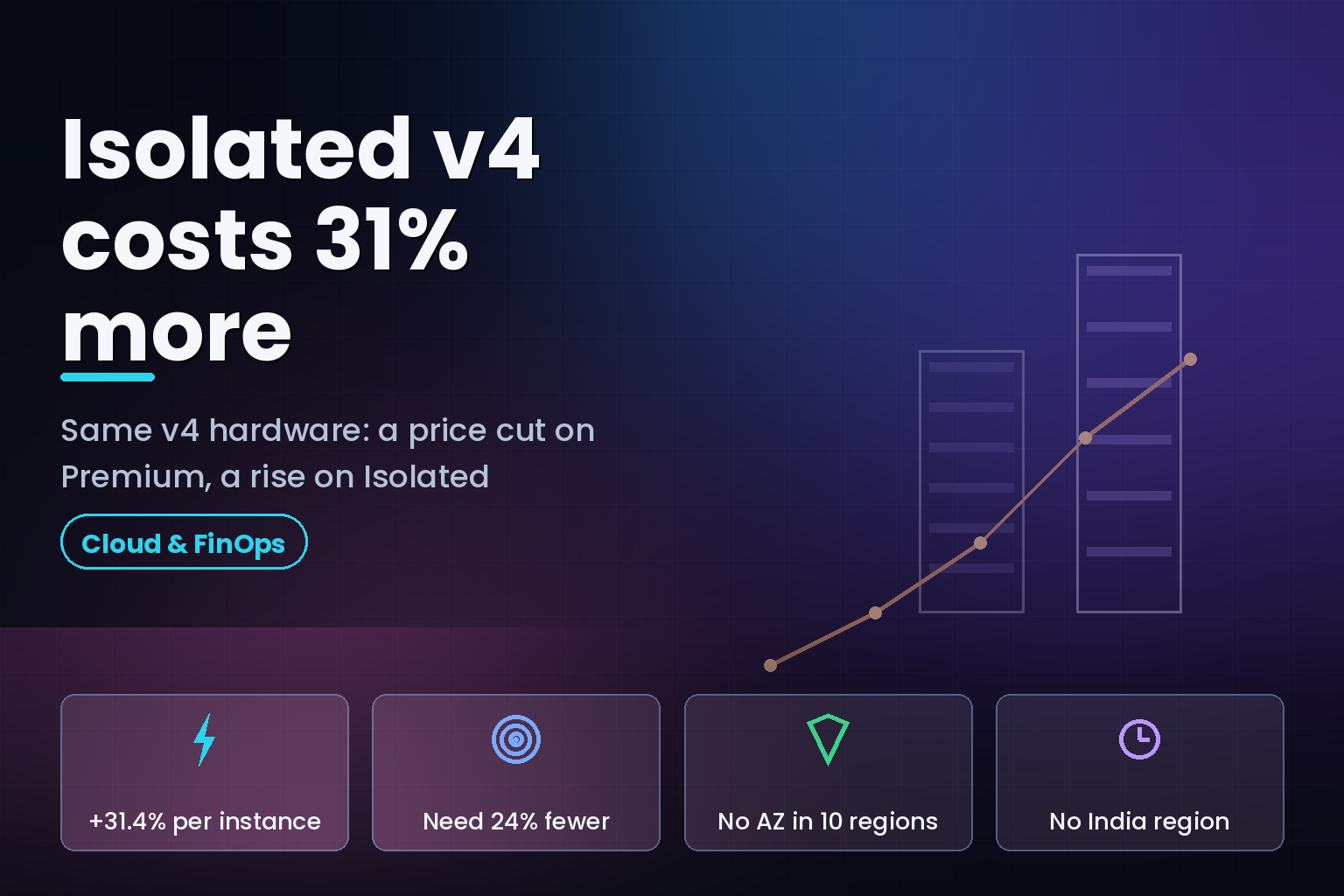
Summary. Isolated v4 (Iv4) on App Service Environment v3 reached general availability on 8 June 2026, and the list prices tell a sharper story than the announcement. In Southeast Asia an I3v4 plan (8 cores, 32 GB) costs $2,205.914 a month pay-as-you-go against $1,679.000 for an I3v2 at identical cores and RAM, a 31.4% increase per instance. The same v4 hardware generation moved the other way on multitenant App Service: P3v4 is $823.440 a month against $1,001.560 for P3v3, a 17.8% cut. So the isolation premium on an 8-core plan widened from 1.68x to 2.68x in one generation, on the same silicon. Microsoft's argument is that better per-instance performance lets you run fewer instances, but it publishes no throughput multiplier, so the break-even is arithmetic: your fleet has to shrink by at least 23.9%. Two constraints usually settle it before price does. Iv4 is live in 15 Azure public regions and none is in India, and only 5 of those 15 support availability zones for App Service Environment v3.
What Isolated v4 is, and what you are paying extra for
Isolated v4 is a pricing tier for App Service Environment v3 running on the v4 hardware generation. Microsoft's configuration guide describes "faster processors, NVMe local storage, and memory-optimized options" and states that Iv4 "uses the same underlying hardware as the Premium v4 tier for multitenant App Service."
That sentence is the whole cost question. The compute is the silicon multitenant Premium v4 runs on. The premium buys the App Service Environment around it: single-tenant compute in your own virtual network subnet, 16,000 maximum outbound TCP/IP connections per instance against 1,920 on a P1V3 and 8,064 on a P3V3, 100 instances per plan and 200 across an environment against a hard 30-instance ceiling on multitenant, and in-region storage of app content, settings and secrets.
"Iv4 brings the latest v4 hardware generation (the same next-generation compute that powers Premium v4) to customers running dedicated, single-tenant workloads on ASEv3, delivering significantly better performance than Isolated v2 without compromising the isolation, compliance, and data residency guarantees that mission-critical apps depend on," wrote Byron Tardif of the Azure App Service team in the Build 2026 announcement. "Significantly better" is the only performance figure Microsoft has published. There is no multiplier, no benchmark and no requests-per-second comparison against Iv2.
The tier supports Windows code apps, Linux code apps, Linux custom containers and Windows containers. SKUs run I1V4 to I6V4 for standard sizes and I1mV4 to I5mV4 for memory-optimized. Check availability before you plan anything:
            az appservice list-locations --sku I1V4
az appservice list-locations --linux-workers-enabled --sku I1V4
Creating a plan is a one-liner once the environment supports the SKU:
            az appservice plan create \
    --resource-group <resource_group_name> \
    --name <app_service_plan_name> \
    --app-service-environment <app_service_environment_name> \
    --sku I1V4
The price gap, SKU by SKU
Pay-as-you-go monthly list prices from the Azure App Service pricing page for Southeast Asia in USD, retrieved 7 August 2026. Cores, RAM and the 1 TB of included storage are identical between the v2 and v4 rows, which is what makes the comparison clean.
| SKU pair | Cores | RAM | Isolated v2 | Isolated v4 | Increase |
|---|---|---|---|---|---|
| I1v2 / I1v4 | 2 | 8 GB | $419.750 | $551.442 | 31.4% |
| I2v2 / I2v4 | 4 | 16 GB | $839.500 | $1,102.957 | 31.4% |
| I3v2 / I3v4 | 8 | 32 GB | $1,679.000 | $2,205.914 | 31.4% |
| I4v2 / I4v4 | 16 | 64 GB | $3,358.000 | $4,411.755 | 31.4% |
| I5v2 / I5v4 | 32 | 128 GB | $6,716.000 | $8,823.510 | 31.4% |
| I6v2 / I6v4 | 64 | 256 GB | $13,432.000 | $17,647.093 | 31.4% |
Memory-optimized SKUs are a materially better deal in the same region. I1mv4 (2 cores, 16 GB) is $640.283 against $518.300 for I1mv2, a 23.5% increase, and the ratio holds to I5mv4 at $10,237.812 against $8,286.960 for I5mv2. If your workload is memory-bound rather than CPU-bound, the v4 premium is roughly a quarter instead of a third.
Note also what the v4 generation did not bring to Isolated. The memory-to-core ratios are unchanged: I1v4 is 2 cores and 8 GB exactly as I1v2 was, and I1mv4 is 2 cores and 16 GB exactly as I1mv2 was. Premium v4's documentation advertises "up to double the memory-to-core ratio of previous tiers", but on the Isolated line the m-SKUs already existed at those ratios. What you get on Iv4 is a newer processor and NVMe local storage, not more memory per core.
The premium is not uniform across regions, which is where teams pricing a migration off one region get it wrong. Switch the same pricing page to Central India and INR: I1v4 is Rs 52,745.428 a month against Rs 38,822.422 for I1v2, a 35.9% increase, and the memory-optimized gap widens to 34.3% (I1mv4 at Rs 61,243.069 against Rs 45,595.399 for I1mv2) rather than narrowing to 23.5%. Same tier, same SKUs, 4.5 points more on standard and 10.8 points more on memory-optimized. Price the region you will actually deploy in.
The break-even nobody publishes
At the Southeast Asia standard-SKU premium of 31.4%, one Iv4 instance costs 1.314 times an Iv2 instance of the same size. Dividing through, the fleet must shrink to 76.1% of its current count: at least 23.9% fewer instances. For memory-optimized SKUs at 23.5%, the fleet must reach 81.0%, so 19.1% fewer. In Central India pricing the standard-SKU threshold rises to 26.4% fewer instances.
Worked through with I3-class SKUs in Southeast Asia:
| Current Iv2 fleet | Iv2 monthly cost | Iv4 instances | Iv4 monthly cost | Outcome |
|---|---|---|---|---|
| 10 x I3v2 | $16,790 | 10 x I3v4 | $22,059 | 31.4% more expensive |
| 10 x I3v2 | $16,790 | 9 x I3v4 | $19,853 | 18.2% more expensive |
| 10 x I3v2 | $16,790 | 8 x I3v4 | $17,647 | 5.1% more expensive |
| 10 x I3v2 | $16,790 | 7 x I3v4 | $15,441 | 8.0% cheaper |
| 10 x I3v2 | $16,790 | 6 x I3v4 | $13,235 | 21.2% cheaper |
Eight instances is still worse than ten. Seven is the first count that pays. The consolidation has to be measured on your own application under load, not inferred from a hardware-generation label.
Three second-order effects change the answer, and all three cut against aggressive consolidation.
Resilience margin shrinks with instance count. Going from ten instances to seven means each remaining instance carries 43% more traffic, and one instance failure removes 14.3% of capacity instead of 10%. Microsoft's own reliability guidance is to over-provision App Service plan capacity so the solution tolerates capacity loss, and warns that Azure "doesn't guarantee that requests for more instances succeed in a zone-down scenario" and backfills lost instances on a best-effort basis.
SNAT ports scale with instance count on an App Service Environment. Microsoft's comparison of App Service Environment v3 and multitenant App Service documents SNAT ports per instance as "Dynamic: 256 to 1,024, depending on the total instance count." Consolidating from ten instances to seven can therefore reduce the SNAT allocation per instance at the same time as it raises per-instance outbound connection volume. For a chatty service calling the same downstream address and port, that is the failure mode to test first. The documented fix is Azure NAT Gateway, where a single gateway supports up to 16 IP addresses at 64,512 SNAT ports each, roughly a million ports.
Zone redundancy imposes an instance floor. Microsoft's reliability guidance for App Service Environment requires a minimum of two instances per plan for zone redundancy, and adds a sharper rule: "When you enable availability zones for an App Service Environment, all App Service plans with fewer than 3 instances are scaled to 3 instances." If your consolidation target lands below three instances on a zone-redundant environment, you will be billed for three regardless.
The same hardware, the opposite price move
Premium v4 for multitenant App Service runs on the same v4 hardware and is priced below the generation it replaces, in the same region on the same day:
| SKU pair | Cores | RAM | Premium v3 | Premium v4 | Change |
|---|---|---|---|---|---|
| P1v3 / P1v4 | 2 | 8 GB | $250.390 | $205.860 | 17.8% cheaper |
| P2v3 / P2v4 | 4 | 16 GB | $500.780 | $411.720 | 17.8% cheaper |
| P3v3 / P3v4 | 8 | 32 GB | $1,001.560 | $823.440 | 17.8% cheaper |
| P1mv3 / P1mv4 | 2 | 16 GB | $277.108 | $243.820 | 12.0% cheaper |
| P3mv3 / P3mv4 | 8 | 64 GB | $1,108.432 | $973.820 | 12.1% cheaper |
| P5mv3 / P5mv4 | 32 | 256 GB | $4,433.728 | $3,894.550 | 12.2% cheaper |
Read the two tables together. On the previous generation an 8-core 32 GB isolated plan cost 1.68 times its multitenant equivalent ($1,679.000 against $1,001.560). On v4 hardware the same comparison is 2.68 times ($2,205.914 against $823.440). Included local storage differs, 1 TB aggregate across all apps in an App Service Environment v3 against 250 GB per App Service plan on multitenant, but not by enough to explain a full point of multiple.
The practical consequence: if you are on an App Service Environment out of habit rather than a written compliance or network-isolation requirement, the v4 generation is the moment to re-test that. Microsoft's own comparison is direct about when the environment is the right answer: a fully isolated and dedicated environment, scaling beyond 30 instances, client certificates issued by a private certificate authority for source-code deployments, or all apps in one subnet. If none of those applies, $823.440 buys the same compute that $2,205.914 does.
Three constraints that decide this before price does
Region availability is the first and it is blunt. Iv4 is listed as available in 15 Azure public regions: Australia East, Canada Central, Central US, East US, East US 2, France Central, North Central US, North Europe, Norway East, Southeast Asia, Switzerland North, West Central US, West Europe, West US and West US 3. No Indian region appears, and neither do Japan East, UK South, Germany West Central or UAE North. Premium v4 is available in Central India. So the v4 hardware generation is reachable in India on multitenant App Service and not on an App Service Environment.
The pricing page will still quote you Central India Isolated v4 rates. It carries the hedge itself, directing you to "visit product documentation" for supported regions. Treat the docs as authoritative and the pricing page as arithmetic.
Availability zones are the second, and this one is easy to miss because two current Microsoft pages disagree. The Isolated v4 page marks only 5 of the 15 Iv4 regions as currently supporting availability zones for App Service Environment v3: Australia East, Canada Central, France Central, Norway East and Switzerland North. The general App Service Environment overview lists a far longer set of ASEv3 regions with availability-zone support, Southeast Asia and East US among them. For an Iv4 deployment the narrower list governs. Choosing Iv4 in Southeast Asia or East US today means choosing between a zone-redundant Iv2 environment and a non-zone-redundant Iv4 one. If you have an availability SLO that requires zone redundancy, the 31.4% question never comes up.
Two related details are worth putting in the same ticket. Zone redundancy itself costs nothing extra beyond the two-instance minimum, and changing the zone-redundancy status of an App Service Environment takes 12 to 24 hours with no downtime. Zone-redundancy support is also assigned per scale unit based on the environment's resource group, and you do not control it: if your environment sits on a scale unit without availability-zone support, you cannot enable zone redundancy at all and have to build a new environment in a new resource group.
Capacity is the third. The documentation is unusually direct: "Isolated v4 capacity is constrained at launch. Large scale-out operations might fail in regions where Isolated v4 capacity isn't pre-provisioned for your subscription." Expect "The requested SKU isn't available in the selected region" or "Insufficient quota", and expect to open an Azure support ticket to request capacity. The Build post repeats it: "Due to significant demand, available capacity may be limited even in supported regions at this time." Treat the capacity request as a scheduled task with lead time, not an incident.
The documentation has not caught up, and it costs you
Four current Microsoft pages still describe App Service Environment as an Isolated v2 product two months after Iv4 went GA, and each one is a place a plan can go wrong.
The App Service plans overview lists the pricing tiers as "Free, Shared, Basic, Standard, Premium, PremiumV2, PremiumV3, PremiumV4 IsolatedV2" and its Isolated category row names only IsolatedV2. Its maximum-apps-per-plan density table covers I1v2 at 16 apps, I2v2 at 32 and I3v2 at 64, with I4v2 to I6v2 marked "Maximum density bound by vCPU usage" and no Iv4 rows at all. If you are planning app density on Iv4, there is no published guidance, only the Iv2 analogue.
The App Service Environment and multitenant comparison lists ASEv3 pricing tiers as "Isolated v2" while correctly listing Premium v4 on the multitenant side. The reliability guidance states that "your plans must use the Isolated v2 pricing tier" to use an App Service Environment and lists Isolated v2 as the plan-type requirement for zone redundancy.
The billing documentation is the one that can actually cost money, because the two relevant pages do not agree. Save costs with Azure App Service reserved instances covers "Premium plan (v3 and later) and Isolated plan (v2 and later)", which reads as including Iv4. How reservation discounts apply to Azure App Service opens by scoping itself to "Azure App Service Premium v3 and Isolated v2 instances" and never mentions v4. Meanwhile the pricing page publishes 1-year and 3-year reserved rates for Iv4. Before you commit to a three-year Iv4 reservation, get the coverage confirmed in writing by your account team rather than inferring it from "and later".
Discounts, and the trap in switching
Both Isolated generations carry the same discount instruments, and the ends of the range differ enough to matter. On the Southeast Asia Isolated v4 rows the pricing page shows roughly 22% off a 1-year savings plan and 39% off a 3-year savings plan, with 1-year reserved near 28% and 3-year reserved near 43%. The Isolated v2 rows show the same 22% and 39% savings-plan figures but reach about 46% on a 3-year reservation for standard SKUs and about 47% for memory-optimized ones.
For a fleet already sitting on a three-year Iv2 reservation, the deepest Iv2 discount is a few points deeper than the deepest Iv4 discount, which widens the effective gap beyond the 31.4% list difference. Worse, the reservation discount is use-it-or-lose-it. Microsoft's guidance is explicit: "if you don't have matching resources for any hour, then you lose a reservation quantity for that hour", and when you shut a resource down the discount moves to another matching resource in scope or the hours are lost. Consolidate ten reserved I3v2 instances onto seven I3v4 instances and three reservation-hours an hour have nothing to match, every hour, until the term ends or you exchange it. Self-service exchanges and refunds exist with limitations, so price the exchange before the migration rather than after.
Model the discount you hold, not the list price. The same discipline applies across a mixed estate, which is the subject of our guide to FinOps for AI and cloud cost across AWS, Azure and GCP and the broader playbook on cutting cloud spend for Indian teams.
What the migration actually involves
Scaling up an existing plan works from the portal under Settings then Scale up (App Service plan), provided the underlying App Service Environment deployment supports the Iv4 SKU. When it does not, the Iv4 options are missing or greyed out and retrying changes nothing. Microsoft offers two redeployment routes.
The first is a new resource group with a new App Service plan inside a new App Service Environment v3 in an Iv4-supporting region, then redeploying your application code. The documentation notes a useful property: once the deployment unit supports Iv4, you can scale the plan down to save money and return to Iv4 later.
The second is app cloning, and its restrictions bite hardest on an App Service Environment. Linux apps are not supported by cloning. Function apps are not supported. Outbound IP addresses change when you clone to a different App Service Environment. And autoscale settings, backup schedules, Application Insights, Easy Auth settings, Kudu extensions, TiP rules, managed identities and database content are not cloned and must be reconfigured on the destination. For a Linux estate the clone path is unavailable, so budget for the new-resource-group route.
Three sizing rules to carry into the redeployment. Use a /24 CIDR block for the App Service Environment v3 subnet, which is sized for full scale-out. An empty App Service Environment v3 is billed as one instance of Windows I1v2 when no instances are deployed. And App Service Environment v3 scales more slowly than multitenant App Service by design, so if your traffic pattern needs near-instant scale-out, the environment was already the wrong answer.
India-specific considerations
For Indian teams the answer is structural rather than financial today. Iv4 is not available in Central India, South India, West India, Jio India Central or Jio India West. App Service Environment v3 on Isolated v2 is available in Central India with availability-zone support, and Premium v4 is available in Central India.
If in-region data residency is why you run an App Service Environment, that reason holds and it argues for staying on Iv2 in an Indian region rather than chasing a hardware generation. An App Service Environment stores customer data, including app content, settings and secrets, only within the region where it is deployed. Moving the environment to Singapore to reach Iv4 moves that data out of India, which is a Digital Personal Data Protection Act 2023 conversation with legal and security before it is a performance conversation. The reasoning is set out in our work on data residency and DPDP cloud architecture.
If the requirement is network reachability rather than residency, cost Premium v4 in Central India properly. At $823.440 for a P3v4 against $2,205.914 for an I3v4, the difference funds a lot of network engineering. Two caveats before you design it. Premium v4 apps have no stable outbound IP addresses by design: the portal shows "Dynamic", and ARM and CLI return empty strings for outboundIpAddresses and possibleOutboundIpAddresses. The Premium v4 documentation says to use Azure NAT Gateway for predictable outbound IPs, while the NAT Gateway integration page states that "Azure NAT Gateway is supported for App Service Environment v3 only". Those two pages cannot both be right, so validate the combination in a test subscription before you promise a partner an IP allow-list. Also note that when a NAT gateway is used with App Service, all traffic to Azure Storage must go through private endpoints or service endpoints.
For the Azure data layer in the same estate, the equivalent generation decision is covered in our comparison of Azure HorizonDB and PostgreSQL flexible server.
The decision in four checks
Run these in order and most teams have an answer in a day.
Is Iv4 available in the region you must deploy in? If not, the decision is made for you until Microsoft adds the region.
Does that region support availability zones for Iv4, and does your SLO require them? If your SLO requires zone redundancy and the region is not one of the five, stop.
What is your measured throughput multiplier for Iv4 against Iv2 on your own application under load? Below 1.32 for standard SKUs or 1.24 for memory-optimized ones at Southeast Asia pricing, the migration costs more than it saves, and the SNAT and instance-floor effects push the real threshold higher still.
What discount do you actually hold on Iv2 today, and what does breaking it cost? A three-year reservation at roughly 46% is the number to beat, plus the exchange cost.
Iv4 is a real hardware upgrade and the foundation for App Service Managed Instance on dedicated infrastructure. It is also 31.4% dearer per instance in Southeast Asia, absent from every Indian region, short on zone-redundant regions, and missing from four of Microsoft's own planning documents. Those are facts to plan around, not reasons to skip it. The upgrade that pays for itself is the one where somebody measured the multiplier first.
FAQ
How eCorpIT can help
eCorpIT is a Gurugram-based technology consulting organisation, founded in 2021, holding CMMI Level 5, MSME and ISO 27001:2022 certifications and partnered with Microsoft, AWS and Google. Our senior-led cloud and platform engineers size App Service Environment decisions on measured numbers: a load test that produces your real Iv4-to-Iv2 throughput multiplier, a region and availability-zone feasibility check, a discount-aware cost model against the reservation you already hold, SNAT and outbound-connection testing at the consolidated instance count, and the redeployment plan for estates where an in-place scale-up is unavailable. We design App Service Environment and data-residency architectures aligned with Digital Personal Data Protection Act 2023 requirements. If you are weighing Isolated v4 against staying on Isolated v2 or moving to Premium v4, talk to us and we will start with the load test rather than the price list.
References
- Configure Isolated v4 tier for App Service Environment - Microsoft Learn: Iv4 description, SKU list, CLI commands, the 15-region list, availability-zone marking, capacity warnings and the cloning restrictions.
- App Service Build 2026 Updates - Byron Tardif, Azure App Service team blog, 8 June 2026: general availability of Isolated v4 on ASEv3 and the limited-capacity note.
- App Service pricing, Windows - Isolated v2, Isolated v4, Premium v3 and Premium v4 pay-as-you-go and discounted monthly rates; retrieved 7 August 2026 for Southeast Asia in USD and Central India in INR.
- Configure Premium v4 tier for Azure App Service - the same v4 hardware generation, the Premium v4 region list including Central India, and the absence of stable outbound IP addresses.
- App Service Environment overview - 200-instance environment limit, 100-instance plan limit, /24 subnet guidance, empty-environment billing, zone-redundancy pricing and in-region data residency.
- App Service Environment v3 and App Service public multitenant comparison - outbound TCP/IP connection and SNAT port limits, instance ceilings, storage limits, and the Isolated v2 pricing-tier row.
- Reliability in Azure App Service Environment - two-instance zone-redundancy minimum, the three-instance scaling rule when enabling availability zones, scale-unit assignment, the 12-to-24-hour status change and best-effort backfill during a zone outage.
- Save costs with Azure App Service reserved instances - reservation scope covering "Premium plan (v3 and later) and Isolated plan (v2 and later)", purchase requirements and one- or three-year terms.
- How reservation discounts apply to Azure App Service - the use-it-or-lose-it rule, discount reassignment when a resource shuts down, and the page's Premium v3 and Isolated v2 scope.
- What are Azure App Service plans? - pricing-tier categories still listing IsolatedV2 only, per-worker billing for the Isolated tier, and the maximum-apps-per-plan density table.
- Configure Azure NAT Gateway integration - 16 IP addresses at 64,512 SNAT ports each, the App Service Environment v3 support statement, and the Azure Storage private-endpoint requirement.
Last updated 7 August 2026.