On this page · 12 sections
- What AWS said, and what the release notes say
- The two deprecations that end a cluster
- The NFS port change that will look like a network fault
- Three more things that break before your job runs
- The security fix nobody labelled a security fix
- The software stack, version by version
- How to tell if this is you
- India-specific considerations
- What is still unknown
- FAQ
- How eCorpIT can help
- References
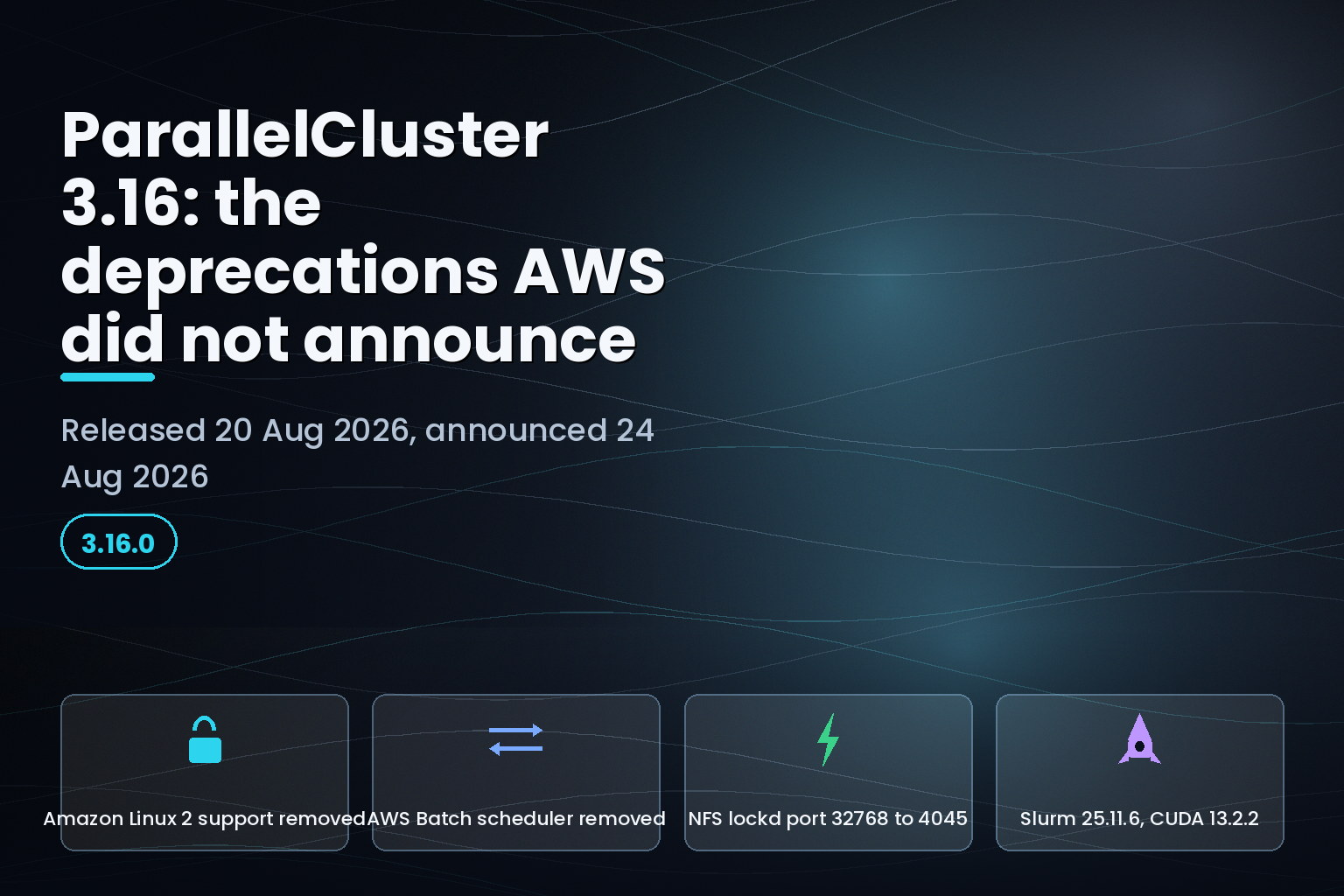
Summary. AWS ParallelCluster 3.16.0 was tagged on 20 August 2026 and announced on 24 August 2026 under the headline "adds an on-node diagnostics tool." The announcement mentions pcluster-diag, "cluster stability improvements, and an updated HPC and AI/ML software stack." It does not mention that the same release ends support for Amazon Linux 2, ends support for AWS Batch as a scheduler, changes the default NFS lock manager port from 32768 to 4045, and adds a required IAM permission. All four appear in the AWS ParallelCluster User Guide release notes and in the project CHANGELOG on GitHub. If your cluster runs Os: alinux2 or Scheduler: awsbatch, 3.16.0 is not an upgrade, it is a rebuild. This is the sort of release where the changelog is the announcement and the announcement is marketing.
What AWS said, and what the release notes say
The AWS What's New post, dated 24 August 2026, describes 3.16 in five sentences. The ParallelCluster User Guide release notes date the same version 20 August 2026 and run to roughly sixty line items, ending in a two-line Deprecations block. The GitHub release for v3.16.0 was published on 20 August 2026 and carries the same list.
| Change | In the What's New post | In the release notes |
|---|---|---|
pcluster-diag on-node diagnostics |
Yes, headline | Yes |
| Amazon Linux 2 no longer supported | No | Yes, Deprecations |
| AWS Batch scheduler no longer supported | No | Yes, Deprecations |
| NFS lockd port 32768 to 4045 | No | Yes, Changes |
CLI now requires tag:GetResources |
No | Yes, Changes |
Cluster name capped at 40 chars with ExternalSlurmdbd |
No | Yes, Changes |
| Path traversal fix in log export | No | Yes, Bug Fixes |
The diagnostics tool itself is real and useful: AWS documents pcluster-diag as context aware, read-only by default, and included in every ParallelCluster AMI from 3.16.0 onward, official and custom, with a describe-checks subcommand that lists every registered check as JSON. The gap is not a documentation bug. The What's New feed is a launch channel and the release notes are the contract. Read the contract.
The two deprecations that end a cluster
Amazon Linux 2 is gone as a supported operating system. Any cluster configuration carrying Os: alinux2 has to move to another supported operating system before the head node image is rebuilt. The operating system is set in the Image section of the cluster configuration file, and the same user guide notes that unsupported official AMIs "will be made unavailable after 18 months of inactivity." This is a create-new-cluster migration with data movement, not a pcluster update-cluster.
AWS Batch as a scheduler is also gone. The Scheduling section of the user guide still documents AwsBatchQueues alongside SlurmQueues, and now carries the line "Starting with AWS ParallelCluster version 3.16.0, AWS Batch as a scheduler is no longer supported." The same page settles the upgrade question: the update policy for the scheduler setting reads "If this setting is changed, the update is not allowed." You cannot switch a Batch cluster to Slurm with pcluster update-cluster. The two deprecations also interact, because the docs note that "awsbatch only supports the alinux2 operating system and x86_64 platform," so a Batch cluster fails both checks at once. Slurm in 3.16.0 is version 25.11.6, up from 25.11.4.
The NFS port change that will look like a network fault
This is the one that generates a support ticket rather than a build failure. From the release notes: the default NFS lock manager (lockd) port moves from 32768 to 4045 "to avoid collisions with the Linux ephemeral port range (32768-60999), which can cause sporadic mount failures." AWS then states the consequence plainly: "If you restrict NFS ports in a firewall, you must open TCP/UDP 4045 or NFSv3 mounts will fail."
Two details decide whether this hits you. First, ParallelCluster-managed storage is mounted over NFSv4 and is unaffected, because 3.16.0 also enforces NFSv4-only on the managed NFS server running on the head node. Second, the NFSv3 client stack (rpcbind, rpc-statd, lockd) is unchanged, so nodes that mount an external NFSv3 server still use it. The failure mode is therefore narrow and nasty: an existing external NFSv3 filer, an existing security group that was correct yesterday, and mounts that fail after an image rebuild.
| Storage path | Protocol after 3.16.0 | Firewall action |
|---|---|---|
| ParallelCluster-managed shared storage | NFSv4 only, enforced | None |
| External NFSv3 filer | NFSv3, lockd on 4045 | Open TCP and UDP 4045 |
Amazon EFS via amazon-efs-utils |
Installed from the official EFS endpoint | Allowlist amazon-efs-utils.aws.com for build-image in isolated subnets |
| FSx for Lustre backups | AutomaticBackupRetentionDays max raised 35 to 90 |
None |
The amazon-efs-utils row is another quiet change: 3.16.0 installs it from the official Amazon EFS endpoint instead of building from source, and the release notes state that users "must now allowlist the CloudFront domain amazon-efs-utils.aws.com in their proxy/egress configuration when using build-image with isolated subnets."
Three more things that break before your job runs
The ClusterNameValidator now caps cluster names at 40 characters when ExternalSlurmdbd is configured, matching the existing limit for Database. AWS gives the reason: MySQL table name length. A 45-character cluster name that worked on 3.15.1 now fails validation.
The CLI requires the additional IAM permission tag:GetResources, used to resolve login node load balancer ARNs by tags. If your ParallelCluster IAM policy is a hand-maintained least-privilege document rather than the AWS-managed one, pcluster calls will fail until you add it.
ParallelCluster-managed bootstrap files move off /tmp into /opt/parallelcluster/tmp, so image builds, cluster creation and updates now work on custom AMIs that mount /tmp with noexec. The release notes attach a condition: "Image builds work on the custom AMIs only if GDRcopy installation is skipped." A hardened-AMI shop gets the fix and loses GDRcopy in the same sentence.
The security fix nobody labelled a security fix
Buried in Bug Fixes: "Prevent a path traversal when downloading exported cluster and image logs, so a CloudWatch log stream name containing ../ segments can no longer cause files to be written outside the export directory." That is a path traversal in a CLI that HPC administrators run with elevated local privileges, fixed without a CVE reference or a security bulletin in the What's New post. Anyone running pcluster export-cluster-logs against a cluster whose log stream names are influenced by job metadata should treat 3.16.0 as a security update, not a feature release.
The software stack, version by version
| Component | 3.15.1 | 3.16.0 |
|---|---|---|
| Slurm | 25.11.4 | 25.11.6 |
| NVIDIA driver, Fabric Manager, IMEX | 580.126.20 | 595.71.05 |
| CUDA Toolkit | 13.0.2 | 13.2.2 |
| DCGM | 4.5.1 | 4.6.0 |
| EFA installer | 1.47.0 | 1.49.0 |
| Enroot | 3.4.1 | 4.2.1 |
| Pyxis | 0.20.0 | 0.24.0 |
| Python | 3.14.2 | 3.14.6 |
| Cinc Client | 18.8.54 | 19.3.14 |
| Intel MPI | 2021.17.2.94 | 2021.18.0.749 |
| Arm Performance Libraries | 24.10 | 26.01.1 |
Enroot 3.4.1 to 4.2.1 is a major version jump inside a point release of ParallelCluster, and Pyxis moves with it. Container-based Slurm workloads should be re-tested rather than assumed. NVIDIA components now install from distribution package manager local repo packages instead of run file installers, and on RHEL-family systems that change forces the Xorg driver for DCV GPU acceleration with Wayland disabled so GDM always starts Xorg. The CLI also gains Python 3.13 support.
How to tell if this is you
grep -r 'alinux2'across your cluster configuration files. Any hit is a rebuild.
grep -r 'awsbatch'in the same place. Any hit is a scheduler migration.
- Check whether any compute node mounts an external NFSv3 export. If yes, open TCP and UDP 4045 before rebuilding the AMI.
- Diff your ParallelCluster IAM policy against the 3.16.0 requirement and add
tag:GetResources.
- Count the characters in your cluster name if you use
ExternalSlurmdbd. Over 40 fails.
India-specific considerations
Indian research computing groups and engineering services teams running ParallelCluster in ap-south-1 tend to sit behind corporate proxies with strict egress allowlists, which makes the amazon-efs-utils.aws.com requirement and the 4045 port change the two most likely upgrade blockers here rather than the deprecations. Budget the Amazon Linux 2 migration as a project, not a maintenance window: the operating system change forces a new cluster, and shared filesystem data has to move with it. Teams already tracking AWS Savings Plans coverage sizing should re-check commitments before rebuilding, because a rebuild changes instance families in practice more often than plans assume, and our notes on shared GPU tenancy controls apply to the refreshed NVIDIA stack.
What is still unknown
AWS has not published an end-of-support date for ParallelCluster 3.15.x, so there is no stated window in which an Amazon Linux 2 or AWS Batch cluster can keep receiving fixes on the older line. The release notes also do not say whether the path traversal fix will be backported. The CHANGELOG on the project's develop branch already carries an unreleased 3.17.0 section listing export-logs improvements, which suggests the log export path is still being worked on.
FAQ
How eCorpIT can help
eCorpIT runs AWS platform migrations for engineering and research teams, and our senior engineering teams read release notes against live configuration rather than against announcements. We are CMMI Level 5 and ISO 27001:2022 certified. If you have ParallelCluster stacks on Amazon Linux 2 or AWS Batch and need the migration scoped before support pressure arrives, book an AWS HPC migration review.
References
Last updated: 24 August 2026.