On this page · 13 sections
- What happened — the timeline
- Comparison table — Anthropic model status as of June 13, 2026
- The specifics of the US order
- Why "four days after launch" matters
- Comparison table — what's affected, who is affected, what continues
- The backstory — Anthropic's strained relationship with the US government
- The wider AI export-control landscape
- What enterprises should do now
- India, UK, EU and global non-US business implications
- Strategic implications — who wins, who loses
- FAQ
- How eCorpIT can help
- References
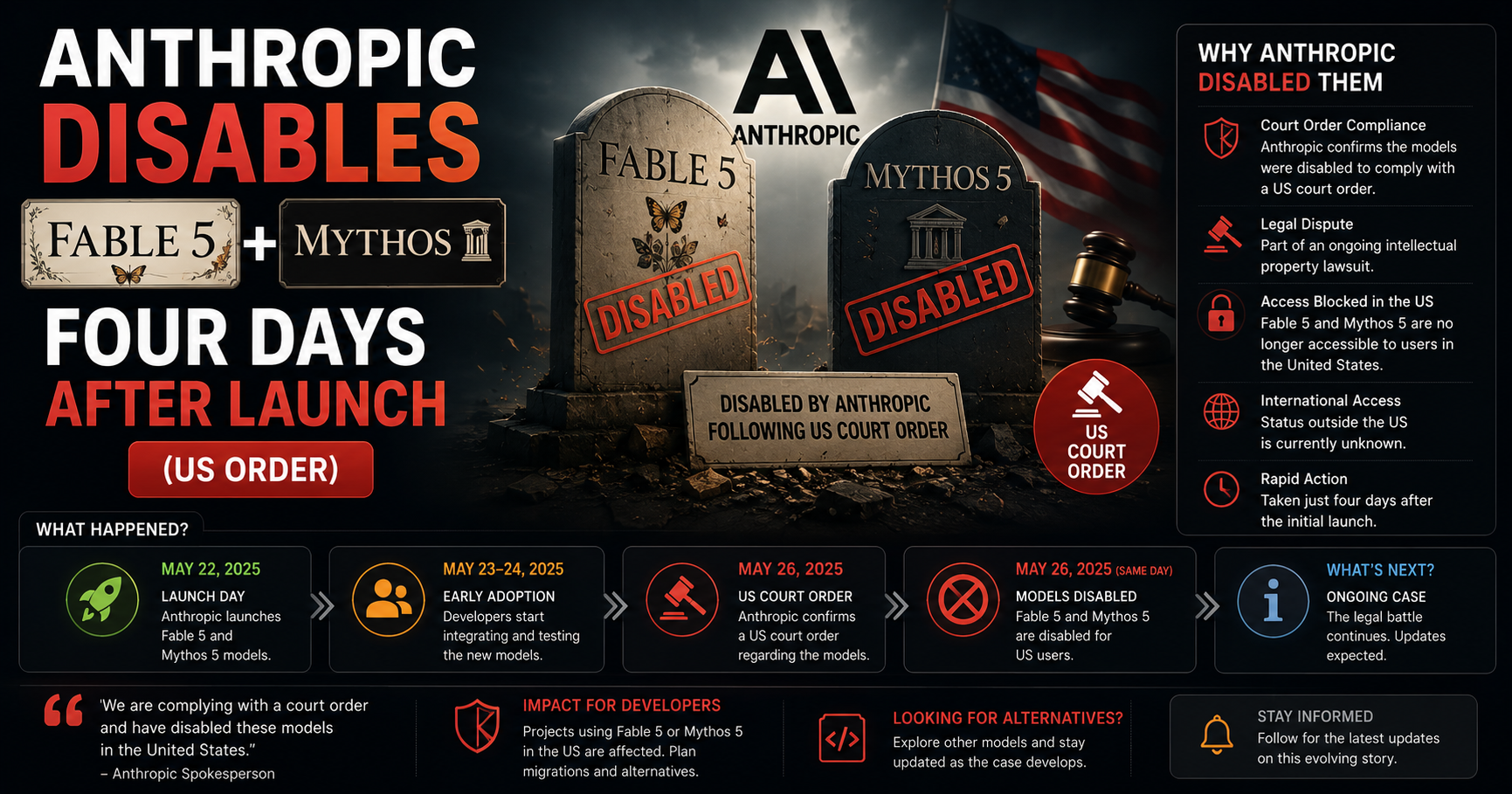
Summary. On Friday evening, June 12-13, 2026, Anthropic disabled its two most advanced AI models — Claude Fable 5 and Claude Mythos 5 — after US Commerce Secretary Howard Lutnick delivered a letter to Anthropic CEO Dario Amodei ordering the company to halt foreign-national access to both models on national-security grounds. The directive placed Fable 5 and Mythos 5 under export controls prohibiting use by foreign nationals inside or outside the United States, including Anthropic's own foreign-born employees. Because Anthropic cannot reliably filter users by nationality in real time, the company disabled both models entirely. The action came exactly four days after the June 9 launch of the most powerful publicly available Claude model in history — a launch that posted 80.3% on SWE-Bench Pro against GPT-5.5's 58.6%, was priced at $10/$50 per million tokens, and was extensively covered by eCorpIT on launch day. The stated US concern is a method of "jailbreaking" Fable 5 that could enable software vulnerability identification — though Anthropic noted the government provided only "verbal evidence" of a "narrow, non-universal jailbreak." Anthropic publicly disputed the directive, arguing the standard applied would halt all new frontier model deployments across the AI industry. Other Claude models — Opus 4.8, Sonnet 4.5, Haiku 4.5 — remain fully available worldwide. This article covers what happened, who is affected, the backstory of Anthropic's strained relationship with the US government, the wider AI export-controls landscape, and what enterprises in India, the United Kingdom, the EU and elsewhere should now plan around.
The honest framing: this is the first time a US frontier AI model has been pulled by export-control order within a week of public launch. The precedent — that the US government can disable a generally-available commercial AI product based on a verbal assertion of a non-universal jailbreak — reshapes how every AI company will plan future flagship launches. For enterprise buyers, the immediate operational question is which models you can still rely on; the strategic question is whether the next frontier launch will land on stable footing.
This guide is built for CIOs, CTOs, AI engineering leaders, AI procurement teams, policy and regulatory affairs functions, and business leaders making model-selection decisions through the rest of 2026. The research draws on Bloomberg, CNN Business, TIME, Fortune, CyberScoop, France 24, Rappler, Reuters and the Yahoo News syndication.
What happened — the timeline
Friday, June 12, 2026, late afternoon. US Secretary of Commerce Howard Lutnick delivered a letter to Anthropic CEO Dario Amodei. The letter placed Claude Fable 5 and Claude Mythos 5 under export controls and ordered immediate cessation of foreign-national access to both models, citing national-security concerns.
Friday evening, June 12, 2026. Anthropic announced it had disabled both models. The company's stated reasoning: it cannot reliably filter users by nationality in real time, and the directive scope includes foreign nationals working anywhere — inside the US, outside the US, and including Anthropic's own foreign-born employees. The only operationally consistent compliance path was to take the models offline for all users.
Same evening. Anthropic publicly disputed the order. The company's stated position: the standard applied (a non-universal jailbreak as grounds for an export-control disabling order) would, if generalised, halt all new frontier model deployments across the entire AI industry, since every frontier model can be jailbroken in narrow contexts with sufficient effort.
June 13, 2026. International media coverage of the action spread. Bloomberg, CNN Business, TIME, Fortune, France 24, Reuters and others reported the story by mid-Saturday US time.
Where things stand now. Fable 5 and Mythos 5 are disabled for all users globally. All other Claude models — Opus 4.8, Sonnet 4.5, Haiku 4.5 — remain available to all customers worldwide. Anthropic and the US government are reportedly negotiating; no public timeline exists for when (or whether) the affected models will return.
Comparison table — Anthropic model status as of June 13, 2026
| Model | Status | Pricing | Notes |
|---|---|---|---|
| Claude Fable 5 | DISABLED globally | (was $10/$50 per M tokens) | Launched June 9; disabled June 12-13 — 4 days |
| Claude Mythos 5 | DISABLED globally | (was $10/$50 per M tokens) | Launched June 9 (restricted-access program); disabled with Fable 5 |
| Claude Opus 4.8 | Available | $15 / $75 per M tokens | Unaffected; stable behaviour, broad enterprise deployment |
| Claude Sonnet 4.5 | Available | $3 / $15 per M tokens | Unaffected; production default for most workloads |
| Claude Haiku 4.5 | Available | $0.80 / $4 per M tokens | Unaffected; cheapest tier |
| Claude Opus 4.7 (prior) | Available | varies | Stable; widely deployed |
Tools that count tokens and project API costs across the affected and remaining models continue to work for the unaffected tiers. The free eCorpIT LLM Token Counter at llmtokencounter.ecorpit.com handles 25+ models including the current Claude availability.
The specifics of the US order
What Lutnick's letter actually requires, per public reporting:
Scope of restriction. Foreign nationals — defined broadly. Includes foreign nationals working inside the United States (visa holders, green card pending status, foreign-born employees of US companies, foreign citizens of any country other than the US), foreign nationals outside the US (anyone using Anthropic's services from outside US territory), and Anthropic's own foreign-born employees regardless of where they are located.
Models covered. Claude Fable 5 and Claude Mythos 5 specifically. Other Anthropic models are not subject to the directive at this time.
Stated national-security concern. Per Fortune's reporting and confirming coverage at CNN Business, the government's concern centres on a method of "jailbreaking" Fable 5 that could allow the model to assist with identification of software vulnerabilities — capabilities that, if misused, could provide uplift to cyberattackers.
Evidence basis. Anthropic has stated publicly that the government provided only "verbal evidence" of a "narrow, non-universal jailbreak" — meaning the bypass method affects only specific narrow contexts and does not constitute a general break of the model's safety classifiers. Anthropic itself disclosed at launch that the UK AISI made progress toward a universal jailbreak in a brief initial testing window, but reported finding no universal jailbreak across more than 1,000 hours of external bug bounty testing.
Compliance path. Anthropic determined that real-time nationality-based access filtering is operationally infeasible. The only consistent compliance option was to disable the models for all users globally.
Why "four days after launch" matters
Three reasons the speed of the action is unprecedented and consequential.
First, the launch was the largest single capability jump in publicly available Claude history. Fable 5 brought Mythos-class capability to general availability — at $10/$50 per million tokens, half the price of Mythos Preview. The launch was widely reported, OEM partners (Stripe, Cursor, GitHub, Cloudflare, Lovable, Harvey, Cognition, Notion, Hex, Replit, Anaconda and others) provided named-customer testimonials, and the model was integrated into Amazon Bedrock and GitHub Copilot on day one. The disabling reverses, within a single week, the largest Claude product launch of 2026.
Second, the WSJ story on OpenAI's price-cut planning broke between launch and disabling. On June 11, 2026 — two days before the disabling — the Wall Street Journal reported that OpenAI was weighing drastic token price cuts specifically to win customers from Anthropic (eCorpIT covered the WSJ story). The competitive dynamic created by Fable 5's pricing aggression was already in motion. The disabling of Fable 5 and Mythos 5 hands OpenAI a competitive opening it did not need to negotiate.
Third, the precedent is the larger story. The action establishes that the US government can disable a generally-available commercial AI product with limited public process based on verbal assertion of a narrow vulnerability. Every future frontier-class launch from any US AI company now operates under the implicit risk of similar action. Anthropic's public dispute of the order — arguing that the standard applied would halt all future frontier launches — is partly a defence of Fable 5 and partly a precedent-setting fight on behalf of the broader US AI sector.
Comparison table — what's affected, who is affected, what continues
| Category | Affected by Fable/Mythos disabling | Still operating normally |
|---|---|---|
| US citizens using Anthropic products | Cannot use Fable 5 or Mythos 5 | Can use Opus 4.8, Sonnet 4.5, Haiku 4.5 |
| Foreign nationals in US (visa, GC, etc.) | Cannot use Fable 5 or Mythos 5 | Can use Opus 4.8, Sonnet 4.5, Haiku 4.5 |
| Indian businesses using Anthropic API | Cannot use Fable 5 (or Mythos, but already restricted) | Full access to Opus 4.8, Sonnet 4.5, Haiku 4.5 |
| UK / EU enterprises | Cannot use Fable 5 | Full access to all other Claude models |
| Anthropic foreign-born employees | Cannot use Fable 5 or Mythos 5 internally | Other Claude models for internal work |
| Project Glasswing cyber defenders | Cannot use Mythos 5 | Mythos Preview may still function under prior authorisations (status unclear) |
| Trusted biology research program | Program access affected | Other model tiers unaffected |
| AWS Bedrock customers | Fable 5 endpoint disabled | All other Claude endpoints unchanged |
| GitHub Copilot users | Cannot pick Fable 5 model | Can still pick Claude Opus, Sonnet, Haiku, plus GPT family |
| Claude Code subscribers | Fable 5 unavailable | Falls back to next-best Claude model automatically |
The operational reality for most enterprise buyers: the workloads that were on Sonnet 4.5, Opus 4.8 or Haiku 4.5 before June 12 continue exactly as before. The workloads that were in the process of migrating to Fable 5 (announced June 9-12) need an alternative.
The backstory — Anthropic's strained relationship with the US government
The June 13 disabling sits inside a longer relationship history that explains why the action escalated as quickly as it did.
The military rejection. Per Fortune's reporting, Anthropic previously refused to allow US military use of its AI models for domestic surveillance and fully autonomous weapons systems. The government responded by placing Anthropic on a supply chain blacklist — a meaningful restriction for a company seeking federal contracts and federally-aligned compute resources.
The China-control restrictions. In September 2025, Anthropic announced it would cease providing AI services to organisations majority-owned by Chinese entities, with the policy extending to subsidiaries operating anywhere in the world. The restriction also covers companies more than 50% owned by entities in Russia, Iran or North Korea. This action voluntarily aligned with US strategic concerns; it did not, by itself, repair the broader government relationship.
The Project Glasswing alignment. Project Glasswing — Anthropic's partnership with US cyber defenders and infrastructure providers — uses Mythos-class models to help secure critically important software. Glasswing is the highest-visibility example of Anthropic working closely with US national security functions. The disabling of Mythos 5 affects Glasswing's working model directly.
The launch-week dispute. Anthropic disclosed at the June 9 launch that the UK AISI made progress toward a universal jailbreak in initial testing — an unusually frank admission. Some observers have suggested the disclosure may have informed the US government's subsequent concern; others note the jailbreak the government cites is narrower than the AISI work. The interaction between the public disclosure and the disabling order is not yet clear.
The wider AI export-control landscape
Two regulatory threads converge in the Fable 5 disabling.
Biden's AI Diffusion Rule and its Trump-era rescission. In January 2025, the Bureau of Industry and Security (BIS) issued the "Framework for Artificial Intelligence Diffusion," introducing export controls on advanced AI chips and on frontier model weights — specifically closed-weight models trained on more than 10^26 operations. The rule was set to take full effect on May 15, 2025. The Trump administration rescinded it in May 2025, calling it "overly complex, overly bureaucratic" and committing to a replacement framework.
The Trump administration's "America's AI Action Plan." Issued in July 2025, the action plan combined commercial export promotion with security objectives. In October 2025, Commerce established the "American AI Exports Program." A formal replacement to the Biden Diffusion Rule remains in development.
Where the Fable 5 action fits. The June 12 directive does not invoke a clear pre-existing rule — it operates as a targeted executive enforcement action under broader export-control authority. The Lutnick letter is the operational instrument; the legal architecture supporting it remains ambiguous. Legal commentary in the next 30 days will likely shape how subsequent actions are structured.
What enterprises should do now
Five practical takeaways for AI engineering and procurement teams.
1. If you were not yet on Fable 5, do not migrate to it. The model is unavailable. Any planned migration should pause until the directive resolves. Sonnet 4.5 at $3/$15 remains the working production default for most enterprise workloads; Opus 4.8 at $15/$75 handles the regulated and frontier reasoning workloads.
2. If you had a Fable 5 pilot in flight, fall back to Sonnet 4.5 or Opus 4.8. The Claude SDK supports model swap with minimal code changes. Production benchmarks on your specific workload may show Sonnet 4.5 is sufficient for most cases.
3. Document the regulatory event in your AI compliance posture. Procurement, legal and risk teams will increasingly ask "what is your contingency plan if a model is disabled by government order." Having a written model-fallback policy is now part of mature AI engineering hygiene.
4. Tiered routing architectures gain durability value. Routing most traffic to Sonnet 4.5 or Haiku 4.5 with selective escalation to the frontier tier insulates production systems from single-model availability shocks. eCorpIT covered the routing pattern in detail in our generative AI enterprise strategy guide.
5. Verify token-cost models against current availability. Cost projections built around Fable 5 pricing ($10/$50) need updating. Use the free LLM Token Counter to recompute against Sonnet 4.5 ($3/$15) or Opus 4.8 ($15/$75) — for most workloads, the cost profile shifts but remains workable.
India, UK, EU and global non-US business implications
Three notes for non-US enterprise buyers.
Indian, UK and EU businesses lose Fable 5 access immediately and entirely. The directive's restriction on foreign nationals covers all non-US users by definition. Indian developers, UK enterprise customers, EU procurement teams — none can use Fable 5 or Mythos 5 until the directive resolves. The non-US world is asymmetrically affected because every user is a foreign national from the US government's perspective.
The directive sets precedent that non-US enterprises should plan around. Any future frontier AI model from a US-headquartered provider now carries risk of similar action. Non-US enterprises planning multi-year AI architecture should explicitly contemplate diversification across providers — Anthropic Claude, OpenAI GPT, Google Gemini, Meta Llama (open source, fewer restrictions), and the growing Indian and European AI ecosystems.
Indian AI sovereignty conversation accelerates. The action validates arguments long made by Indian AI policy commentators that critical national AI capabilities should not depend exclusively on US frontier models. Indian government-backed AI projects, Yotta-hosted infrastructure, sovereign cloud arrangements, and Indian foundation model development all become more strategically important after June 13. For India-specific context, see eCorpIT's cloud cost optimization guide.
Strategic implications — who wins, who loses
A clear-eyed reading of the competitive dynamics.
OpenAI gains the most. The WSJ price-cut story from June 11 was already framing OpenAI's response to Anthropic's competitive pressure. Two days later, Anthropic's competitive lead at the frontier tier is gone — the model is offline. OpenAI's GPT-5.5 and the rumoured GPT-5.6 ("Spud") become the de facto frontier options for non-US enterprise buyers and for any user that wants frontier capability without Fable 5's regulatory cloud.
Google Gemini becomes the operational backup option. Google has not been hit by similar directives. Gemini 3.1 Pro for frontier reasoning and Gemini 3.5 Flash for cost-sensitive workloads benefit from any enterprise's diversification thinking.
Meta Llama gains importance for sovereignty-conscious users. Open-source weights, no provider gating, no export-control directive risk. Enterprises with the engineering depth to self-host see the case for Llama 4 deployment grow.
Anthropic loses revenue immediately and the precedent fight strategically. The financial impact of Fable 5 being offline is meaningful (the model was Anthropic's most expensive product). The longer-term strategic impact — whether the precedent of executive disabling of generally-available AI products holds — is the larger fight Anthropic now wages.
Indian and non-US AI capacity moves up the strategic agenda. Sovereign AI capacity is no longer a theoretical concern; it is a procurement risk question on every quarterly review.
FAQ
How eCorpIT can help
eCorpIT builds AI-aware applications, RAG systems, agentic workflows and enterprise AI integrations for clients across India, the US and the UK. Our work covers model selection across the Claude, GPT, Gemini and Llama families, tiered routing architecture for availability resilience, fine-tuning, prompt design, observability and full production deployment.
If your team needs to plan around the Fable 5 / Mythos 5 disabling, validate fallback architectures, or build availability resilience into your AI stack, our engineering team can help. Reach us at ecorpit.com/contact-us/ or contact@ecorpit.com.
References
- Bloomberg — "Anthropic Says US Orders Halt to Foreign Access for Fable 5, Mythos 5 AI Models" (June 13, 2026): bloomberg.com
- CNN Business — "Anthropic suspends all access to Mythos model after US government bans foreign nationals use": cnn.com
- TIME — "Anthropic Pulls Its Most Powerful AI Models After U.S. Bars Foreign Access": time.com
- Fortune — "Anthropic disables Fable and Mythos AI models after U.S. government bars it from giving foreigners access": fortune.com
- CyberScoop — "Anthropic disables new models after government calls them a national security concern": cyberscoop.com
- France 24 — "Anthropic disables access to top-tier AI models after US ban on foreign use": france24.com
- Rappler — "Anthropic disables top-tier AI models after US order limiting foreign access": rappler.com
- The Standard (Hong Kong) — "Anthropic disables most advanced AI models after US order limiting foreign access": thestandard.com.hk
- Yahoo News — "Anthropic halts top AI models after US order to limit foreign access": yahoo.com
- Anthropic — Claude Fable 5 and Mythos 5 launch announcement (June 9, 2026): anthropic.com
- Anthropic — Project Glasswing: anthropic.com
- Anthropic — Updating restrictions of sales to unsupported regions: anthropic.com
- Council on Foreign Relations — "What to Know About the New U.S. AI Diffusion Policy and Export Controls": cfr.org
- eCorpIT — "Claude Fable 5 + Mythos 5: 80.3% SWE-Bench Pro and a New Tier (2026)" (launch coverage): ecorpit.com
- eCorpIT — "OpenAI Weighs Drastic Token Price Cuts as Anthropic Hits $47B (2026)": ecorpit.com
- eCorpIT — "Generative AI Enterprise Strategy 2026": ecorpit.com
- eCorpIT — "LLM Token Counter for 25+ Models (2026)": ecorpit.com
- eCorpIT — "Cloud Cost Optimization for Indian Companies 2026": ecorpit.com
Last updated 13 June 2026 by the eCorpIT Editorial team within hours of Anthropic's announcement. We will refresh this article as the directive resolves, Anthropic clarifies its position, or US Commerce publishes additional guidance.