On this page · 8 sections
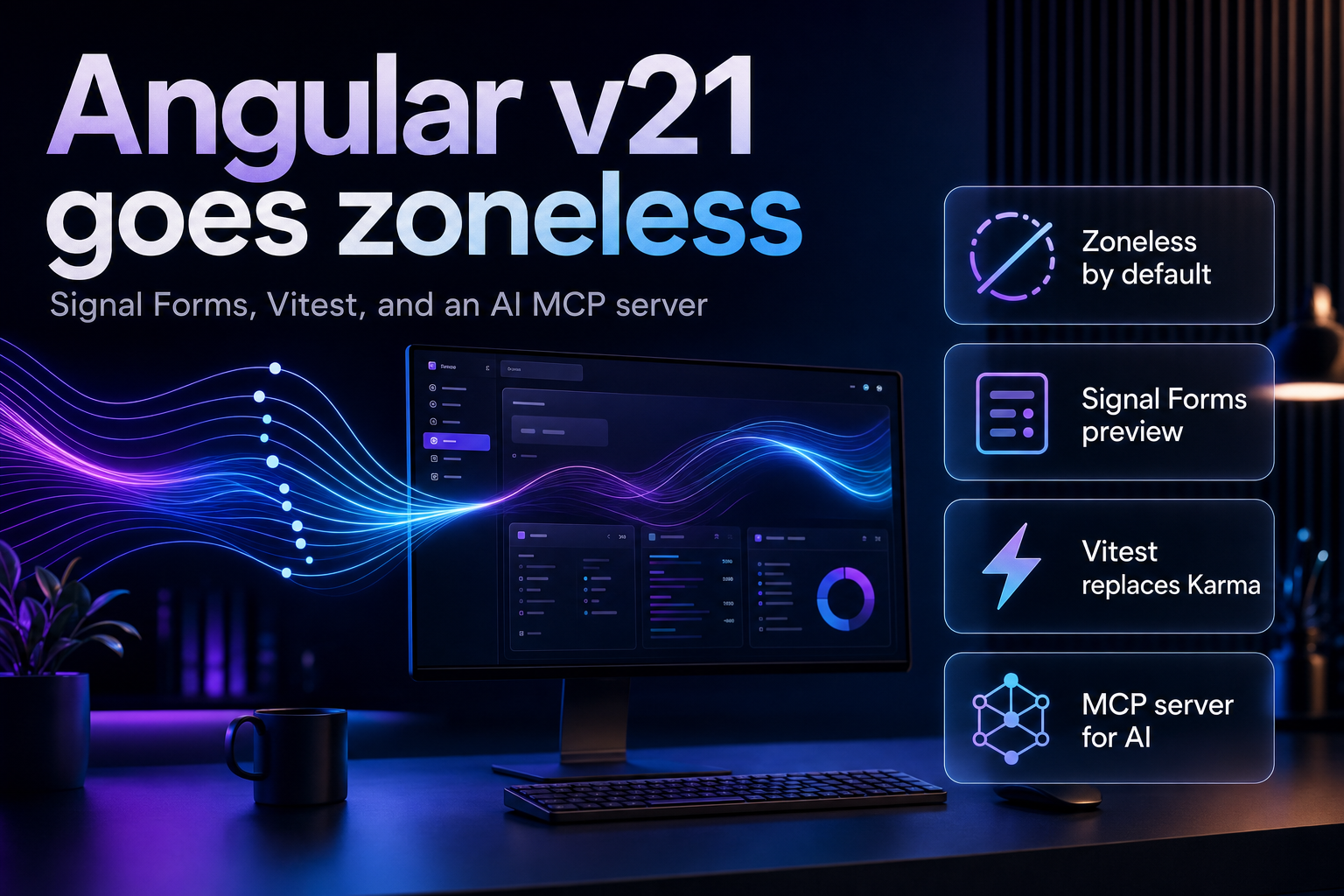
Summary. Angular v21, released on 20 November 2025 and now on stable point releases such as 21.2.4 as of April 2026, is the version that finishes Angular's move to signals. New apps are zoneless by default, so Zone.js is no longer bundled unless you add it, which cuts bundle size and improves Core Web Vitals. Vitest replaces Karma as the default test runner, an experimental Signal Forms system arrives, Angular Aria enters developer preview, and a Model Context Protocol server ships in the CLI for AI coding agents. Breaking changes are limited: most teams on v19 or v20 upgrade in 2 to 8 hours. The performance angle has a price tag, because page speed maps to revenue. Industry data suggests a 500 millisecond load-time improvement can recover roughly $500,000 a year for a $10 million ecommerce site, and pages that pass Core Web Vitals convert 15% to 30% better. This guide covers what shipped, what breaks, and how to upgrade safely.
The one-line read for a lead developer: adopt the stable parts now, keep Signal Forms in low-risk corners, and let the MCP server plan the zoneless migration for you.
What shipped in Angular v21
Angular v21 is a consolidation release. Signals have been arriving for several versions; v21 makes them the default posture rather than an opt-in. The Angular team's v21 announcement frames zoneless as the headline, and the surrounding features support that direction.
| Feature | Status in v21 | Why it matters |
|---|---|---|
| Zoneless change detection | Default for new apps, production-ready | Smaller bundles, better Core Web Vitals, native async |
| Signal Forms | Experimental | New reactive forms built on signals |
| Vitest test runner | Default for new apps, production-ready | Faster tests, Vite-native, replaces Karma |
| Angular Aria | Developer preview | Headless, accessibility-first components |
| MCP server in CLI | Stable, included by default | AI agents that follow Angular patterns |
Two of these deserve care. Zoneless is fully production-ready and is the reason to upgrade. Signal Forms, by contrast, is the one major feature still marked experimental; it is a new form system built on signals, not an evolution of Reactive Forms, so it is a preview to prototype with rather than a foundation for critical production flows.
Zoneless by default, and why it pays
For years Angular used Zone.js to know when to check for changes. It worked, but it patched browser APIs, added weight, and made debugging harder. Zoneless change detection replaces that with a signal-driven model. New v21 apps do not bundle Zone.js at all, which gives smaller bundles, native async and await, easier debugging, and better Core Web Vitals.
The business case is concrete because speed converts. Page-speed data for 2026 puts the cost of latency in plain numbers: a 500 millisecond improvement can recover about $500,000 a year for a site doing $10 million, every 100 milliseconds of load time is worth roughly 1% of conversions, and reaching good Core Web Vitals lifts conversion by 15% to 30%. With Google having increased the weight of Core Web Vitals in its March 2026 update, the ranking and revenue arguments now point the same way. A faster framework default is not a developer nicety; it is margin. Our guide to trust and Core Web Vitals in 2026 search covers the ranking side of the same coin.
Existing apps are safe. Zone.js support is retained for projects that already use it, and you migrate when ready. The prerequisite is moving components to OnPush change detection first, and the CLI's MCP server includes a tool that plans exactly that.
The Angular MCP server: AI coding that follows the rules
The most forward-looking part of v21 is the MCP server built into the Angular CLI. It has been stable since v20.2 and is included by default in v21. The point is quality control for AI-generated code: instead of a model inventing outdated Angular patterns, the server gives the agent authoritative tools and examples so the output matches current best practice.
| Tool | What it does | Use it for |
|---|---|---|
| find_examples | Pulls curated, official code examples | Modern, correct feature usage |
| get_best_practices | Returns the Angular best-practices guide | Standalone components, modern control flow |
| search_documentation | Searches angular.dev APIs and tutorials | Grounding answers in real docs |
| onpush_zoneless_migration | Plans an OnPush-to-zoneless migration | Preparing an app to go zoneless |
| Web Codegen Scorer | Scores generated code quality | Checking AI output before merge |
You start it by pointing your IDE or CLI host at npx @angular/cli mcp. Angular reports that its curated prompts and scorer push LLM compliance scores above 97, meaning agents wired to the server generate code that aligns with current security and structure guidance far more reliably than an ungrounded model. If your team already codes with AI assistants, this is the piece that makes that safe for an Angular codebase. For the broader picture of native-speed tooling arriving across the stack, see our write-up on Node.js running TypeScript natively.
What breaks, and how to upgrade
The good news is that v21 is a light upgrade. The jump from v19 or v20 typically takes 2 to 8 hours because the breaking changes are contained. Here they are.
| Change | Impact | Fix |
|---|---|---|
| Karma replaced by Vitest | New default test runner | Run ng generate @angular/core:karma-to-vitest |
| Zone.js excluded in new apps | Only affects newly generated apps | Existing apps keep Zone.js until opt-out |
| HttpClient in root injector | Some tests and interceptor orders shift | Update tests that assumed it was absent |
| Strict peer-dependency checks | ERESOLVE errors on old libraries | Use --force on ng update as documented |
| Node and TypeScript minimums | Build fails on old toolchains | Node 20+ and TypeScript 5.8+ |
The safe sequence is boring on purpose. Commit a clean tree, confirm Node 20+ and TypeScript 5.8+, then run ng update @angular/core@21 @angular/cli@21 one major version at a time, and run the test suite immediately. The official Angular update guide gives the exact steps for your version pair, and the practical v20-to-v21 survival guide covers the edge cases, including the ERESOLVE peer-dependency errors many enterprise projects hit against older third-party libraries.
India-specific considerations
Angular is heavily used in Indian enterprise and services work, where large, long-lived applications are common. Two notes for teams here. First, the zoneless and Vitest changes are low-risk and worth scheduling, because faster load times matter most on the mid-range Android devices and variable networks that dominate Indian traffic, where Core Web Vitals gains translate directly into conversion. Second, the MCP server is a practical lever for the AI-assisted delivery that Indian software teams are adopting fast: it keeps AI-generated Angular code on current patterns, which reduces the review burden on senior engineers. For teams modernizing older Angular estates, sequencing the OnPush and zoneless migration with the MCP tooling is the pragmatic path.
FAQ
How eCorpIT can help
eCorpIT is a Gurugram-based engineering organization, founded in 2021 and assessed at CMMI Level 5, with senior-led teams that build and modernize Angular applications. We help teams upgrade to v21, migrate to OnPush and zoneless change detection safely, move test suites from Karma to Vitest, and wire the Angular MCP server into AI-assisted workflows without losing code quality. If you run a large Angular estate, talk to our engineers for an upgrade and performance review.
References
_Last updated: 12 July 2026._