On this page · 11 sections
- What "an AI app" actually means for the budget
- Build cost bands in India, 2026
- The part nobody budgets for: the running AI bill
- The token bill, priced out
- Storage and retrieval: the vector database line
- India-specific considerations
- How to keep the total honest
- Build versus buy for the AI layer
- FAQ
- How eCorpIT can help
- References
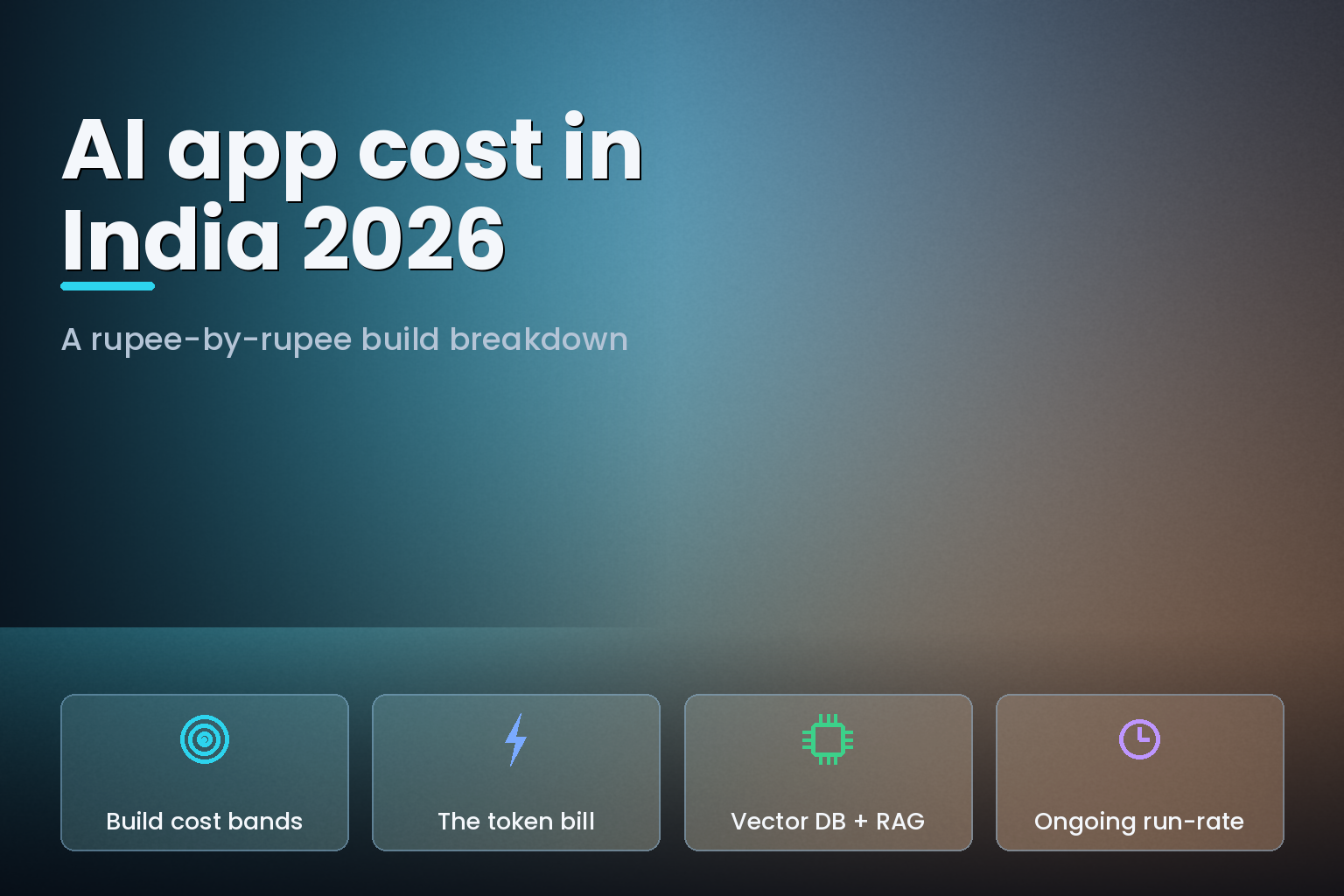
Summary. A cross-platform AI app in India costs roughly ₹6–60 lakh ($7,000–$72,000) to build in 2026, and a heavier system with computer vision or custom models can pass ₹1 crore ($120,000). Those are the numbers most quotes stop at. The line that actually breaks budgets is the running cost: the LLM token bill, inference, a vector database, and retrieval. Gartner said in June 2026 that half of generative AI projects could exceed their budgets by 2028, and its March 2026 research put agentic systems at 5 to 30 times more tokens per task than a plain chatbot. A fintech fraud agent that cost $5,000 a month at 50 users reached $15,000 a month at 500 users. This is a rupee-by-rupee breakdown of both halves, build and run, for founders sizing an AI app in 2026.
What "an AI app" actually means for the budget
The phrase covers three very different builds, and the cost gap between them is wide. The first is a standard app with one AI feature bolted on through an API, such as a support chatbot or a copilot that calls GPT-5.6 or Claude Sonnet 5. The second is an AI-native app where the model drives the core experience: a document assistant, a voice agent, a recommendation engine that reasons over your data. The third is a system with custom or fine-tuned models, computer vision, or real-time inference on your own infrastructure.
Each step up moves both numbers: the one-time build and the monthly run rate. A support chatbot on a hosted API might add ₹3–15 lakh to a build and a few hundred dollars a month to run. A retrieval-heavy assistant serving thousands of users can spend more on tokens and vector storage every month than the chatbot cost to build. Sizing an AI app means sizing both halves at once, because the running cost compounds with usage in a way a fixed build price never does.
For the India-versus-offshore rate comparison that sets your build baseline, our India vs US app development cost breakdown covers day rates by role and region. This guide starts where that one ends and adds the AI-specific lines.
Build cost bands in India, 2026
Indian studios and independent estimates converge on a familiar ladder for 2026. A simple cross-platform app or MVP sits at ₹4–12 lakh; a mid-complexity app for most startups lands around ₹12.6–25 lakh; and an AI app that leans on large language models, computer vision, or machine learning generally starts near ₹20 lakh ($25,000) and can exceed ₹1 crore ($120,000) once you add custom model training, data pipelines, and real-time inference.
The AI layer itself is a distinct line. Integrating an existing model through an API, a chatbot or copilot on GPT-5.6, Claude, or Gemini, adds roughly ₹3–15 lakh ($3,600–$18,000) to an otherwise standard app, and a full AI-powered MVP built on hosted APIs runs about $12,000–$25,000 at Indian development rates. Building cross-platform with Flutter or React Native cuts 30–40% off the build versus shipping two native codebases, which is why most startup budgets start there.
| App type (India, 2026) | Indicative build cost | Typical timeline | AI layer included |
|---|---|---|---|
| Simple app / MVP (cross-platform) | ₹4–12 lakh ($5,000–$14,000) | 6–12 weeks | None, or one API call |
| AI MVP (LLM API, chatbot or copilot) | ₹10–21 lakh ($12,000–$25,000) | 10–16 weeks | Hosted model, basic RAG |
| Mid-complexity app | ₹12.6–25 lakh | 4–6 months | Optional API feature |
| AI-native app (RAG, agents, voice) | ₹20–60 lakh ($25,000–$72,000) | 5–9 months | Retrieval, orchestration, evals |
| Custom models / CV / on-device | ₹60 lakh–₹1 crore+ ($72,000–$120,000+) | 8–14 months | Fine-tuning, data pipeline, inference |
Treat these as starting bands, not quotes. Scope, integrations, and design maturity move them, and the AI-native and custom rows are the two where the running cost, not the build, decides the true total.
The part nobody budgets for: the running AI bill
Here is where founders get surprised. A traditional app has a predictable monthly cost: hosting, a few managed services, app-store fees, maintenance. An AI app adds a usage-metered stack on top, and every line in it grows with the number of users and the amount of work each request does.
Gartner made the mechanism explicit. "Organizations are rapidly moving from experimentation to scaled deployment of AI coding agents, but many are underestimating the financial impact of rising token consumption," said Nitish Tyagi, Senior Principal Analyst at Gartner, in a June 2026 forecast that projected AI coding costs could pass the average developer's salary by 2028. The same pattern hits AI apps of every kind. The venture firm CRV, which backs early-stage AI companies, observes that most founders do not measure token consumption until they are in production, and by then the cost is baked into the user experience.
The multiplier is real and documented. Gartner's March 2026 analysis found agentic AI models consume 5 to 30 times more tokens per task than a standard chatbot, because every reasoning loop, retry, tool call, and context reload spends more tokens. One fintech fraud agent went from $5,000 a month at 50 users to $15,000 a month at 500 users inside a few months. Per-token prices keep falling, and Gartner still expects roughly a 90% drop in inference cost per token by 2030, yet monthly bills rise because usage grows faster than prices fall.
The AI cost stack, line by line
| Running cost line | What it is | Indicative monthly cost (2026) |
|---|---|---|
| LLM API / tokens | Per-token charges for each request and response | Usage-based; frontier output $12–$50 per 1M tokens |
| Inference (self-hosted) | Your own GPUs when API spend gets large | 8×H200 near $36/hour; only past heavy volume |
| Vector database | Stores embeddings for retrieval | Pinecone ~$70/mo at 10M vectors, $700+/mo at 100M |
| RAG pipeline | Embeddings, retrieval, orchestration, re-ranking | Compute plus embedding tokens; scales with corpus |
| Evals and monitoring | Quality, drift, and cost observability | Tooling plus engineering time |
| Maintenance | Fixes, model updates, dependency upgrades | 15–25% of build cost per year |
Read that table as a set of dials, not fixed prices. The token line moves with traffic and with how much reasoning each request does. The vector line moves with how much data you index. And the gap between a pricing-page estimate and the real invoice is wide: vector database bills alone run an average of 2.5 to 4 times over budget for teams that never modelled growth. To keep the token line from running away, an LLM hybrid routing approach to control API spend sends cheap requests to small models and reserves the frontier model for the hard ones.
The token bill, priced out
Token cost is the line founders find hardest to picture, so price it directly. As of July 2026, frontier model pricing per million tokens runs roughly as follows against published vendor rates, with prompt caching cutting cached input by about 90% on both OpenAI and Anthropic.
| Model (per 1M tokens, July 2026) | Input | Output | Best fit |
|---|---|---|---|
| Gemini 3.x Pro | ~$2 | ~$12 | High-volume, cost-sensitive |
| Claude Sonnet 5 | ~$2 | ~$10 | Balanced quality and price |
| GPT-5.6 Sol | ~$5 | ~$30 | Hard reasoning, coding |
| Claude Fable 5 | ~$10 | ~$50 | Top-end quality, sparing use |
| Self-hosted open model | GPU cost | GPU cost | Very high sustained volume |
Now do the arithmetic your future self will do. Suppose an assistant handles 20,000 requests a day, each sending 2,000 input tokens and returning 500 output tokens on a mid-tier model. That is 40 million input and 10 million output tokens a day. At roughly $2 input and $10 output per million, that is about $80 plus $100, near $180 a day, or $5,400 a month, before you add retrieval and embeddings. Move the same load to a top-end model and the bill roughly triples. Cut input tokens with caching and tighter prompts and it halves. The model choice and the prompt design, not the head-count of engineers, decide this number.
Self-hosting becomes worth considering only when sustained API spend is high. Running a frontier-scale open model needs roughly eight H200 GPUs at about $36 an hour, and the crossover against a hosted API generally sits somewhere above $12,000–$19,000 a month of usage, accounting for hardware, power, and the staff to run it. Below that, a hosted API is cheaper and far less work.
Storage and retrieval: the vector database line
Most useful AI apps answer from your data, not just the model's memory, which means retrieval-augmented generation and a place to store embeddings. That place is a vector database, and its pricing model matters more than its logo.
Managed services such as Pinecone start free, then move to a flat builder tier near $20 a month, with production workloads around $70 a month at 10 million vectors and above $700 a month once you reach 100 million. Running pgvector inside a PostgreSQL database you already operate costs closer to $45 a month at 10 million vectors, roughly 75% cheaper than a managed cluster, and keeps vectors and relational data in one transaction with no new infrastructure to run. For most startups under 10 million vectors, that is the pragmatic default; the decision framework in pgvector versus a dedicated vector database walks through when the managed option earns its price. Whichever you pick, model the growth curve up front, because this is the line that most often lands 2.5 to 4 times over its first estimate.
India-specific considerations
Two India factors shift the sums. The first is rate: Indian engineering rates make the build cheaper than the United States or Western Europe for the same scope, which is why the ₹6–60 lakh bands sit well below equivalent Western quotes, and why founders worldwide build here. Cross-platform delivery with Flutter or React Native compounds that saving.
The second is data protection. An AI app that processes the personal data of Indian residents falls under the Digital Personal Data Protection Act 2023, which carries no small-business exemption and no turnover threshold. That adds real engineering to the budget: consent capture and management, data-retention controls, and care about where personal data flows when a request is sent to a model API. Those are line items, not afterthoughts, and they are cheaper to design in at the start than to retrofit after launch. eCorpIT designs applications aligned with DPDP Act requirements so the consent and retention model is part of the architecture rather than a later scramble.
How to keep the total honest
A few habits keep an AI app budget from drifting. Meter tokens from day one, in staging, so the per-request cost is visible before real users arrive. Route by difficulty, so a cheap model handles the easy majority and the expensive model is reserved for the hard minority. Cache aggressively, because cached input is about a tenth of the price. Size the vector database against a realistic growth curve, not today's tiny corpus. And treat the build price as the deposit, not the full cost: the run rate over 12 to 24 months is usually the larger number for anything AI-native.
For teams moving from a working demo to something that survives real traffic, our AI prototype to production app service sets up exactly this instrumentation, routing, and cost control before launch. And for founders costing their first build, the pricing and scoping guidance in mobile app development for startups pairs with the numbers here.
Build versus buy for the AI layer
One more decision moves the total: whether to build the AI plumbing or assemble it from managed services. Building your own orchestration, evals, and retrieval gives control and can be cheaper at very large scale, but it adds months and senior engineering time to the build. Buying managed pieces, a hosted model, a managed vector database, an evaluation tool, ships faster and turns capital cost into a predictable monthly line, at the price of less control and per-unit fees that grow with usage.
| Decision vector | Build the AI stack | Buy managed services |
|---|---|---|
| Time to market | Slower; months of engineering | Faster; assemble and ship |
| Upfront cost | Higher; senior team time | Lower; pay as you grow |
| Monthly run rate | Lower at very large scale | Higher per unit, predictable |
| Data control | Full control of data path | Depends on vendor terms |
| Maintenance overhead | Yours to carry | Mostly the vendor's |
For most startups in 2026, buy the plumbing, own the product. Build the pieces that are genuinely your differentiator, and rent the rest until scale justifies bringing it in-house. This mirrors the wider enterprise mobile app development build-versus-buy logic, applied to the AI layer specifically.
FAQ
How eCorpIT can help
eCorpIT is a Gurugram technology company, founded in 2021, that builds AI-powered mobile and web apps for founders and enterprises. We are assessed at CMMI Level 5, MSME certified, and ISO 27001:2022 certified, and we build with AWS, Microsoft, and Google. Our senior-led teams cost the build and the running AI bill together, instrument token and inference spend before launch, and design applications aligned with DPDP Act requirements. If you are sizing an AI app and want an honest breakdown of build and run costs, talk to our team.
References
_Last updated: 31 July 2026._