On this page · 10 sections
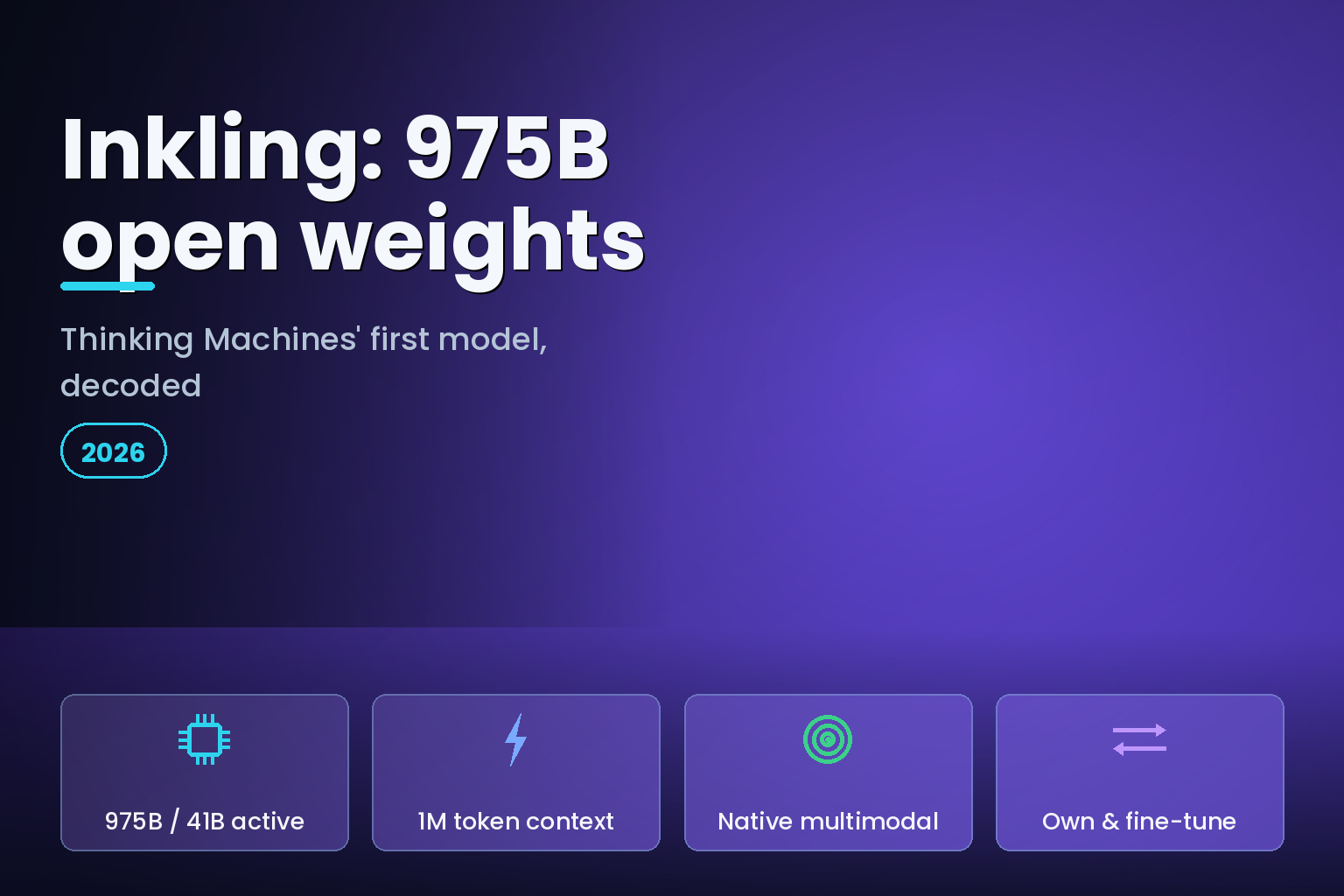
Summary. Thinking Machines Lab, the company founded by former OpenAI CTO Mira Murati, released Inkling on 15 July 2026, its first model and its first open-weights release. Inkling is a Mixture-of-Experts transformer with 975 billion total parameters and 41 billion active per token, a context window up to 1 million tokens, pretrained on 45 trillion tokens of text, images, audio and video. The full weights are on Hugging Face, reported under the Apache 2.0 license, and the model reasons natively over text, images and audio. On benchmarks it posts 77.6% on SWE-bench Verified and 97.1% on AIME 2026, competitive with the open-weights field but behind Kimi K2.6 at 80.2% and DeepSeek V4 Pro at 80.6% on coding. Hosted access starts near $1.00 per million input tokens and $4.05 per million output tokens, while running the full model yourself needs close to 2 terabytes of GPU memory. The company is unusually blunt about positioning: "Inkling is not the strongest overall model available today, open or closed." This piece reads the benchmarks honestly and gives a clear adopt-or-wait call.
The interesting thing about Inkling is not a leaderboard win, because there is not one. It is what the model is built to be: an open, multimodal, efficient base that teams can own and fine-tune. Whether that is worth a slot in your stack depends less on the headline scores and more on whether you need to customize a model you control. Here is the case on both sides.
What Inkling actually is
Inkling is a single large model plus a lighter preview sibling, released together on 15 July 2026 by Thinking Machines Lab.
The main model is a Mixture-of-Experts (MoE) transformer with 975 billion total parameters and 41 billion active per token. It supports a context window up to 1 million tokens and was pretrained on 45 trillion tokens spanning text, images, audio and video. Alongside it, the company previewed Inkling-Small, a 276 billion-parameter model with 12 billion active parameters, aimed at workloads where cost and latency matter more than peak capability. Inkling-Small's full weights are not out yet; the company said it is finishing testing.
Two design choices set Inkling apart from a plain frontier clone. First, it is natively multimodal: it reasons over text, images and audio rather than bolting a vision encoder onto a text model. According to reporting from TechCrunch and VentureBeat, its outputs today are text, including code and structured data, while inputs span the modalities. Second, it has controllable thinking effort: a single dial, swept from 0.2 to 0.99, that trades tokens for accuracy. The company reports Inkling spends about one third as many tokens as Nemotron 3 Ultra to reach the same score on Terminal Bench 2.1.
On the architecture, the MoE design follows DeepSeek-V3: 256 routed experts plus 2 shared, with 6 routed experts active per token and a sigmoid router with auxiliary-loss-free load balancing. It interleaves sliding-window and global attention at a 5:1 ratio, and it uses relative positional embeddings rather than the more common RoPE, which the company says extrapolates better to long sequences. Inkling was trained on NVIDIA GB300 NVL72 systems with more than 30 million reinforcement-learning rollouts.
The benchmarks, read honestly
Thinking Machines published a wide benchmark table run at maximum effort (0.99). The honest reading: Inkling is competitive across the open-weights field, leads it on safety, and trails the strongest open models on coding while sitting well behind the closed frontier on the hardest reasoning tasks.
Here is how Inkling compares against the leading open-weights models on the headline benchmarks, all figures from the company's release table.
| Model (open weights) | SWE-bench Verified | AIME 2026 | Terminal Bench 2.1 | GPQA Diamond |
|---|---|---|---|---|
| Inkling (975B / 41B active) | 77.6% | 97.1% | 63.8% | 87.2% |
| Kimi K2.6 | 80.2% | 96.4% | 71.3% | 91.1% |
| DeepSeek V4 Pro | 80.6% | 96.7% | 64.0% | 88.8% |
| GLM 5.2 | 80.0% | 99.2% | 82.7% | 89.5% |
| Nemotron 3 Ultra | 70.7% | 94.2% | 56.4% | 86.7% |
On coding, Inkling's 77.6% on SWE-bench Verified beats Nemotron 3 Ultra but falls a few points short of Kimi K2.6, DeepSeek V4 Pro and GLM 5.2, which all cluster around 80%. On agentic terminal work it trails further, with GLM 5.2 at 82.7% well ahead. Where Inkling does lead the open field is safety: it scores 78.0% on FORTRESS Adversarial, the strongest built-in safeguards of any open-weights model in the company's comparison, while keeping benign refusals low at 95.9%.
Against the closed frontier, the gap is honest and visible.
| Benchmark | Inkling (open) | Claude Fable 5 | GPT-5.6 Sol | Gemini 3.1 Pro |
|---|---|---|---|---|
| SWE-bench Verified | 77.6% | 95.0% | 82.2% | 80.6% |
| AIME 2026 | 97.1% | 99.9% | 99.9% | 98.3% |
| HLE (with tools) | 46.0% | 64.5% | 55.0% | 51.4% |
| Weights | Open, on Hugging Face | Closed | Closed | Closed |
Claude Fable 5's 95.0% on SWE-bench Verified is 17 points clear of Inkling, and on Humanity's Last Exam with tools the closed models pull away. Factuality is another soft spot: Inkling scores 43.9% on SimpleQA Verified, below DeepSeek V4 Pro at 57.0% and far below Gemini 3.1 Pro at 77.3%. If your use case is single-shot correctness on hard, obscure facts, Inkling is not the pick.
The company's own framing is the fairest summary: it is a "broad, balanced generalist" and "not the strongest overall model available today, open or closed." Treat the benchmarks as evidence of a capable base, not a leader.
Where Inkling earns its place
If Inkling does not win the leaderboard, why would you use it? Three reasons, each concrete.
Multimodality in the open. Most strong open-weights models, Kimi K2.6, DeepSeek V4 Pro and GLM 5.2 among them, are primarily text and code models. Inkling reasons natively over audio and vision. It scores 91.4% on VoiceBench and 73.5% on MMMU Pro for vision. For a team that wants to own and fine-tune a multimodal model rather than rent one behind a closed API, the open multimodal options are thin, and Inkling is one of the few.
Token efficiency you can dial. Controllable thinking effort is not a gimmick. For workloads you run millions of times, the cost curve matters more than the peak score, and reaching a target quality at one third of the tokens is a direct bill reduction. That efficiency framing is the same discipline behind LLM hybrid routing and API spend decisions.
Built for customization. Inkling is available for fine-tuning on Tinker, the company's own customization platform, with 64K and 256K context options and a 50% launch discount. The pitch is explicitly that a fine-tuned Inkling on your specialized data beats a stronger generalist you cannot adapt. For organizations whose advantage is proprietary data, an ownable, fine-tunable multimodal base is worth more than a couple of benchmark points.
Where it will cost you: self-hosting is heavy
The open-weights label does not mean cheap to run. Holding 975 billion parameters in full precision takes close to 2 terabytes of GPU memory, so running the full Inkling yourself is out of reach for most teams without a serious cluster. In practice, "open weights" here means you can fine-tune and own the model, not that you will casually self-host it.
The cost options break down like this.
| Deployment option | Price (as of July 2026) | Notes |
|---|---|---|
| Inkling API via OpenRouter | $1.00 in / $4.05 out per 1M tokens | Cheapest hosted access |
| Inkling first-party API (xhigh) | $1.87 in / $4.68 out per 1M tokens | Thinking Machines direct |
| Self-host full Inkling | ~2 TB GPU memory; from about $3.99–$6.49 per H100 hour | Impractical for most teams |
| Tinker fine-tuning | 50% launch discount; 64K / 256K context | Customization path |
| Inkling-Small (276B / 12B active) | Lower cost and latency | Preview; weights pending |
At $1.00 per million input tokens and $4.05 per million output tokens on OpenRouter, hosted Inkling is priced to compete with other open-weights APIs. Dedicated H100 capacity on providers such as Together runs from about $3.99 per hour on longer reserved commitments up to $6.49 per hour on-demand, so a self-hosted deployment only makes sense at high, steady volume, or when data control forbids a shared API. For most teams the practical path is the hosted API for evaluation and Tinker for fine-tuning, with self-hosting reserved for the cases that truly need it. If you are weighing that trade-off, our guide to running local LLMs in production with vLLM and Ollama covers the operational side.
Inkling against the field: a decision, not a ranking
The right way to place Inkling is by job, not by a single score. For pure coding agents, Kimi K2.6, DeepSeek V4 Pro and GLM 5.2 currently score higher on SWE-bench Verified and Terminal Bench, so a team optimizing only for autonomous code work has stronger open options. Our Kimi K3 adopt-versus-wait analysis applies the same lens to that model. For a multimodal base you can fine-tune and own, especially one with strong safety behavior out of the box, Inkling is a leading open choice with fewer direct competitors. And for maximum single-shot capability regardless of ownership, the closed frontier, Claude Fable 5, GPT-5.6 Sol and Gemini 3.1 Pro, remains ahead, which our Gemini 3.5 Pro versus GPT-5.6 versus Claude Fable 5 comparison covers in depth.
Who should adopt Inkling now: teams building multimodal products who want to own and fine-tune the model on proprietary data, teams that value strong default safety and controllable cost, and research or platform groups that need open weights for customization or on-premises control.
Who should wait: teams that only need a hosted text or coding model, where a higher-scoring open model or a closed frontier API is simpler and stronger; teams without the appetite to fine-tune, since Inkling's edge is customization, not out-of-the-box supremacy; and anyone whose core need is single-shot factual accuracy, where Inkling trails today.
India-specific considerations
For Indian teams, the case for an open, fine-tunable model has a data-governance dimension. The Digital Personal Data Protection Act (DPDP), 2023 pushes organizations toward tighter control over where personal data is processed. A model whose weights you can host on infrastructure you control, or fine-tune inside your own boundary, is easier to align with data-residency expectations than a closed API in another jurisdiction. That is a real reason a bank, hospital or public-sector team might prefer an ownable base like Inkling even if a closed model scores a few points higher.
The cost math in rupee terms is worth stating plainly. Hosted Inkling at $1.00 and $4.05 per million tokens is roughly ₹85 to ₹350 per million tokens at mid-2026 exchange rates, cheap enough for evaluation. Self-hosting is the expensive path: at about $6.49 per H100 hour, and with the full model needing close to 2 terabytes of GPU memory across many cards, a production deployment runs into serious monthly infrastructure cost. For most Indian teams the sensible sequence is evaluate on the hosted API, fine-tune on Tinker, and only move to self-hosting when data rules or volume demand it. Teams that reach that point often prefer a private LLM deployment handled end to end.
The bigger signal
Inkling matters beyond its scorecard because of who shipped it and how. A company led by a former OpenAI CTO chose to make its first release open weights rather than a closed API, and paired it with a customization platform rather than only a chat product. That is a bet that the value in AI is moving toward models teams can adapt and own, not only rent. Whether Inkling itself is in your stack this quarter, that direction is worth planning for.
FAQ
How eCorpIT can help
eCorpIT helps teams choose, deploy and fine-tune the right model rather than defaulting to whatever is loudest this month. Our senior engineering teams run structured evaluations against your actual workloads, weigh open-weights options like Inkling against closed APIs on capability, cost and data-control needs, and stand up fine-tuning or private deployment where it pays off. If you are deciding whether Inkling or another model belongs in your 2026 stack, contact us to scope an evaluation.
References
- Inkling: our open-weights model — Thinking Machines Lab.
- Inkling model card — Thinking Machines Lab.
- Inkling weights on Hugging Face — Hugging Face.
- Thinking Machines open sources Inkling, focused on low cost and resistance to censorship — VentureBeat.
- Inkling API pricing and benchmarks — OpenRouter.
- Inkling intelligence, performance and price analysis — Artificial Analysis.
- Inkling architecture and benchmark notes — Sebastian Raschka.
- Together AI pricing — Together AI.
_Last updated: 19 July 2026._