On this page · 11 sections
- The three-region split at a glance
- What Siri AI actually is in 2026
- Region 1: the rest of the world gets Siri AI first
- Region 2: the EU block and the DMA standoff
- Region 3: China's conditional, regulator-gated path
- What this means for your enterprise iOS fleet
- India-specific considerations
- A region-aware rollout checklist
- FAQ
- How eCorpIT can help
- References
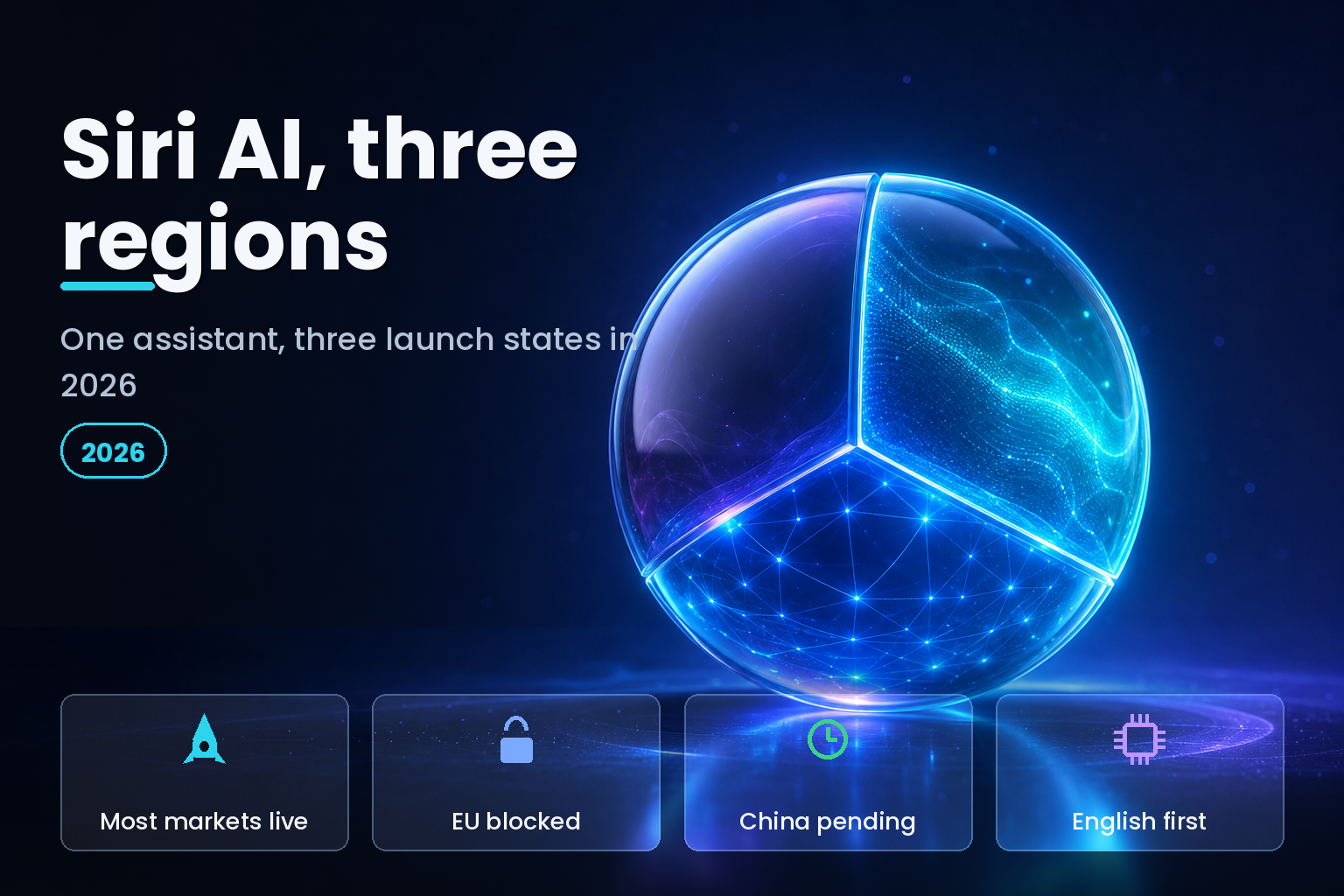
Summary. On June 8, 2026, at WWDC, Apple introduced Siri AI, a rebuilt assistant running on a custom 1.2-trillion-parameter Google Gemini model, and confirmed it ships this fall in English as an opt-in beta. Three days later, on June 11, Apple published a newsroom post stating that Siri AI will not reach EU iPhones or iPads under the Digital Markets Act (DMA), with no timeline. In China, the same feature waits on the Cyberspace Administration of China (CAC) and a filtering layer built with Alibaba. For any team shipping Apple-Intelligence-dependent features, the result is three regions in three states: most markets get it, roughly 450 million EU users do not, and China stays gated. Apple pays Google about $1 billion per year for the model, and iOS 27 reaches the public around September 2026. This guide maps the split and the decisions it forces.
If your product roadmap assumed one global Apple assistant, that assumption broke at WWDC 2026. The technology is the same everywhere. The legal and regulatory wrapper around it is not. A product manager in Chicago, a developer in Munich, and an operations lead in Shenzhen now plan against three different versions of the same iPhone.
The three-region split at a glance
Apple shipped one feature and three availability states. The table below is the version to put in front of your rollout committee.
| Region / market | Siri AI on iPhone and iPad (iOS 27, fall 2026) | Governing constraint |
|---|---|---|
| United States and most markets | Available, English beta, opt-in | First launch markets; English only at start |
| India | Available, English beta | English-only at launch; DPDP Act governs personal data handling |
| European Union | Blocked, no published timeline | DMA interoperability dispute with the European Commission |
| EU on Mac and Vision Pro | Available | macOS 27 and visionOS 27 fall outside the disputed iOS interoperability scope |
| China (mainland) | Pending | CAC model approval plus an Alibaba-built filtering layer |
Three points matter for planning. Siri AI launches in English first, so non-English markets wait regardless of region. The EU block applies to iPhone and iPad specifically, not to every Apple device. And China's delay is a regulatory queue, not a refusal, which means the timeline is outside Apple's control.
What Siri AI actually is in 2026
The feature at the center of this is not a small Siri update. Apple rebuilt the assistant on a custom 1.2-trillion-parameter Google Gemini model, a deal reported to cost about $1 billion per year. The earlier, self-built version of these features had slipped repeatedly. Apple first delayed the personalised Siri work to 2026 in March 2025, then targeted spring 2026 for the rebuilt assistant before settling on a fall 2026 launch alongside iOS 27.
Siri AI can answer open-ended questions, read personal context from messages, email, photos and notes, recognise what is on screen, and pull current answers from the web. It ships with a dedicated app that stores past conversations and syncs them across Apple devices through iCloud. The on-screen awareness and cross-app actions are the parts that touch enterprise apps directly, because they run through the App Intents your teams already maintain. The mechanics of how a Gemini-backed assistant pulls and cites web answers also overlap with how other AI answer engines surface citations, which matters if your content strategy depends on being quoted by assistants.
For most of the world this is a fall 2026 capability you can plan around. iOS 27 reaches the public around September, with developer betas that began June 8 and public betas in July. The complication is that "most of the world" no longer includes two of the largest device markets on the same terms.
Region 1: the rest of the world gets Siri AI first
The United States, India, and most non-EU markets get Siri AI as an opt-in English beta with iOS 27 this fall. If your primary users sit in these markets, your planning question is narrow: when does Siri AI gain the languages your users speak, and which of its capabilities do you want your app to support through App Intents.
English-first is the real gate here, not geography. A team in Bengaluru shipping an English-language app gets the same Siri AI access as a team in Austin. A team whose users rely on Hindi, German, or Mandarin waits for language support that Apple has not dated. Build your App Intents and on-screen actions now, test them against the developer beta, and treat multilingual support as a later phase rather than a launch dependency.
Region 2: the EU block and the DMA standoff
This is the part that changes architecture decisions. Apple will not ship Siri AI on EU iPhones or iPads with iOS 27, and it has set no date for when it might. Craig Federighi, Apple's senior vice president of Software Engineering, said in the company's newsroom statement: "We're deeply disappointed that our EU users won't have Siri AI on iPhone or iPad when we share our new software releases later this year."
The dispute is about interoperability. The DMA requires a designated gatekeeper to make new platform features usable by third parties on equal terms. Apple proposed a technical layer it calls the Trusted System Agent, an intermediary meant to let rival voice assistants reach the same on-device capabilities as Siri AI, and asked to roll it out over 18 months while Siri AI launched first. The European Commission rejected that approach. Thomas Regnier, a Commission spokesperson, framed it as a request for a blanket exemption rather than a compliant design, and the Commission has maintained that nothing in the DMA stops Apple from launching Siri AI in Europe.
Both sides disagree publicly about whether a privacy-preserving, fully interoperable version was technically possible on Apple's timeline. For your purposes, the cause matters less than the effect. As Digital Watch reported, the block is regulatory, not technical, which has two consequences. The feature could appear with little notice if the two sides settle, so your EU plan needs a fast-follow path. And EU-based developers cannot test Siri AI features for their own apps on iOS 27, iPadOS 27, or watchOS 27, which means a London team building App Intents is working partly blind compared with a New York team.
One detail softens the picture slightly. EU users still get Siri AI on macOS 27 and visionOS 27, because those platforms sit outside the specific iOS interoperability scope under dispute. If your product spans Mac and iPhone, expect an EU user whose laptop assistant is smarter than the one on the phone in their pocket.
Region 3: China's conditional, regulator-gated path
China is a different kind of problem. The block there is not a standoff over rules Apple disputes; it is a regulatory queue Apple cannot jump. China's CAC must test and approve every AI model before it can power a consumer service. Apple's route into China runs through Alibaba, which builds a real-time filtering layer to meet CAC content rules, with Baidu reported in the role that Google and OpenAI hold elsewhere.
That approval has stalled. The feature briefly went live by mistake. In late March 2026, Apple Intelligence features appeared on Chinese devices without approval before being pulled, a sequence AppleInsider also tracked. As of June 2026, the submission sits with the CAC, with the delay tied to political uncertainty between the United States and China rather than to any technical gap. There is no public approval date.
For planning, treat China as available-when-approved with an unknown date, gated through a partner stack you do not control. Any feature that assumes Apple's assistant on a mainland China iPhone should have a non-Apple fallback, because the approval could land next quarter or next year.
What this means for your enterprise iOS fleet
If you manage iPhones across borders, the headline is a capability gap inside one device model. Two identical managed iPhones on iOS 27, one in Frankfurt and one in Toronto, now run different assistants. That gap touches policy, testing, and support.
| Capability | Non-EU managed iPhone (iOS 27) | EU managed iPhone (iOS 27) |
|---|---|---|
| Siri AI assistant | Available, opt-in beta | Not available, no timeline |
| Developer testing of Siri AI App Intents | Available | Blocked for EU-based developers |
| Writing Tools and Image Playground | Available, MDM-controllable | Subject to separate EU availability rules |
| On-screen awareness and cross-app actions | Available through App Intents | Not available on iPhone or iPad |
| MDM switch to disable the feature | Supported via Restrictions payload | Not needed where the feature is absent |
The management lever already exists. Apple lets IT switch Apple Intelligence off through the standard Restrictions payload on supervised devices, and the controls have expanded with each release since iOS 18.1 to cover features such as Writing Tools, Genmoji, and Image Playground. The catch is that your policy now has to be region-aware on purpose. Where Siri AI is present, decide whether to enable it for managed users and whether personal-context access fits your data rules. Where it is absent, your support team needs a clear answer for the EU employee who reads about Siri AI and cannot find it.
Three actions are worth taking before iOS 27 ships. Inventory your fleet by region so you know exactly which devices can run the assistant. Write region-specific MDM profiles rather than one global policy. And brief your help desk so the EU capability gap is a known, scripted answer rather than a ticket queue in September.
India-specific considerations
For Indian teams, the binding constraint is language, not regulation. India sits in the available group, so an English-language product gets Siri AI this fall on the same terms as the United States. The work is the same App Intents and on-screen-action testing every launch market needs, with multilingual support treated as a later phase once Apple adds Indian languages.
Data handling is the part to get right early. Siri AI reads personal context from messages, mail, photos, and notes, so any enterprise deployment in India should map that processing against the Digital Personal Data Protection Act (DPDP) 2023. We design applications aligned with DPDP requirements rather than claiming any product is automatically compliant, and the same posture applies to Apple-Intelligence features: document what personal data the assistant can reach inside your app, and decide through MDM whether managed users should have that access at all. This sits inside the wider question of enterprise AI strategy, where the assistant is one more system touching regulated personal data.
A region-aware rollout checklist
Turn the three-region split into a short plan. Build and test your Siri AI App Intents now against the iOS 27 developer beta, using non-EU developer accounts so the EU testing block does not stall you. Ship English-first and stage other languages behind it. Make every Apple-assistant feature degrade cleanly where Siri AI is absent, so EU and China users get a working app rather than a broken hook. Set region-specific MDM policy before the September public release. And keep a watch on the EU position, because a settlement could switch the feature on faster than a normal feature ships.
The honest read for 2026 is that Apple's assistant is now a regional feature wearing a global brand. Plan for the regions, not the brand.
FAQ
How eCorpIT can help
eCorpIT is a senior-led technology consulting organisation in Gurugram that helps product and IT teams plan for exactly this kind of fragmented platform rollout. We map Apple-Intelligence-dependent features against regional availability, design App Intents and fallbacks that degrade cleanly where Siri AI is absent, and set region-aware MDM policy for managed fleets, with data handling mapped to DPDP and GDPR expectations. If you are planning an iOS 27 launch across the EU, India, China, and the Americas, contact us to scope a region-by-region rollout that survives the regulatory split.
References
_Last updated: June 22, 2026._