On this page · 9 sections
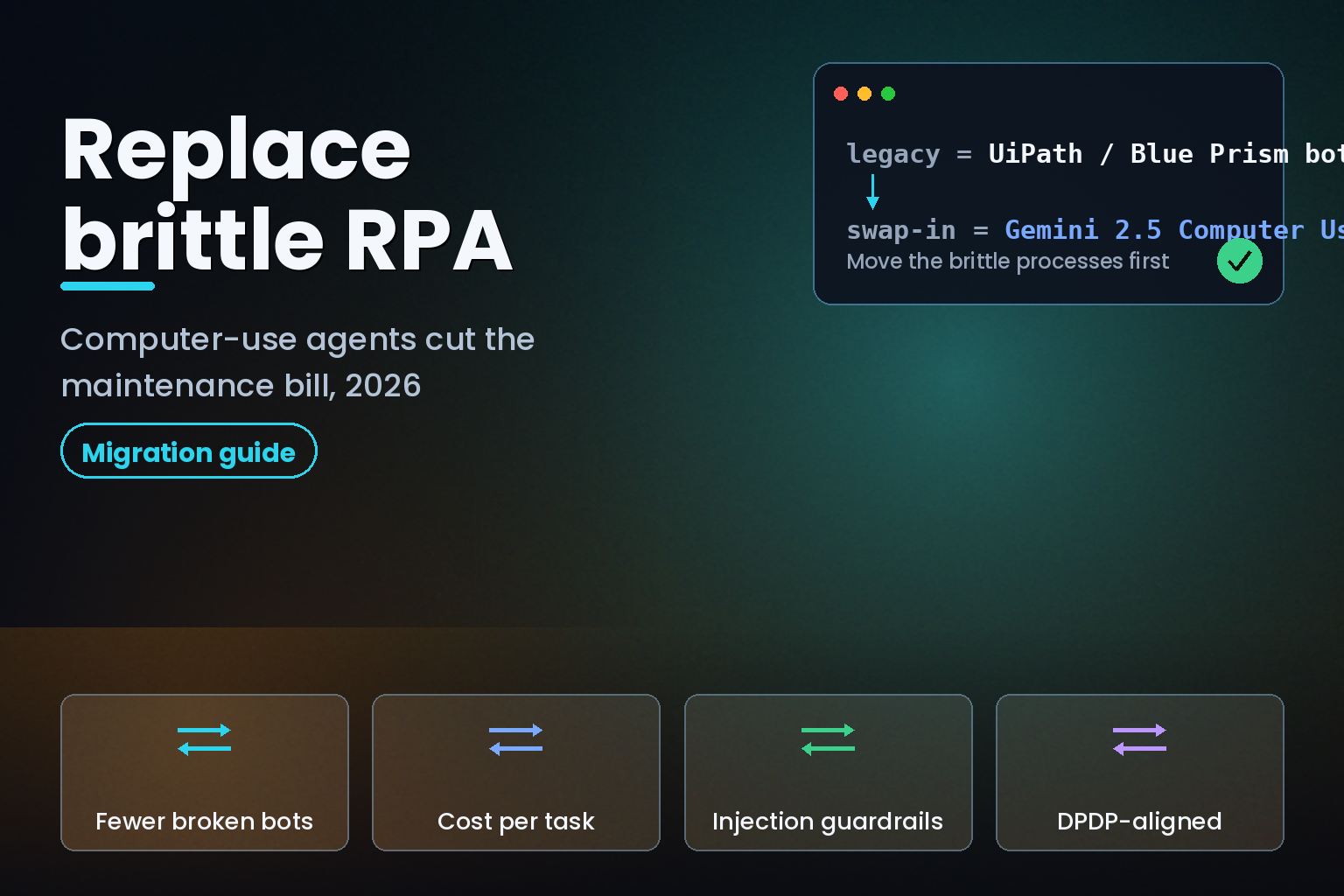
Summary. Legacy robotic process automation is expensive to keep alive. EY has estimated that 30% to 50% of initial RPA implementations fail, and Forrester has put maintenance at up to 60% of total RPA program cost. The licensing you signed for is the small part: UiPath developer licences run about $420 per month, Automation Anywhere cloud bot runners start near $50,000 per year for five bots, and Blue Prism enterprise deals begin around $75,000 per year, with per-bot rates of $10,000 to $35,000. Computer-use agents attack the root cause. Instead of brittle UI selectors, models such as Google's Gemini 2.5 Computer Use (7 October 2025), Anthropic's Claude computer-use tool and OpenAI's computer-use-preview read the screen and act like a person, at token prices from $1.25 to $15 per million, roughly ₹105 to ₹1,275 at about ₹85 to the US dollar. This guide covers when that swap pays off, when it does not, and how to migrate without breaking what already works.
If you run an automation team in 2026, the problem is not that your bots cannot do the work. It is that they stop doing it every time a vendor ships a UI update, and your engineers spend their week patching selectors instead of automating new processes. That is the gap computer-use agents are built to close, and it is also where an honest cost comparison matters more than a demo.
Why RPA breaks
A traditional RPA bot finds an on-screen element by its selector: an XPath, a control id, an image match. When the target application looks the way the bot was recorded against, it works. When a vendor renames a button, restructures a form, or changes an authentication step, the selector no longer matches and the workflow stops. The worst version fails silently, returning no error and delivering no data downstream until someone notices the gap hours later.
At scale, that fragility becomes the dominant cost. One 2026 analysis of enterprise RPA programs reported that 45% of companies see bot breakdowns every week from changes in the underlying applications, and that RPA teams spend between 30% and 70% of their effort maintaining existing bots rather than building new automation. Every portal redesign and every forced login change becomes a support ticket. The capacity that automation was meant to free up gets consumed keeping the automation itself upright.
This is an architecture problem, not a tuning problem. A selector is a promise that the screen will not change. Screens change.
The real cost of an RPA program
Licensing is the number that gets budgeted and the number that misleads. Across UiPath, Automation Anywhere and Blue Prism, licensing is commonly 25% to 30% of the total cost of ownership; implementation, maintenance and support take the other 70% to 75%. Blue Prism renewals after the SS&C acquisition have been reported at 20% to 40% above 2023 rates, and vendor list prices generally sit 20% to 40% above negotiated deal prices, so the headline figure and the real figure diverge before a single bot runs.
| Cost line | Share of RPA total cost of ownership | Note |
|---|---|---|
| Software licensing | 25% to 30% | UiPath about $420 per developer per month; per-bot enterprise rates on top |
| Implementation | part of the 70% to 75% | Process discovery, recording, environment setup |
| Maintenance | up to 60% (Forrester) | Selector repair after every UI change |
| Support and monitoring | part of the 70% to 75% | Reruns, exception handling, on-call |
| Failure and rework | hard to bound | EY: 30% to 50% of initial programs fail |
The point is not that RPA is worthless. For high-volume, stable, back-office processes it can still be the right tool. The point is that the maintenance line is structural, and it grows with every application your bots touch.
What computer-use agents change
A computer-use agent does not depend on a selector. It works from a screenshot. Google describes the loop plainly for its Gemini 2.5 Computer Use model: the inputs are the user request, a screenshot of the environment and a history of recent actions; the model returns a function call such as a click or a keystroke; your code executes it, takes a new screenshot, and sends it back until the task finishes or a safety check stops it. Because the agent reasons about what is on the screen rather than matching a fixed control id, a renamed button or a moved field is something it can adapt to instead of something that stops it cold.
Three vendors ship a production-grade version in 2026. Google's Gemini 2.5 Computer Use, released on 7 October 2025 and built on Gemini 2.5 Pro, leads the Online-Mind2Web, WebVoyager and AndroidWorld web and mobile benchmarks and carries the lowest token price at $1.25 and $10 per million. Anthropic's Claude computer-use tool, first shipped in October 2024, reached 72.7% on the OSWorld benchmark with Claude Sonnet 4.6 and treats the full desktop as its environment, at $3 and $15 per million. OpenAI's computer-use-preview, the model behind Operator, runs inside the Responses API at $3 and $12 per million and reports 38.1% on OSWorld. We compare the three in detail in our guide to computer-use models for browser agents.
| Decision vector | Selector-based RPA | Computer-use agent |
|---|---|---|
| How it targets the UI | Fixed selectors (XPath, control id, image) | Reads the screenshot and reasons about it |
| Reaction to a UI change | Breaks, often silently | Can adapt to a moved or renamed element |
| Upfront cost | Per-bot licence plus recording | Token and session cost plus harness build |
| Ongoing cost driver | Selector repair after every change | Screenshots as tokens, retries, session minutes |
| Reliability profile | Deterministic until the screen changes | Probabilistic; needs guardrails and confirmation |
| Data control | On-prem options mature | Depends on model host and deployment choice |
Where computer-use agents are not the answer
An honest migration starts with the cases where you should not migrate. Computer-use agents are probabilistic. They can pass a task once and fail it on the thousandth run, which is exactly the property a payroll or reconciliation process cannot tolerate without controls. Bryan Silverthorn, director of Amazon's AGI Autonomy research lab, framed the bar at VB Transform 2026 in a talk titled "Closing the capability-reliability gap": "But can it do those things correctly 100 times in a row without accidentally leaking sensitive data or going rogue on a prompt injection?"
For a high-volume, unchanging, deterministic process, a well-maintained RPA bot can still be cheaper and more predictable than a vision loop that pays for a screenshot on every step. Computer use earns its place where the interface changes often, where no API exists, or where the task needs judgement a fixed script cannot encode. The right 2026 answer for most enterprises is a mix: keep stable bots, move the brittle and judgement-heavy ones, and wrap both in monitoring. We treat the reliability and control problem directly in enterprise AI agents in production and the injection defences in AI agent security and prompt-injection guardrails.
A migration approach that does not break what works
The mistake teams make is treating this as a rip-and-replace. It is not. A safe migration ranks candidate processes by how often their target UI changes and how much judgement they need, then moves the worst offenders first, because those are where selector repair is eating the most engineering time. Each migrated process gets wrapped in a harness that handles authentication, session persistence and retries, a per-step confirmation on any irreversible action, and full logging so an auditor can reconstruct what the agent did and why.
The cost model changes with it. RPA is priced per bot per year. A computer-use agent is priced per completed task, driven by step count, screenshot resolution and hosted-session minutes. A cheaper per-token model that needs more steps or more retries can cost more than a pricier model that finishes cleanly, so the number to track is cost per successful task, not per bot or per million tokens. That is the calculation that decides whether a given process should move at all.
| Model | Priced by | Indicative rate | Best when |
|---|---|---|---|
| UiPath or Automation Anywhere bot | Per bot per year | About $50,000 per year for five bots (AA) | High-volume, stable UI |
| Blue Prism bot | Per bot per year | $10,000 to $35,000 per bot | Regulated, on-prem back office |
| Gemini 2.5 Computer Use | Per token plus session | $1.25 / $10 per million | Changing web UIs, low latency |
| Claude computer use | Per token plus session | $3 / $15 per million | Desktop and native app workflows |
| OpenAI computer-use-preview | Per token plus session | $3 / $12 per million | Teams already on the Responses API |
India-specific considerations
For Indian enterprises and the global capability centres and business-process operations run from India, the maintenance burden of RPA lands on local engineering teams, so cutting it converts directly into freed capacity. The currency maths favours moving the right processes: at about ₹85 to the US dollar in July 2026, Gemini 2.5 Computer Use input runs near ₹106 per million tokens, and the saving compounds against per-bot licences that are quoted in dollars. Public cloud spending in India is projected to reach $17.5 billion in 2026, up 28.1% from $13.7 billion in 2025, so leadership is already scrutinising automation run-rates.
Data protection is the gate that decides deployment shape. A computer-use agent that logs into a CRM, an HRMS or a payments console processes personal data under the Digital Personal Data Protection Act 2023. That means data-minimisation on what screenshots capture, a lawful basis for the processing, scoped credentials, and an audit trail of every agent action. For regulated back-office work, a self-hosted or private deployment of the model may be the safer route, and the agent's logs must not quietly become an unmanaged store of customer data.
FAQ
How eCorpIT can help
eCorpIT designs and builds the migration from brittle RPA to computer-use agents for enterprises and global capability centres that are tired of paying for selector repair. Founded in 2021 and based in Gurugram, our senior-led engineering teams handle process selection, the agent loop and harness, authentication and session handling, prompt-injection guardrails, per-action logging, and a cost model measured per completed task. We are CMMI Level 5, MSME and ISO 27001:2022 certified, partner with AWS, Microsoft and Google, and design agent workflows aligned with DPDP Act 2023 requirements. See our enterprise AI agent development service, and to scope a migration on your own processes, contact our team.
References
- Ernst & Young estimate that 30% to 50% of initial RPA implementations fail (as cited by VSoft Consulting) — blog.vsoftconsulting.com
- Forrester on RPA maintenance as up to 60% of implementation cost (as cited by Allata) — allata.com
- Vendr, "UiPath software pricing and plans 2026" — vendr.com
- Vendr, "Automation Anywhere software pricing and plans 2026" — vendr.com
- Costbench, "Blue Prism pricing 2026" — costbench.com
- Coasty, "The hidden maintenance cost of RPA bots nobody budgets for" (2026) — coasty.ai
- Duvo, "Why every RPA project breaks (and how agentic AI fixes it)" (2026) — blog.duvo.ai
- Google DeepMind, "Introducing the Gemini 2.5 Computer Use model" (7 October 2025) — blog.google
- Google AI for Developers, "Computer use" documentation — ai.google.dev
- OpenAI, "computer-use-preview" model documentation — developers.openai.com
- MarkTechPost, "Claude Sonnet 5 vs Sonnet 4.6 vs Opus 4.8: benchmarks and pricing" (13 July 2026) — marktechpost.com
- VentureBeat, "Amazon AGI director says AI agent reliability, not capability, is blocking enterprise deployment at VB Transform 2026" — venturebeat.com
- Business Standard, "AI to fuel India's tech services growth; public cloud spending to reach $17.5 bn in 2026" — bignewsnetwork.com
_Last updated: 31 July 2026._