On this page · 11 sections
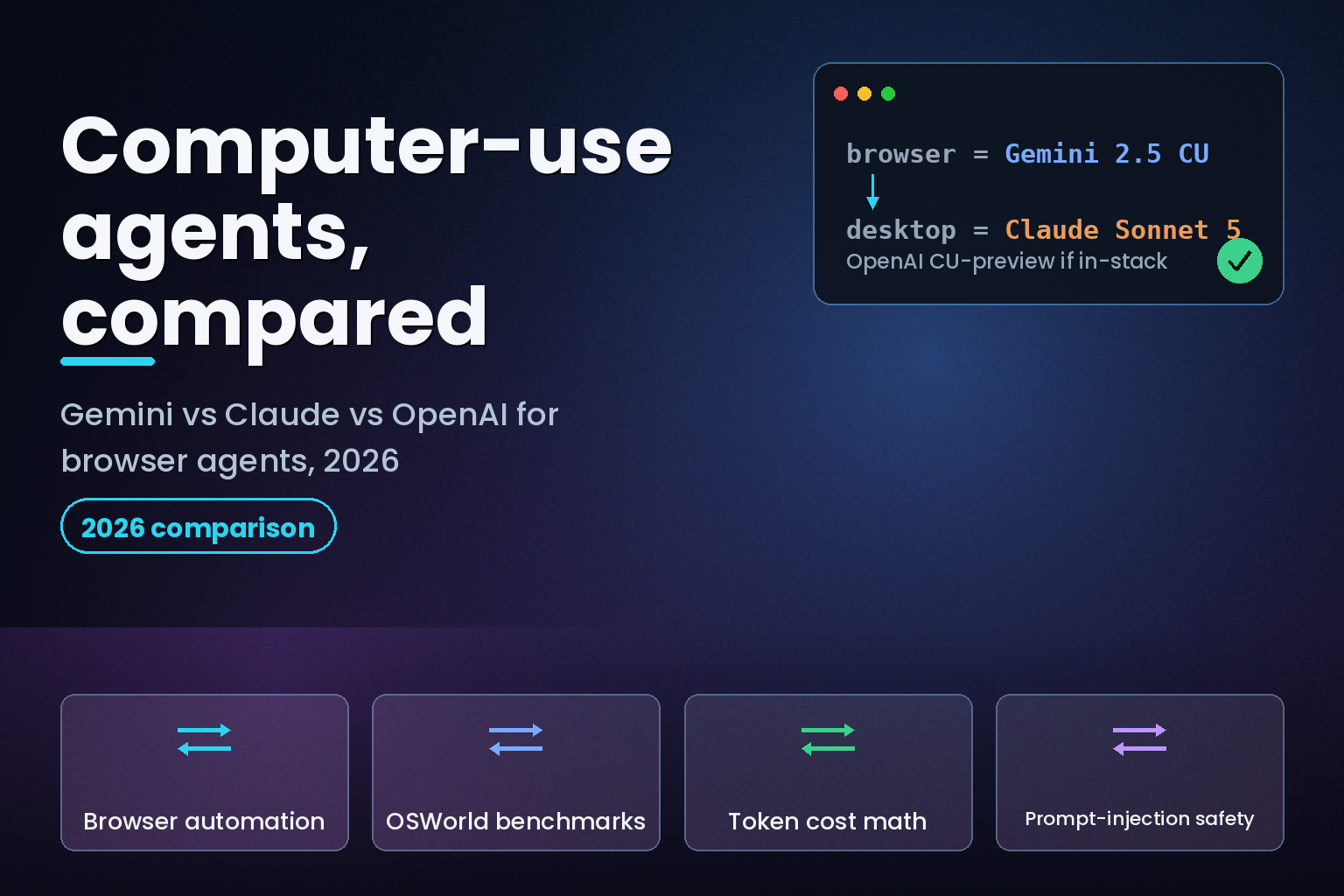
Summary. Three computer-use models now drive real browser and mobile interfaces in production. Google's Gemini 2.5 Computer Use (model id gemini-2.5-computer-use-preview-10-2025) shipped in public preview on 7 October 2025 and leads the Online-Mind2Web, WebVoyager and AndroidWorld web and mobile control benchmarks. OpenAI's computer-use-preview, the model behind Operator, scores 38.1% on OSWorld and runs only inside the Responses API. Anthropic's Claude computer-use tool, first released in October 2024, reached 72.7% on OSWorld with Claude Sonnet 4.6 (17 February 2026). On token price, Gemini 2.5 Computer Use inherits Gemini 2.5 Pro rates of $1.25 and $10 per million tokens, OpenAI computer-use-preview costs $3 and $12, and Claude Sonnet 4.6 costs $3 and $15. For an Indian team that is roughly ₹105 to ₹1,275 per million tokens at about ₹85 to the US dollar, before you count a single screenshot. This guide compares the three on price, benchmark evidence, environment support and safety, then says which one to build on.
The pitch is the same across all three vendors: an agent that reads a screen, clicks, types and scrolls the way a person does, so it can operate software that has no clean API. The differences show up once you leave the demo and start paying per screenshot, debugging a stalled loop, or explaining to a security team why an agent is allowed to log into production tools. That is the ground this comparison covers.
What "computer use" actually means
A computer-use model does not call your backend. It looks at a screenshot, decides on one UI action, and hands that action back to your code to execute. Google describes the pattern plainly: the inputs to its computer_use tool are the user request, a screenshot of the environment and a history of recent actions; the model returns a function call such as a click or a keystroke; your client executes it, takes a new screenshot, and sends it back. The loop repeats until the task finishes, an error occurs, or a safety check stops it.
That loop is why computer use is both powerful and awkward. Powerful, because the agent can drive any interface a human can see, including tools behind a login and forms with no public endpoint. Awkward, because every step is a full round trip of image in, action out, and each screenshot is billed as image tokens. The model quality matters, but so does the harness you wrap around it: Playwright driving a local browser, or a hosted browser such as Browserbase driving a cloud session.
Three vendors ship a production-grade version of this today. They made different bets on environment, price and safety.
The three options in 2026
Google: Gemini 2.5 Computer Use
Google DeepMind released the Gemini 2.5 Computer Use model on 7 October 2025, built on Gemini 2.5 Pro's visual reasoning. It is available in public preview through the Gemini API on Google AI Studio and on Vertex AI for enterprise use. The model is tuned for web browsers and shows strong results on mobile UI control, but Google states it is not yet optimised for desktop OS-level control. Token limits are 128,000 in and 64,000 out.
Google reports that the model leads the Online-Mind2Web, WebVoyager and AndroidWorld benchmarks against rival computer-use tools, and that on the Browserbase harness for Online-Mind2Web it holds above 70% accuracy at roughly 225 seconds of latency, the lowest latency in its test set. Versions of the model already power Project Mariner, the Firebase Testing Agent and agentic behaviour in AI Mode in Search. One detail matters for 2026 planning: Google's own model page notes that Gemini 3 Pro and Flash support built-in computer use without a separate model, so the standalone 2.5 model is the specialised option, not the only door in.
Anthropic: Claude computer use
Anthropic was first to ship computer use through a frontier API, releasing the capability in beta with Claude 3.5 Sonnet in October 2024. The mechanism is the same screenshot-and-action loop, exposed through a computer_use tool with a reference agent implementation, and it runs on the Anthropic API, Amazon Bedrock and Google Vertex.
The scores have climbed fast. Claude Sonnet 4.6, released on 17 February 2026, reached 72.7% on OSWorld, the desktop-and-browser benchmark where computer use scored far lower in 2024. Its successor, Claude Sonnet 5, pushed OSWorld to about 81% with a one-million-token context window. Pricing is the trade: Claude Sonnet 4.6 costs $3 per million input tokens and $15 per million output tokens, while Claude Sonnet 5 launched at an introductory $2 and $10 through 31 August 2026, moving to $3 and $15 afterwards. Claude's strength is that it treats the full desktop, not only the browser, as its environment.
OpenAI: computer-use-preview and Operator
OpenAI introduced its computer-use tool in March 2025 alongside the Responses API, under the banner "new tools for building agents." The model, computer-use-preview, is the engine inside Operator, OpenAI's consumer agent that ships with the ChatGPT Pro plan at $200 per month. For developers, computer-use-preview is available only inside the Responses API and is priced at $3 per million input tokens and $12 per million output tokens.
On raw capability it trails the other two: computer-use-preview reports 38.1% on OSWorld, and independent testers note it does best when the prompt hands it detailed navigation hints for a specific site. If your stack already lives in the Responses API and you want computer use as one tool among many, it is the path of least resistance. As a standalone browser agent in mid-2026, it is the weakest of the three on public numbers.
The three options at a glance
| Dimension | Gemini 2.5 Computer Use | Claude computer use (Sonnet 4.6 / 5) | OpenAI computer-use-preview |
|---|---|---|---|
| How you access it | computer_use tool, Gemini API and Vertex AI |
computer_use tool, Anthropic API, Bedrock, Vertex |
Responses API only; powers Operator |
| First shipped | 7 October 2025 | October 2024 (beta) | March 2025 |
| Environment focus | Web browser strong, mobile UI promising, desktop not yet | Full desktop plus browser | Browser via Operator, VM/desktop via API |
| Headline benchmark | Leads Online-Mind2Web, WebVoyager, AndroidWorld | OSWorld 72.7% (4.6), about 81% (5) | OSWorld 38.1% |
| Token price per million (in / out) | $1.25 / $10 | $3 / $15 (4.6); $2 / $10 intro (5) | $3 / $12 |
| Context window | 128K in, 64K out | Up to 1M (Sonnet 5) | Model-dependent |
| Built-in safety | Per-step safety service, action confirmations | Tool-level guardrails, reference harness | Tool-call model with usage policies |
What the benchmarks really say, and don't
Do not read those benchmark scores as a straight league table. OSWorld and the web-agent benchmarks are measured on different harnesses, at different dates, with different amounts of retry and hint-giving, so a 38.1% and a 72.7% are not two runners in one race. Google reported its lead on Online-Mind2Web, WebVoyager and AndroidWorld rather than OSWorld, and its numbers mix self-reported results with evaluations run by Browserbase. Anthropic's OSWorld figures come from its own model releases. The honest reading is directional: Claude and Gemini are in a similar top tier for web and desktop tasks in 2026, and OpenAI's public computer-use model sits a clear step behind.
The bigger caveat is that none of these benchmarks predict reliability on your software. A benchmark rewards a task done once. Production punishes a task done wrong on the thousandth run. That gap is now the main blocker to shipping. As Bryan Silverthorn, director of Amazon's AGI Autonomy research lab, framed it at VB Transform 2026 in a talk titled "Closing the capability-reliability gap": "But can it do those things correctly 100 times in a row without accidentally leaking sensitive data or going rogue on a prompt injection?" A 2026 research paper, "On the Reliability of Computer Use Agents," makes the same point with numbers: success on a benchmark and success across repeated real runs are different measurements.
| Benchmark | Model | Reported score | As of |
|---|---|---|---|
| OSWorld | OpenAI computer-use-preview | 38.1% | 2025 |
| OSWorld | Claude Sonnet 4.6 | 72.7% | Feb 2026 |
| OSWorld | Claude Sonnet 5 | about 81% | 2026 |
| Online-Mind2Web | Gemini 2.5 Computer Use | above 70% accuracy, about 225s latency | Oct 2025 |
| WebVoyager / AndroidWorld | Gemini 2.5 Computer Use | reported leader vs rivals | Oct 2025 |
The cost model nobody budgets for
The per-million token price is the number teams quote and the number that misleads them. Computer use is a vision loop, and the screenshots are the spend. Every step sends a fresh image of the screen into the model, and images are billed as input tokens. A task that takes forty steps sends forty screenshots plus the growing action history, so the input side of the bill grows faster than the text-only intuition suggests.
Three drivers decide the real cost per task. First, step count: a form with five fields and a login might be ten steps; a multi-page workflow can be fifty. Second, image token cost per screenshot, which scales with resolution. Third, latency, because a hosted browser session such as Browserbase is billed by the minute, and Gemini's roughly 225-second web tasks or OpenAI's slower runs turn into real session fees on top of tokens. OpenAI also applies a per-tool-call fee for its tool models, and Operator itself ships on the ChatGPT Pro plan at $200 per month rather than as a per-token API model.
| Cost driver | What it is | Why it grows the bill |
|---|---|---|
| Screenshots as input tokens | Each step sends a full screen image | A 40-step task pays for 40 images plus history |
| Action history | Prior steps resent for context | Input tokens rise as the task runs longer |
| Session minutes | Hosted browser billed by time | Long tasks add per-minute fees beyond tokens |
| Per-tool-call fees | Charged on some tool models | Adds a fixed cost to every model turn |
| Retries on failure | Reliability gap forces reruns | A flaky flow can double effective cost |
The practical lesson: model the cost per completed task, not per million tokens. A cheaper per-token model that needs more steps or more retries can cost more than a pricier model that finishes in fewer, cleaner actions. This is where Gemini's low latency and Claude's higher accuracy each earn their keep, depending on the workload.
Safety, prompt injection and the login problem
An agent that can click anything can also be tricked into clicking the wrong thing. All three vendors treat this as a first-order risk, and Google's design is the most explicit. Its Gemini 2.5 Computer Use model ships a per-step safety service, an out-of-model check that assesses each proposed action before your code runs it, plus system instructions that make the agent refuse or ask for confirmation on high-stakes actions such as making a purchase or bypassing a CAPTCHA. The model can also return a request for end-user confirmation mid-loop.
Prompt injection is the sharp edge. A page can contain hidden text that tells the agent to exfiltrate a session cookie or email a file. Defending against it is an architecture problem, not a model setting: scope the agent's credentials, keep a human confirmation step on irreversible actions, log every step, and treat any web content the agent reads as untrusted input. We cover the pattern in depth in our guide to AI agent security and prompt-injection guardrails, and the governance controls in enterprise AI agent governance layers. The real cost of a computer-use agent is usually the guardrails, not the model call.
Authentication is the other unglamorous blocker. Computer-use agents operate behind logins, which means storing credentials, holding sessions and passing multi-factor prompts inside enterprise tools that enforce role-based access and time out mid-task. A model that scores well on a public benchmark still has to survive a VPN, a single sign-on redirect and a session that expires after fifteen minutes. Plan for that harness work before you promise a business owner an automation date.
How to choose by use case
For browser automation at low latency, such as filling forms, moving data between web apps or driving a checkout, Gemini 2.5 Computer Use is the strong default: it leads the web benchmarks, carries the lowest token price at $1.25 and $10 per million, and returns actions quickly. For desktop workflows that touch native applications and files, Claude's computer use is the better fit, because Anthropic treats the whole desktop as the environment and posts the highest OSWorld scores in 2026. For teams already standardised on the OpenAI Responses API who want computer use as one capability beside function calling and file search, computer-use-preview is the least-friction option, with the caveat that its standalone browser numbers trail.
For mobile UI testing, Gemini's AndroidWorld results make it the one to trial first. For a consumer-facing assistant that a non-developer will operate, OpenAI's Operator is the packaged product, at $200 per month, rather than a model you wire up yourself. Match the environment to the model before you match the price, then verify on your own flows rather than on the leaderboard. If you are weighing an in-house build against a vendor agent, our AI customer support agent build versus buy cost analysis walks the same decision for a support workflow, and the broader patterns sit in our roundup of enterprise AI agents in production.
India-specific considerations
For Indian teams the currency maths sharpens the choice. At about ₹85 to the US dollar in July 2026, Gemini 2.5 Computer Use input runs near ₹106 per million tokens against roughly ₹255 for Claude Sonnet 4.6 and OpenAI computer-use-preview, and a busy screenshot-heavy agent multiplies that difference across every step. Public cloud spending in India is projected to reach $17.5 billion in 2026, up 28.1% from $13.7 billion in 2025, so cost discipline on agent workloads is not a rounding error; it is a line item leadership is already watching.
Data protection is the other India-specific gate. A computer-use agent that logs into a CRM, an HRMS or a payments console is handling personal data, which brings it under the Digital Personal Data Protection Act 2023. That means data-minimisation on what the agent captures in screenshots, a lawful basis for the processing, and an audit trail of agent actions. Design the agent so its screenshots and logs do not quietly become an unmanaged store of customer data. The safe default is to keep the agent's access scoped, its actions logged, and any irreversible step behind a human approval.
FAQ
How eCorpIT can help
eCorpIT builds and hardens computer-use and browser-automation agents for teams that need them to run correctly in production, not just in a demo. Our senior engineering teams handle the parts that decide success: the agent loop and harness, authentication and session handling, prompt-injection guardrails, per-action logging, and a cost model measured per completed task rather than per token. We are CMMI Level 5, MSME and ISO 27001:2022 certified, and we design agent workflows aligned with DPDP Act 2023 requirements. To scope a computer-use agent on your own tools and software, contact our team.
References
- Google DeepMind, "Introducing the Gemini 2.5 Computer Use model" (7 October 2025) — blog.google
- Google AI for Developers, "Gemini 2.5 Computer Use model" model reference — ai.google.dev
- Google AI for Developers, "Computer use" guide — ai.google.dev
- OpenAI, "computer-use-preview" model documentation — developers.openai.com
- OpenAI, "New tools for building agents" (March 2025) — openai.com
- OpenAI, API pricing — developers.openai.com
- MarkTechPost, "Claude Sonnet 5 vs Sonnet 4.6 vs Opus 4.8: benchmarks and pricing" (13 July 2026) — marktechpost.com
- DataCamp, "Claude Sonnet 5: features, benchmarks and pricing" — datacamp.com
- VentureBeat, "Amazon AGI director says AI agent reliability, not capability, is blocking enterprise deployment at VB Transform 2026" — venturebeat.com
- Crypto Briefing, "Amazon AGI director says reliability, not capability, is blocking enterprise AI deployment" — cryptobriefing.com
- arXiv, "On the Reliability of Computer Use Agents" (2026) — arxiv.org
- Browserbase, "Evaluating browser agents" — browserbase.com
- Business Standard, "AI to fuel India's tech services growth; public cloud spending to reach $17.5 bn in 2026" — bignewsnetwork.com
- CloudZero, "Gemini pricing in 2026: every model, every plan" (Gemini 2.5 Pro token rates) — cloudzero.com
- Finout, "OpenAI pricing in 2026 for individuals, orgs and developers" (Operator and ChatGPT Pro) — finout.io
_Last updated: 31 July 2026._