On this page · 11 sections
- The market a 2026 proptech app is being built for
- Gate 1: RERA turns your listing screen into a compliance surface
- Gate 2: TRAI is the constraint that bites today, not DPDP
- Gate 3: DPDP is a 2027 deadline you architect for in 2026
- Gate 4: the geo bill, and the India price sheet nobody uses
- Gate 5: structured data will not save you, and one feature just died
- What we build, and how the engagement runs
- India-specific considerations
- FAQ
- How eCorpIT can help
- References
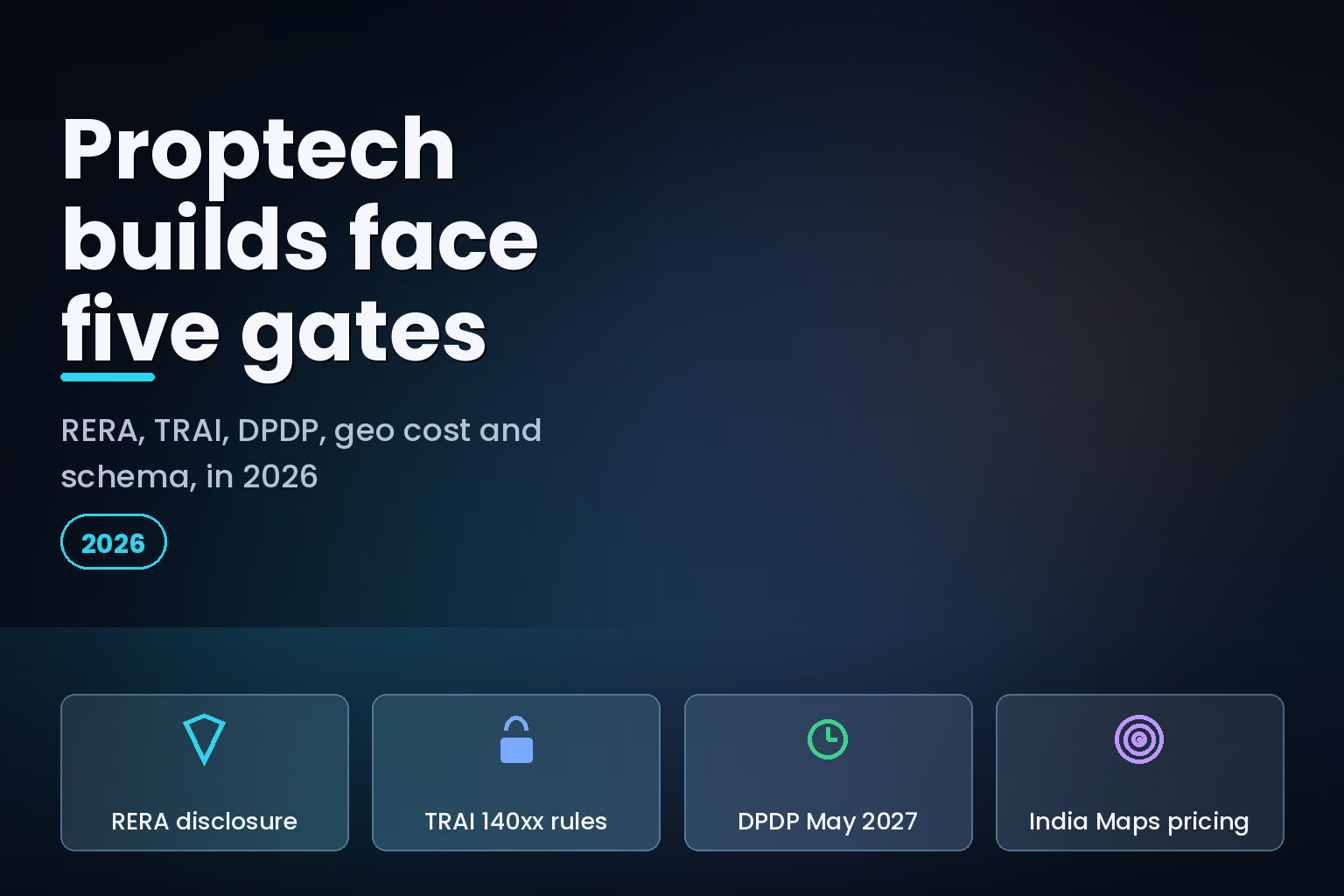
Summary. Indian proptech startups raised over $550 million across 32 deals in 2025, with Infra.Market taking around $175 million of it, according to Entrackr's compilation published 3 February 2026. The market those apps sell into shrank in volume and grew in value: ANAROCK's January 2026 review records housing sales in the top seven cities falling 14% to roughly 395,625 units from 459,645 in 2024, while total sales value rose 6% past ₹6 lakh crore. Any real estate app shipped in India in 2026 has to satisfy four separate regimes before it can show a single listing: the Real Estate (Regulation and Development) Act 2016, TRAI's commercial-communication rules, the Digital Personal Data Protection Act 2023, and Google's structured-data reality. Three of those four are already binding today. The fourth, DPDP, has a hard date: 13 May 2027.
Most build quotes for a proptech app price the listing feed, the map and the chat. The regulatory surface is where the schedule actually goes.
The market a 2026 proptech app is being built for
Three numbers set the shape of the product.
Volume is down and ticket size is up. ANAROCK's Indian Residential Real Estate: A Review and the Road Ahead, January 2026 records the 14% volume decline against a 6% rise in value, and notes that listed and Grade-A developers now hold 45% of the market, up from 28% five years ago. A discovery app that treats every developer as an equivalent supplier is building for a market that no longer exists.
Buyers arrive with a loan and a preference for unfinished stock. Knight Frank India's Beyond Bricks: The Pulse of Home Buying 2025, a survey of 1,629 respondents across eight cities, found 79% relying on home loans or mortgages and 67% favouring under-construction property. It also ranks what buyers actually weigh: location 50%, property size and layout 45%, affordability 45%, builder reputation 43%, financing options 29%, and future resale value last at 22%.
The regulator has a lot of data. ANAROCK's Homebuyer Sentiment Survey H1 2025, citing the Economic Survey 2024-25, reports RERA has registered 1.38 lakh projects nationally and resolved an equal 1.38 lakh consumer complaints.
For scale reference at the top of the market, Aurum PropTech's 16 July 2026 announcement of its Housing.com acquisition puts Housing.com at 58 million average monthly visits and 12 million monthly active users. Ashish Deora, Founder and CEO of Aurum Ventures, described the logic in that release: "The real power lies in the data flywheel: as Housing and Aurum platforms work together, every intent, intelligence, transaction, financing and living makes the whole ecosystem smarter, setting a new benchmark for how real estate is discovered, transacted, and serviced in India."
Gate 1: RERA turns your listing screen into a compliance surface
RERA is usually discussed as a developer's problem. Read as a specification, it is a product requirement.
Section 11(2) of the Act is the one that binds the app directly. The statutory text: "The advertisement or prospectus issued or published by the promoter shall mention prominently the website address of the Authority, wherein all details of the registered project have been entered and include the registration number obtained from the Authority and such other matters incidental thereto." A listing card is an advertisement. That means the registration number and the authority URL are not optional metadata fields you can leave nullable.
Section 11(1) requires the promoter to maintain a project web page on the authority's own site carrying quarterly updated lists of apartments and garages booked, approvals taken and pending, and project status. Any app that shows availability is showing a number that has a canonical, dated public counterpart. Building without a reconciliation job against the authority record is how a portal ends up advertising inventory the regulator's own page says is sold.
Section 9(1) prohibits an agent from facilitating a sale without registration, section 9(3)(a) grants a single registration valid for the whole state or union territory, and section 9(5) requires that number to be quoted in every sale the agent facilitates. Section 10(a) goes further: an agent "shall not facilitate the sale or purchase of any plot, apartment or building ... which is not registered with the Authority." A marketplace onboarding agents needs registration capture and expiry tracking as a first-class entity, not a text field in a profile. Penalties for contravening sections 9 and 10 sit at section 62. All section text above is from the Act as published on India Code.
Section 4(2)(l)(D) is where the money moves. It requires "that seventy per cent. of the amounts realised for the real estate project from the allottees, from time to time, shall be deposited in a separate account to be maintained in a scheduled bank to cover the cost of construction and the land cost." The provisos matter more than the headline: withdrawals must be "in proportion to the percentage of completion of the project" and must be certified by an engineer, an architect and a chartered accountant in practice, with an annual audit within six months of the financial year end. If your app collects booking amounts, it is a collection front-end for a three-account structure with a certification workflow behind it. That is a payments and document-workflow build, not a checkout.
State authorities layer more on top. MahaRERA's public order register lists Order No-46C/2025, MahaRERA/Secy/File No. 27/246/2025, "Norms for QR Code and font size of MahaRERA registration number in advertisements", alongside Order No-64/2025 on the go-live of its Project Lifecycle Management Module. Treat the QR artefact and the registration-number rendering as state-specific requirements to be read off the current order for each state you operate in, because the norms differ and they change. MahaRERA also runs a certification exam for agents: its notice board records the 8th phase agent exam scheduled for 15 December 2025.
| RERA provision | What it says | What it forces into the product |
|---|---|---|
| Section 11(2) | Advertisement must show authority website and registration number | Non-nullable fields on every listing card, plus a render check in the listing component |
| Section 11(1) | Quarterly project web page on the authority site | A reconciliation job comparing app inventory against the authority record |
| Section 9(1) and 9(5) | Agent registration required; number quoted in every sale | Agent registration entity with state scope, expiry and validation |
| Section 10(a) | Agent may not facilitate an unregistered project | A hard block on listing creation for unregistered project IDs |
| Section 4(2)(l)(D) | 70% of allottee money to a separate scheduled-bank account | Split-collection payment design and a certified-withdrawal workflow |
| State orders (MahaRERA 46C/2025) | QR code and font-size norms in advertisements | QR generation in the listing render path, including social cards |
Gate 2: TRAI is the constraint that bites today, not DPDP
Property lead follow-up is telemarketing, and Indian telemarketing is a registered-sender regime.
The base rules are the Telecom Commercial Communications Customer Preference Regulations, 2018 (6 of 2018), dated 19 July 2018. The Second Amendment Regulations, 2025 (1 of 2025), dated 12 February 2025 tightened them. Three clauses in that amendment change how a lead-management module has to work.
An unregistered sender cannot send at all: "No Sender, who is not registered with any Access Provider ... shall make any commercial communication, and in case any such Sender sends commercial communication, all the telecom resources of such Sender may be put under suspension or may also be disconnected."
Content type is contagious. The amendment states that "if promotional content is mixed with any type of Transactional or Service Message, such Message shall be treated as a Promotional Message." A site-visit confirmation SMS that also mentions a launch offer becomes a promotional message, subject to DND filtering and an in-message opt-out. That is a template-design decision your engineers make months before anyone notices the deliverability drop.
Revoked consent has a cooling period: consent can only be re-acquired "after ninety (90) days from the date of revoking consent." Your consent store needs a revocation timestamp, not a boolean.
The sending path itself is gated by DLT registration. TRAI's advice to senders lists the mandatory steps as principal entity registration, header assignment, content template registration, transmission of the PE ID and header, consent template registration, and consumer consent acquisition, adding that "failing to follow any steps will not allow you to send CC." Headers are 11-character alphanumeric with a suffix convention of -P, -S, -T and -G for promotional, service, transactional and government messages, and a header unused for ninety days is temporarily deactivated. Enforcement is already live: TRAI's press release of 11 December 2024 records that SMS traffic sent through unregistered paths is being rejected, across roughly 1.13 lakh active principal entities in sectors including real estate.
Voice is worse. TRAI's press release No. 91 of 2026, dated 10 July 2026 confirms the 1600xx series is reserved for service and transaction calls by regulated BFSI entities, while "TRAI has mandated use of 140xx series numbers for making promotional calls by entities of any sector," and customers may block 140-series calls through the DND registry. Property outreach is promotional. It sits on 140xx, it is fully blockable, and it cannot borrow the 1600xx lane.
The escalation maths are in press release No. 11 of 2025: the complaint window widened from 3 days to 7, the action window against unregistered senders fell from 30 days to 5, the trigger is 5 complaints in 10 days, and a first violation bars outgoing services across all of that sender's telecom resources for 15 days.
The engineering consequence is blunt. A proptech app's growth model cannot assume outbound calling works. Build for in-app messaging, scheduled callbacks initiated by the buyer, and WhatsApp Business templates with recorded consent, and treat 140xx dialling as a low-yield channel rather than the primary one.
Gate 3: DPDP is a 2027 deadline you architect for in 2026
This is where most published advice is wrong, and the correction is worth money.
DPDP's operative obligations are not in force. The commencement notification, G.S.R. 843(E) dated 13 November 2025, splits the Act into three tranches. Immediately in force from that date: section 2, sections 18 to 26, and the rule-making and Board provisions. One year from publication: section 6(9) and section 27(1)(d), the Consent Manager machinery. Eighteen months from publication: sections 3 to 5, sections 6(1) to (8) and (10), sections 7 to 17, sections 28 to 34, 36 and 37.
Read the dates off that. Consent Manager registration lands 13 November 2026. Notice, consent, the general obligations of a data fiduciary, children's data, and the full set of data principal rights land 13 May 2027. The Digital Personal Data Protection Rules, 2025 and the corrigendum of 11 December 2025 follow the identical schedule.
That is a design brief, not a reprieve. Rule 3 specifies the consent notice must "be presented and be understandable independently of any other information," must give "an itemised description of such personal data" and the specific purpose, and must provide a link letting the data principal withdraw consent "with the ease of doing so being comparable to that with which such consent was given."
An itemised, purpose-scoped, independently-rendered consent notice with symmetric withdrawal is a data-model decision. If your leads table stores one consent_given flag, retrofitting purpose-level granularity across a live database of a few hundred thousand enquiries in early 2027 is an expensive migration. Building it as a purpose-keyed consent ledger in 2026 costs a sprint. We have written the broader engineering view of this in our DPDP Act engineering playbook for Indian startups.
eCorpIT holds CMMI Level 5, MSME certification and ISO 27001:2022. For DPDP specifically, we design applications aligned with the Act's requirements rather than claiming certification against a statute that has no certification scheme.
Gate 4: the geo bill, and the India price sheet nobody uses
A property app is a map app with a CRM attached, and map calls are metered.
Google replaced the $200 monthly recurring credit with per-SKU free usage thresholds effective 1 March 2025, per Google's own March 2025 pricing change page. The current global price list and the separate India price list are both quoted in USD per 1,000 events, and they are not the same sheet.
| Google Maps Platform SKU | Global, USD per 1,000 | India, USD per 1,000 |
|---|---|---|
| Dynamic Maps | $7.00 | $2.10 |
| Geocoding | $5.00 | $1.50 |
| Autocomplete requests | $2.83 | $0.85 |
| Place Details Essentials | $5.00 | $1.50 |
| Text Search Pro | $32.00 | $9.60 |
| Static Maps | $2.00 | not separately listed |
Free monthly caps differ by the same order. Google's billing overview gives Essentials 10,000, Pro 5,000 and Enterprise 1,000 free events per SKU per month globally; the India sheet gives 70,000, 35,000 and 7,000. Eligibility is narrow: India pricing "is available only to India-based customers that incur a large majority of their usage in India and are billed in India," and accounts on India pricing "cannot enroll in subscription plans."
Two traps sit inside that table. There is no paid Text Search Essentials SKU, so any text search returning real fields starts at Pro rates. And Places API, Directions API and Distance Matrix API are now designated Legacy, with the volume-discount ladder truncated, so a new build that reaches for the familiar legacy endpoints pays more at scale than the same build on the current SKUs.
Work an example at the published rates. A portal serving 2 million autocomplete requests and 400,000 geocodes a month pays 2,000 units of autocomplete and 400 units of geocoding. On the India sheet that is $1,700 plus $600, so $2,300. On the global sheet it is $5,660 plus $2,000, so $7,660, before any place-details calls and before the free caps are applied. Entity structure and billing address are architecture decisions here, not finance ones.
Gate 5: structured data will not save you, and one feature just died
Property portals routinely budget for rich results that do not exist.
RealEstateListing is real, but it sits at Thing > CreativeWork > WebPage > RealEstateListing on schema.org, is flagged as being in the "new" area, and has exactly two of its own properties: datePosted and leaseLength. The property itself models as `Accommodation`, a subtype of Place, which carries numberOfBedrooms, numberOfBathroomsTotal, floorSize, yearBuilt and tourBookingPage. Apartment and House sit under Accommodation, not under Residence, whose only subtypes are ApartmentComplex and GatedResidenceCommunity.
The part that changes the budget: Google's search gallery, last updated 15 June 2026, lists every supported rich result, and there is no real-estate category in it. RealEstateListing, Accommodation, Apartment and House appear nowhere. Google's own guidance is explicit that "you should rely on the Google Search Central documentation as definitive for Google Search behavior, rather than the schema.org documentation."
Separately, the FAQ rich result is gone. Google's search updates log records that the feature "will no longer appear in Google Search starting May 7, 2026," and that its documentation was removed on 15 June 2026.
What a property portal can still win in the gallery: Breadcrumb, Local business through RealEstateAgent (which schema.org records at 100,000 to 1,000,000 domains as of July 2026), Organization, Image metadata and Video. Mark up the accommodation types anyway, because AI answer engines read the graph even where Google renders no visual feature. Just do not put a rich-result line in the forecast.
What we build, and how the engagement runs
The scope of a serious 2026 India proptech build, in the order we sequence it:
- Listing and inventory core. Project and unit entities with RERA registration number, authority URL and QR artefact as required fields, plus the reconciliation job against the authority's project page.
- Agent and developer onboarding. Registration capture with state scope and expiry, and a hard block on listing creation against unregistered project IDs.
- Search and geo. Map, autocomplete and geocoding on the India price sheet where the entity qualifies, with request budgeting and client-side session tokens to hold the bill down.
- Consent and lead management. A purpose-keyed consent ledger with revocation timestamps, DLT-registered template management, and 140xx-aware outbound policy.
- Payments and documents. Split collection aligned to the section 4(2)(l)(D) account structure, with the engineer, architect and chartered accountant certification workflow modelled rather than emailed.
Our five-step delivery process is discovery and regulatory mapping, architecture and data model, build in two-week increments with a working app from sprint two, hardening and security review under our ISO 27001:2022 practices, and launch with a defined support period. The stack we default to for this class of build is React Native or Flutter on the client, a Node or Python API layer, PostgreSQL with PostGIS for spatial queries, and cloud on AWS or Azure, both of which we hold partner relationships with alongside Google and Shopify.
On engagement models, we run three: a fixed-scope build for a defined MVP where the requirements are stable, a dedicated senior-led team on a monthly retainer where the roadmap is still moving, and a milestone-based build-and-transfer where you intend to take the codebase in-house. Which one fits depends on how settled your regulatory footprint is, and we will tell you honestly if a fixed scope is the wrong shape for what you are describing. If you are still assembling requirements, our mobile app development RFP template is a reasonable starting point, and the trade-offs we set out in agency versus freelancer for mobile app builds apply directly here.
Adjacent marketplace patterns share most of this architecture. If your model is closer to a rental or services marketplace, the same consent, geo and payments spine appears in an on demand app development company build and in an ecommerce app development company build.
India-specific considerations
Three things differ from a US or UK proptech build in ways that change the estimate.
Regulatory surface is state-fragmented. RERA is central legislation with state authorities issuing their own orders, so a portal operating across Maharashtra, Karnataka and Haryana is implementing three overlapping disclosure regimes, not one. Budget for a rules layer keyed by state rather than hardcoded constants.
Outbound is structurally weaker. The TRAI regime described above means the growth playbook that works in markets with looser telemarketing rules does not transfer. Retention and in-app engagement have to carry more of the load.
Loan-linked journeys are the norm, not an add-on. With 79% of Knight Frank's respondents relying on a mortgage, a property app that treats financing as a downstream referral is dropping the step that most determines whether the transaction completes.
FAQ
How eCorpIT can help
eCorpIT is a Gurugram-based technology company founded in 2021, holding CMMI Level 5, MSME certification and ISO 27001:2022, with senior-led engineering teams building mobile and platform products for Indian and international clients. We build proptech applications with the RERA disclosure surface, TRAI-compliant lead handling and DPDP-ready consent architecture designed in from the first sprint rather than bolted on before an audit. If you are scoping a listing portal, a developer sales app or a rental platform, we can map the regulatory surface against your target states before you commit to an architecture. Tell us what you are building at contact us, or read our detailed view of a real estate and proptech app development service in India.
References
Last updated: 15 August 2026.