On this page · 14 sections
- Layer 1: the storefront and commerce platform
- Layer 2: the order management system, your spine
- Layer 3: inventory and dark-store management
- Layer 4: last mile and route optimisation
- Layer 5: payments, UPI first
- Layer 6: ONDC, the open-network option
- Layer 7: data, demand forecasting, and analytics
- Quick commerce versus traditional e-commerce, by requirement
- The market you are building for
- India-specific considerations
- How to choose, in order
- FAQ
- How eCorpIT can help
- References
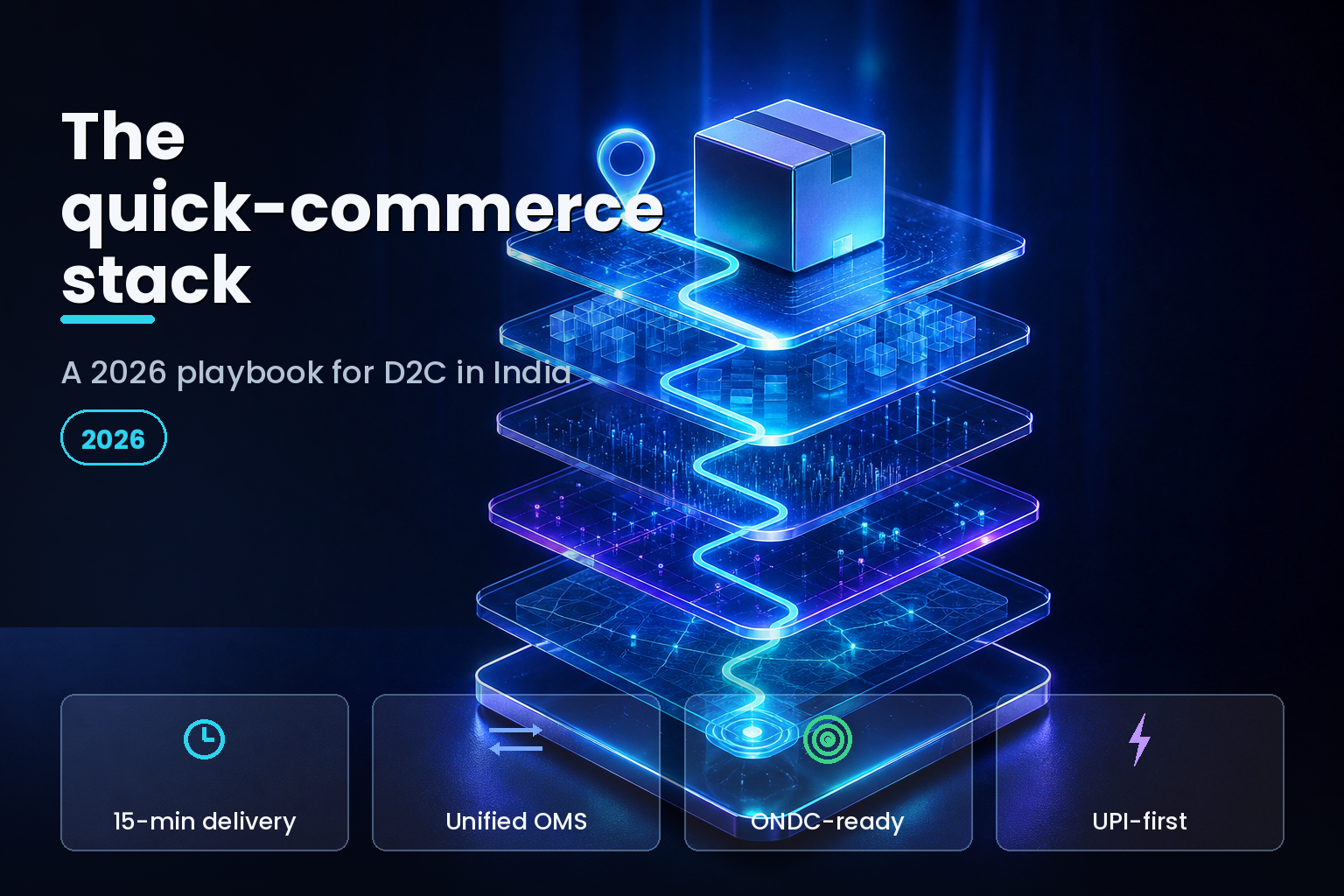
Summary. India's quick-commerce market is estimated between $3.65 billion and $6.94 billion in 2026 depending on methodology, and one industry report projects it from $5.48 billion in 2024 to about $12.97 billion by 2029. Three platforms, Blinkit, Zepto, and Swiggy Instamart, held more than 90% of volume in 2024-2025, with Blinkit near 48% share and roughly 2,100 dark stores. Amazon entered with Amazon Now in 2025, and orders are growing about 25% month over month. Underneath, the open layer is moving too: ONDC is live across 500-plus cities with about 7.6 lakh sellers. For a D2C brand, the question in 2026 is no longer whether to be in quick commerce, but how to build the tech stack behind it, across seven layers from storefront to data. A Shopify Basic plan in India starts near ₹1,499 per month, but the stack that decides whether you can deliver in 15 minutes is far bigger than a storefront. This playbook walks through each layer and how to choose.
Quick-commerce tech is a different animal from standard e-commerce. A normal online store can take minutes or hours to confirm stock and dispatch. A quick-commerce order has to check live inventory in a specific dark store, reserve it, route it to a picker, and assign a rider, in seconds. The warehouse process from order receipt to dispatch typically runs under three minutes, leaving the rest of a 10 to 30 minute promise for the last mile. That speed requirement reshapes every layer of the stack. This guide is written for D2C founders, retail CTOs, and operations leads building on quick commerce and ONDC in India, who need a clear way to decide what to buy, what to integrate, and the rare thing worth building.
A note on the central decision before the layers: build, buy, or integrate. For almost every layer below, proven Indian platforms already exist, so the default is to buy or integrate, not build. The place to spend engineering effort is where you have a real edge, usually demand forecasting or a specific operational workflow, not the plumbing that companies like Unicommerce, Shiprocket, and Locus have already solved.
| Stack layer | What it does | What to evaluate |
|---|---|---|
| 1. Storefront | Customer-facing ordering | UPI checkout, speed, channel reach |
| 2. Order management (OMS) | Unifies orders across channels | Live inventory sync, returns, q-commerce connectors |
| 3. Warehouse / dark store (WMS) | Picking and dispatch in the store | Sub-3-minute pick, real-time stock |
| 4. Last mile | Routing and rider assignment | Route optimisation, courier coverage |
| 5. Payments | Collecting money | UPI-first, GST invoicing, low friction |
| 6. ONDC | Open-network demand | Buyer-app reach, integration effort |
| 7. Data and forecasting | Predicting and analysing | Demand forecasts, real-time dashboards |
Layer 1: the storefront and commerce platform
The storefront is where your own D2C demand lands, separate from the marketplace apps. The pragmatic default for Indian D2C is Shopify, which handles UPI natively through gateways such as Razorpay, PhonePe, and Cashfree, supports GST-compliant invoicing, offers Hindi and regional-language checkout, and integrates with Shiprocket and Delhivery out of the box. A Basic plan is about ₹1,499 per month on annual billing, before 18% GST and a 2% transaction fee on external gateways. Indian Shopify stores grew 55% year over year, a sign of how much D2C has consolidated onto it.
The choice to weigh is hosted versus headless. A headless build, typically a custom front end on Next.js talking to a commerce backend, gives full control of speed and experience but takes four to six months to implement for an Indian D2C brand. Go headless only if storefront performance is a genuine differentiator for you. Most brands in 2026 are better served by a fast hosted storefront and spending the saved months on fulfilment, because in quick commerce the delivery experience, not the homepage, is the product.
Layer 2: the order management system, your spine
If one layer decides whether your quick-commerce operation holds together, it is the order management system. A D2C brand in quick commerce sells through its own site and through Blinkit, Zepto, Swiggy Instamart, and often a clutch of marketplaces, each with its own inventory view. Without a single OMS, you end up reconciling stock by hand and overselling. An OMS centralises inventory, orders, returns, and fulfilment across channels; Indian platforms such as Unicommerce connect a brand's website with quick-commerce channels and 30-plus marketplaces in one place.
What to evaluate here is connector quality and inventory sync latency. Ask whether the OMS has live, supported connectors to the specific quick-commerce platforms you sell on, not just generic marketplaces, and how quickly a sale on one channel decrements stock everywhere else. In quick commerce, a stock view that lags by even a few minutes turns into cancelled orders. This is the layer to buy from a specialist, because building reliable multi-channel inventory sync is a deep problem others have already solved.
Layer 3: inventory and dark-store management
The warehouse management system runs the dark store, the mini-warehouse built only for online fulfilment, with no walk-in customers and every square foot arranged for fast picking. The job here is real-time inventory accuracy and a picking flow that gets an order from receipt to dispatch in under three minutes. Platforms built for this, such as Omneelab's dark-store WMS, Increff, and the integrated Prozo supply-chain operating system with its ProWMS and ProShip modules, focus on speed and stock truth rather than the slower receiving-and-storage flows of a classic warehouse.
What to evaluate is whether the WMS is purpose-built for quick commerce, with support for the two to three kilometre dark-store radius model, real-time stock at the store level, and picking optimised for speed. A general warehouse system retrofitted for quick commerce usually shows its seams under load. If you run your own dark stores rather than selling through the platforms' stores, this layer is as important as the OMS.
Layer 4: last mile and route optimisation
The last mile is where the delivery promise is kept or broken, and it is mostly a routing and assignment problem. Specialist platforms apply machine learning to it: Locus runs an engine trained on more than 1.5 billion deliveries and handles 250-plus real-world constraints across multi-depot, multi-carrier operations. For brands that ship rather than run riders, aggregators like Shiprocket connect 25-plus courier partners across 24,000-plus pin codes through one interface, and ONDC logistics participants such as LoadShare plug in on the network side.
What to evaluate is whether you need true sub-30-minute routing with live rider assignment, or fast standard shipping. A brand selling its own quick commerce from dark stores needs route optimisation and rider orchestration. A brand using quick commerce mainly as a marketplace channel can lean on the platform's logistics and use an aggregator for its D2C orders. Match the last-mile tool to the model, because routing software for 10-minute delivery is overkill for next-day shipping and underpowered the other way round.
Layer 5: payments, UPI first
Payments in Indian quick commerce are UPI first, and the stack should reflect that. High-frequency, low-value baskets punish checkout friction, so the goal is to collect money in as few taps as possible. Storefront platforms handle UPI natively through gateways such as Razorpay, PhonePe, Cashfree, and Easebuzz, with GST-compliant invoice numbering built in. Encouraging UPI also helps unit economics, since it can avoid the percentage gateway fee that cards carry and leave only the platform's transaction fee.
What to evaluate is total payment cost and checkout speed together. On a Shopify Basic plan, combined payment-processing costs commonly land between about 2.3% and 4.5% per sale once the transaction fee, gateway, and GST are counted, which on thin quick-commerce margins is a real line item. Pick the gateway mix that keeps both the tap count and the blended fee low, and make UPI the default path rather than an option buried below cards.
Layer 6: ONDC, the open-network option
ONDC is the layer most D2C brands underuse. The Open Network for Digital Commerce lets a seller reach many buyer apps without being locked to a single platform, and it is gaining ground precisely in hyperlocal and quick commerce, where grocery, FMCG, and daily essentials drive much of the volume. It is live across 500-plus cities and towns, had onboarded about 7.6 lakh sellers and service providers by early 2025, and its leadership has guided toward a steep rise in daily transactions through 2026. Vibhor Jain became its managing director and chief executive in April 2026, taking the network into its next phase.
What to evaluate is reach versus integration effort. ONDC gives a D2C brand an open route to demand that does not depend on one marketplace's terms, through seller-side enablers that connect you to the network. The trade-off is that the network and its participants are still maturing, so treat ONDC in 2026 as a high-potential additional channel to integrate, not a replacement for your own site or the established quick-commerce platforms. The brands that move early on it are building optionality against platform concentration.
Layer 7: data, demand forecasting, and analytics
The last layer is the one worth building if anything is. Quick commerce lives or dies on having the right stock in the right dark store before the order arrives, which is a forecasting problem. The platforms compete on proprietary technology and operational efficiency here, and Amazon is leaning in hard. As Andy Jassy, Amazon's chief executive, told the Q1 2026 earnings call, "It started last year in India, where orders are increasing 25 per cent month-over-month, with Prime members tripling their shopping frequency once they start using it." That frequency is exactly what good forecasting turns into stocked shelves and kept promises.
What to evaluate is whether your forecasting is a commodity or an edge. Off-the-shelf analytics in your OMS and WMS cover the basics: what sold, what is low, what is dead stock. The edge case, predicting demand per SKU per dark store per hour, is where custom data work pays off, because it directly sets fill rates and waste. This is the one layer where a D2C brand with strong data talent should consider building, since the forecast is a durable advantage that the plumbing layers are not.
Quick commerce versus traditional e-commerce, by requirement
| Dimension | Traditional e-commerce | Quick commerce |
|---|---|---|
| Delivery promise | 2 to 7 days | 10 to 30 minutes |
| Inventory view | Periodic sync acceptable | Real-time, per dark store |
| Dispatch decision | Minutes to hours | Seconds |
| Fulfilment node | Central warehouse | Dark stores in 2 to 3 km radius |
| Last mile | Courier aggregator | Live route and rider assignment |
The market you are building for
| Player | Dark stores (approx.) | Position |
|---|---|---|
| Blinkit | About 2,100 | Around 48% share, market leader |
| Zepto | About 1,000 to 1,100 | 66 cities, single-digit EBITDA in sight |
| Swiggy Instamart | About 1,100 to 1,200 | 23 to 25% share, 100-plus cities |
| Amazon Now | Scaling from 2025 launch | About 25% month-over-month order growth |
| ONDC network | Open hyperlocal layer | 500-plus cities, 7.6 lakh sellers |
India-specific considerations
Three India-specific factors should shape the stack. The first is ONDC, which has no real equivalent elsewhere and gives D2C brands an open-network hedge against the concentration of three platforms holding more than 90% of quick-commerce volume. Building ONDC-readiness into your OMS early is cheaper than retrofitting it later. The second is UPI: payments here are mobile and instant by default, so a stack designed UPI-first will out-convert one that treats cards as primary. The third is data privacy. Quick commerce captures precise location, address, and order-history data, and under the Digital Personal Data Protection Act 2023 and the DPDP Rules 2025, that personal data carries consent and security duties. A brand has to build consent and minimisation into the stack rather than bolt it on. For the wider view on running technology in an organisation, see our note on generative AI enterprise strategy for 2026.
How to choose, in order
Sequence the decision rather than buying everything at once. Start with the storefront and a UPI-first checkout, because that is your owned demand. Put the OMS in next, since it is the spine that keeps every channel honest on inventory. Add WMS and last-mile only to the depth your model needs: full dark-store and routing software if you run your own quick commerce, lighter aggregator tooling if quick commerce is a marketplace channel for you. Layer ONDC in as an open-network channel once the core is stable. Build custom only in data and forecasting, where an edge is durable. At each step, buy or integrate the proven option and reserve engineering for the one or two places where your operation is genuinely different. The brands that win quick commerce in India are the ones that treat the stack as an operations decision, measured in minutes to the customer's door, not a software shopping list.
FAQ
How eCorpIT can help
eCorpIT is a CMMI Level 5, senior-led technology organisation in Gurugram that builds and integrates commerce and supply-chain systems for retail and D2C brands. We connect storefronts, order management, dark-store and last-mile tools into one working quick-commerce stack, build ONDC and UPI integrations, and develop the demand-forecasting layer where a brand wants a real edge, all designed to meet DPDP requirements for customer data. If you are choosing or stitching together a quick-commerce stack in 2026, talk to our team or read more about how we work.
References
_Last updated: 25 June 2026._