On this page · 10 sections
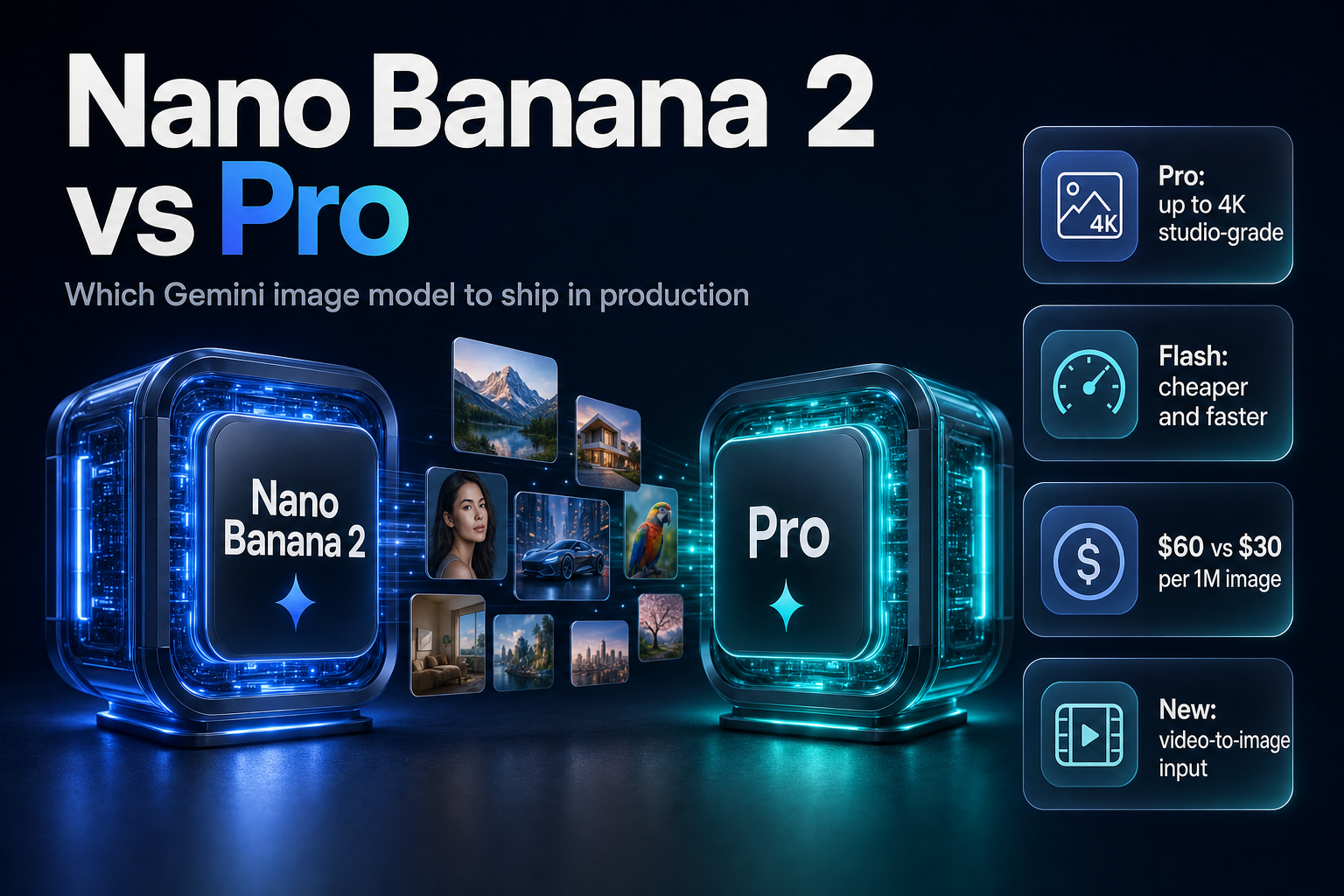
Summary. Google's two headline image models are now generally available, and they are built for different jobs. Nano Banana Pro (Gemini 3 Pro Image) is the quality model: up to 4K output, the best text rendering in the family, blending of up to 14 input images, consistency across up to 5 people, and Google Search grounding. By Google's own per-image pricing, a Nano Banana Pro image runs about $0.134 at 1K or 2K and $0.24 at 4K, on token rates of $1 per million input and $6 per million text output. Nano Banana 2 (Gemini 3.1 Flash Image) is the volume model: about $0.067 for a 1K image, $0.101 at 2K, and $0.15 at 4K, on $0.25 input and $1.50 output token rates, at lower latency. It is also the only one of the two that accepts video as an input. Nano Banana 2 Lite (Gemini 3.1 Flash-Lite Image) undercuts both at about $0.034 for a 1K image. Google's own developer guidance is blunt about the trade: use the Flash image model "for faster, lower cost image generation," and the Pro model "for higher quality image generation, with higher cost and latency." This is the production decision, priced out.
The two share a name and a lineage but not a use case. Picking by brand is how teams overpay for hero-image quality on a thumbnail pipeline, or ship soft, mis-lettered output on a print campaign. The right call depends on resolution, text, volume, latency, and whether your input is an image or a video clip.
The lineup: three models, one family
The Nano Banana line now has three production members, each a different Gemini image model underneath. Naming is the first thing teams get wrong, so it is worth stating plainly.
Nano Banana Pro is Gemini 3 Pro Image, launched in November 2025 and built on Gemini 3 Pro. Its product manager at Google DeepMind, Naina Raisinghani, positions it for "studio-quality designs with unprecedented control, improved text rendering and enhanced world knowledge." Nano Banana 2 is Gemini 3.1 Flash Image, the faster and cheaper 2026 successor to the original Nano Banana (Gemini 2.5 Flash Image). Nano Banana 2 Lite is Gemini 3.1 Flash-Lite Image, the cheapest tier for high-volume, cost-sensitive generation. All three carry an invisible SynthID watermark on every image, and all three are reachable through the Gemini API in Google AI Studio and Vertex AI for enterprise use.
Cost per image, side by side
Token prices tell you the unit economics, but image generation is easier to budget per finished image, because each output image is billed as a fixed block of image output tokens. The rates below come from Google Cloud's own pricing page.
| Model | Input (per 1M tokens) | ~1K image | ~2K image | ~4K image |
|---|---|---|---|---|
| Nano Banana Pro (Gemini 3 Pro Image) | $1.00 | $0.134 | $0.134 | $0.24 |
| Nano Banana 2 (Gemini 3.1 Flash Image) | $0.25 | $0.067 | $0.101 | $0.15 |
| Nano Banana 2 Lite (Gemini 3.1 Flash-Lite Image) | $0.125 | $0.034 | N/A | N/A |
At 1K resolution, Nano Banana 2 is about half the per-image cost of Pro, and Lite is about a quarter. The gap matters at volume: a pipeline generating 100,000 images a month pays about $13,400 on Nano Banana Pro at 1K or 2K, roughly $0.134 each, against about $6,700 on Nano Banana 2 and $3,400 on Nano Banana 2 Lite at 1K. For a single campaign hero image, the difference is a rounding error and quality wins. For a catalogue, the model choice is the budget. This is the same unit-economics discipline we apply in the Gemini Enterprise Agent Platform cost breakdown.
Where Nano Banana Pro earns its price
Pro is not just a bigger Flash. It does specific things the Flash models do not, and each maps to a real production requirement.
Resolution and print. Pro outputs at 2K and 4K, which is what advertising, packaging, and print production need. Nano Banana 2 also reaches 4K, but Pro's higher fidelity holds up better under the scrutiny that high-resolution output invites.
Text in the image. Pro is the strongest model in the family for rendering correct, legible text directly in an image, including long strings and multiple languages, and it can localise or translate text inside an existing image while keeping the layout. For anything with a headline, a label, a menu, or a poster, that capability is the difference between a usable asset and a retouching job.
Composition and consistency. Pro blends up to 14 input images into one scene and keeps up to 5 people looking like themselves across a composition. That is what lets a team turn product shots, a logo, and reference photos into a single coherent advert, or hold a character's face steady across a storyboard.
Knowledge and grounding. Because it is built on Gemini 3 Pro, Pro can connect to Google Search grounding to pull real-world data into an image, which is useful for factual infographics, diagrams, and anything that has to be correct as well as attractive. Our note on Gemini 3.6 Flash token efficiency covers the reasoning-tier trade in more depth.
Where Nano Banana 2 wins: speed, cost, and video
Nano Banana 2 is the model to reach for when you are generating a lot, generating fast, or generating from a video. Google's guidance frames the first two directly: the Flash image model is for faster, lower-cost generation. On a high-throughput pipeline, that latency and price advantage compounds across every request.
The third advantage is structural, not just a discount. Nano Banana 2 accepts video as an input modality, listed on Google Cloud's pricing page as "text, image, video" input, where Nano Banana Pro takes only text and image. This video-to-image capability, in preview, lets the model read a short clip and generate context-aware stills from it, such as thumbnails or frames that match the action in the footage. If your source material is video and you need images out of it, Nano Banana 2 is the only one of the two that does the job at all. For teams already costing video generation, our Gemini Omni Flash video cost guide is the companion piece.
Watermarking and provenance
Every image from these models carries Google's SynthID digital watermark, an invisible marker that identifies the image as AI-generated or AI-edited. For production teams, the policy differs by tier and surface, and it affects whether a finished asset ships clean. Images generated by free and Google AI Pro users also carry a visible watermark, the Gemini sparkle. Google removes that visible mark for Google AI Ultra subscribers and inside the Google AI Studio developer tool, so professional output does not ship with a visible badge. The invisible SynthID watermark stays on every image regardless of tier or subscription.
That provenance is a feature, not a tax. You can upload an image into the Gemini app and ask whether Google AI generated it, and SynthID will answer, which gives brand and legal teams a way to verify what a pipeline produced. Decide early which tier your production surface runs on, because that choice determines whether a visible watermark lands on a customer-facing asset. A team rendering finals through Google AI Studio or an Ultra plan avoids the visible sparkle; one generating on a free or Pro surface does not.
How to choose: a use-case map
The decision is rarely "which is better." It is "which fits this workload." The table below maps common production jobs to the model that fits, on quality, cost, and input type.
| Production job | Best fit | Why |
|---|---|---|
| Campaign hero or key visual | Nano Banana Pro | Highest fidelity, 4K, print-ready |
| Poster, packaging, or anything text-heavy | Nano Banana Pro | Best in-image text rendering, multilingual |
| Multi-element ad from logo plus product shots | Nano Banana Pro | Blends up to 14 inputs, holds 5-person consistency |
| Factual infographic or diagram | Nano Banana Pro | Search grounding and world knowledge |
| High-volume product thumbnails | Nano Banana 2 | Lower cost and latency per image |
| Stills generated from a video clip | Nano Banana 2 | Only model of the two that takes video input |
| Bulk, cost-first generation at 1K | Nano Banana 2 Lite | Cheapest per image, about $0.034 at 1K |
A practical pattern many teams land on is a two-model pipeline: draft and iterate on Nano Banana 2 for speed and cost, then render the final, customer-facing asset on Nano Banana Pro for quality. That keeps the expensive model off the throwaway drafts while still shipping Pro-grade finals. The same build-versus-buy logic that governs a budget LLM tier comparison applies to image models: match the tier to the value of the output, not to the brand on the box.
India-specific considerations
For Indian D2C brands, marketplaces, and marketing teams, the per-image gap is the whole story at catalogue scale. A retailer generating tens of thousands of listing images a month sees the difference between about $0.067 and $0.134 per 1K image land directly on the monthly bill, so the default should be Nano Banana 2 or Lite for bulk listing and thumbnail work, reserving Pro for campaign creative and anything carrying rendered text in English or an Indian language. Pro's multilingual text rendering is genuinely useful here, because a single model can produce campaign assets with correct Hindi, Tamil, or Bengali text instead of routing to a designer for every localisation. Teams budgeting in rupees should price the workload per finished image, in the resolution they actually ship, rather than per million tokens, which hides the real cost.
FAQ
How eCorpIT can help
eCorpIT is a Gurugram-based, senior-led engineering organisation, founded in 2021, CMMI Level 5 certified, and a Google partner. We help product and marketing teams put Gemini image models into production: choosing the right tier per workload, building the two-model draft-then-final pipeline, wiring generation into Vertex AI with cost controls, and handling SynthID provenance and brand consistency. If you are deciding how to ship image generation without overpaying for quality you do not need, talk to our AI engineering team.
References
- Introducing Nano Banana Pro — Naina Raisinghani, Product Manager, Google DeepMind, November 20, 2025.
- Build with Nano Banana Pro (Gemini 3 Pro Image) — Google Developers blog, November 20, 2025.
- Gemini Enterprise Agent Platform generative AI pricing — Google Cloud (per-model token and image output rates).
- Nano Banana 2 and Nano Banana Pro are generally available — Google Cloud Blog.
- Nano Banana Pro available for enterprise — Google Cloud Blog.
- Start building with Nano Banana 2 Lite and Gemini Omni Flash — Google DeepMind.
- Gemini 3 Pro Image (Nano Banana Pro) model page — Google DeepMind.
- Nano Banana Pro prompting tips — Google.
- Gemini 3 Pro Image documentation — Google Cloud.
- SynthID content provenance — Google DeepMind.
- Where to use Nano Banana Pro now — Google.
_Last updated: July 28, 2026._