On this page · 10 sections
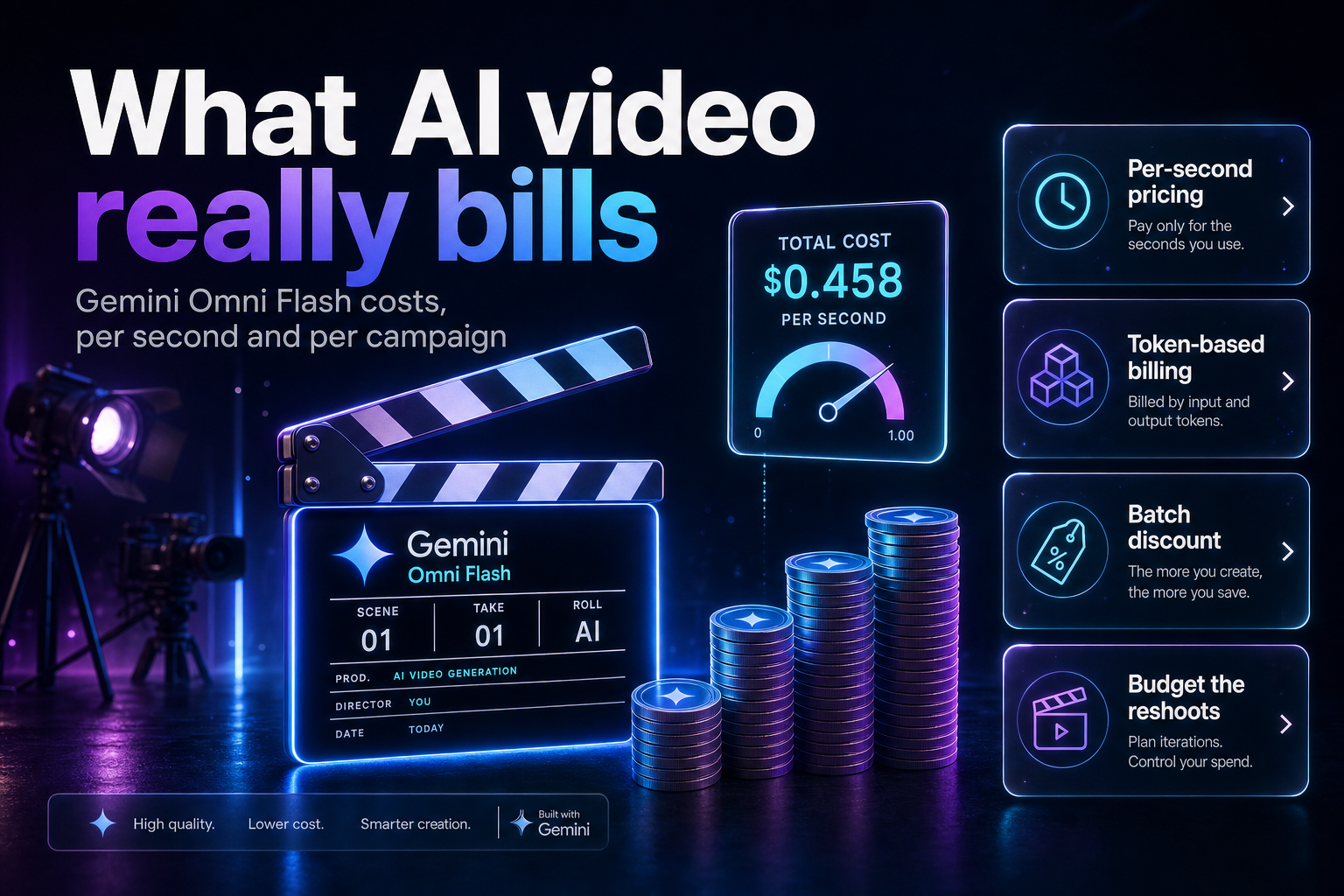
Summary. Google brought Gemini Omni Flash to developers on 30 June 2026, priced at $0.10 per second of video output, the same rate as Veo 3.1 Fast. The model ships as gemini-omni-flash-preview in the Gemini API, Google AI Studio and Gemini Enterprise Agent Platform. At that rate a 10-second clip, which is the current maximum length, costs $1.00 to generate. A 60-second brand film cut from 6 clips costs roughly $48 in generation even if you burn 8 takes on every clip. Google shipped it alongside Nano Banana 2 Lite, an image model at $0.034 per 1K image with 4-second latency. The bill is not the problem. Google documents 4 limitations, and 2 of them decide how many takes you actually burn. If you publish the output in India, the IT Rules amendments that took effect on 20 February 2026 make it labelled content by law.
Marketing teams keep asking what AI video costs. The published unit price answers a question nobody's budget actually turns on.
What Google shipped on 30 June 2026
Gemini Omni Flash was introduced at Google I/O and reached developers on 30 June 2026 through the Gemini API and Google AI Studio, in public preview. Alisa Fortin and Anish Nangia, both Product Managers at Google DeepMind, described the pricing directly: "This model is priced competitively at $0.10 per second of video output, which is the same as Veo 3.1 Fast."
It supports video generation and conversational editing from a combination of text, image and video inputs. Google lists four strengths: conversational video editing in natural language, multimodal referencing to hold a scene consistent, real-world knowledge drawn from Gemini, and synchronisation of text and graphics to video actions.
The companion release matters for the cost model. Nano Banana 2 Lite (gemini-3.1-flash-lite-image) "delivers text-to-image outputs in 4 seconds" at "$0.034 per 1K image", and Google positions it as the recommended replacement for the original Nano Banana (gemini-2.5-flash-image). The intended workflow chains them: generate a reference image with Nano Banana 2 Lite, pass it to Omni Flash, animate it. We covered the image side of that pairing in our note on Nano Banana 2 Lite for marketing images.
One caution on figures circulating elsewhere. Several summaries quote a token-level rate for Omni Flash video output, expressed as tokens per second of 720p video and dollars per million video output tokens. When we checked Google's Gemini Developer API pricing page on 16 July 2026, Omni Flash did not appear on it at all. The rate we can source to Google is the one in the launch post: $0.10 per second of video output. Budget from that, and treat token-level arithmetic from third-party blogs as unconfirmed until it shows up on Google's own pricing page.
The campaign math
Here is the arithmetic at $0.10 per second, with a 10-second maximum clip length. The take counts are planning assumptions, not measured data; the per-generation cost is Google's published rate.
| Deliverable | 10s clips needed | Takes per clip | Total generations | Video output cost |
|---|---|---|---|---|
| One 10s social cut | 1 | 5 | 5 | $5.00 |
| One 30s ad, 3 scenes | 3 | 5 | 15 | $15.00 |
| One 60s brand film, 6 scenes | 6 | 8 | 48 | $48.00 |
| 20-product catalogue, 1 clip each | 20 | 4 | 80 | $80.00 |
| Always-on programme, 100 clips | 100 | 4 | 400 | $400.00 |
Read the right-hand column again. A hundred finished clips with four takes each costs $400 in generation. That is less than a single day rate for a freelance videographer in most markets, and it is why the "what does AI video cost" question is the wrong question.
At $0.10 a second, the model is not the expensive part of your campaign. The edit is.
The generation cost is so low that it disappears against the cost of the people deciding which take to use, the brand review, the legal sign-off and the labelling work. Teams that budget this as a software line item and then discover it as a headcount problem have mis-modelled it. The correct comparison is not Omni Flash versus a stock library. It is Omni Flash versus your existing production calendar, and the constraint that moves is throughput, not price.
The 10-second ceiling is the real budget driver
Google is explicit: "Omni offers 10-second video generations currently, with longer durations coming soon."
That single limit shapes everything downstream. Any deliverable longer than 10 seconds is a cut, not a take. A 60-second film is six generations stitched together, and every join is a place where continuity can break. Which brings us to the limitation that actually costs money.
Google documents it plainly: "Character consistency when changing scenes or panning movements has some limitations but we are working to make this better."
Those two facts interact badly. The 10-second ceiling forces you to cut between scenes, and cutting between scenes is exactly where the model's consistency is weakest. That is where your take count goes from 4 to 12. If your creative concept follows one recognisable person through five locations, you are buying the model's weakest capability repeatedly. If your concept is five separate product beauty shots that never need to match, you are buying its strongest.
Choose concepts that respect the ceiling and your effective cost stays near the table above. Fight the ceiling and the take count, not the unit price, is what blows the budget.
The four documented limitations, and what each costs you
| Limitation (Google's wording) | Practical cost |
|---|---|
| "Omni offers 10-second video generations currently, with longer durations coming soon." | Everything longer is a multi-clip edit. Storyboard in 10-second beats or pay for it in assembly. |
| "Character consistency when changing scenes or panning movements has some limitations but we are working to make this better." | The take multiplier. Concepts with a recurring character across cuts cost several times more generations than concepts without. |
| "Uploading audio references and scene extension is not yet supported in the Gemini API for this model." | No audio reference means sound design stays in your existing tool. Do not scope Omni Flash as an end-to-end spot. |
| "Video references up to 3 seconds in duration are accepted by the API schema but are not correctly processed by the model at this time." | The dangerous one. The API accepts the input and does the wrong thing with it. No error, just a bad take you pay for and have to notice yourself. |
The last row deserves the emphasis. A limitation that throws an error costs you nothing but time. A limitation where "the API schema accepts it but the model does not correctly process it" costs you generations, and worse, it costs you trust in your own outputs, because the failure is silent. If you are wiring Omni Flash into an automated pipeline, validate video reference handling by hand before you let it run unattended.
Google also caps iteration depth. Using the Interactions API for multi-turn sessions, "you can maintain session history and context so users can stack up to three sequential edits." Three. If your review culture runs to six rounds of notes, the tool does not accommodate that within a session, and round four starts over.
How it compares
| Option | Published price | Max clip length | Editing model |
|---|---|---|---|
| Gemini Omni Flash | $0.10 per second of video output | 10 seconds | Conversational editing, up to 3 stacked edits per session |
| Veo 3.1 Fast | $0.10 per second, per Google's own comparison | Not stated in the Omni Flash launch post | Not covered in this source |
| Nano Banana 2 Lite (stills) | $0.034 per 1K image | Not applicable, 4-second latency | Prompt and regenerate |
Google's positioning of Omni Flash against Veo 3.1 Fast is a price match, not a capability claim: "the same as Veo 3.1 Fast". The differentiator Google actually argues for is conversational editing and multimodal referencing rather than cost.
There is a real strategic point buried in that. When two models from the same vendor land on the identical per-second price, price has stopped being the axis of competition. The question becomes which one gets you to an approved take in fewer rounds, and that is measurable only against your own creative, not a benchmark.
India-specific considerations
If you generate marketing video with Omni Flash and publish it to an Indian audience, it is regulated content the moment it goes up.
MeitY introduced the 2026 Amendments to the Information Technology (Intermediary Guidelines and Digital Media Ethics Code) Rules 2021 on 10 February 2026, and they came into force on 20 February 2026. They create a category called synthetically generated information, defined as "audio, visual, or audio-visual information that is artificially or algorithmically created, generated, modified or altered using a computer resource, in a manner that such information appears to be real, authentic, or true and depicts or portrays any individual or event in a manner that is, or is likely to be perceived as indistinguishable from a natural person or real-world event."
An Omni Flash brand film with a photoreal presenter sits inside that definition. A few points worth getting right:
AI-generated text is outside the definition. Your blog copy is not SGI; your video is.
The much-quoted 10% rule is gone. The draft amendments released in October 2025 proposed watermarking covering at least 10% of the surface area for visual content, or a disclaimer during the first 10% of the duration for audio. That fixed-size requirement was dropped from the final rules. The standard now is that non-prohibited SGI must be "clearly and prominently labelled", with visual labels on visual SGI and audio disclosures on audio SGI. Plenty of guidance still circulating repeats the 10% figure as though it were law. It is not.
Where feasible, intermediaries must embed permanent metadata or unique identifiers tracing the resource that generated the content, and must not permit removal or modification of labels or metadata. Google's models help here: both Omni Flash and Nano Banana 2 Lite carry SynthID watermarking, and content can be verified through the Gemini app, Gemini in Chrome or Search. That gives you a provenance story, though the labelling obligation on the published asset remains yours and the platform's.
Routine editing is carved out. Formatting, technical corrections, colour adjustment, transcription and compression do not create SGI, provided they do not materially alter the substance, context or meaning. Colour-grading real footage is safe. Generating the footage is not.
Platforms with over 5 million registered users in India carry heavier duties: requiring users to declare whether uploaded content is SGI, deploying technical measures to verify those declarations rather than relying on the user's word, and displaying prominent labels. In practice your agency will be asked to declare, and the platform will check.
Takedown windows tightened sharply. Three hours for a court order or authorised government notice, down from 36. Two hours for high-risk categories including impersonation and artificially morphed images, down from 24. If a campaign asset is challenged, the response window is a working morning. Our fuller treatment is in India's IT Rules 2026: deepfake takedown and AI-labelling, and the provenance side in our note on SynthID watermarking and content authenticity for marketers.
The budget consequence: label design, declaration workflow and a named person who can act within two hours are line items in an Indian AI video campaign. They cost more than the $400 of generation.
How to budget a campaign properly
- Price the generation from the published rate, not from third-party token math. $0.10 per second of video output, 10 seconds maximum, so $1.00 per full-length clip.
- Set a take multiplier from your concept, not from a vendor average. Scenes with a recurring character across cuts: assume high. Independent product shots: assume low. Then measure your own on the first campaign and replace the assumption.
- Storyboard in 10-second beats. Every beat that needs to exceed 10 seconds or hold a character across a cut is a cost centre, and you should know which ones they are before anyone opens AI Studio.
- Keep sound design outside the tool. Audio reference upload is not supported in the Gemini API for this model, so scope it accordingly rather than discovering it mid-flight.
- Validate video reference handling manually before automating. References up to 3 seconds are accepted by the schema and not processed correctly, and it fails quietly.
- Budget the labelling, not just the pixels. For India, that means a prominent visual label, provenance metadata retained end to end, a declaration workflow with the platform, and a two-hour response path.
- Compare against your production calendar. The decision is throughput, since the generation cost is already negligible against one day of crew.
FAQ
How eCorpIT can help
eCorpIT builds AI content pipelines for marketing teams who need a repeatable cost per finished asset rather than a demo reel. Our senior engineering teams wire Nano Banana 2 Lite and Gemini Omni Flash into your existing production workflow, measure your real take multiplier instead of assuming one, and handle the validation gaps that fail quietly. We design deployments aligned with India's IT Rules requirements for synthetically generated information, including labelling, provenance metadata and a takedown response path that fits the two-hour window. If you are costing an AI video programme this quarter, talk to our team.
References
- Start building with Nano Banana 2 Lite and Gemini Omni Flash — Alisa Fortin and Anish Nangia, Google DeepMind, The Keyword, 30 June 2026.
- Gemini Omni Flash — Gemini API, Google AI for Developers.
- Generate and edit videos with Gemini Omni Flash — Gemini API documentation.
- Gemini Developer API pricing — Google AI for Developers, checked 16 July 2026.
- Gemini Omni — Google DeepMind model page and benchmarks.
- Nano Banana 2 Lite — Google DeepMind.
- Nano Banana 2 Lite and Gemini Omni Flash available — Google Cloud Blog.
- Gemini Omni Flash Preview — Gemini Enterprise Agent Platform documentation.
- India targets deepfakes and AI-generated content: key changes under MeitY's 2026 amendments to the IT Rules — Freshfields, 20 February 2026.
- Interactions API — Gemini API documentation.
- Identifying AI-generated images with SynthID — Google DeepMind.
- Image generation with the Gemini API — Google AI for Developers.
Last updated: 16 July 2026.