On this page · 10 sections
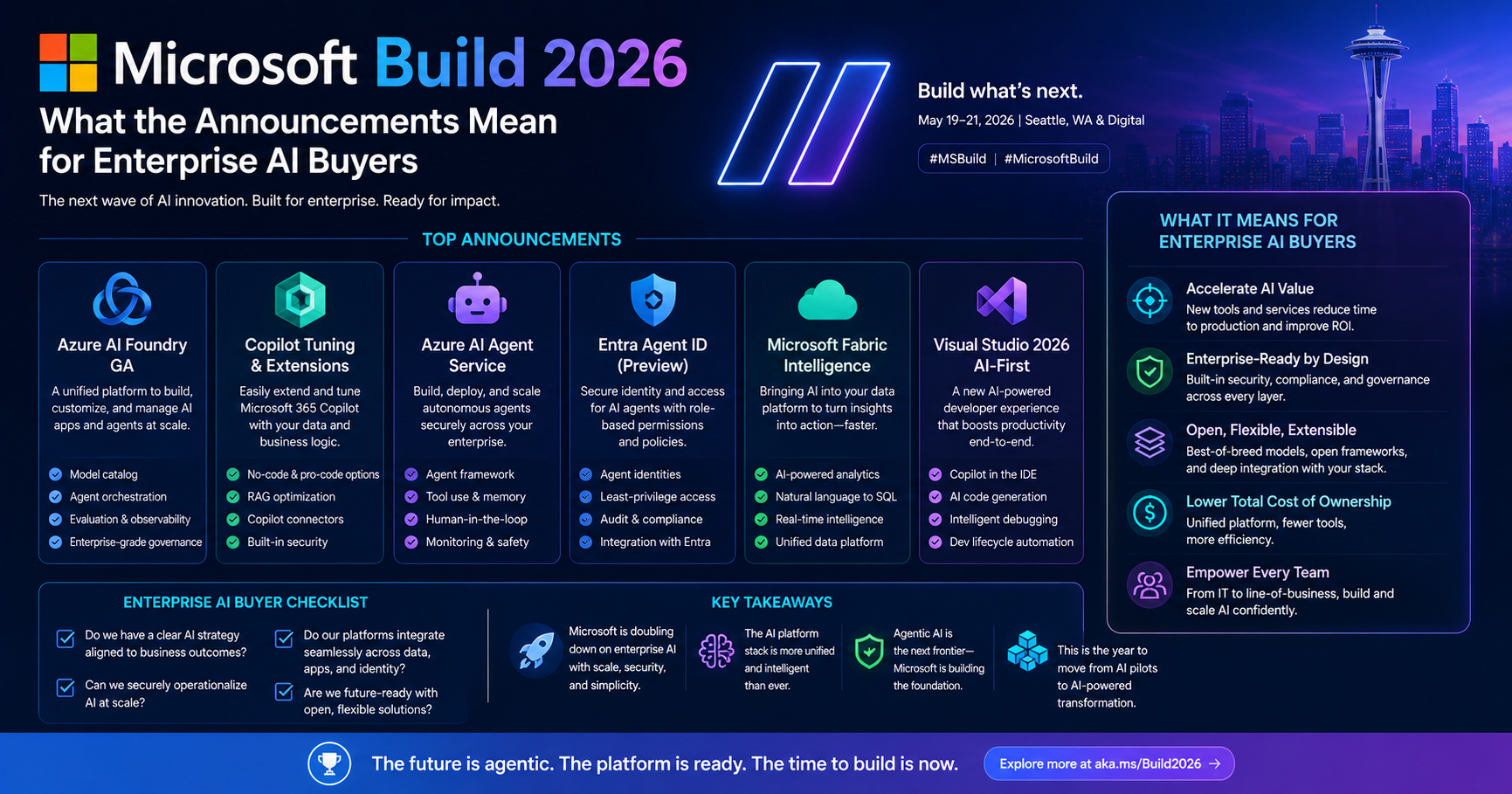
Summary. Microsoft Build 2026 ran 2-3 June in San Francisco. Satya Nadella framed the conference around an agent stack with six layers: compute, models, context, tools, runtime, security. The headline-grabbers — MAI-Thinking-1 reasoning model, Surface Axion AI dev box, Project Solara agent OS, the NVIDIA GB300-powered DGX Station for Windows — are real product moves. The deeper story is Microsoft's bet that Windows becomes the local agent runtime, Foundry becomes the production deployment surface, and Microsoft IQ (Work IQ + Fabric IQ + Web IQ) becomes the context layer that ties them together. This guide does the actual enterprise takeaways, separates real product from positioning, and gives buyers a practical lens on what to budget for in 2026 H2.
Talk to eCorpIT about your Microsoft AI build · AI Mobile App Development services
What Microsoft actually announced
The full list, with sources. Everything below is confirmed across at least two reputable outlets.
AI models from Microsoft's own labs
MAI-Thinking-1. Microsoft AI chief Mustafa Suleyman introduced Microsoft's first reasoning-focused AI model, developed without using model distillation from competitors. Significant signal: Microsoft is now investing in foundation-model R&D as a parallel track to its OpenAI and Anthropic relationships.
MAI-Image-2.5 and MAI-Image-2.5-Flash. New image generation models from the same Microsoft AI lab, also announced at the conference. The Flash variant targets cost-sensitive workloads.
Hardware: AI development moves local
Surface Axion. Microsoft's first Windows-native AI developer box, positioned as the local-development counterpart to cloud-based Foundry. Windows-specific optimisations include workload scheduling, power and thermal management, and unified memory handling tuned for AI workloads.
DGX Station for Windows. A deskside AI supercomputer powered by NVIDIA's GB300 Grace Blackwell Ultra. Microsoft positions this as capable of developing and running up to 1-trillion-parameter frontier AI models locally and connecting always-on AI agents to enterprise applications.
RTX Spark optimisations. Windows-specific tuning for NVIDIA's RTX Spark, including improvements to workload scheduling, power management, and unified memory handling, plus increased GPU memory availability and improved memory management for AI, gaming, and content-creation workloads.
Cloud infrastructure: Microsoft's own silicon scaling
Maia 200. Microsoft's AI accelerator is live in Arizona and will deploy internationally. Microsoft's own claim: 30% more tokens per dollar versus the leading GPU today. Maia 200 will power Microsoft 365 Copilot at scale. This is the same Maia line that Anthropic is in talks to run Claude inference on per coverage from May 2026.
Cobalt 200 VMs. Azure's next-generation CPU platform for cloud-native and agent workloads, delivering 50% performance improvement, optimised specifically for modern agentic AI.
Azure HorizonDB. Enterprise-ready Postgres engineered for the AI era — designed to handle the vector, embedding, and agent-state workloads that increasingly dominate AI-application backends.
Fabric Data Warehouse on NVIDIA acceleration. Fabric DW now runs eligible queries directly on NVIDIA accelerated computing without requiring query rewrites or infrastructure setup. Quiet but consequential change for enterprise analytics workloads.
Agent runtime and Microsoft IQ
Microsoft IQ general availability. The new context layer feeds AI agents three streams of grounded knowledge: Work IQ (M365 Signals from your tenant), Fabric IQ (structured business data), and Web IQ (live web grounding). Now generally available across GitHub Copilot, Foundry, and Copilot Studio. This is the answer to the "where does the agent get its grounded context from?" question that has slowed enterprise AI adoption.
Copilot Studio capabilities to GA. Three capabilities moved from preview to general availability ahead of Build, per Microsoft's May 2026 Copilot Studio update: computer-using agents (CUAs that navigate websites and desktop applications visually), agent-to-agent communication, and real-time voice agents. The CUA piece is the big one — it lets agents act in legacy applications that have no API.
Office 365 Copilot Agent Mode as default. Microsoft made Agent Mode the default in Office 365 Copilot. Significant for the enterprise rollout question: tenants that have not opted into agentic workflows are now opted in by default.
Project Solara: the agent-first device platform
Project Solara. Described as a chip-to-cloud platform for agent-first devices, including desk devices and wearable badge concepts. Some coverage characterises Solara as an Android-based OS for running agents. The deeper read: Microsoft is hedging on Windows-only as the agent runtime by also building an Android-based device platform.
GitHub Copilot evolution
GitHub Copilot desktop app. Now in preview as a native desktop experience for agentic workflows. Acts as the control centre for agentic development across the toolchain. The autonomous-agent capabilities that debuted at Build 2025 have matured into production deployment, with real-world data showing the agent independently fixing bugs, writing tests, and opening pull requests.
Nadella's six-layer agent stack
The framing matters because it tells you where Microsoft is investing. Satya Nadella laid out the agent stack as: compute, models, context, tools, runtime, security.
Each layer maps to specific Build announcements.
| Layer | Build 2026 announcement |
|---|---|
| Compute | Maia 200 (cloud), Surface Axion + DGX Station for Windows (local) |
| Models | MAI-Thinking-1, MAI-Image-2.5 (Microsoft's own) + Claude in Foundry + GPT in Foundry |
| Context | Microsoft IQ (Work + Fabric + Web) GA across all surfaces |
| Tools | Copilot Studio CUAs, agent-to-agent, real-time voice |
| Runtime | Windows Agent Runtime, Project Solara, Office 365 Agent Mode default |
| Security | Windows security model extended to local AI agents |
The strategic move: Microsoft is building all six layers itself while keeping the door open to third-party models. Claude and GPT continue to be available through Foundry. Microsoft's own MAI models add a parallel track. The compute layer mixes Microsoft's Maia chips with NVIDIA RTX/GB300 hardware. The bet is that the stack — not any single model — is the moat.
What this means for enterprise AI buyers
Five practical takeaways for buyers planning 2026 H2 AI spending.
The local-vs-cloud architecture decision changes
Before Build 2026, enterprise AI was mostly cloud. After Build 2026, Microsoft is positioning Windows as the local agent runtime for privacy-sensitive workloads, iterative development, and cost-controlled inference. The hybrid architecture Microsoft is promoting:
- Local Surface Axion or DGX Station for development, iteration, privacy-sensitive workloads, and smaller models.
- Cloud Azure Foundry on Maia 200 for production scaling, frontier models, and massive training runs.
- Windows Agent Runtime as the local orchestration layer.
- Microsoft Foundry as the path from local prototyping to production deployment.
For most enterprise buyers, this hybrid is now the recommended architecture rather than pure-cloud. Budget implications: local AI development hardware is no longer a research-only line item.
Token economics are the procurement story
Microsoft's Maia 200 claim of 30% more tokens per dollar matters because token costs are how enterprise AI procurement is now framed. Our analysis of Microsoft and Uber's Claude Code budget blowouts shows that token-based billing on agentic workloads is the budget surprise nobody scoped properly in 2025.
The Maia 200 cost story will compete with the same workloads running on NVIDIA GPUs. For enterprise CFOs, the question for 2026 H2 is which Foundry-hosted model on which Microsoft silicon delivers the right economics. Watch this conversation closely in the second half of the year.
Microsoft IQ closes the grounding gap
The single most-cited enterprise complaint about generative AI in 2024–2025 was "we cannot get the agent to retrieve our actual company knowledge." Microsoft IQ's Work IQ + Fabric IQ + Web IQ stack is the response. For Microsoft 365 customers, the grounding problem now has a Microsoft-shaped answer that requires no third-party RAG stack.
The trade-off: tenants that lean into Microsoft IQ are deeper inside the Microsoft ecosystem. For most enterprises already standardised on M365, this is acceptable. For multi-vendor strategies, it adds Microsoft lock-in.
Computer-using agents change the legacy-app picture
Copilot Studio's CUAs navigate websites and desktop applications visually, using the UI just as a human would. This matters because most enterprise legacy applications have no API — and most enterprise AI projects have ground to a halt against that constraint.
CUAs let you ship agentic workflows against applications that nobody is going to refactor. The reliability of CUAs in production is the question to test in 2026 H2; the capability is now generally available.
Agent Mode default opens the procurement conversation
Microsoft 365 Copilot Agent Mode becoming the default changes the IT procurement conversation. Tenants that had not formally approved agentic workflows are now using them by default. For governance-conscious enterprises, this triggers a policy review.
The right move is not necessarily to opt out — it is to ensure your IT governance framework explicitly addresses agentic capabilities now operating across your tenant.
What is real vs what is positioning
Honest separation, the same shape as our Microsoft and Uber Claude Code analysis.
Real product, available today:
- Microsoft IQ GA across GitHub Copilot, Foundry, Copilot Studio.
- Copilot Studio CUAs, agent-to-agent, real-time voice in GA.
- Office 365 Copilot Agent Mode as default.
- Maia 200 live in Arizona.
- Cobalt 200 VMs available in Azure.
- GitHub Copilot desktop app in preview.
Real product, coming in months:
- Surface Axion (announced; availability follows).
- DGX Station for Windows (announced; availability follows).
- MAI-Thinking-1 (announced; deployment surface details follow).
- MAI-Image-2.5 variants (announced; pricing follows).
- Azure HorizonDB (announced; enterprise rollout follows).
- Maia 200 international deployment (Arizona first, others follow).
Strategic positioning, deployment timeline less clear:
- Project Solara (a vision more than a shippable product as of Build 2026).
- Windows as the universal local AI agent runtime (a direction, not a current state).
- Microsoft's own MAI models replacing third-party dependencies (a parallel track, not a replacement).
For 2026 H2 budget planning, focus on the first category. Treat the second as imminent. Treat the third as direction, not commitment.
Where this fits in the broader 2026 AI landscape
The context matters because Microsoft's positioning sits inside a larger industry shift.
Microsoft's relationship with Anthropic deepened in May 2026 alongside the Build announcements. The $5 billion Microsoft investment in Anthropic announced in late 2025, the Foundry availability of Claude Opus 4.6, and the Maia chip talks for Claude inference all signal that Microsoft is hosting third-party frontier models alongside building its own. The MAI-Thinking-1 announcement does not change this; it adds a track.
OpenAI continues as the closest Microsoft partner but the relationship has become more arms-length compared to 2023–2024. Microsoft is now publicly investing in alternatives. For enterprise buyers, this matters because the assumption that "Microsoft AI = OpenAI" no longer holds. The model landscape inside Microsoft Foundry is genuinely multi-vendor in 2026.
Token economics drove the conversation at Build 2026 in a way they did not at Build 2025. The Uber AI budget blowout, the Microsoft Claude Code internal cancellation, and the broader enterprise pushback on token-based billing have made cost-per-token a first-class procurement metric. Maia 200's 30% more tokens per dollar claim is positioned as the response.
Agent reliability is the gating issue for the next 18 months. CUAs in production, autonomous coding agents like GitHub Copilot, agent-to-agent communication — all of these can demo well and fail unpredictably at enterprise scale. The Build announcements assume reliability that has not been fully tested in production deployments.
What to budget for in 2026 H2
A practical list for enterprise AI procurement teams planning H2 2026 spending.
Microsoft IQ usage budget. If your tenant uses Microsoft 365 and you adopt Microsoft IQ for agent grounding, the consumption costs will appear on the M365 bill. Plan for a line item; size it after a 90-day pilot.
Copilot Studio agent runs. CUAs and agent-to-agent workflows consume tokens. Set a per-engineer or per-business-process cap before adoption. Run an incremental rollout, not an enterprise-wide rollout.
Local AI hardware capex. Surface Axion or DGX Station per developer for teams doing serious AI development. Position as capex rather than opex; the deskside hardware story is now real, not aspirational.
Foundry model-mix planning. If your AI workloads will run on Foundry, decide whether to standardise on Microsoft MAI, Claude, GPT, or a mix. Token economics differ; latency differs; capability differs.
Governance framework update. Office 365 Copilot Agent Mode as default requires a policy review. Specify which agent capabilities are approved, which require explicit business-unit sign-off, and which are blocked.
Maia 200 cost-tracking discipline. Maia's 30% per-token economics depend on workload mix. Test against your actual workloads, not against synthetic benchmarks.
Need help planning a 2026 H2 Microsoft AI rollout? eCorpIT runs Microsoft AI architecture reviews for enterprise teams — Foundry, Copilot Studio, Microsoft IQ, agent governance, token-economics modelling. Talk to our team about a review.
Frequently asked questions
A short closing note
Microsoft Build 2026 was the conference where Microsoft formalised its full-stack AI strategy: Microsoft silicon (Maia 200, Cobalt 200), Microsoft hardware (Surface Axion, DGX Station for Windows), Microsoft models (MAI-Thinking-1, MAI-Image-2.5), Microsoft context (IQ), Microsoft runtime (Windows Agent Runtime, Office 365 Agent Mode), all wrapped in the Foundry developer surface. Third-party models from Anthropic and OpenAI remain hosted, but the strategic direction is clear: Microsoft wants to own every layer of the agent stack.
For enterprise AI buyers, the practical takeaways are token-economics discipline, hybrid local-plus-cloud architecture planning, governance framework updates for default agentic capabilities, and a serious look at whether Microsoft IQ closes your AI grounding gap.
If you want a senior, honest read on what Build 2026 means for your specific Microsoft AI roadmap, that is what we do.
Further reading
- Microsoft and Uber Cut Back on Claude Code in 2026 — the token-economics context for Maia 200.
- AI Chatbots for Customer Service: Real Cost Savings in 2026 — enterprise AI cost discipline.
- B2B Performance Marketing Playbook 2026 — how the apps and agents we build feed measurable pipeline.
- AEO vs GEO vs SEO Complete Guide — how to get your AI product cited by AI search.
- eCorpIT AI Mobile App Development services — the canonical AI services surface.