On this page · 9 sections
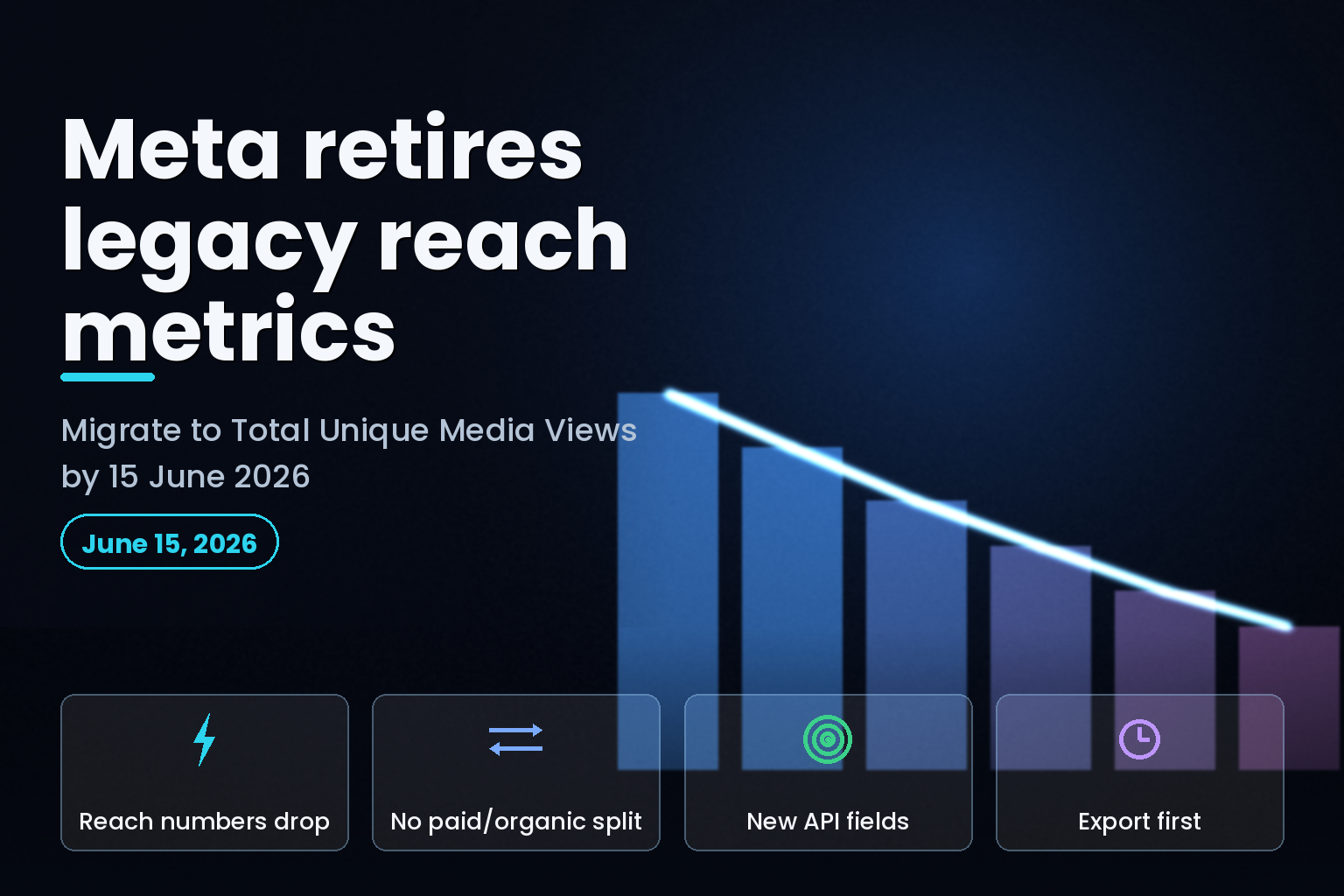
Summary. On 15 June 2026, Meta removes a set of legacy Facebook reach and impression metrics from its Graph API and Marketing API and replaces reach with a new Total Unique Media Views metric. The change was announced on 18 February 2026 alongside Graph API v25 and Marketing API v25, and it lands for third-party partners on 15 June 2026. Two things matter for anyone reporting on Meta performance. First, your reach numbers will move, because the underlying event changes from an impression, counted when content is delivered to a feed, to a media view, counted when content is visually rendered, and a media view is more selective, so the new figures usually read lower. Second, Meta will no longer split reach into paid and organic, so a team spending, say, 5,00,000 rupees a month on Facebook ads loses the clean paid-reach line it used to report against that budget. In the API the swap is concrete: post_impressions_unique becomes post_total_media_view_unique, and page_impressions_unique becomes page_total_media_view_unique. Several older metrics, including 3-second unique video views and page-level post impressions, go away with no replacement at all. This guide lists exactly what changes, why the numbers shift, and the migration steps to run before 15 June 2026.
This is not a paid-ads bidding change, and campaigns keep running. It is a measurement and reporting change, and it hits every team that pulls Meta numbers through the API or a third-party dashboard such as Sprout Social, Sprinklr, or Emplifi. If reach is a headline number in your monthly report, treat this as a deadline.
What Meta changed, and when
Meta has been moving toward views as its single headline metric since late 2024, when it said it would shift away from separate plays, impressions, and accounts-reached counts and toward one uniform views count for video and image content across Facebook and Instagram. The February 2026 API release builds that shift into the developer platform.
In its developer announcement, Meta stated: "By the end of June 2026, we plan to introduce Page Viewer Metric in the Graph API. Viewers metric is intended to replace the legacy reach metric and provide a consistent cross-platform measurement (Facebook and Instagram) of how many people saw a piece of content." Meta added that it will retire Post/Page Reach, Video Impressions, and Story Impressions within the Graph API, noting that "these legacy metrics are no longer surfaced in our Insights tools, but they remained available via APIs until now." The removal date that partners are working to is 15 June 2026.
The exact metric mapping
The core swap replaces the unique-impression basis of reach with a media-view basis. Reporting tools are remapping the fields as follows, so a dashboard that read reach from the old field now reads it from the new one.
| Legacy metric (API field) | Replacement (API field) | What changes for you |
|---|---|---|
post_impressions_unique (post reach) |
post_total_media_view_unique |
Reach now counts unique media viewers, not unique impressions |
page_impressions_unique (page reach) |
page_total_media_view_unique |
Page reach rebases to unique media views |
| Total Reach | Total Unique Media Views | The one reach metric that survives, remapped |
| 3-second unique video views | None | Removed with no replacement |
| Page-level post impressions (all variants) | None | Removed with no replacement |
The single reach metric that survives is Meta's standard Total Reach, which reporting tools remap onto the new Total Unique Media Views field at both post and page level. Everything else on the reach and legacy-impression side is either remapped or dropped.
What disappears with no replacement
A long list of granular reach and impression breakdowns goes away entirely on 15 June 2026, not just the headline numbers. On the reach side that includes organic reach and paid reach at post level, plus viral and non-viral reach, and the page-level daily averages for each. On the impression side it includes page-level post impressions and their organic, paid, viral, and non-viral variants. On video it includes unique video views and the organic and paid splits of those. If any of these feed a client report or an internal dashboard, they will return nothing after the cutoff, so find them now.
For a performance team, the loss that stings most is the paid-versus-organic split of reach. With this update Meta no longer provides a paid-versus-organic breakdown for the surviving reach metric: Total Unique Media Views represents the combined total of paid and organic unique viewers for your media. A report that showed "paid reach" as a distinct line against ad spend can no longer source that number from Meta's API.
Why your reach numbers will drop
The shift is not cosmetic. An impression was counted when content was delivered to a feed; a media view is counted when the content is visually rendered on screen. Those are different events, and the media-view event is the stricter of the two, so the new source typically returns lower values than the old one for the same content and period.
That has a direct reporting consequence. Total Unique Media Views is not a one-to-one replacement for the legacy unique-impression metric that reach used to draw from, because Meta defines and calculates the two differently. Expect your reach trend to step down across the changeover even when nothing about your content or delivery changed. Reporting tools are backfilling the new metric from 1 January 2026 forward so you have some history on the new basis, but you should still annotate the break and stop comparing post-cutoff reach to pre-cutoff reach as if they were the same measure. The same discipline that protects a 10x ROI digital marketing strategy applies here: a metric definition change is not a performance change, and your dashboard should say so.
Your migration checklist before 15 June 2026
Treat the cutoff as a hard date and work backward. Run these steps now.
| Team or asset | What breaks on 15 June 2026 | What to do before then |
|---|---|---|
| Monthly client reports | Paid reach, organic reach, and legacy impression lines return null | Rebuild those rows on Total Unique Media Views; drop the paid-versus-organic reach split |
| Historical benchmarks | Reach history on the old basis becomes uncomparable | Export the date ranges you need as CSV or PDF before the cutoff |
| Automated dashboards and BI feeds | Pipelines pulling post_impressions_unique or page_impressions_unique break |
Repoint to post_total_media_view_unique and page_total_media_view_unique |
| Video reporting | 3-second unique video views and unique video view splits vanish | Move video KPIs to the surviving Views metric; reset targets |
| Reach-based KPIs and targets | Engagement rate per reach and cost per reach shift down | Recalculate baselines on the new, lower reach figures |
The highest-risk items are historical exports and any KPI expressed as a rate over reach. Deprecated data will not be retrievable after the cutoff, so export first. Then reset every reach-denominated target, because cost per reach and engagement rate per reach will move purely because the denominator changed. For teams that run paid social alongside search, align this with your Google Ads reporting so both channels report on a consistent, current basis.
India-specific considerations
For Indian brands and agencies, two points deserve attention. First, the loss of the paid-versus-organic reach split changes how you prove paid media value. Many India retainers report paid reach as evidence of delivered spend, and that specific number now has no clean API source, so shift the paid-story to metrics that survive, such as Views, results, and cost per result, and set that expectation with clients before June rather than after a report breaks. This is a natural moment to review reporting with a social media marketing partner so the change is planned, not discovered.
Second, treat measurement data under the Digital Personal Data Protection Act 2023 (DPDP) as you migrate. Meta frames part of this shift as an effort to simplify metrics and address privacy concerns, and audience-level reach data is personal-data-adjacent, so keep exports and dashboards within your normal data-handling and retention rules rather than spreading historical CSVs across personal drives to beat the cutoff. eCorpIT helps performance teams rebuild Meta reporting on the new metrics and keep the migration clean.
FAQ
How eCorpIT can help
eCorpIT rebuilds Meta reporting for brands and agencies ahead of the 15 June 2026 cutoff: repointing dashboards and BI feeds to the new Total Unique Media Views fields, exporting and preserving historical reach data, and resetting reach-denominated KPIs and client benchmarks so the metric change is not mistaken for a performance drop. See our digital marketing team in Gurugram or talk to us at /contact-us/.
References
- Introducing Graph API v25 and Marketing API v25 — Meta for Developers, 18 February 2026 (the announcement and Page Viewer statement).
- Deprecated metrics, Platform Insights — Meta for Developers (list of removed metrics).
- Meta Updates Marketing API To Align With Latest Ad Shifts — Andrew Hutchinson, Social Media Today, 19 February 2026.
- Facebook Metric Deprecations June 2026 — Sprout Social Support (exact field remapping and cutoff).
- Facebook Metric Deprecation, June 2026 — Emplifi documentation.
- Facebook Reach Metrics Deprecation — Sprinklr Help Center.
- Meta overhauls Marketing API, retires legacy reach metrics — Mobile Marketing Reads.
- Facebook Switches to Views as Primary Metric — Social Media Today (the 2024 pivot to views).
- Facebook Launches Graph API v25 and Marketing API v25 Updates — Swipe Insight.
- Graph API changelog — Meta for Developers.
_Last updated: 28 July 2026._