On this page · 10 sections
- The 2026 SMB machine learning picture in numbers
- Machine learning vs generative AI: clearing the confusion
- The 7 ML applications that pay back for SMBs
- What does not yet pay back for most SMBs
- The 90-day SMB ML adoption playbook
- Common SMB ML pitfalls
- Frequently asked questions
- A short closing note
- Further reading
- References
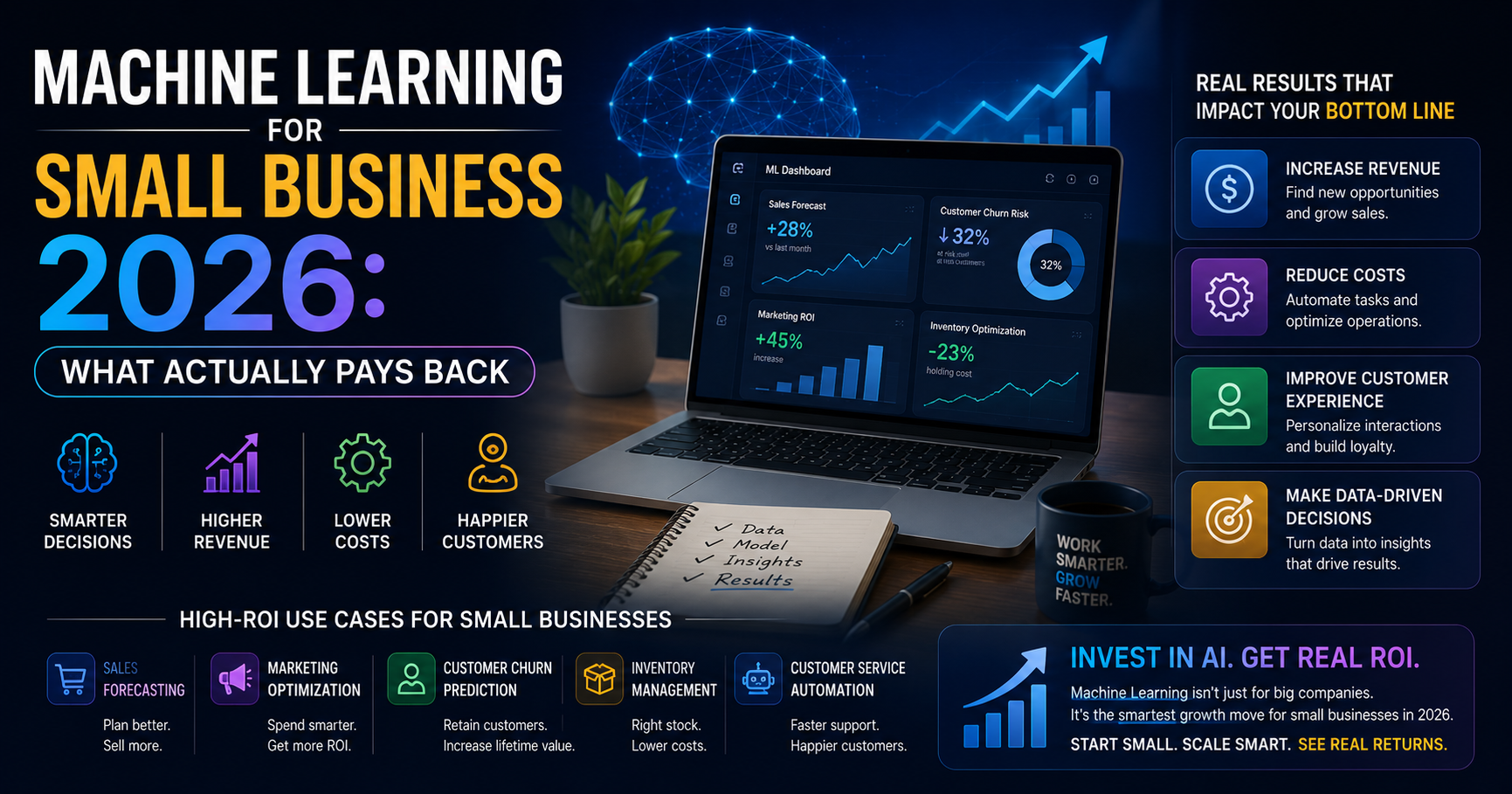
Summary. 68% of small businesses in 2026 use AI regularly, but most are still treating it as a productivity hack rather than a measurable investment. The ones getting real returns — an average 5.8× ROI within 14 months — built around seven specific machine learning applications that actually pay back at SMB scale: customer churn prediction, demand forecasting, lead scoring, customer segmentation, dynamic pricing, fraud detection, and customer-service automation. This guide does the honest data, separates ML from generative AI, gives real cost ranges, and lays out a 90-day adoption playbook for small businesses navigating ML in 2026.
Talk to eCorpIT about a small-business ML pilot · AI Chatbots Real Cost Savings 2026
The 2026 SMB machine learning picture in numbers
Five data points that frame every SMB ML conversation in 2026.
68% of small businesses use AI regularly. Per DigitalApplied's 2026 SMB AI adoption research, more than two-thirds of SMBs now use AI tools as part of regular workflows. The catch: 77% have no formal AI policy. Adoption is happening; governance is not.
42% of SMBs (50–499 employees) use AI in at least one formal business process. Up from 23% in 2024 per the same research. The growth is real and accelerating — adoption nearly doubled in 24 months.
74% of SMBs use AI indirectly through embedded features. Email filtering, CRM lead scoring, accounting categorisation, calendar scheduling. Most SMBs are already running ML at meaningful scale; they often do not realise it because the ML is inside tools they already pay for.
5.8× average ROI within 14 months. For SMBs that deployed AI into production with measurable success metrics, the median return is roughly 5.8× the investment within 14 months of go-live. Marketing and customer service deliver the fastest paybacks — often within 60 days.
The median AI-using SMB now runs 5 AI tools. A shift from "we are experimenting with one tool" to "we have an operational AI stack." Content, customer service, scheduling, analytics, workflow automation — five categories, each with at least one ML-driven product.
The big picture: ML for SMBs in 2026 has moved past the experimental phase. The question is no longer "should we use it" — it is "are we extracting the returns the market is reporting."
Machine learning vs generative AI: clearing the confusion
Before the use cases, an honest framing of terminology.
Machine learning is the broader discipline. Statistical models that learn patterns from historical data and make predictions or classifications on new data. Customer churn prediction, demand forecasting, fraud detection, lead scoring, segmentation, recommendation engines — all classical machine learning applications that have been delivering business value since the early 2010s.
Generative AI is a subset of machine learning that creates new content (text, images, code, voice). ChatGPT, Claude, Gemini, Midjourney, GitHub Copilot. This is the AI category that got most of the headlines from 2022 onward.
Why this matters for SMBs: generative AI gets the attention; classical machine learning typically delivers the ROI. The 5.8× return figure is dominated by applications like churn prediction, demand forecasting, and lead scoring — not by chatbot deployment alone. A balanced ML strategy for SMBs in 2026 includes both: generative AI for content and customer service, classical ML for prediction and optimisation.
The remaining sections cover both, but treat them as distinct disciplines requiring different investment shapes.
The 7 ML applications that pay back for SMBs
In rough order of typical ROI and implementation simplicity for an SMB.
1. Customer service automation (Tier 1 deflection)
The most common SMB starting point. AI chatbots powered by ML and increasingly by generative AI handle routine customer queries without human escalation.
Typical 2026 performance: Tier-1 deflection of 41-58% median, as documented in our AI Chatbots Real Cost Savings 2026 guide. The 2026 average is a 30% reduction in support costs in the first year; top-quartile SMB deployments hit 53%.
Cost range: Intercom Fin at $0.99 per resolution. Zendesk AI at $1.50–$2.00 per resolution plus an Advanced AI add-on. Fini at $0.69 per resolution. For an SMB at 5,000 monthly contacts, that is roughly $3,000–$10,000/month in resolution fees plus the knowledge-base maintenance overhead.
Payback: Usually within 3-5 months for SMBs. The fastest-paying ML application for most service-handling SMBs.
2. Customer churn prediction
For subscription businesses, recurring-service businesses, and any SMB where retention matters more than acquisition.
What it does: Identifies customers likely to cancel or stop purchasing within a defined window (30/60/90 days). The marketing or customer-success team intervenes with retention offers, check-in calls, or targeted content before the customer churns.
Typical SMB performance: A well-trained churn model identifies 70-85% of likely churners with reasonable precision. Retention campaigns targeting that list typically save 15-30% of forecasted churn. For an SMB with $200K annual churn, that translates to $30K-$60K in retained revenue annually.
Cost range: Off-the-shelf platforms (Klaviyo for D2C, Custify or Gainsight for SaaS, ChurnZero) deliver basic churn prediction at $200-$2,000/month. Custom ML models built on a data warehouse plus a tool like AWS SageMaker or Vertex AI run $15K-$40K for initial development plus 5-10% annual maintenance.
Payback: 6-9 months for most SMBs. Compounds across the customer base.
3. Demand forecasting and inventory optimisation
For retail, e-commerce, manufacturing, and any SMB carrying inventory.
What it does: Forecasts demand at the SKU-store-week level by combining historical sales, seasonality, promotions, weather, market trends, and competitor activity into a single model. Reduces stock-outs and excess inventory simultaneously.
Typical SMB performance: Per Netstock's retail-forecasting research, ML-driven demand forecasting reduces forecast error by 30-50% over rule-based approaches, with corresponding reductions in stock-outs and excess inventory.
Cost range: Vendor solutions (Netstock, RELEX, Inventory Planner) at $500-$3,000/month for SMBs. Custom-built solutions $25K-$60K initial plus the data-warehouse infrastructure.
Payback: 4-8 months for most inventory-carrying SMBs. The working capital released often pays back the investment in the first year.
4. Lead scoring and sales prioritisation
For B2B SMBs with sales teams that have more leads than capacity.
What it does: Scores each inbound lead or account on likelihood to convert. Sales focuses on the high-probability leads first. Reduces wasted time on leads that will not close.
Typical SMB performance: Lead-scoring ML typically improves sales conversion rates 20-40% by routing reps to higher-probability opportunities. For SMBs with 200-500 leads/month, that compounds to meaningful revenue lift.
Cost range: HubSpot, Salesforce Einstein, and similar CRM-embedded scoring at $50-$200/seat/month. Standalone platforms like Madkudu or 6sense at $1K-$5K/month. Custom-built scoring models $20K-$50K initial.
Payback: 4-6 months for most B2B SMBs. The CRM-embedded options have the fastest payback because the integration is already there.
5. Customer segmentation
For any SMB doing marketing that wants to personalise rather than blast.
What it does: Clusters customers into behaviorally similar groups (high-value, at-risk, dormant, prospects). Marketing campaigns are targeted by segment rather than sent uniformly. Email opens, click-through rates, and conversion all improve.
Typical SMB performance: Segmented email campaigns typically deliver 2-4× the conversion rate of uniform campaigns. For an SMB doing $1M annual e-commerce, that translates to meaningful incremental revenue.
Cost range: Klaviyo, Mailchimp, ActiveCampaign, and most modern email platforms include ML-based segmentation at $200-$1,500/month for SMB tiers. Custom segmentation in a CDP (Customer Data Platform) costs $1K-$5K/month plus implementation.
Payback: 3-5 months for most marketing-active SMBs.
6. Dynamic pricing
For SMBs in retail, e-commerce, hospitality, transport, and services with variable demand.
What it does: Adjusts prices in real time based on demand, competitor pricing, inventory levels, and customer segments. Maximises revenue per unit sold rather than locking in static prices.
Typical SMB performance: Dynamic pricing typically lifts revenue 5-15% on the categories it covers. The lift compounds quickly for high-velocity SKUs.
Cost range: Vendor solutions for e-commerce (Prisync, Competera) at $500-$2,500/month for SMBs. For hospitality (Duetto, IDeaS) similar ranges. Custom-built solutions $30K-$80K initial.
Payback: 6-12 months for most SMBs adopting dynamic pricing. Requires careful change management because customers and staff notice price changes.
7. Fraud detection
For payment-handling SMBs, e-commerce, and any business processing significant transaction volume.
What it does: Identifies likely fraudulent transactions in real time. Stripe Radar, Adyen RevenueProtect, Riskified, Signifyd, and similar tools score each transaction. High-risk transactions are blocked or flagged for review.
Typical SMB performance: Modern ML-based fraud detection blocks 60-85% of fraudulent transactions while keeping false-positive rates below 1%. For an SMB processing $500K/month, even a 1% fraud rate reduction is $60K/year in saved chargebacks.
Cost range: Most payment processors (Stripe, Adyen, Square) include basic ML fraud detection in standard fees. Enhanced fraud-detection tiers and specialist providers run 0.05-0.40% of transaction volume.
Payback: Immediate. Fraud prevention typically pays back in the first month of deployment for SMBs above a meaningful transaction volume.
What does not yet pay back for most SMBs
Honest list of ML applications that get headlines but underdeliver at SMB scale.
Computer vision for general business operations. Image recognition, document understanding, video analytics. Powerful in specific contexts (warehouse logistics, retail shelf monitoring, security) but typically requires meaningful infrastructure and produces SMB-scale ROI only in narrow vertical applications.
Custom large language model deployment. Running a self-hosted LLM, fine-tuning a model on proprietary data, building agentic systems from scratch. For most SMBs in 2026, this is too expensive and too complex relative to using OpenAI, Anthropic, or Google APIs.
Predictive maintenance. Real ROI for manufacturing and equipment-heavy businesses, but the sensor infrastructure and data-pipeline work make it a poor early-stage SMB investment unless equipment costs are very high.
Autonomous agents at scale. Our analysis of the Microsoft and Uber Claude Code budget blowouts shows that agentic AI works best with hard cost caps and well-defined workflows. For SMBs without engineering teams to govern token budgets, autonomous agents create more risk than reward in 2026.
Voice AI for general customer service. Real-time voice agents (recently moved to general availability in Copilot Studio and other platforms) are powerful but typically over-engineered for SMBs. Text-based chatbots deliver most of the ROI at a fraction of the operational complexity.
The principle: SMBs win with high-ROI, low-complexity ML applications that solve a specific business problem. They lose with broad-spectrum AI ambitions that require enterprise-grade engineering resources.
The 90-day SMB ML adoption playbook
Six steps SMBs can run without a dedicated data-science team.
Days 1-14: identify the highest-ROI candidate. Pick one of the seven applications above that maps to your biggest current business pain. For an e-commerce SMB with retention problems, churn prediction. For a B2B SMB with overloaded sales reps, lead scoring. For a retailer with stock-outs, demand forecasting. Do not start with three; start with one.
Days 15-30: choose between off-the-shelf and custom. For most SMBs in 2026, off-the-shelf wins on time-to-value, total cost of ownership, and risk. Custom ML makes sense only when the off-the-shelf tools genuinely cannot solve your problem (which is rare for the seven applications above).
Days 31-45: pilot on a defined segment. Limit the pilot to one product category, one geography, or one customer segment. Measure baseline metrics before deployment. Define what "success" looks like in writing.
Days 46-75: deploy and monitor weekly. Measure the pilot outputs weekly against the baseline. Customer service deflection rate, churn prediction accuracy, lead-scoring precision, forecast error. Adjust thresholds; iterate on segmentation.
Days 76-90: decide on expansion. Document the ROI honestly. Decide whether to expand to the rest of the business or to abandon this application and try a different one. SMBs that try three applications sequentially over a year tend to outperform SMBs that try seven in parallel.
The principle throughout: small, measured, sequential. SMBs that ship one ML application well in 90 days are dramatically further along than SMBs that experiment with five in parallel and ship none.
Need help running an ML pilot at SMB scale? eCorpIT runs 90-day ML pilots for small businesses in India, the UK, and the US — covering use-case selection, tool evaluation, baseline measurement, and honest go/no-go decisioning at the end of the pilot. Talk to our team about a pilot.
Common SMB ML pitfalls
Six patterns that derail otherwise sensible ML adoption at SMB scale.
Picking the technology before the business problem. "We need to use AI" is a strategy. "We are losing 8% of customers per quarter and need a model to identify which ones will churn next" is a project. The first fails; the second ships.
Buying a platform that requires a data team to operate. Many enterprise ML platforms assume in-house data engineers and ML engineers. For SMBs, this is fatal. Choose tools where the vendor handles the model engineering and you handle the business decisions.
Skipping the baseline measurement. ML claims do not survive an honest before-and-after comparison if no before-measurement exists. Spend two weeks measuring the baseline before deploying anything.
Underestimating data quality. Most SMB CRM data, transaction history, and customer records are messy. ML models trained on messy data produce messy predictions. Budget 30-50% of any ML project for data cleanup and pipeline work.
Setting up vanity metrics. "Our model has 87% accuracy" tells you nothing about business impact. "Our churn intervention campaign retained $42K in customers we would otherwise have lost" tells you everything. Measure dollars and customers, not algorithm metrics.
No governance framework. Per the 2026 SMB AI adoption research, 77% of SMBs using AI have no formal policy. Bias, privacy, regulatory exposure (GDPR, DPDP, CCPA), and customer-trust risks compound silently. Even a one-page AI usage policy is better than nothing.
Frequently asked questions
A short closing note
Machine learning for small businesses in 2026 is no longer "should we" — it is "which seven applications match our biggest business problems, and which one do we ship first." The 5.8× ROI figure across SMB AI deployments is real but earned: it goes to small businesses that ship one application well, measure honestly, and iterate. The SMBs trying everything in parallel typically end up with five abandoned tools and no measurable returns.
If you want a senior, honest read on which ML application your specific small business should ship first, that is what we do.
Further reading
- AI Chatbots for Customer Service: Real Cost Savings in 2026 — the deep dive on customer-service automation specifically.
- B2B Performance Marketing Playbook 2026 — where ML-driven lead scoring fits in the broader B2B funnel.
- Retail Digital Transformation: D2C and Quick Commerce in India 2026 — demand forecasting context for Indian retail SMBs.
- Microsoft Build 2026: Enterprise AI Takeaways — the broader 2026 AI infrastructure context.
- Microsoft and Uber Cut Back on Claude Code in 2026 — the enterprise AI cost-discipline context.
- AEO vs GEO vs SEO Complete Guide — making sure your business shows up in AI search.
References
This article will be reviewed and refreshed quarterly, and immediately when new SMB AI adoption data is published. Next planned refresh: September 2026.