On this page · 10 sections
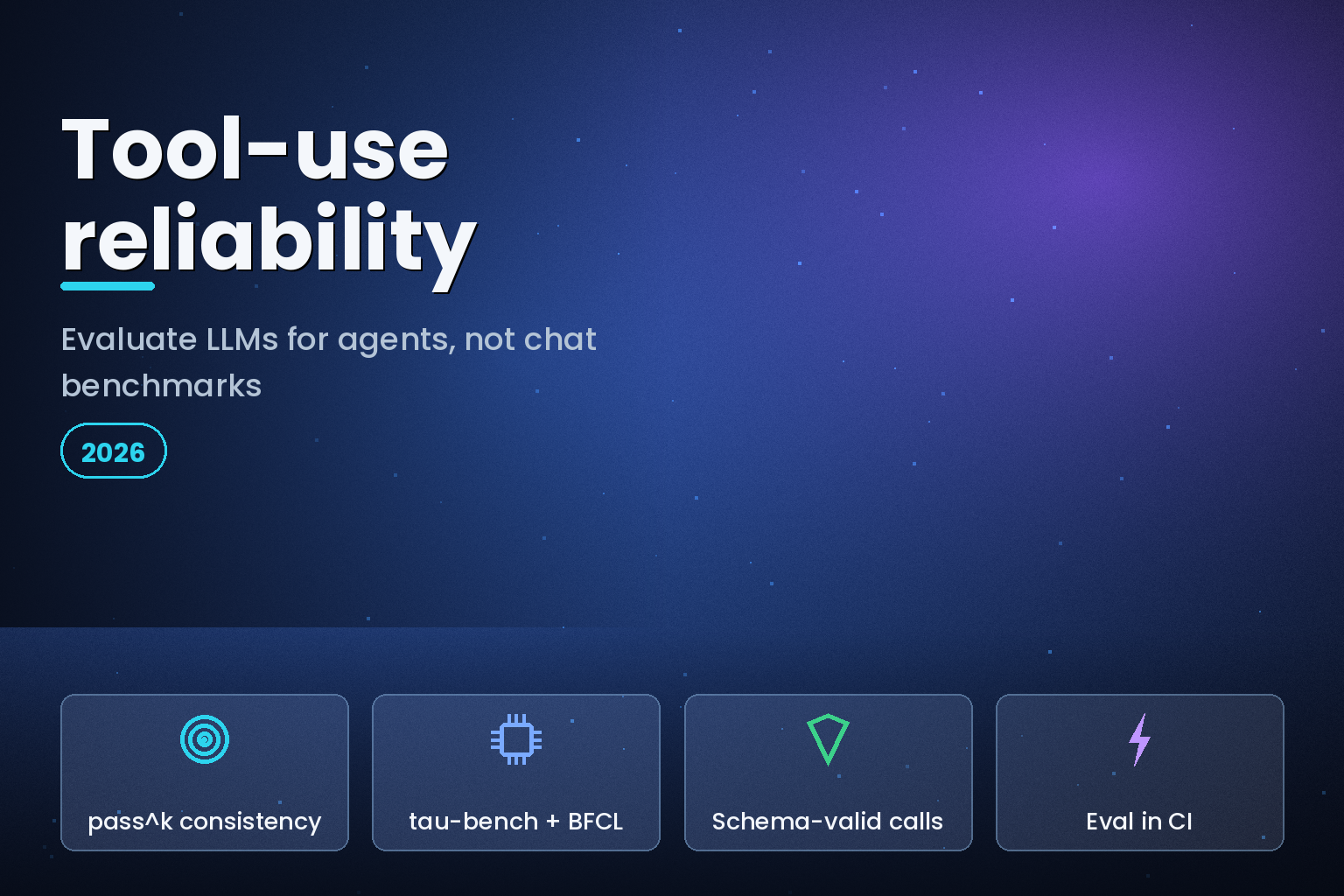
Summary. The benchmark that predicts whether an AI agent survives production is not the one most teams check. The Berkeley τ-bench paper, published June 2024 by a Sierra and Princeton team, found that even state-of-the-art function-calling agents such as gpt-4o solved under 50% of real tool-use tasks, and were "quite inconsistent (pass^8 <25% in retail)." That means a model that looks strong on a single try can fail three of four times when the same task is run eight times. In 2026 the model menu has changed, Grok 4.5 at $2 and $6 per million input and output tokens, Claude Opus 5 reported at $5 and $25, and OpenAI's GPT-5.6 family from about $1 to $5 per million input tokens with a 1 million token context window, but the evaluation gap has not. Chat and knowledge scores still say little about whether a model emits valid tool calls, follows your policy, and recovers from an error across a 12-step workflow. This guide covers what tool-use reliability means, which benchmarks measure it (BFCL, τ-bench, Terminal-Bench, SWE-Bench Pro), how the 2026 models stack up, and how to build an eval harness on your own tools, because that is the only score that matches your product.
Why chat benchmarks mislead for agents
A model that tops a reasoning leaderboard can still make a poor agent. The reason is that agent work is a different task. Instead of producing one good answer, the model has to choose a tool, format the call so the arguments validate against a schema, read the result, decide the next step, and stay inside a set of rules across many turns. A single malformed argument or one hallucinated tool name ends the task, and none of that shows up in a knowledge score.
The τ-bench paper measured this directly. It simulates a user talking to an agent that has domain-specific API tools and written policy guidelines, then compares the database state at the end of the conversation against an annotated goal state. Its headline metric, pass^k, is the fraction of k independent attempts at the same task that all succeed. The authors, Shunyu Yao and colleagues at Sierra and Princeton, reported that state-of-the-art function-calling agents "succeed on <50% of the tasks, and are quite inconsistent (pass^8 <25% in retail)." Consistency, not peak capability, is where agents break.
That distinction reframes model selection. A pass^1 score of 60% and a pass^8 score of 25% describe the same model. The first number sells a demo. The second decides whether a customer-facing agent is safe to ship. If your evaluation only measures a single attempt, you are measuring the demo.
What "tool-use reliability" actually means
Reliability for an agent is made of concrete, measurable behaviours, not a vibe. Five of them matter most.
Tool-call validity is whether the model emits calls whose arguments satisfy the declared JSON schema: right types, required fields present, enums respected. Schema adherence is a stricter version of the same idea across a whole trajectory. Policy and rule-following is whether the model obeys the domain rules you wrote, for example refusing a refund outside the returns window. Multi-step trajectory quality is whether it sequences tool calls correctly, without redundant or out-of-order calls. Error recovery is whether it reads a failed tool response and retries sensibly rather than looping or giving up. Consistency, the pass^k idea, is whether it does all of the above on every attempt, not just its best one.
An agent can be excellent at four of these and useless because of the fifth. A model that writes beautiful plans but hallucinates a tool argument once every ten calls will fail one in ten production tasks, which is not shippable for anything that touches money or customer records.
The benchmarks that measure it
Four public benchmarks measure different slices of tool-use reliability, and a fifth is the one you build yourself. Match the benchmark to the behaviour you care about rather than trusting a single leaderboard.
| Benchmark | What it measures | How it works | Best used for |
|---|---|---|---|
| BFCL (Berkeley, Gorilla) | Function-call correctness | Abstract Syntax Tree match of serial and parallel calls across Python, Java, JavaScript, REST | Does the model emit valid, correct calls |
| τ-bench, τ²-bench, τ³-bench (Sierra) | Tool-agent-user interaction, policy adherence, consistency | Simulated user plus goal-state check, pass^k over retries | Real multi-turn workflows and reliability |
| Terminal-Bench 2.1 | End-to-end terminal task completion | Runs tasks in a shell sandbox and checks the result | Agents that operate a command line |
| SWE-Bench Pro | Resolving real repository issues | Applies the model's patch and runs the test suite | Coding agents on real codebases |
| Your internal eval | Your tools, your policy, your tasks | Goal-state or action-correctness check on your task set | Production fit, the score that matters |
BFCL, the Berkeley Function Calling Leaderboard, uses an Abstract Syntax Tree method to check whether calls are structurally correct, including parallel calls and multiple languages. It answers a narrow but foundational question: can the model produce a valid call at all. The τ-bench line of work goes further into realism. τ²-bench added a dual-control setup where both the user and the agent can call tools, and the 2026 τ³-bench release (version 1.0.0, March 2026) added a knowledge-retrieval domain and full-duplex voice evaluation across airline, retail, telecom, and banking domains. Terminal-Bench and SWE-Bench Pro test the two agent jobs most enterprises actually run first: operating a terminal and fixing code.
The catch is that none of these use your tools or your policy. They are directional, not decisive. A model that leads τ-retail can still fail on your refund rules, because your rules are not in the benchmark.
The 2026 model picture
The frontier moved in July 2026, and the pricing spread is wide. Grok 4.5 from xAI is the notable entrant on agentic work.
| Model (2026) | Input / output per 1M tokens | Context window | Reported tool-use positioning |
|---|---|---|---|
| Grok 4.5 (xAI) | $2 / $6, cached input $0.50 | 500K | Ranked #4 on the Artificial Analysis Intelligence Index and reported to lead agentic tool use, July 2026 |
| Claude Opus 5 (Anthropic) | $5 / $25 (reported) | Large | Strong coding and agentic results; reported within ~0.5% of Claude Fable 5 at about half the per-task cost |
| GPT-5.6 Sol (OpenAI) | ~$1–$5 input tiers | 1M | Sol, Terra, and Luna tiers spanning capability and cost |
According to reported benchmark data, Grok 4.5 posts strong agentic tool-use numbers at a price well below the top Claude and GPT tiers, which is why it belongs in any 2026 evaluation shortlist. It supports tool calling, structured outputs, and low, medium, and high reasoning settings through the API, with a higher-context surcharge above 200,000 prompt tokens. For a deeper single-model view, our Grok 4.5 enterprise coding-agent evaluation breaks down where it fits, and the broader Gemini 3.5 Pro vs GPT-5.6 vs Claude Fable 5 comparison covers the full frontier. Treat every public number here as a starting hypothesis. The decision comes from your own eval.
Build your own tool-use eval harness
Public benchmarks tell you which models are worth testing. Your harness tells you which one to ship. The τ-bench design is a good template because it is open and its method is sound: give the agent your tools and policy, run tasks, and check the end state against a goal.
Start by defining each tool with a strict schema, because schema validity is the first thing to measure.
            {
  "name": "issue_refund",
  "description": "Refund an order if it is inside the 30-day window.",
  "parameters": {
    "type": "object",
    "properties": {
      "order_id": { "type": "string" },
      "amount":   { "type": "number", "minimum": 0 },
      "reason":   { "type": "string", "enum": ["defective", "wrong_item", "no_longer_needed"] }
    },
    "required": ["order_id", "amount", "reason"]
  }
}
Then write tasks with an expected set of actions and a goal state, and run each task several times to get a pass^k figure, not just a single pass. The open τ-bench harness runs exactly this shape from the command line, using LiteLLM so any provider works:
            # Evaluate an agent on the tau2-bench airline domain, 4 retries per task
tau2 run --domain airline --agent-llm grok-4.5 --user-llm gpt-4.1 \
  --num-trials 4 --num-tasks 20
Score the runs on the metrics that predict production behaviour, not just task success.
| Metric | Definition | Why it matters |
|---|---|---|
| Task success (pass^1) | Fraction of tasks solved on a single attempt | Baseline capability |
| Consistency (pass^k) | Fraction solved on all k independent retries | Production reliability, the τ-bench point |
| Tool-call validity | Percentage of calls whose arguments pass the schema | Broken calls are failed actions |
| Hallucinated-tool rate | Calls to tools or parameters that do not exist | Safety and silent failure |
| Policy adherence | Actions match the rules you wrote | Rule-following under pressure |
| Recovery rate | Percentage of tasks recovered after a tool error | Resilience in the real world |
| Turns to completion | Steps and tokens per solved task | Cost and latency per task |
The τ-bench evaluation gates its reward on action correctness, which is the pattern to copy: a task counts as passed only if the agent reached the goal state through allowed actions, not if it happened to say the right thing. Run this harness on 20 to 50 tasks that mirror your real workflows, across your model shortlist, and the winner is usually not the model with the best chat score.
Production guardrails around an imperfect model
No 2026 model passes every task, so the system around the model carries reliability the model cannot. Validate every tool call against its JSON schema before executing it, and reject or repair invalid calls rather than passing them through. Keep a tool allow-list so a hallucinated tool name cannot fire. Wrap tool calls in timeouts and bounded retries with backoff so a single failure does not stall the whole run. Log full trajectories so you can compute pass^k and hallucination rates continuously, not once at selection time.
Most important, run the eval in continuous integration. Model versions change under you, a provider ships an update, and a silently worse trajectory ships to users. Gating deploys on a tool-use eval catches that, which is the argument in our guide to AI agent evals in CI/CD and silent failures. Model choice is one input among several; the fuller decision, including cost and governance, is laid out in our enterprise model-selection scorecard and the enterprise AI agents production guide.
India-specific considerations
For Indian teams building agents on a budget, the eval itself has a cost, and the pass^k requirement multiplies it. Running 40 tasks at pass^8 across four candidate models is 40 × 8 × 4, or 1,280 full agent runs, each spending input and output tokens plus tool-call time. Grok 4.5's cached-input rate of $0.50 per million tokens and a smaller GPT-5.6 tier help keep an evaluation loop affordable, but budget for it as a real line item, not an afterthought.
On data, an agent eval that touches customer records, order history, or payment data processes personal data under India's Digital Personal Data Protection Act 2023. Use synthetic or de-identified task data in evaluation wherever possible, keep tool logs inside your controlled environment rather than shipping full trajectories to a third-party dashboard without a lawful basis, and apply retention limits to the trajectory logs you keep for pass^k tracking.
FAQ
How eCorpIT can help
eCorpIT builds and evaluates production AI agents, and we treat tool-use reliability as the acceptance test, not an afterthought. Our senior engineering teams set up a harness on your own tools and policy, measure pass^k, schema validity, and recovery rate across a model shortlist, and wire the eval into your CI so a model update cannot silently ship a worse agent. If you are choosing a model for a customer-facing or code-writing agent and want a decision grounded in your workflows rather than a public leaderboard, talk to our team.
References
_Last updated: August 1, 2026._