On this page · 11 sections
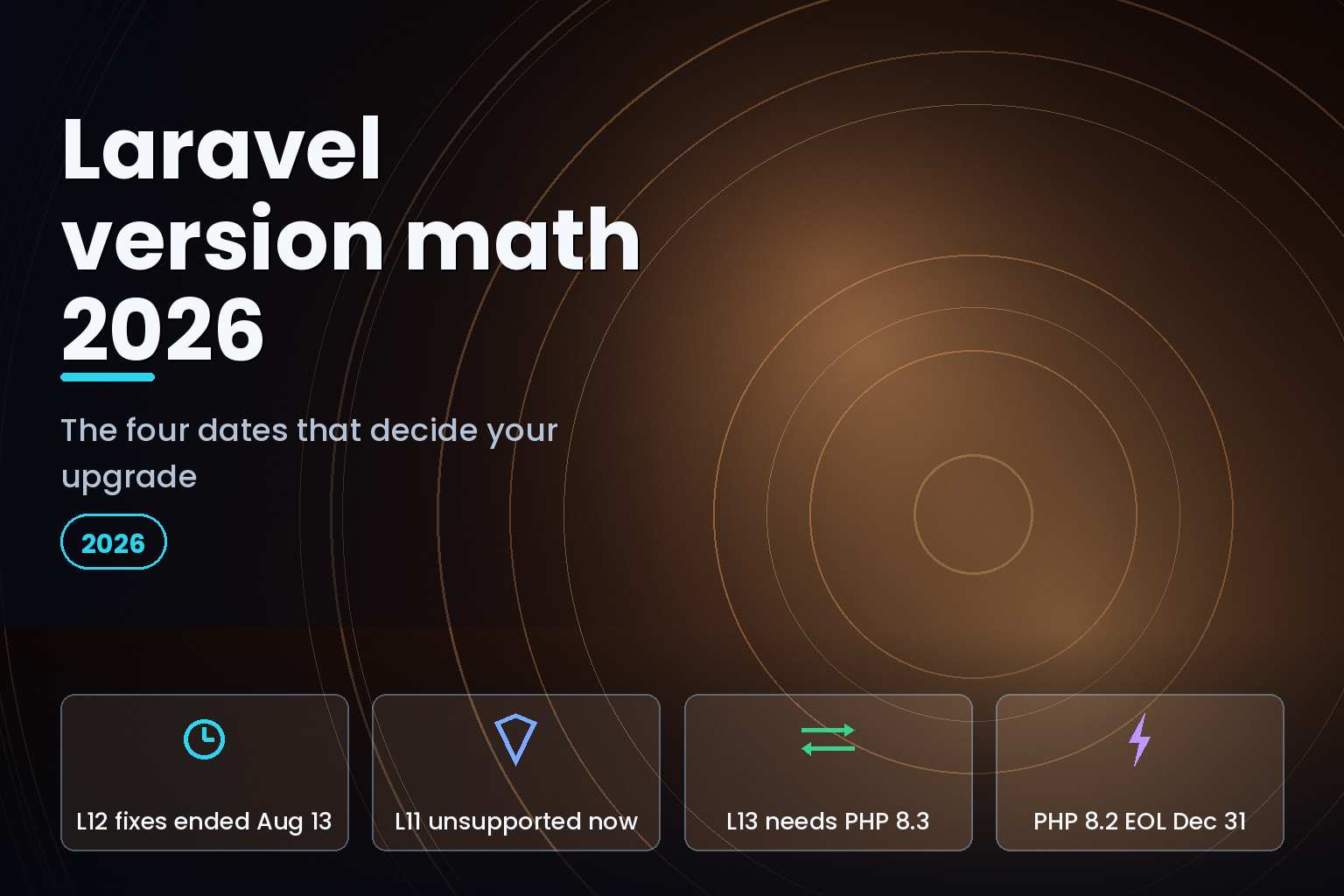
Summary. Laravel 12 left bug-fix support on 13 August 2026, three days ago, and now receives security patches only until 24 February 2027. Laravel 11 passed its final security date on 12 March 2026 and is unsupported today. Laravel 13 shipped on 17 March 2026 with a minimum of PHP 8.3. Underneath all of it, PHP 8.2 reaches end of life on 31 December 2026. Those four dates decide more about a Laravel engagement's real cost than any hourly rate on a proposal, and most quotes never mention them.
Where your Laravel version actually stands
Laravel publishes a fixed support policy: bug fixes for 18 months, security fixes for 2 years, with a major release roughly every Q1. The dates are not negotiable and they are not estimates. Here is the current matrix from Laravel's own release notes.
| Laravel version | Supported PHP | Released | Bug fixes until | Security fixes until |
|---|---|---|---|---|
| 10 | 8.1 - 8.3 | 14 February 2023 | 6 August 2024 | 4 February 2025 |
| 11 | 8.2 - 8.4 | 12 March 2024 | 3 September 2025 | 12 March 2026 |
| 12 | 8.2 - 8.5 | 24 February 2025 | 13 August 2026 | 24 February 2027 |
| 13 | 8.3 - 8.5 | 17 March 2026 | Q3 2027 | 17 March 2028 |
Read that table as a buyer, not as a developer. If your application runs Laravel 11 or Laravel 10, no security patch is coming for the framework at all. If it runs Laravel 12, you have until 24 February 2027 of security-only cover, and any non-security bug you hit from now on is your team's problem to patch or backport. That is the difference between a maintenance retainer that fixes things and one that reimplements things.
The PHP floor moves on a separate clock. PHP 8.2 reaches end of life on 31 December 2026, PHP 8.5.9 was the current patch as of 30 July 2026, and only four of the eighteen PHP release cycles tracked by GetEndOfLife remain supported. A Laravel 12 application sitting on PHP 8.2 therefore has two expiry dates stacked on top of each other, four months apart.
The real cost is usually the runtime, not the framework. Laravel 13 was built as a deliberately small upgrade, and Laravel's own release notes say most applications can move without changing much application code. Moving PHP 8.2 to 8.3 or 8.4 underneath it is where the extension audit, the deprecation sweep and the regression testing live.
What we build on Laravel
eCorpIT builds and maintains production Laravel applications: multi-tenant SaaS backends, internal business systems, customer portals, ecommerce and marketplace backends, and the API layer behind mobile apps. We also take over existing Laravel codebases that another team started, which in practice is most of the work.
Three categories cover almost every enquiry we receive.
Version and runtime upgrades. Moving an application off an unsupported Laravel or PHP release, with the extension audit and regression suite that makes the move safe rather than hopeful. This overlaps heavily with our application modernization framework upgrade work, and the sequencing logic is the same one we apply to a Postgres end-of-life upgrade decision.
New builds on Laravel 13. Greenfield applications that start on PHP 8.3 or later and use the current framework primitives rather than patterns carried over from Laravel 8.
Ongoing engineering. Retained teams that own a Laravel codebase's roadmap, queue reliability, deployment pipeline and security posture.
What actually changed in Laravel 13
Laravel 13 arrived on 17 March 2026 with a stated focus on minimising breaking changes, and the framework team spent the cycle shipping quality-of-life improvements rather than saving them for a big-bang release. The additions that change how we architect a new build:
The Laravel AI SDK gives a first-party, provider-agnostic API for text generation, tool-calling agents, embeddings, audio and images. Before this, every Laravel team wrote its own provider abstraction, and every one of them was slightly different.
Native vector search. The query builder now supports similarity clauses directly, so semantic search runs against PostgreSQL with pgvector without a separate search service:
            $documents = DB::table('documents')
    ->whereVectorSimilarTo('embedding', 'Best wineries in Napa Valley')
    ->limit(10)
    ->get();
JSON:API resources are now first-party, handling resource serialization, relationship inclusion, sparse fieldsets and compliant response headers. Request forgery protection was formalised as PreventRequestForgery with origin-aware verification alongside token-based CSRF. Queue routing by class arrived via Queue::route(...), and Cache::touch(...) extends a cache item's TTL without a read-and-rewrite cycle.
PHP attributes expanded across controllers, queues, Eloquent, events, notifications and validation. Controller middleware and policy checks now sit on the class:
            #[Middleware('auth')]
class CommentController
{
    #[Middleware('subscribed')]
    #[Authorize('create', [Comment::class, 'post'])]
    public function store(Post $post)
    {
        // ...
    }
}
How we run a Laravel engagement
- Version and runtime audit. We establish which Laravel and PHP versions the application actually runs, which of the dates in the table above have already passed, and which composer dependencies block the next step. This is a fixed-scope piece of work and it produces a written upgrade path, not a verbal one.
- Risk and test baseline. Before changing a framework version we measure what the existing test suite covers. Upgrading an application with thin test coverage is a different project from upgrading one with a mature suite, and pretending otherwise is how upgrade projects overrun.
- Runtime first, framework second. We move PHP before Laravel wherever the support matrix allows it, because PHP deprecations produce more surprises than Laravel's documented breaking changes.
- Incremental delivery. Changes ship behind feature flags in reviewable slices rather than one long-lived upgrade branch that diverges from main for six weeks.
- Handover and retention. Runbooks, deployment documentation and a named engineer who stays available after the engagement closes.
The hosting question, with real numbers
Most Laravel proposals quote engineering time and leave infrastructure as "to be discussed". That hides a real number, and since Laravel Cloud published per-resource rates the number is now public. As of August 2026 the plan tiers are Starter at $5/month, Growth at $20/month and Business at $200/month, each including $5 in monthly usage credits, with compute billed on top.
| Compute size | vCPU | RAM | Monthly cap |
|---|---|---|---|
| Flex 512 MiB | 1 | 512 MiB | $6.00 |
| Flex 1 GiB | 1 | 1 GiB | $12.00 |
| Flex 2 GiB | 1 | 2 GiB | $24.00 |
| Pro 4 GiB | 1 | 4 GiB | $32.00 |
| Pro 8 GiB | 2 | 8 GiB | $64.00 |
| Pro 16 GiB | 4 | 16 GiB | $128.00 |
| Pro 32 GiB | 8 | 32 GiB | $256.00 |
Laravel's own worked scenarios put a mostly-idle side project at about $0.39/month, a personal blog at about $6.23/month, an early-stage SaaS running business hours at about $34.29/month, and an always-on ecommerce application with round-the-clock workers at about $176.00/month. Bandwidth overages run $0.10/GB and extra custom domains $0.25/month.
The June 2026 scale-to-zero release is what makes those low numbers real. Compute, database and cache now sleep and wake as a unit in under 500 milliseconds, twenty times faster than the previous implementation, which took around 10 seconds and kept databases running regardless. MySQL scale-to-zero followed on 20 July 2026. Scale-to-zero Flex compute costs $1/month more than the legacy Flex option. Laravel Cloud runs on dedicated AWS EC2 instances rather than a serverless runtime, which is why the performance is predictable.
None of this obliges you to use Laravel Cloud. We deploy Laravel to AWS, Azure and Google Cloud as often as to first-party platforms. It does give you a published price to hold any hosting proposal against, including ours.
AI agents and Laravel code quality
If a vendor tells you AI tooling makes a Laravel build dramatically cheaper, the useful question is what the tooling actually gets right. Laravel's Boost benchmark suite is the closest thing to an answer. Frontier models previously cleared 16 of 17 evals at 99.4% test accuracy; with Boost supplying framework context, current models pass at or near 100%.
Passing is not the same as merging. As Pushpak Chhajed of Laravel put it on the framework's official engineering blog: "Correctness is the baseline. Efficiency and idiomatic Laravel are the new frontier." The same post describes a controller that passes every test while dropping in a raw query, ignoring Route::resource(), hand-rolling validation instead of using a form request and skipping $fillable.
Laravel's official best-practices skill names 19 concrete convention areas, and its first rule is "Consistency First" — match the sibling files already in the application before reaching for a supposedly better pattern. That is the standard we hold generated code to in review. AI tooling shortens the first draft. It does not remove the review.
India-specific considerations
For Indian businesses the Laravel decision carries two extra constraints.
Data protection. The Digital Personal Data Protection Act 2023 governs how personal data is collected, stored and processed, and it shapes schema design, consent capture, retention and deletion paths well before it becomes a compliance document. We design applications aligned with DPDP requirements, and the engineering detail sits in our DPDP Act engineering playbook.
Hosting region. Laravel Cloud's published regions include Asia Pacific (Tokyo), Singapore and Sydney, but no Indian region at the rates above. For workloads with data-residency requirements that pushes you toward AWS, Azure or Google Cloud regions inside India, and the cost comparison changes accordingly. Budget in rupees against the region you will actually deploy to, not the cheapest row on a US price list.
Why eCorpIT
eCorp Information Technologies Private Limited was founded in 2021 and works from Gurugram, Haryana. We hold CMMI Level 5, ISO 27001:2022 and MSME certification, and we are partners with AWS, Microsoft, Google, Shopify and Kaspersky. Teams are senior-led and multi-disciplinary, which for a Laravel engagement means the person who scoped your upgrade path is the person who reviews the pull requests.
We publish our engagement model rather than a rate card. Version and runtime audits run as fixed-scope, fixed-price pieces of work with a written deliverable. Build and modernisation projects run as time-and-materials against an agreed backlog, with a monthly ceiling. Retained engineering runs as a monthly commitment sized in engineer-days. Which of the three fits depends on how much of the table at the top of this article already applies to you, and that is a short conversation rather than a long proposal.
For adjacent work, see our web development company in Gurgaon page, our software development company in India overview, and our ecommerce app development company page if the Laravel application in question is a storefront backend.
FAQ
How eCorpIT can help
We audit Laravel applications against the support matrix above, produce a written upgrade path covering both the framework and the PHP runtime, and then execute it in reviewable slices. For new builds we start on Laravel 13 and PHP 8.3 or later so the next two support windows are already behind you. Whether you need a one-off upgrade, a greenfield build or a retained engineering team, contact us with your current Laravel and PHP versions and we will tell you which of the four dates in this article applies to you.
References
- Laravel 13 release notes, versioning scheme and support policy — Laravel, accessed 16 August 2026.
- Laravel Cloud pricing and per-resource usage rates — Laravel, accessed 16 August 2026.
- Your Laravel Cloud stack now scales to zero and wakes 20x faster — Laravel Engineering, 1 June 2026.
- AI coding agents pass tests. Can they write idiomatic Laravel? — Pushpak Chhajed, Laravel Engineering, 24 July 2026.
- PHP end-of-life and release lifecycle tracker — GetEndOfLife, accessed 16 August 2026.
- Laravel Boost best-practices skill — Laravel, GitHub.
- Laravel AI SDK — Laravel.
Last updated: 16 August 2026.