On this page · 13 sections
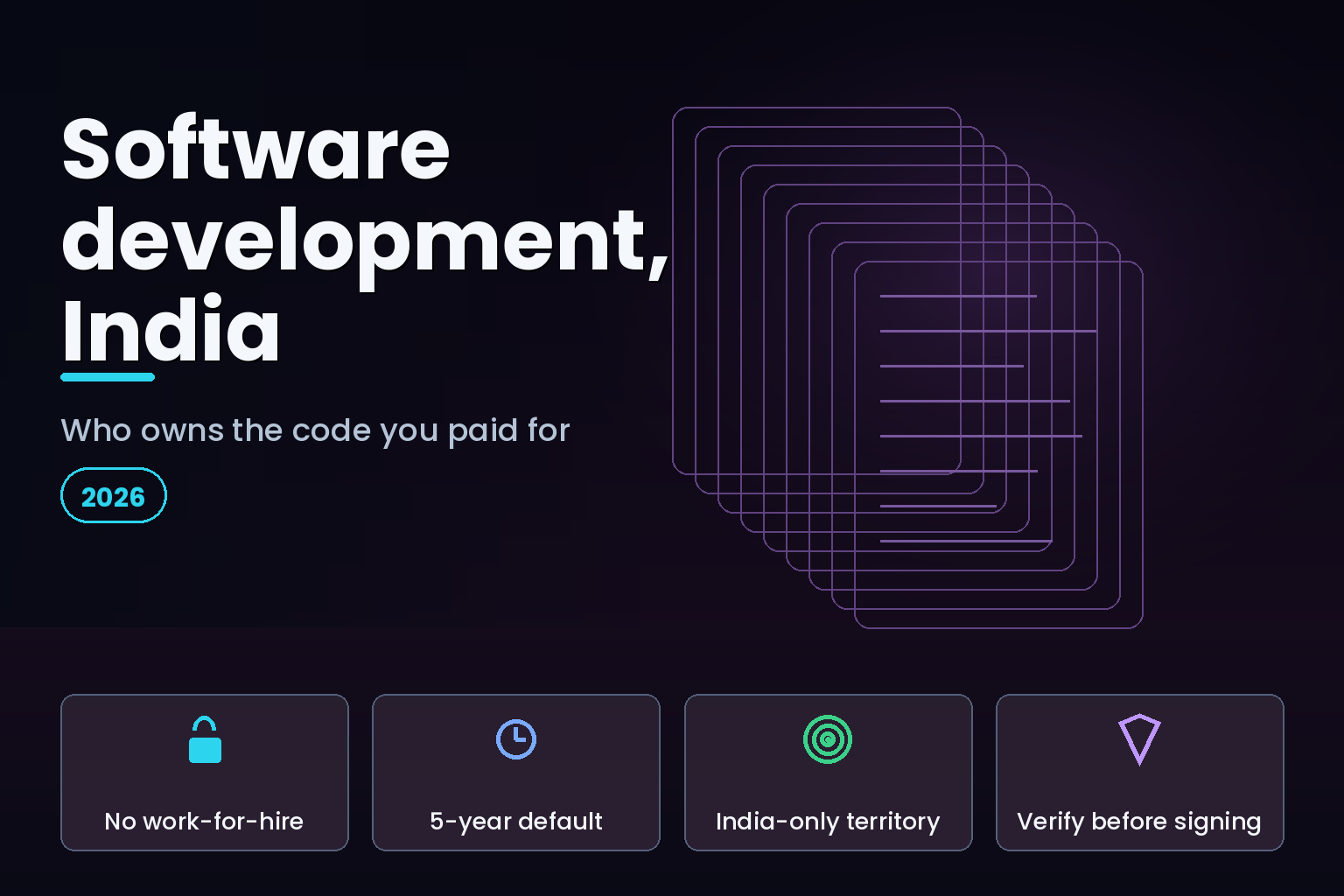
Summary. India's technology sector reached $315 billion in revenue in the year to 31 March 2026, up 6.1%, of which $246 billion was exports, and 2,117 global capability centres now operate in the country. Voluntary attrition at TCS was 13.6% in the quarter ended 30 June 2026. Buying from this market is straightforward. Owning what you buy is where foreign clients get caught. The Copyright Act 1957 has no work-for-hire rule for commissioned software: under section 17 the author is the first owner, and the "commissioned work" proviso covers photographs, paintings, portraits, engravings and films, none of which is code. Section 19 then imposes three defaults on any assignment that is silent. If duration is unstated it is five years. If territory is unstated it covers India only. If the assignee does not exercise the rights within one year, the assignment lapses. A Delhi High Court division bench applied exactly this to a software contract in Pine Labs v. Gemalto in August 2011, and copyright reverted to the developer. Two free government registries let you check a vendor is real before any of that matters. This page covers what to verify, what to sign, and how we work.
The IP position, which is the part that costs money
Most guides to hiring in India discuss rates. The clause that actually decides whether the engagement was worth anything is the assignment.
Software is a literary work under section 2(o) of the Copyright Act 1957, which includes computer programmes. Section 17 makes the author the first owner. Its employment proviso gives the employer first ownership only for work made under a contract of service, meaning employment. A vendor engaged under a contract for services is not that, so nothing passes to you automatically. There is no equivalent of the US work-for-hire doctrine for commissioned code.
Section 19 governs what happens next, and it is unusually prescriptive.
| Section 19 provision | What it requires | What happens if your contract is silent |
|---|---|---|
| 19(1) | Assignment must be in writing, signed by the assignor | No valid assignment at all |
| 19(2) | Must identify the work, the rights, the duration and the territory | The defaults below apply |
| 19(4) | Assignee must exercise the rights assigned | Assignment deemed lapsed after one year |
| 19(5) | Duration must be stated | Deemed to be five years |
| 19(6) | Territory must be stated | Presumed to extend within India only |
In Pine Labs v. Gemalto, decided by a Delhi High Court division bench on 3 August 2011, a master services agreement said the developer assigned copyright in project materials to the client. It named no duration and no territory. Sections 19(5) and 19(6) filled the gaps, the assignment was read as five years and India only, and rights in the delivered software reverted to the developer.
Courts have not applied that mechanically since. Where an agreement says perpetual, worldwide, or for the full term of copyright, later judgments have read the contract as a whole rather than cutting it to five years. The practical conclusion is the same either way: write the words. Perpetual, irrevocable, worldwide, for the full term of copyright, with the rights identified.
There is a second gap that vendor contracts rarely close. Your vendor owns its own employees' code automatically under the employment proviso, but it does not automatically own code written by its independent contractors. If subcontractors or freelancers touch your codebase, the vendor needs separate deeds of assignment from each of them, or the chain of title has a hole in it that your agreement with the vendor cannot repair. Ask how subcontractors are papered, and ask before the first commit rather than during a diligence exercise.
Patents work differently and less favourably. The Patents Act 1970 gives the right to apply to the true and first inventor or their assignee, and contains no employer-ownership default at all, so even the Indian vendor does not own its employees' inventions by operation of law without an express assignment. For most software this is moot, because section 3(k) excludes a computer programme per se from being an invention.
Verify the company before you verify the code
Two Indian government registries are genuinely free, need no login, and answer the questions a foreign buyer actually has.
| Check | Where | What it tells you |
|---|---|---|
| GST taxpayer search | GST portal, search by GSTIN, captcha only | Legal name, trade name, registration date, constitution, principal place of business, cancellation date if any |
| GST return filing table | Same page, "show filing table" | Whether the company has actually filed returns, by financial year |
| EPFO establishment search | EPFO public portal, captcha only | Whether the vendor runs provident-fund covered payroll, and which establishments share its PAN |
| MCA master data | MCA services, master data services | Incorporation details and registered charges over assets |
| Udyam verification | Udyam portal | MSME registration status, self-declared |
The GST return filing history is the strongest free signal available. A real operating Indian software company files monthly or quarterly, and gaps are visible on a public page. The EPFO same-PAN view answers a different and equally useful question: whether the entity you are contracting with is the same one that employs the engineers, or a thin front company with the delivery team sitting somewhere else.
MCA gives incorporation details and charges over the company's assets, which is worth checking, but director-level history sits behind a login and annual financial filings are paid. Treat it as supporting evidence rather than the primary check.
The tax position, corrected
Advice on this topic ages badly, and most of what circulates is now wrong on the face of it.
The Income-tax Act 1961 was repealed on 1 April 2026, when the Income-tax Act 2025 came into force. Any guide still telling you to look at section 195 or section 9(1)(i) is describing law that no longer exists, though the substance largely carried across.
Withholding is simpler than buyers expect. The non-resident withholding provision keys off the residence of the payee, not the payer. Your Indian software vendor is an Indian resident, so a foreign company paying it for services sits outside that provision. In ordinary practice a foreign buyer with no permanent establishment, no business connection and no Indian tax account number has no Indian withholding mechanism to operate. Your vendor pays its own Indian corporate tax.
The equalisation levy is gone in both its forms. The 2% levy on e-commerce supply and services ceased to apply from 1 August 2024, and the 6% levy on online advertising was withdrawn from 1 April 2025. It was always a charge on non-resident recipients, never a tax a foreign buyer owed for hiring an Indian development shop, a misconception several outsourcing guides still repeat.
On GST, your vendor's invoice should carry no Indian tax. Export of services is zero-rated, and the vendor either supplies under a letter of undertaking without paying integrated tax, or pays and claims a refund. The definition sets five conditions, including that the supplier is in India, the recipient is outside India, the place of supply is outside India, and payment is received in convertible foreign exchange or in Indian rupees where the Reserve Bank of India permits it. That rupee limb has been law since 1 February 2019, so the common claim that you must pay in foreign currency is wrong. If a supply fails the export test, 18% GST applies. The last condition catches captives rather than vendors: a foreign parent paying its own Indian branch is not dealing with a separate person, so it is not an export.
Permanent establishment is the real exposure, and it is a function of how you behave rather than what you sign. The Supreme Court held in E-Funds that outsourcing work to India does not by itself create a fixed place permanent establishment, and in Morgan Stanley that back-office operations did not, though seconding staff who remain on your payroll did create a service permanent establishment. In July 2025 the Supreme Court found a fixed place permanent establishment in Hyatt International where the foreign enterprise exercised continuous and substantive control over day-to-day operations and had premises at its disposal. A buyer who contracts for outcomes is in E-Funds territory. A buyer who runs the daily standup, assigns individual tickets and treats the offshore team as their own staff is closer to Hyatt. Take advice on this before you design the operating model, not after.
Data protection is not yet the obstacle vendors claim. The Digital Personal Data Protection Act's substantive obligations, including consent, notice, data-principal rights and cross-border rules, sit in an eighteen-month tranche that runs to mid-May 2027 from the notifications published in November 2025. Section 17(1)(d) will then exempt processing of non-Indian data under a contract with a person outside India from most of that machinery, though the accountability and reasonable-security obligations and the penalty regime still apply. Our DPDP Act engineering playbook covers what to build for.
What we build
We are a software development company, not a staffing desk. The work divides into four areas.
Custom product engineering covers web and mobile applications built from a defined scope, including the API layer, data model and infrastructure. Modernisation covers legacy replatforming, cloud migration and the decomposition of monoliths where the goal is a system a team can keep changing. Data and AI covers pipelines, analytics and applied machine learning where a measurable business decision depends on it. Dedicated engineering teams cover longer programmes where scope cannot be frozen. Our vertical practices, including ecommerce app development, on-demand app development and taxi app development, sit on the same engineering base.
If you want an offshore delivery centre rather than a project engagement, our offshore software development company page covers that structure. This page is about choosing and contracting with a vendor; that one is about how the delivery centre runs.
How we deliver
Five steps, in this order.
Discovery and scope. A short paid engagement producing a written scope, an architecture note, a risk list and an estimate you can hold us to, rather than a proposal written against a feature list.
Contracting. A master services agreement and a statement of work, with the assignment language set out above written properly, and confirmation that subcontractor deeds are in place before code is written.
Build in short cycles. Two-week iterations, a demonstrable increment each time, and your own repository and cloud accounts from the first commit, so ownership is a fact rather than a clause.
Hardening. Testing, performance work, security review and documentation, scoped as work rather than left to whatever time remains.
Handover or run. Either a documented handover to your team or an ongoing support arrangement with defined response times. A client who can leave is a client who stays for the right reasons.
The stack
We work primarily in TypeScript and Node.js, Python, Java and Go on the server; React, Next.js and Astro on the web; Flutter, React Native, Kotlin and Swift on mobile; PostgreSQL, MySQL and MongoDB for data, with Redis and Kafka where the workload needs them. Infrastructure runs on AWS, Azure or Google Cloud with infrastructure as code and continuous deployment. Where a client has an existing stack we work in it rather than proposing a rewrite for our own convenience.
Cost, attrition and the honest comparison
India's main advantage is depth of supply. The price gap is narrower than the marketing suggests once you buy senior people. Glassdoor's Bangalore medians in August 2026 put a software engineer at ₹16.0 lakh total pay a year and a senior software engineer at ₹28.0 lakh, and the same pages show large IT services firms clustering well below product companies, with Infosys at ₹6.0 lakh and Google at ₹40 lakh for comparable titles. What you are buying at the top of that range is a different person from what you are buying at the bottom, and a rate card alone will not tell you which one you are getting.
Continuity is a fair concern and the numbers are public. TCS disclosed voluntary attrition of 13.6% for the quarter ended 30 June 2026, and Wipro 13.9% on the same basis, down from 15.1% a year earlier. Ask any prospective vendor for its own figure and for the average tenure of the specific people proposed.
The alternative to a vendor is your own capability centre, and 2,117 of them now operate in India across 3,728 units, employing about 2.36 million people. That route makes sense at scale and over years. Below that, the setup, statutory and management overhead usually exceeds what a vendor relationship costs.
Time zones, honestly
The overlap problem is real and has been measured properly, which is rare. A 2024 study in Organization Science analysed communications from more than 12,000 employees at a large multinational and found that a one-hour increase in temporal distance reduced synchronous communication by 11%. Tommy Pan Fang of Rice University, one of the authors, put the magnitude in context: "The loss of an hour from the workday represented a 19% loss in the overlap of business hours. So proportionally, communications went down less than opportunities to communicate did."
People absorb the gap by shifting their working hours, at a personal cost the study also documents. The practical answer is to design for it: a guaranteed overlap window, written decisions rather than meetings, and no dependency that requires a same-day answer across twelve hours.
Why eCorpIT
We are a Gurugram-based engineering organisation founded in 2021, appraised at CMMI Level 5 and MSME certified, with senior-led teams and partnerships with AWS, Microsoft, Google, Shopify and Kaspersky. We work with clients in India, the United Kingdom and the United States. Our practice covers custom product engineering, modernisation, data and AI, and dedicated teams, and our broader mobile work is described on our mobile app development company in Gurgaon page.
How we engage
Three models. Fixed-scope delivery suits a defined build with a clear acceptance definition and puts the estimating risk on us. A dedicated team suits multi-quarter programmes where priorities move and you want continuity of people rather than a frozen scope. Build-operate-transfer suits clients who intend to run their own team in India eventually, where we hire, build and operate, then transfer the entity or the people on an agreed date. We scope after discovery rather than quoting from a feature list, because the scope of the unknowns moves the number more than the feature count does.
FAQ
How eCorpIT can help
We build and modernise software for clients in India, the United Kingdom and the United States, under contracts that transfer ownership properly rather than leaving it to statutory defaults. If you are evaluating Indian development partners, we are happy to be checked against the registries above before you talk to us about work. Contact us with what you are trying to build and we will come back with a scope, an architecture note and an estimate you can hold us to.
References
Last updated: 15 August 2026.